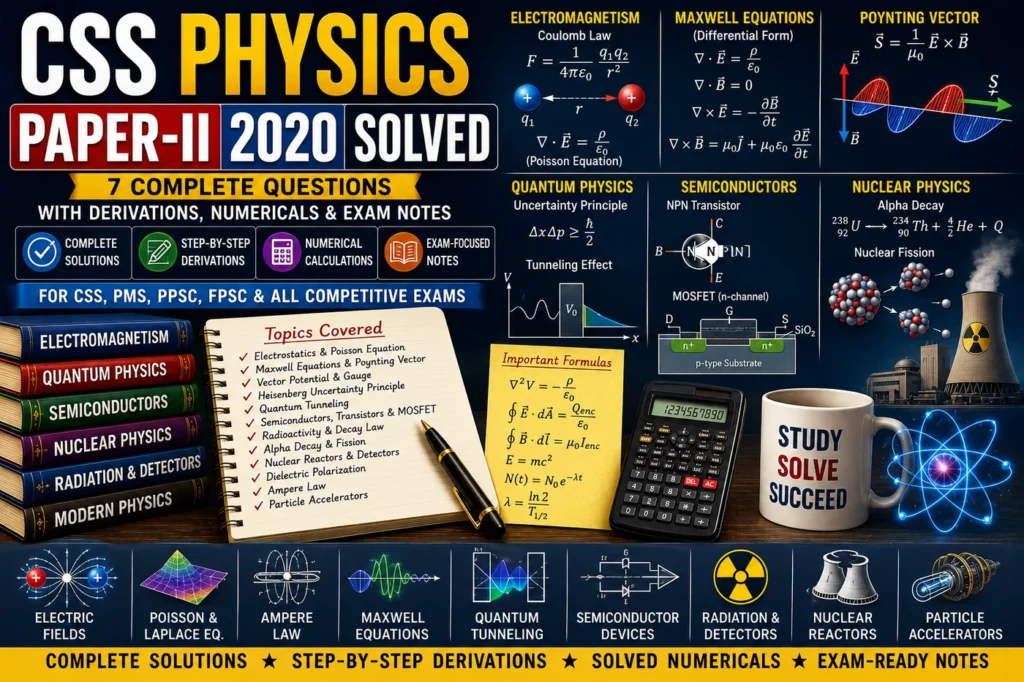
CSS Physics Paper-II 2020 Solved is a complete solved guide for CSS aspirants who need real answers, not short hints. This post solves the subjective section question by question with definitions, derivations, formulas, numerical substitutions, final answers, tables and exam-ready explanations. It covers Coulomb’s law, electric field of point charges, Poisson equation, Laplace equation, Poynting vector, Maxwell equations, magnetic vector potential, Heisenberg uncertainty principle, barrier tunneling, electron momentum, semiconductor doping, NPN and PNP transistors, MOSFET, natural radioactivity, radioactive decay law, alpha-decay energy, nuclear fission, nuclear reactors, radiation detection methods, dielectric polarization, Ampere’s law and particle accelerators.
Central Argument: A CSS Physics solved paper should not only name the topic. It should define the principle, derive the equation, show the numerical working and explain the physical meaning. Therefore, this CSS Physics Paper-II 2020 Solved post gives the complete route to each answer so students can reproduce the solution in the examination hall.
Scan Note: The uploaded text uses spellings such as “Dopping” and “MOFET.” In this solved post, they are corrected to doping and MOSFET, while the original question meaning is preserved.
CSS Physics Paper-II 2020 Solved Study Scope
This post covers CSS Physics Paper-II 2020 Solved in a complete, structured and WordPress-ready format. Each question includes the printed question, part-wise solution, formulas, mathematical working, final answer and examiner-friendly explanation.
Use this solved paper as a study document. First revise the formula sheet, then read Q2 to Q8 one by one. After reading, close the post and rewrite each solution from memory. CSS Physics rewards clean definitions, correct assumptions, dimensional accuracy, correct units and disciplined presentation.
Show Table of Contents
- Overview
- Study Scope
- Important Formula Sheet
- Question Map
- Question 2: Coulomb Law, Poisson Equation and Electric Field
- Question 3: Poynting Vector, Maxwell Equations and Vector Potential
- Question 4: Uncertainty Principle, Tunneling and Electron Momentum
- Question 5: Doping, NPN/PNP Transistors and MOSFET
- Question 6: Natural Radioactivity, Radioactive Decay and Alpha-Decay Energy
- Question 7: Nuclear Fission, Reactors and Radiation Detection
- Question 8: Dielectric Polarization, Ampere Law and Accelerators
- Revision Plan
- Internal and External Resources
- FAQs
Important Formula Sheet for CSS Physics Paper-II 2020 Solved
Electrostatics
F = (1/4πε0)(q1q2/r²)
E = F/q0
E = (1/4πε0)(q/r²)
∇·E = ρ/ε0
∇²V = -ρ/ε0
Electromagnetism
S = E × H
S = (1/μ0)E × B
B = ∇ × A
∮B·dl = μ0Ienc
∇×B = μ0J + μ0ε0∂E/∂t
Quantum and Semiconductor Physics
ΔxΔp ≥ ℏ/2
p = mv
λ = h/p
n-type: donor impurity
p-type: acceptor impurity
Nuclear Physics
N = N0e^(-λt)
A = λN
T1/2 = 0.693/λ
Q = Δmc²
1 u = 931.5 MeV/c²
Question Map of CSS Physics Paper-II 2020 Solved
| Question | Main Area | What Is Fully Solved |
|---|---|---|
| Q2 | Electrostatics | Electric field of point charges, Poisson equation from Gauss law, Laplace equation and electric field numerical. |
| Q3 | Electromagnetism | Energy transport, Poynting vector, Maxwell equations in integral and differential forms and vector potential. |
| Q4 | Quantum mechanics | Heisenberg uncertainty principle, barrier tunneling and electron momentum numerical. |
| Q5 | Semiconductor physics | Doping, n-type and p-type semiconductors, NPN and PNP transistors and MOSFET. |
| Q6 | Nuclear physics | Natural radioactivity, radioactive decay law and alpha-decay energy of uranium-238. |
| Q7 | Nuclear technology | Nuclear fission, basic principles of nuclear reactors and radiation detection methods. |
| Q8 | Short notes | Dielectric medium and polarization, Ampere law and particle accelerators. |
Question 2: Coulomb Law, Poisson Equation and Electric Field
Full Question
Q.2. (a) Discuss electric field of point charges, keeping in view the magnitude of force acting on test charge according to Coulomb’s law.
Q.2. (b) Derive Poisson’s equation from Gauss’s law. Also write the expression for Laplace’s equation.
Q.2. (c) Find out the electric field due to charge of 2e at a distance of 26.5 × 10⁻¹² m. Given ε0 = 8.85 × 10⁻¹² C²/Nm² and e = 1.60 × 10⁻¹⁹ C.
Q2(a): Electric Field of Point Charges
Electric field is the force experienced by a unit positive test charge placed at a point in space. If a test charge q0 experiences force F, then electric field is:
According to Coulomb’s law, the force between a source charge q and a test charge q0 separated by distance r is:
Therefore, electric field due to point charge q is:
In vector form:
The direction of electric field depends on the sign of the source charge. For a positive charge, electric field is radially outward. For a negative charge, electric field is radially inward.
Electric Field Due to Multiple Point Charges
Electric field obeys the principle of superposition. If several point charges are present, the net electric field at a point is the vector sum of electric fields due to all charges:
E=(1/4πε0)(q/r²)r̂. The force on a test charge is F=q0E.Q2(b): Derivation of Poisson’s Equation from Gauss’s Law
Gauss’s law in differential form is:
where ρ is volume charge density.
Electric field is related to electric potential V by:
Substitute this into Gauss’s law:
But:
Therefore:
So:
∇²V = -ρ/ε0.Laplace’s Equation
In a charge-free region:
Therefore, Poisson’s equation becomes:
∇²V = 0.Q2(c): Electric Field Due to Charge 2e
Given:
The electric field due to a point charge is:
Using:
Substitute:
Calculate denominator:
Calculate numerator:
Now:
4.10 × 10¹² N/C.Question 3: Poynting Vector, Maxwell Equations and Vector Potential
Full Question
Q.3. (a) Discuss in detail the energy transport and the Poynting vector.
Q.3. (b) Write the four Maxwell’s equations both in integral and differential forms.
Q.3. (c) Explain vector potential.
Q3(a): Energy Transport and Poynting Vector
Electromagnetic fields carry energy and momentum. When an electromagnetic wave travels through space, energy is transported by the electric and magnetic fields. The rate of energy flow per unit area is represented by the Poynting vector.
The Poynting vector is defined as:
In vacuum, since:
we can write:
The direction of S is the direction of electromagnetic energy propagation. Its SI unit is:
Energy Density of Electromagnetic Field
The energy density stored in electric and magnetic fields is:
For an electromagnetic wave in vacuum, electric and magnetic energy densities are equal on average.
Poynting Theorem
Poynting theorem is the energy conservation law of electromagnetism:
This means that the decrease in electromagnetic field energy inside a volume equals the energy flowing out through the surface plus the work done on charges inside the volume.
S=E×H=(1/μ0)E×B represents electromagnetic energy flow per unit area per second.Q3(b): Maxwell’s Equations in Integral and Differential Forms
| Law | Integral Form | Differential Form | Meaning |
|---|---|---|---|
| Gauss’s law for electricity | ∮ E·dA = Qenc/ε0 |
∇·E = ρ/ε0 |
Electric charges are sources or sinks of electric field. |
| Gauss’s law for magnetism | ∮ B·dA = 0 |
∇·B = 0 |
There are no isolated magnetic monopoles. |
| Faraday’s law | ∮ E·dl = -dΦB/dt |
∇×E = -∂B/∂t |
Changing magnetic field produces electric field. |
| Ampere-Maxwell law | ∮ B·dl = μ0Ienc + μ0ε0 dΦE/dt |
∇×B = μ0J + μ0ε0∂E/∂t |
Current and changing electric field produce magnetic field. |
Importance of Maxwell’s Equations
- They unify electricity and magnetism.
- They predict electromagnetic waves.
- They show that light is an electromagnetic wave.
- They provide the foundation of radio, optics, antennas and communication technology.
Q3(c): Vector Potential
The magnetic vector potential is a vector field A defined such that magnetic field is the curl of A:
This definition automatically satisfies Gauss’s law for magnetism:
because divergence of curl is always zero:
Scalar and Vector Potentials
In electromagnetism, electric and magnetic fields can be expressed in terms of scalar potential V and vector potential A:
Importance of Vector Potential
- It simplifies electromagnetic field calculations.
- It is used in radiation and antenna theory.
- It is important in quantum mechanics, especially the Aharonov-Bohm effect.
- It helps express Maxwell’s equations in potential form.
A is defined by B=∇×A. It is useful because it automatically satisfies ∇·B=0 and simplifies electromagnetic theory.Question 4: Uncertainty Principle, Tunneling and Electron Momentum
Full Question
Q.4. (a) State and explain Heisenberg’s uncertainty principle.
Q.4. (b) Discuss the phenomenon of barrier tunneling.
Q.4. (c) Find the momentum of an electron moving with a speed of 1.88 × 10⁶ m/s, where mass of electron is 9.11 × 10⁻³¹ kg.
Q4(a): Heisenberg’s Uncertainty Principle
Heisenberg’s uncertainty principle states that it is impossible to know simultaneously the exact position and exact momentum of a microscopic particle. The more accurately position is known, the less accurately momentum can be known, and vice versa.
The mathematical form is:
Since:
we can also write:
Energy-Time Uncertainty
Another form of uncertainty principle is:
Physical Meaning
The uncertainty principle is not due to defective instruments. It is a fundamental property of quantum systems. A particle localized sharply in space must be represented by a wave packet containing many wavelengths, which creates uncertainty in momentum.
Significance
- It explains why electrons cannot exist inside the nucleus as ordinary confined particles.
- It supports the wave nature of matter.
- It explains zero-point energy.
- It limits classical determinism at microscopic scales.
ΔxΔp ≥ ℏ/2. It shows that exact position and momentum cannot be known simultaneously.Q4(b): Barrier Tunneling
Barrier tunneling is a quantum phenomenon in which a particle passes through a potential barrier even when its energy is less than the barrier height. In classical physics, this is impossible. In quantum mechanics, the particle has a wave function that can penetrate the barrier.
Classical View
If a particle has energy E and faces a barrier of height V0, then classically:
means the particle cannot cross the barrier.
Quantum View
In quantum mechanics, the wave function inside the classically forbidden barrier region does not become zero immediately. Instead, it decays exponentially:
where:
If the barrier is thin enough, the wave function may still have non-zero value on the other side. Therefore, there is a finite probability that the particle will appear beyond the barrier.
Transmission Probability
For a rectangular barrier of width a, the tunneling probability roughly behaves like:
This shows that tunneling probability decreases rapidly as barrier height or barrier width increases.
Applications of Tunneling
- Alpha decay: Alpha particles escape nuclei by tunneling through nuclear potential barriers.
- Tunnel diode: Semiconductor device based on quantum tunneling.
- Scanning tunneling microscope: Uses tunneling current to image surfaces at atomic scale.
- Nuclear fusion in stars: Tunneling helps particles overcome Coulomb repulsion.
E<V0. It is explained by the non-zero wave function inside and beyond the barrier.Q4(c): Momentum of Electron
Given:
The speed is much less than the speed of light, so non-relativistic momentum is sufficient:
Substitute values:
1.71 × 10⁻²⁴ kg m/s.Question 5: Doping, NPN/PNP Transistors and MOSFET
Full Question
Q.5. (a) What do you understand by the term doping? How can we make semiconductors as n-type or p-type with doping?
Q.5. (b) Discuss in detail the NPN and PNP transistors.
Q.5. (c) Explain MOSFET.
Q5(a): Doping in Semiconductors
Doping is the deliberate addition of a small controlled amount of impurity atoms to a pure semiconductor to increase its electrical conductivity. Pure silicon or germanium is called an intrinsic semiconductor. After doping, it becomes an extrinsic semiconductor.
n-Type Semiconductor
An n-type semiconductor is made by adding pentavalent impurity atoms to silicon or germanium. Pentavalent atoms have five valence electrons. Four electrons form covalent bonds with neighbouring semiconductor atoms, while the fifth electron becomes free for conduction.
Examples of pentavalent donor impurities are:
- Phosphorus
- Arsenic
- Antimony
p-Type Semiconductor
A p-type semiconductor is made by adding trivalent impurity atoms. Trivalent atoms have three valence electrons, so one bond remains incomplete. This creates a hole, which behaves as a positive charge carrier.
Examples of trivalent acceptor impurities are:
- Boron
- Aluminium
- Gallium
- Indium
| Feature | n-Type Semiconductor | p-Type Semiconductor |
|---|---|---|
| Impurity | Pentavalent donor | Trivalent acceptor |
| Majority carriers | Electrons | Holes |
| Minority carriers | Holes | Electrons |
| Examples | P, As, Sb | B, Al, Ga, In |
Q5(b): NPN and PNP Transistors
A bipolar junction transistor is a three-layer semiconductor device used for amplification and switching. It has three terminals:
- Emitter
- Base
- Collector
NPN Transistor
An NPN transistor consists of a thin p-type base between two n-type regions. Electrons are the majority carriers. In active mode, the emitter-base junction is forward biased and the collector-base junction is reverse biased.
Emitter Base Collector
N | P | N
electrons move from emitter toward collector
In an NPN transistor, a small base current controls a much larger collector current. Conventional current enters the collector and leaves through the emitter.
PNP Transistor
A PNP transistor consists of a thin n-type base between two p-type regions. Holes are the majority carriers. In active mode, the emitter-base junction is forward biased and the collector-base junction is reverse biased.
Emitter Base Collector
P | N | P
holes move from emitter toward collector
Comparison Between NPN and PNP Transistors
| Feature | NPN Transistor | PNP Transistor |
|---|---|---|
| Structure | N-P-N | P-N-P |
| Majority carriers | Electrons | Holes |
| Emitter arrow | Arrow points outward | Arrow points inward |
| Speed | Generally faster because electrons are more mobile | Generally slower than NPN |
| Common use | Amplifiers and switches | Amplifiers and switches with opposite polarity bias |
Transistor Action
The emitter is heavily doped to inject carriers. The base is very thin and lightly doped, so most carriers pass through it. The collector is moderately doped and collects the carriers. This allows a small base current to control a large collector current.
Q5(c): MOSFET
MOSFET stands for Metal-Oxide-Semiconductor Field-Effect Transistor. It is a voltage-controlled device in which gate voltage controls current between source and drain.
Main Terminals of MOSFET
- Gate: Controls the channel.
- Source: Supplies charge carriers.
- Drain: Collects charge carriers.
- Body/Substrate: Semiconductor base region.
Structure and Working
The gate is separated from the semiconductor channel by a thin insulating oxide layer, usually silicon dioxide. Because the gate is insulated, gate current is extremely small. When a suitable gate voltage is applied, a conducting channel is formed between source and drain.
Types of MOSFET
| Type | Meaning |
|---|---|
| n-channel MOSFET | Current is mainly carried by electrons. |
| p-channel MOSFET | Current is mainly carried by holes. |
| Enhancement MOSFET | Normally off; channel forms when gate voltage is applied. |
| Depletion MOSFET | Normally on; gate voltage can reduce channel conduction. |
Applications of MOSFET
- Digital logic circuits.
- Microprocessors and memory chips.
- Power switching circuits.
- Amplifiers.
- Voltage regulators and motor control circuits.
Question 6: Natural Radioactivity, Radioactive Decay and Alpha-Decay Energy
Full Question
Q.6. (a) Discuss in detail the process of natural radioactivity.
Q.6. (b) Discuss in detail the radioactive decay.
Q.6. (c) Find the energy released during the alpha decay of ²³⁸U. Atomic masses are: ²³⁸U = 238.050785 u, ²³⁴Th = 234.043539 u and ⁴He = 4.002603 u.
Q6(a): Natural Radioactivity
Natural radioactivity is the spontaneous disintegration of unstable atomic nuclei found in nature. During this process, nuclei emit radiation in order to become more stable. The phenomenon was discovered by Henri Becquerel and later studied by Marie Curie and Pierre Curie.
Types of Natural Radioactive Emissions
| Radiation | Nature | Effect on Nucleus | Penetrating Power |
|---|---|---|---|
| Alpha radiation | Helium nucleus ⁴He |
Mass number decreases by 4 and atomic number decreases by 2. | Low |
| Beta radiation | Electron or positron | Atomic number changes by 1, mass number remains nearly same. | Medium |
| Gamma radiation | High-energy photon | No change in atomic number or mass number. | High |
Alpha Decay
In alpha decay, a heavy nucleus emits an alpha particle:
Alpha decay occurs mainly in heavy nuclei because emission of an alpha particle increases nuclear stability.
Beta Decay
In beta-minus decay, a neutron changes into a proton:
In beta-plus decay, a proton changes into a neutron:
Gamma Decay
Gamma decay occurs when an excited nucleus releases energy as a gamma photon:
Q6(b): Radioactive Decay
Radioactive decay is a random nuclear process. It is impossible to predict exactly when one particular nucleus will decay, but the decay of a large number of nuclei follows a definite statistical law.
Decay Law
The rate of decay is proportional to the number of undecayed nuclei:
where λ is decay constant.
Separate variables:
Integrate:
At t=0, N=N0. Therefore:
Activity
Activity is the number of decays per second:
Since dN/dt=-λN:
Therefore:
Half-Life
Half-life is the time in which half of the radioactive nuclei decay:
Mean Life
Mean life is:
N=N0e^(-λt). Activity is A=λN, and half-life is T1/2=0.693/λ.Q6(c): Energy Released in Alpha Decay of Uranium-238
The decay is:
Given atomic masses:
Step 1: Mass Defect
Step 2: Convert Mass Defect to Energy
Use:
Therefore:
Step 3: Energy in Joules
Since:
Therefore:
²³⁸U is approximately 4.33 MeV, or 6.94 × 10⁻¹³ J.Question 7: Nuclear Fission, Reactors and Radiation Detection
Full Question
Q.7. (a) Discuss in detail the phenomenon of fission.
Q.7. (b) Explain the basic principles of nuclear reactors.
Q.7. (c) Briefly write about the methods of detection of nuclear radiation.
Q7(a): Nuclear Fission
Nuclear fission is the process in which a heavy nucleus splits into two medium-mass nuclei with the release of energy and neutrons. It usually occurs when a heavy nucleus such as uranium-235 absorbs a slow neutron.
A typical fission reaction is:
Features of Fission
- A heavy nucleus splits into two lighter fragments.
- Two or three neutrons are usually released.
- A large amount of energy is released due to mass defect.
- The released neutrons can cause further fission events.
- This can lead to a chain reaction.
Chain Reaction
A chain reaction occurs when neutrons released in one fission event trigger further fission events. If controlled, it is used in nuclear reactors. If uncontrolled, it can produce a nuclear explosion.
Energy Released in Fission
The energy appears as kinetic energy of fragments, kinetic energy of neutrons, gamma rays and later heat. The average energy released per fission of uranium-235 is about 200 MeV.
Q7(b): Basic Principles of Nuclear Reactors
A nuclear reactor is a device in which a controlled nuclear chain reaction is maintained. The heat produced by fission is used to generate steam, which can drive turbines for electricity production.
Main Parts of a Nuclear Reactor
│ Biological Shield │
│ ┌────────────────────────┐ │
Control Rods ────┼──┤ || || || || │ │
Fuel Rods ───────┼──┤ [U] [U] [U] [U] │ │
Moderator ───────┼──┤ water / graphite │ │
Coolant In ─────┼──► coolant removes heat │ │
Coolant Out ─────┼──┤ hot coolant exits │ │
│ └────────────────────────┘ │
└──────────────────────────────┘
Heat Exchanger → Steam → Turbine → Generator → Electricity
| Part | Function |
|---|---|
| Fuel | Contains fissile material such as uranium-235 or plutonium-239. |
| Moderator | Slows down fast neutrons to thermal energies so they can cause further fission. |
| Control rods | Absorb excess neutrons and control the chain reaction. |
| Coolant | Removes heat from the reactor core. |
| Shielding | Protects workers and surroundings from radiation. |
| Heat exchanger | Transfers heat to water to produce steam. |
| Turbine and generator | Convert thermal energy into electrical energy. |
Principle of Operation
Fission releases neutrons and energy. The moderator slows neutrons. Control rods adjust neutron population. Coolant removes heat. The heat produces steam, and the steam drives a turbine connected to a generator.
Q7(c): Methods of Detection of Nuclear Radiation
Nuclear radiation is detected through ionization, excitation, photographic effect or semiconductor charge production. Common detectors are described below.
| Detector | Working Principle | Use |
|---|---|---|
| Geiger-Muller counter | Radiation ionizes gas inside a tube, producing electrical pulses. | Counting radiation events. |
| Ionization chamber | Measures ionization current produced by radiation. | Radiation dose measurement. |
| Scintillation counter | Radiation produces light flashes in a scintillator, converted into electrical signal. | Gamma-ray and particle detection. |
| Cloud chamber | Charged particles leave visible tracks by ionizing vapour. | Visual study of particle paths. |
| Bubble chamber | Particles produce trails of bubbles in superheated liquid. | High-energy particle experiments. |
| Semiconductor detector | Radiation creates electron-hole pairs in semiconductor material. | High-resolution energy measurement. |
| Photographic plate | Radiation blackens photographic emulsion. | Radiation exposure record. |
Question 8: Dielectric Polarization, Ampere Law and Accelerators
Full Question
Q.8. Write notes on any two of the following:
(a) Dielectric medium and electric polarization
(b) Ampere’s law
(c) Accelerators
Exam Strategy: The paper asks for any two notes, but all three are solved below so students can choose the two they understand best.
Q8(a): Dielectric Medium and Electric Polarization
A dielectric medium is an insulating material that does not conduct electricity easily but becomes polarized when placed in an electric field. Examples include glass, mica, rubber, plastic, paper, oil and ceramics.
Electric Polarization
Electric polarization is the dipole moment per unit volume of a dielectric material:
In vector form:
where p is electric dipole moment.
How Polarization Occurs
When a dielectric is placed in an electric field, positive and negative charges inside atoms or molecules shift slightly in opposite directions. This creates induced dipoles. In polar molecules, permanent dipoles tend to align with the applied field.
Types of Polarization
| Type | Explanation |
|---|---|
| Electronic polarization | Displacement of electron cloud relative to nucleus. |
| Ionic polarization | Relative displacement of positive and negative ions. |
| Orientational polarization | Alignment of permanent dipoles with applied field. |
| Space-charge polarization | Accumulation of charges at interfaces or defects. |
Effect on Capacitor
When a dielectric is inserted between capacitor plates, capacitance increases:
where κ is dielectric constant.
Q8(b): Ampere’s Law
Ampere’s circuital law states that the line integral of magnetic field around a closed path is equal to μ0 times the current enclosed by that path.
Proof for a Long Straight Wire
Consider a long straight wire carrying current I. Magnetic field at distance r is circular and constant in magnitude on a circular Amperian loop.
For a circular path:
The circumference of the circular path is:
Therefore:
Ampere’s law gives:
So:
Ampere-Maxwell Law
Maxwell corrected Ampere’s law by adding displacement current:
In differential form:
Applications
- Magnetic field of a long straight wire.
- Magnetic field inside a solenoid.
- Magnetic field of a toroid.
- Foundation of electromagnetic wave theory.
∮B·dl=μ0Ienc. With Maxwell’s correction, it includes displacement current and becomes essential for electromagnetic waves.Q8(c): Accelerators
Particle accelerators are machines that increase the kinetic energy of charged particles using electric fields and guide them using magnetic fields. They are used in nuclear physics, particle physics, medicine, industry and materials research.
Basic Principle
A charged particle in an electric field experiences force:
The electric field does work on the particle and increases its kinetic energy:
Magnetic fields are used to bend and focus charged particles:
Types of Accelerators
| Accelerator | Working | Use |
|---|---|---|
| Linear accelerator | Accelerates particles in a straight line using alternating electric fields. | Medical radiation therapy and research. |
| Cyclotron | Uses magnetic field and alternating voltage between D-shaped electrodes. | Nuclear physics and isotope production. |
| Synchrotron | Uses varying magnetic field and radiofrequency cavities to keep particles in circular orbit. | High-energy physics and synchrotron radiation. |
| Betatron | Accelerates electrons by electromagnetic induction. | High-energy electron beams. |
| Collider | Accelerates particles in opposite directions and collides them. | Particle discovery and fundamental physics. |
Applications of Accelerators
- Study of atomic nuclei and elementary particles.
- Cancer treatment using particle beams.
- Production of medical isotopes.
- Material analysis and ion implantation.
- Synchrotron radiation for biology, chemistry and materials science.
Revision Plan for CSS Physics Paper-II 2020 Solved
After reading this complete CSS Physics Paper-II 2020 Solved guide, revise it in three rounds. In the first round, learn the definitions and formulas. In the second round, reproduce each derivation without looking. In the third round, solve the numerical questions again with units and compare your answer with the final result.
| Question | Revision Task |
|---|---|
| Q2 | Derive electric field from Coulomb law, derive Poisson equation and recalculate 4.10×10¹² N/C. |
| Q3 | Write Poynting vector, Poynting theorem, four Maxwell equations and vector potential definitions. |
| Q4 | Explain uncertainty, tunneling and solve electron momentum numerical again. |
| Q5 | Compare n-type and p-type semiconductors, NPN and PNP transistors, and explain MOSFET. |
| Q6 | Write decay law, activity, half-life and alpha-decay energy calculation. |
| Q7 | Explain fission chain reaction, draw reactor diagram and list radiation detectors. |
| Q8 | Prepare any two notes but revise all three: dielectric polarization, Ampere law and accelerators. |
Related Resources for CSS Physics Paper-II 2020 Solved
Internal Bellum Report Reading
- CSS Physics Paper-I 2026 Solved
- CSS Physics Paper-I 2025 Solved
- CSS Physics Paper-I 2024 Solved
- CSS Physics Paper-I 2023 Solved
- CSS Physics Paper-I 2022 Solved
- CSS Physics Paper-I 2021 Solved
- CSS English Essay Past Paper
- Regulating Act 1773
- Pitt’s India Act 1784
- Government of India Act 1935
- Indian Independence Act 1947
Exam Note: For CSS Physics Paper-II, many answers combine theory and equations. Write definitions first, then formula, then derivation or explanation, and close with one application. This makes answers clearer and more examiner-friendly.
FAQs About CSS Physics Paper-II 2020 Solved
What does CSS Physics Paper-II 2020 Solved include?
CSS Physics Paper-II 2020 Solved includes complete solved answers for Q2 to Q8 with definitions, derivations, numerical calculations, formulas, final answers and exam-ready notes.
What is the electric field answer in Question 2?
The electric field due to charge 2e at distance 26.5×10⁻¹² m is approximately 4.10×10¹² N/C.
What is Poisson’s equation?
Poisson’s equation is ∇²V = -ρ/ε0. In a charge-free region, it becomes Laplace’s equation: ∇²V = 0.
What is the Poynting vector?
The Poynting vector is S=E×H, or S=(1/μ0)E×B in vacuum. It gives electromagnetic energy flow per unit area per second.
What is the momentum of the electron in Question 4?
For m=9.11×10⁻³¹ kg and v=1.88×10⁶ m/s, electron momentum is approximately 1.71×10⁻²⁴ kg m/s.
What is the alpha-decay energy in Question 6?
The alpha decay of ²³⁸U releases approximately 4.33 MeV, or 6.94×10⁻¹³ J.
What is the difference between n-type and p-type semiconductors?
n-type semiconductors are formed by pentavalent donor doping and have electrons as majority carriers. p-type semiconductors are formed by trivalent acceptor doping and have holes as majority carriers.
What are the main parts of a nuclear reactor?
Main reactor parts include fuel, moderator, control rods, coolant, shielding, heat exchanger, turbine and generator.
Can I paste this HTML into WordPress?
Yes. The post avoids an H1 heading so your WordPress post title can remain the only H1. The internal structure begins with H2 and continues with H3/H4 headings.
The Indus Odyssey from Debal to Islamabad
The Ultimate Guide to Pakistan Affairs (711-2025). A focused Kindle guide for CSS, PMS, PCS, PPSC and FPSC Pakistan Affairs preparation.