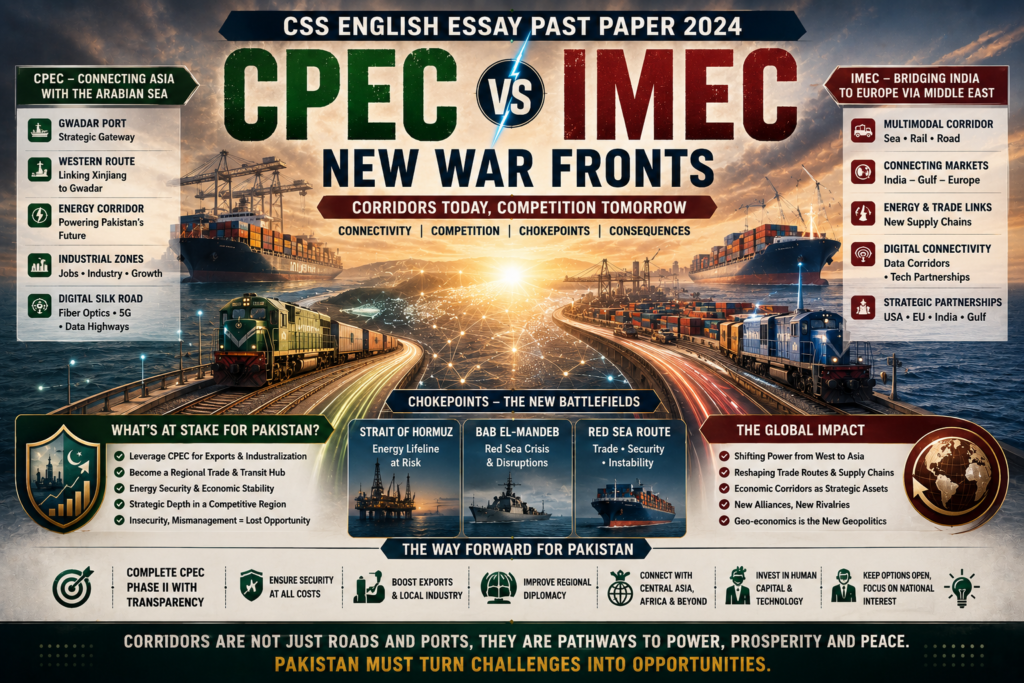
CPEC and IMEC have become two of the most important geo-economic ideas of the present world. The CSS English Essay Past Paper 2024 topic “CPEC and ‘Indo–Middle East–Europe’, New War Fronts” must not be read as a simple comparison between two trade corridors. It must be read as a study of how the modern world is turning connectivity, ports, railways, sea lanes, energy chokepoints, digital networks and supply chains into new theatres of competition. The old war fronts were trenches, borders and battlefields. The new war fronts are corridors, ports, shipping routes, sanctions, tariffs, data cables, energy pipelines and investment networks.
CPEC and IMEC represent two different visions of connectivity. The China-Pakistan Economic Corridor is a flagship project of China’s Belt and Road Initiative and connects western China with Pakistan’s Arabian Sea coastline through roads, energy projects, industrial zones and Gwadar Port. The India-Middle East-Europe Economic Corridor, commonly called IMEC, seeks to connect India with the Gulf, the Middle East and Europe through maritime, rail, energy and digital links. One strengthens China-Pakistan geo-economics; the other strengthens India’s westward connectivity with the support of the United States, Europe and key Middle Eastern partners.
These corridors are called “new war fronts” not because they are automatically military battlefields, but because they represent strategic competition in a world where economics and security are fused. Whoever controls corridors controls access. Whoever controls ports controls trade. Whoever controls chokepoints controls costs. Whoever controls digital networks controls data. Whoever controls supply chains controls industrial power. Therefore, CPEC and IMEC are not only infrastructure projects; they are symbols of a changing world order.
The current global situation makes this topic even more urgent. The Gaza war, Iran-US-Israel conflict, Red Sea crisis, Bab el-Mandeb insecurity, Strait of Hormuz disruption, US-China rivalry, India’s rise, China’s Belt and Road strategy and Europe’s search for secure trade routes have all turned connectivity into a security question. The Red Sea and Bab el-Mandeb disruption has already shown how one maritime route can disturb global trade. The Strait of Hormuz crisis has shown how energy routes can threaten the economies of Asia. In such a world, CPEC and IMEC are not peaceful lines on a map; they are contested corridors in a troubled global order.
For Pakistan, the subject is existential. Pakistan is central to CPEC, but it is outside IMEC. If Pakistan uses CPEC wisely, it can become a hub of regional trade, industrialization, energy connectivity and transit. If Pakistan mismanages CPEC through insecurity, political instability, weak exports and poor governance, the corridor may remain underused. At the same time, IMEC can bypass Pakistan and strengthen India’s connectivity with the Gulf and Europe. Therefore, Pakistan must treat this topic as a policy warning. The question is not whether Pakistan should oppose IMEC emotionally. The question is whether Pakistan can make CPEC more competitive, secure and productive.
Bellum Report has already discussed several themes that directly support this essay. The essay on Globalization and National Economies explains how trade corridors, energy chokepoints and supply chains now shape national economies. The post on BRICS and Pakistan shows how Pakistan is searching for recovery in a multipolar world. The essay on Emerging Multipolar World Order is directly relevant because both CPEC and IMEC are products of multipolar competition. The post on Pathways to Pakistan’s Prosperity also matters because corridors create prosperity only when domestic governance, exports, skills and security are ready.
Central Argument: CPEC and IMEC are new war fronts because modern power is increasingly fought through connectivity, ports, trade routes, energy corridors, supply chains, digital networks and regional alignments. CPEC gives Pakistan an opportunity to become a geo-economic bridge between China, Central Asia, the Middle East and the Arabian Sea. IMEC gives India an opportunity to bypass Pakistan and connect with the Gulf and Europe through a Western-backed corridor. Pakistan should not respond with fear or slogans; it must respond with security, exports, industrialization, Gwadar development, regional diplomacy, CPEC Phase-II reforms and policy stability.
Show Table of Contents
Table of Contents
- Introduction
- CSS Essay Outline
- Thesis Statement
- Meaning of New War Fronts
- CPEC: Pakistan’s Geo-Economic Opportunity
- IMEC: India’s Westward Corridor
- CPEC and IMEC: A Comparative Analysis
- Corridors in a Multipolar World Order
- China-India Rivalry and Corridor Politics
- United States, Europe and the Strategic Logic of IMEC
- Middle East as the Central Battleground of Corridors
- Red Sea, Bab el-Mandeb and Suez: Trade Route Vulnerability
- Strait of Hormuz and Energy Security
- Risks for Pakistan
- Opportunities for Pakistan
- Gwadar as Pakistan’s Strategic Test
- Security, Balochistan and Chinese Workers
- Exports, Industry and CPEC Phase-II
- Digital Corridors and Cyber Fronts
- Policy Recommendations for Pakistan
- Counterargument
- Conclusion
- FAQs
Introduction
The meaning of war is changing. In the past, war was mostly understood through armies, tanks, borders, missiles and military alliances. Today, war also appears through trade routes, sanctions, maritime chokepoints, energy supply, ports, investment corridors, cyberattacks, tariffs and control over supply chains. This does not mean that traditional wars have disappeared; Gaza, Ukraine, Iran and other conflicts prove that military violence remains real. But alongside military conflict, a new form of geo-economic conflict has emerged. In this new world, corridors are weapons of influence.
CPEC and IMEC are two major examples of this shift. CPEC connects China and Pakistan through infrastructure, energy, roads, industrial cooperation and Gwadar Port. It gives China access to the Arabian Sea and gives Pakistan a chance to become a regional trade and energy hub. IMEC, on the other hand, seeks to connect India with the Middle East and Europe through ports, railways, energy pipelines and digital connectivity. It gives India a strategic route to the Gulf and Europe while strengthening its role in the US-backed connectivity architecture.
The title “CPEC and ‘Indo–Middle East–Europe’, New War Fronts” reflects this transformation of global politics. The competition is not only about territory; it is about routes. It is not only about flags; it is about logistics. It is not only about military bases; it is about ports. It is not only about ideology; it is about market access. It is not only about weapons; it is about infrastructure. Thus, CPEC and IMEC symbolize the new geography of power.
Pakistan’s location makes the topic more serious. Pakistan sits between South Asia, Central Asia, China, Iran, Afghanistan, the Gulf and the Arabian Sea. This geography can become a blessing if connected with trade, transit, industry and peace. It can become a burden if surrounded by insecurity, militancy, political instability and weak governance. CPEC gives Pakistan a chance to convert geography into economic strength. But geography alone does not create prosperity. It must be supported by security, exports, industrial zones, skilled labour, local inclusion and diplomatic maturity.
IMEC challenges Pakistan because it strengthens India’s connectivity without passing through Pakistani territory. Historically, Pakistan’s location gave it transit relevance between India, Central Asia, Afghanistan, Iran and the Arabian Sea. But if alternative routes bypass Pakistan, the country loses leverage. IMEC may allow India to connect with the Gulf and Europe through maritime and rail links, reducing the importance of Pakistan in India’s westward connectivity. Therefore, Pakistan must not ignore IMEC.
However, Pakistan should also avoid emotional reaction. IMEC is not automatically the death of CPEC. It is also facing challenges: Middle East instability, Gaza war, Israel-Arab normalization politics, Red Sea insecurity, financing needs, technical complexity and geopolitical uncertainty. A corridor is not built by announcement alone. It needs peace, money, trust, standards, customs systems, ports, railways, legal agreements and political continuity. Pakistan’s response should be to improve CPEC, not merely criticize IMEC.
The current Middle East crisis shows why both corridors are vulnerable. The Red Sea crisis has forced shipping companies to divert routes away from Suez and Bab el-Mandeb. The Strait of Hormuz conflict has threatened energy supplies. The Gaza war has disrupted normalization politics. US-Iran-Israel tensions have made the Gulf uncertain. If the Middle East is unstable, IMEC becomes difficult. If Pakistan is unstable, CPEC becomes difficult. Therefore, both corridors depend on security.
Bellum Report’s essay on Globalization and National Economies explains this exact reality: globalization is no longer a peaceful textbook process; it is contested through wars, tariffs, chokepoints and supply chains. CPEC and IMEC are part of the same struggle. They show that countries are now competing to control the routes through which globalization flows.
This essay argues that CPEC and IMEC are new war fronts because they represent strategic competition over connectivity, trade, energy, ports and influence. Pakistan must treat CPEC not as a slogan but as a national development strategy. It must secure Chinese workers, develop Gwadar, industrialize special economic zones, increase exports, include Balochistan, connect with Central Asia and maintain balanced diplomacy. In the age of corridor politics, only states that combine geography with governance can win.
CSS Essay Outline
- Introduction
- Meaning of “new war fronts” in geo-economics
- CPEC as Pakistan’s strategic and economic corridor
- IMEC as India’s westward connectivity project
- Comparison between CPEC and IMEC
- Corridors in the emerging multipolar world order
- China-India rivalry and the politics of routes
- US and European role in supporting IMEC
- Middle East as the central zone of corridor competition
- Gaza war, Iran conflict and corridor uncertainty
- Red Sea, Bab el-Mandeb and Suez Canal vulnerabilities
- Strait of Hormuz and Asian energy security
- Risks for Pakistan: bypass, insecurity and weak exports
- Opportunities for Pakistan: Gwadar, Central Asia, Gulf and China
- CPEC Phase-II: industrialization, agriculture and technology
- Security of Chinese workers and Balochistan inclusion
- Digital corridors, data and cyber war fronts
- Policy recommendations for Pakistan
- Counterargument: corridors are economic, not war fronts
- Rebuttal: modern war includes economic and connectivity competition
- Conclusion
Thesis Statement
CPEC and IMEC are new war fronts because modern strategic competition is increasingly fought through connectivity corridors, ports, trade routes, energy chokepoints, digital networks and supply chains. CPEC gives Pakistan an opportunity to become a regional geo-economic hub, while IMEC gives India a Western-backed route to the Middle East and Europe. Pakistan can benefit from this new era only if it secures CPEC, develops Gwadar, industrializes its economy, increases exports, includes Balochistan, connects with Central Asia and practices mature diplomacy.
Meaning of New War Fronts
The phrase “new war fronts” does not mean that CPEC and IMEC are necessarily military battlefields. It means that strategic competition has expanded beyond conventional war. In today’s world, states compete through trade corridors, ports, shipping lanes, energy routes, sanctions, technology, digital infrastructure and financial systems. These are new fronts because they shape national power without always using direct military force.
A port can become a war front when rival powers compete to control maritime access. A railway can become a war front when it redirects trade flows. A pipeline can become a war front when energy dependence creates political leverage. A digital cable can become a war front when it carries data and strategic communication. A trade corridor can become a war front when it bypasses one country and empowers another.
Therefore, CPEC and IMEC are new war fronts in the sense that they represent competing visions of regional order. CPEC strengthens China-Pakistan connectivity and the Belt and Road Initiative. IMEC strengthens India’s connection with the Gulf, Israel, Europe and Western-backed infrastructure planning. Both corridors are economic, but their implications are strategic.
This is the core of geo-economics: using economic instruments for geopolitical goals. In the present world, infrastructure is not neutral. It creates dependencies, alliances and influence.
CPEC: Pakistan’s Geo-Economic Opportunity
The China-Pakistan Economic Corridor is one of Pakistan’s most important strategic and economic projects. It connects China’s western region with Pakistan through roads, energy projects, industrial zones and Gwadar Port. Its purpose is to improve connectivity, reduce infrastructure gaps, support energy supply, promote trade and strengthen Pakistan-China relations.
CPEC gives Pakistan several opportunities. First, it can improve infrastructure. Second, it can attract investment. Third, it can support industrial zones. Fourth, it can connect Pakistan with China, Central Asia, Afghanistan, Iran and the Gulf. Fifth, it can develop Gwadar as a maritime hub. Sixth, it can help Pakistan shift from geopolitics to geo-economics.
However, CPEC has not yet delivered its full potential. Energy projects helped reduce power shortages, but industrialization remains slow. Special economic zones need faster development. Gwadar still requires local inclusion, water, electricity, security, roads, jobs and urban services. Pakistan’s exports remain weak. Security threats against Chinese workers remain a serious concern. These gaps must be addressed.
Recent reporting says China and Pakistan are again seeking to revamp CPEC and Gwadar, with emphasis on high-quality development, third-party participation, infrastructure upgrades and stronger security. This shows that CPEC remains alive, but it also shows that Pakistan must improve implementation. A corridor succeeds through delivery, not ceremony.
IMEC: India’s Westward Corridor
The India-Middle East-Europe Economic Corridor, or IMEC, is a proposed connectivity project linking India with the Middle East and Europe through maritime, railway, energy and digital infrastructure. It was announced at the G20 Summit in New Delhi in 2023 and is supported by major global actors, including India, the United States, European partners and Middle Eastern states.
IMEC aims to connect India to the Gulf by sea, then connect Gulf states through rail networks toward Jordan, Israel and Europe. It also includes potential energy, digital and data connectivity. Its supporters present it as a modern trade route that can reduce shipping time, improve supply chains and strengthen economic cooperation among India, the Gulf and Europe.
For India, IMEC is strategically important. It supports India’s ambition to become a major manufacturing, trade and diplomatic power. It strengthens India’s links with the Gulf, Europe and the United States. It may also reduce India’s dependence on routes influenced by China or Pakistan.
For Pakistan, IMEC is a strategic warning. It can reduce Pakistan’s transit relevance if Pakistan fails to activate its own corridors. It strengthens India’s geo-economic profile while Pakistan remains trapped in political instability, security challenges and weak exports. Therefore, Pakistan must take IMEC seriously.
CPEC and IMEC: A Comparative Analysis
| Aspect | CPEC | IMEC |
|---|---|---|
| Main Anchor | China and Pakistan | India, Middle East and Europe |
| Strategic Framework | Belt and Road Initiative | US/EU-backed connectivity and India’s westward strategy |
| Key Port Logic | Gwadar and Arabian Sea access | Indian ports, Gulf ports, Mediterranean/European links |
| Pakistan’s Role | Central participant | Bypassed actor |
| Main Opportunity | Industrialization, transit, China access, Gwadar development | India-Gulf-Europe trade, energy and digital connectivity |
| Main Challenge | Security, implementation, debt concerns, local inclusion | Middle East instability, financing, Israel-Arab politics, route complexity |
CPEC and IMEC are not identical projects. CPEC is more advanced in physical implementation because many projects have already been completed or started. IMEC is still more of a strategic proposal requiring large-scale coordination. However, IMEC has strong geopolitical backing and can gain momentum if regional normalization and financing improve.
CPEC’s advantage is geographic directness for China and Pakistan. IMEC’s advantage is political backing from India, the United States, Europe and key Middle Eastern economies. CPEC’s challenge is Pakistan’s domestic instability. IMEC’s challenge is Middle East instability. Both corridors are powerful but vulnerable.
Pakistan’s mistake would be to assume that CPEC alone guarantees success. India’s mistake would be to assume that IMEC can ignore Middle East conflict. In corridor politics, announcements are easy; security and implementation are hard.
Corridors in a Multipolar World Order
CPEC and IMEC belong to the emerging multipolar world order. The world is no longer dominated by one uncontested power. China is rising. India is expanding its global profile. The Gulf states are becoming more independent and investment-driven. Europe is searching for secure supply chains. The United States is trying to maintain influence through alliances and infrastructure alternatives to China’s Belt and Road Initiative.
Bellum Report’s essay on Emerging Multipolar World Order explains that multipolarity creates both opportunity and risk for Pakistan. CPEC and IMEC are examples of this. They show how infrastructure becomes a tool of alignment.
In a multipolar world, countries do not only choose military alliances. They choose trade routes, payment systems, ports, technology platforms and investment partners. Corridors are therefore instruments of global positioning.
Pakistan must understand that multipolarity rewards prepared states. Countries with exports, governance, security and infrastructure can benefit from multiple powers. Countries with instability become objects of competition rather than players.
China-India Rivalry and Corridor Politics
China and India are two rising Asian powers, but their relationship is competitive and tense. They compete over borders, trade, technology, regional influence, Indian Ocean access and global leadership. CPEC and IMEC reflect this rivalry in infrastructure form.
CPEC gives China access to the Arabian Sea through Pakistan and strengthens China’s western connectivity. It also deepens Pakistan-China strategic cooperation. India has objected to CPEC because parts of the corridor pass through Gilgit-Baltistan, which India claims as part of the Kashmir dispute.
IMEC gives India a route toward the Gulf and Europe and strengthens India’s status as a counterweight to China. It is often seen as part of a wider effort to provide alternatives to China’s Belt and Road Initiative. Thus, IMEC is not only about trade; it is also about strategic balancing.
For Pakistan, China-India rivalry creates opportunity and danger. Pakistan benefits from Chinese support, but it must avoid becoming only a battlefield of larger rivalry. It must build its own economic capacity so that CPEC serves Pakistan’s development, not only external strategy.
United States, Europe and the Strategic Logic of IMEC
The United States and Europe support IMEC because it aligns with their strategic interests. It strengthens India as a major economic partner. It gives Europe an alternative connectivity route. It deepens links between the Gulf, Israel and India. It provides an infrastructure narrative that competes with China’s Belt and Road Initiative.
For Washington, IMEC helps integrate India into a larger Western-aligned economic architecture without requiring a formal military alliance. It also supports efforts to normalize relations between Israel and Arab states, though the Gaza war has complicated that process. For Europe, IMEC offers potential trade diversification and access to fast-growing markets.
However, IMEC depends heavily on political stability in the Middle East. If Israel-Arab normalization remains frozen, if Gaza continues to burn, if Iran tensions rise, or if Red Sea shipping remains insecure, IMEC becomes difficult to operationalize. Corridors require trust, and war destroys trust.
Therefore, IMEC is strategically attractive but operationally fragile. Its success depends on a calmer Middle East, long-term financing and serious technical coordination.
Middle East as the Central Battleground of Corridors
The Middle East is the central battleground of both CPEC-related and IMEC-related thinking. It sits between Asia, Africa and Europe. It controls energy routes, sea lanes, ports, sovereign wealth funds and religious geography. Gulf states are no longer only oil exporters; they are becoming logistics, finance, aviation, technology and investment hubs.
IMEC depends directly on the Middle East because its route passes through Gulf states and potentially toward Israel and Europe. CPEC also depends indirectly on the Middle East because Gwadar faces the Arabian Sea close to Gulf energy routes, and Pakistan’s economy depends on Gulf remittances, oil and investment.
The Gaza war has damaged normalization politics and made IMEC more complicated. The Iran-US-Israel conflict has threatened energy security. The Red Sea crisis has shown that maritime routes can be disrupted quickly. The Middle East is therefore not only a bridge between continents; it is also a zone of risk.
Bellum Report’s essay on Hamas-Israel Conflict: A Test Case for World Conscience is relevant because the Gaza conflict is not only humanitarian; it also affects regional alignments and corridor politics. No corridor through the Middle East can ignore Palestine, Iran, Gulf security and maritime chokepoints.
Red Sea, Bab el-Mandeb and Suez: Trade Route Vulnerability
The Red Sea and Bab el-Mandeb crisis proves that global trade corridors are vulnerable to war. The Bab el-Mandeb Strait connects the Red Sea with the Gulf of Aden and the Indian Ocean. The Suez Canal connects the Red Sea with the Mediterranean. Together, they form one of the most important trade routes between Asia and Europe.
The World Bank notes that the Suez Canal and Bab el-Mandeb route used to carry about 30 percent of world container traffic, but vessel traffic through the route plunged during the crisis. Shipping companies have diverted vessels around Africa, increasing travel time, fuel costs, insurance costs and delivery delays. This is a clear example of a new war front.
For IMEC, Red Sea insecurity creates both a challenge and a justification. Supporters may argue that alternative rail-maritime corridors are needed because traditional sea routes are vulnerable. Critics may argue that IMEC itself remains exposed to the same regional instability because it depends on Middle Eastern cooperation.
For Pakistan, the lesson is broader. Trade routes are not safe by default. Pakistan must improve maritime awareness, port efficiency, naval cooperation, insurance systems and logistics resilience. Gwadar can become valuable only if it is secure and connected.
Strait of Hormuz and Energy Security
The Strait of Hormuz is one of the world’s most important energy chokepoints. Any disruption in Hormuz affects oil and gas prices across Asia and beyond. The Iran-US-Israel conflict has made Hormuz a central concern in 2026. Reuters has reported discussions about reopening the Strait after a peace deal and also reported global corporate costs from the Iran war and Hormuz disruption.
Hormuz matters for Pakistan, India, China, Japan and South Korea because Asian economies depend heavily on Gulf energy flows. A disruption raises fuel prices, electricity costs, transport costs, fertilizer prices and inflation. For Pakistan, which already faces external financing pressure, higher oil and LNG prices can become a macroeconomic crisis.
Bellum Report’s essay on Phase Out of Fossil Fuel and Arab Economies connects with this issue because Arab energy economies and Asian importers are tied through chokepoints. Energy transition, maritime security and corridor politics are now part of the same debate.
CPEC’s Gwadar dimension is also linked with Hormuz. Gwadar is located near the mouth of the Gulf and can become strategically important if developed properly. But its value depends on stability, infrastructure and industrial activity. A port without security and hinterland connectivity cannot transform an economy.
Risks for Pakistan
The first risk for Pakistan is strategic bypass. IMEC can strengthen India’s connectivity with the Gulf and Europe without using Pakistan. If Pakistan fails to activate CPEC and regional trade, it may lose transit relevance.
The second risk is insecurity. Attacks on Chinese workers, Balochistan unrest, militant threats and political instability can slow CPEC. Investors do not trust corridors that are unsafe. Security is therefore not separate from development; it is part of development.
The third risk is weak exports. A corridor is useful only if goods move through it. If Pakistan does not produce exportable goods, CPEC becomes a road network rather than an economic revolution. Bellum Report’s Pathways to Pakistan’s Prosperity explains why exports, jobs and productivity are essential for recovery.
The fourth risk is debt and dependency. CPEC projects must be economically productive. If Pakistan borrows without generating exports and revenue, infrastructure can become a financial burden. The answer is not to reject CPEC, but to make it productive.
The fifth risk is diplomatic imbalance. Pakistan must maintain strong ties with China while also managing relations with the Gulf, Europe, the United States, Iran, Afghanistan and Central Asia. Corridor politics requires balanced diplomacy.
Opportunities for Pakistan
Despite risks, CPEC offers Pakistan major opportunities. First, it can develop Gwadar as a regional port. Second, it can connect Pakistan with western China. Third, it can improve road and energy infrastructure. Fourth, it can support special economic zones. Fifth, it can link Pakistan with Central Asia, Afghanistan, Iran and the Gulf. Sixth, it can attract third-party investment.
Pakistan can also use CPEC to become a bridge between China and the Muslim world. With Saudi Arabia, UAE, Qatar and other Gulf states investing globally, Pakistan can invite Gulf participation in CPEC-linked projects. This would reduce overdependence on one partner and give CPEC broader regional legitimacy.
Pakistan can connect CPEC with BRICS-related diplomacy. Bellum Report’s essay on BRICS and Pakistan explains that Pakistan needs diversified partnerships in a changing world. CPEC can become part of a wider Global South connectivity strategy if Pakistan reforms.
The biggest opportunity is industrialization. Roads alone do not create prosperity. Factories, exports, skills and markets do. CPEC Phase-II must focus on special economic zones, agriculture modernization, technology, minerals, logistics and digital connectivity.
Gwadar as Pakistan’s Strategic Test
Gwadar is the symbolic heart of CPEC. It is located near important sea lanes and close to the Gulf. It can become a hub for trade, logistics, fisheries, energy, tourism and regional connectivity. But Gwadar’s potential remains underdeveloped because of local grievances, infrastructure gaps, water shortages, security issues and slow economic activity.
For Gwadar to succeed, local people must benefit. Development without inclusion creates resentment. Balochistan must not be treated only as strategic geography; it must be treated as a human community with rights, jobs, education, health, water and dignity. If local people see CPEC as extraction rather than development, insecurity will continue.
Gwadar also needs practical connectivity. A port cannot function without roads, warehouses, customs efficiency, power, water, security, skilled workers and investor confidence. Pakistan must build the ecosystem around Gwadar rather than only praise its location.
If Pakistan develops Gwadar properly, it can compete in regional logistics. If it fails, Gwadar will remain a strategic slogan rather than an economic engine.
Security, Balochistan and Chinese Workers
Security is the most urgent challenge for CPEC. Chinese workers and projects have faced repeated attacks in Pakistan. This directly affects investor confidence and China’s willingness to expand projects. Pakistan has pledged stronger security, but security must be broader than protection convoys.
Security has two dimensions. The first is hard security: intelligence, policing, counterterrorism, border control and protection of workers. The second is human security: local jobs, political inclusion, fair resource sharing, education, health, water and trust. Both are necessary.
Balochistan is central to CPEC, but it is also one of Pakistan’s most deprived and politically sensitive provinces. Development must be inclusive. Local communities must see benefits in employment, fisheries, education, electricity, water and business opportunities. Otherwise, hostile forces can exploit grievances.
Bellum Report’s essay on Political Polarization in Pakistan is relevant because national projects require internal consensus. A divided country cannot secure strategic corridors effectively.
Exports, Industry and CPEC Phase-II
CPEC Phase-II must focus on exports and industrialization. The first phase of CPEC was mostly about energy and infrastructure. That was important, but the next phase must create jobs, factories, value chains and export capacity. Without exports, Pakistan cannot escape repeated external crises.
Special economic zones should not become empty plots. They need electricity, gas, water, roads, customs facilitation, skilled workers, one-window operations, legal protection and market linkages. Pakistan should target sectors such as textiles, engineering goods, pharmaceuticals, food processing, surgical instruments, sports goods, IT hardware, minerals and renewable-energy equipment.
Agriculture can also benefit from CPEC. Cold chains, processing units, seed technology, irrigation efficiency and export logistics can connect farmers to markets. Bellum Report’s essay on Revitalising the Agriculture Sector of Pakistan supports this point because agriculture can become a source of exports and rural prosperity.
Pakistan must also connect CPEC with human capital. Roads do not create prosperity if people are unskilled. Technical education, vocational training, Chinese language skills, logistics management and industrial training are necessary.
Digital Corridors and Cyber Fronts
Modern corridors are not only roads and railways. They are also digital corridors. Data cables, cloud infrastructure, payment systems, e-commerce networks, cybersecurity systems and artificial intelligence platforms are now part of geo-economic power. IMEC and CPEC both include possibilities for digital connectivity.
Digital routes can become new war fronts because data is strategic. Cyberattacks can disrupt ports, customs systems, banks, logistics networks and power grids. Countries that control digital infrastructure gain influence. Countries that depend blindly on others become vulnerable.
Bellum Report’s essay on Cyber Security as the New National Security Frontier is highly relevant here. Pakistan must treat CPEC’s digital dimension carefully. Smart ports, customs systems, surveillance networks and logistics platforms need strong cybersecurity.
Artificial intelligence also matters. Bellum Report’s article on Artificial Intelligence and Creativity explains how AI is reshaping work and innovation. In corridor politics, AI can optimize logistics, predict delays, manage ports and improve customs. Pakistan must not ignore this technological front.
Policy Recommendations for Pakistan
First, Pakistan must treat CPEC as an economic strategy, not a political slogan. Every project should be linked with exports, jobs, revenue and local development.
Second, Gwadar must be developed through local inclusion. Water, electricity, health, education, fisheries, jobs and local business opportunities should be prioritized.
Third, security for Chinese workers and CPEC projects must be strengthened through both hard security and human security. Balochistan’s grievances must be addressed seriously.
Fourth, CPEC Phase-II should focus on industrialization, special economic zones, agriculture modernization, minerals, technology and digital connectivity.
Fifth, Pakistan should invite third-party investment from Gulf countries, Central Asia, Türkiye and other friendly states into CPEC-linked projects. This can broaden ownership and reduce dependency.
Sixth, Pakistan should not oppose IMEC emotionally. It should study IMEC professionally and improve its own competitiveness. The best response to a rival corridor is a better corridor.
Seventh, Pakistan should connect CPEC with Central Asia through Afghanistan where possible, while also exploring Iran and Gulf connectivity. Regional diplomacy is essential.
Eighth, Pakistan must increase exports. Corridors need cargo. Without production, Pakistan cannot benefit from connectivity.
Ninth, digital and cyber security must be integrated into corridor planning. Ports, logistics, payment systems and data networks must be protected.
Tenth, Pakistan needs political stability. Corridor projects require continuity across governments. National consensus on CPEC should be built through parliament, provinces and local stakeholders.
Counterargument: CPEC and IMEC Are Economic Corridors, Not War Fronts
Some critics may argue that calling CPEC and IMEC “new war fronts” is exaggerated. They may say that both are development projects aimed at trade, infrastructure, investment and connectivity. According to this view, corridors should be seen as opportunities for cooperation, not conflict.
This argument has partial truth. Corridors can promote trade, jobs and cooperation. If managed peacefully, CPEC and IMEC can increase regional connectivity and reduce costs. Infrastructure itself is not war. Roads, ports and railways can serve development.
However, in the present world, infrastructure is never completely neutral. CPEC is linked with China’s Belt and Road strategy. IMEC is linked with India’s rise and Western efforts to build alternatives to China-led connectivity. Ports, railways, energy routes and digital cables create influence. Therefore, corridors can be economic in form but strategic in meaning.
The correct conclusion is that CPEC and IMEC are not traditional war fronts, but they are geo-economic war fronts. They represent competition over routes, markets and influence. States that understand this will benefit. States that ignore it will be bypassed.
Conclusion
CPEC and IMEC represent the new geography of power. In the twenty-first century, states compete not only through armies and alliances but also through corridors, ports, shipping lanes, energy routes, digital systems and supply chains. CPEC strengthens China-Pakistan connectivity and gives Pakistan a chance to become a regional economic hub. IMEC strengthens India’s westward connectivity and gives India a strategic route to the Gulf and Europe.
These corridors are new war fronts because modern power is increasingly geo-economic. The Red Sea crisis, Bab el-Mandeb disruption, Strait of Hormuz conflict, Gaza war, Iran tensions and US-China rivalry show that trade routes are vulnerable and strategic. A country’s prosperity now depends not only on what it produces but also on how safely and efficiently it connects with the world.
For Pakistan, CPEC is both opportunity and test. It can support infrastructure, energy, Gwadar, industrialization, exports and regional connectivity. But it can fail if security remains weak, Balochistan remains excluded, exports remain narrow, special economic zones remain slow and governance remains unstable. IMEC should not be dismissed. It should be treated as a strategic reminder that Pakistan must make CPEC work.
Pakistan’s response must be practical. It should secure CPEC, develop Gwadar, include local communities, expand exports, modernize agriculture, attract third-party investment, connect with Central Asia and the Gulf, and build digital security. It should not rely on geography alone. Geography becomes power only when supported by governance.
Thus, the CSS English Essay Past Paper 2024 topic concludes that CPEC and IMEC are not merely corridors; they are symbols of the new world order. In this order, routes are power, ports are influence, and connectivity is strategy. Pakistan must either become a serious geo-economic player or risk being bypassed in the age of corridor wars.
Important Facts and References for CSS Essay
| Fact / Reference | Relevance |
|---|---|
| Reuters reported in May 2026 that China and Pakistan aim to revamp CPEC and Gwadar as a regional connectivity hub. | Shows CPEC remains a live strategic and economic priority. |
| IMEC aims to connect India, the Middle East and Europe through infrastructure, trade, energy and digital connectivity. | Shows why IMEC is strategically important for India and its partners. |
| The World Bank notes that the Suez Canal and Bab el-Mandeb route used to carry about 30 percent of world container traffic before crisis-related disruption. | Shows why chokepoints are new economic war fronts. |
| Reuters reported 2026 disruptions and negotiations around the Strait of Hormuz amid Iran-US-Israel tensions. | Shows energy chokepoints directly affect corridor politics and Asian economies. |
| CPEC’s success depends on security, Gwadar development, industrialization, exports and local inclusion. | Provides the core policy direction for Pakistan. |
Quotations for CSS Essay
- “In the new world order, routes are power and ports are influence.”
- “The new war fronts are not only borders; they are corridors, chokepoints and supply chains.”
- “CPEC will become Pakistan’s strength only if geography is converted into productivity.”
- “IMEC is a warning that countries without competitive corridors can be bypassed.”
- “Connectivity without security is vulnerability; connectivity with productivity is power.”
Short CSS Essay Summary
CPEC and IMEC are new war fronts because modern strategic competition is increasingly fought through trade corridors, ports, energy chokepoints, digital networks and supply chains. CPEC connects China and Pakistan through infrastructure, energy, industrial zones and Gwadar, while IMEC seeks to connect India with the Middle East and Europe through maritime, rail, energy and digital links. CPEC gives Pakistan an opportunity to become a regional geo-economic hub, but IMEC can bypass Pakistan and strengthen India’s westward connectivity. The Gaza war, Iran conflict, Red Sea crisis, Bab el-Mandeb disruption and Strait of Hormuz tensions show that corridors depend on security. Pakistan must secure CPEC, develop Gwadar, include Balochistan, increase exports, industrialize special economic zones and practice balanced diplomacy.
External Authoritative Sources
- Reuters: China and Pakistan Aim to Revamp CPEC and Gwadar
- Official CPEC: China-Pakistan Economic Corridor
- India-Middle East-Europe Economic Corridor
- World Bank: Red Sea Shipping Crisis
- Reuters: Strait of Hormuz and Iran-US Negotiations
- Reuters: Iran War, Hormuz and Global Corporate Costs
FAQs
What is meant by CPEC and IMEC as new war fronts?
CPEC and IMEC are called new war fronts because modern competition is increasingly fought through corridors, ports, trade routes, energy chokepoints, digital networks and supply chains rather than only through military battlefields.
What is CPEC?
CPEC is the China-Pakistan Economic Corridor, a major connectivity project linking China with Pakistan through roads, energy projects, industrial zones and Gwadar Port.
What is IMEC?
IMEC is the India-Middle East-Europe Economic Corridor, a proposed corridor connecting India with the Gulf, Middle East and Europe through maritime, railway, energy and digital links.
Why is IMEC important for Pakistan?
IMEC is important for Pakistan because it can strengthen India’s connectivity with the Gulf and Europe while bypassing Pakistan. It is a strategic warning that Pakistan must make CPEC more productive and competitive.
How do Red Sea and Hormuz crises affect corridors?
Red Sea, Bab el-Mandeb and Strait of Hormuz crises show that trade and energy corridors depend on maritime security. Disruptions can raise costs, delay shipping and affect national economies.
How can Pakistan benefit from CPEC?
Pakistan can benefit from CPEC by developing Gwadar, securing projects, building special economic zones, increasing exports, modernizing agriculture, improving logistics, including Balochistan and attracting third-party investment.
The Indus Odyssey from Debal to Islamabad
The Ultimate Guide to Pakistan Affairs (711-2025). A focused Kindle guide for CSS, PMS, PCS, PPSC and FPSC Pakistan Affairs preparation.