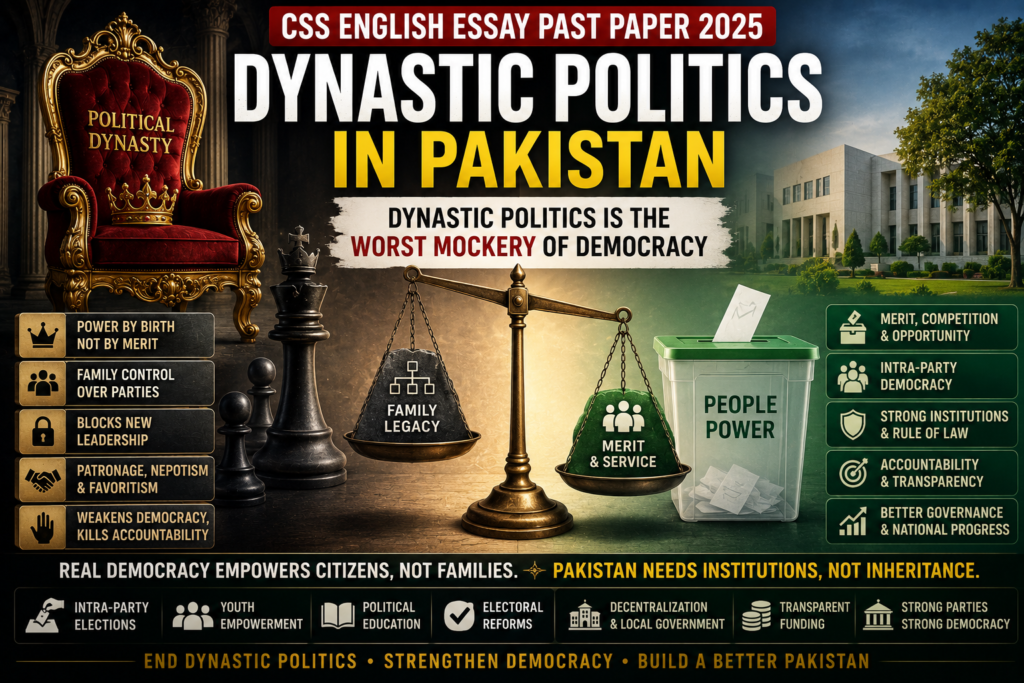
Dynastic Politics in Pakistan is one of the most important CSS English Essay Past Paper 2025 topics because it directly questions the quality of democracy, political representation, party organization, leadership selection and public accountability in the country. The topic “Dynastic politics is the worst mockery of democracy” is not a simple criticism of political families; it is a deeper argument that democracy loses its moral meaning when political power becomes hereditary, party leadership becomes family property, and ordinary citizens are reduced to voters without real access to leadership.
Democracy is based on equality, consent, competition, accountability and public representation. Dynastic politics violates these principles by turning politics into inheritance. In a true democracy, leadership should emerge through merit, service, ideas, organization, struggle and public trust. In dynastic politics, leadership often emerges through birth, surname, family wealth, inherited networks and emotional loyalty. Therefore, Dynastic Politics in Pakistan represents a serious contradiction: democratic institutions exist, elections are held, parties campaign, and citizens vote, yet leadership frequently remains concentrated within a few families.
The problem is not that a person from a political family should be banned from politics. That would itself be undemocratic. The problem begins when political parties become family-controlled, when tickets are distributed through personal loyalty, when party offices are inherited, when internal elections are symbolic, and when ordinary workers cannot rise to top leadership. In such a system, democracy becomes a performance rather than a practice. This is why dynastic politics is called the worst mockery of democracy.
Central Argument: Dynastic Politics in Pakistan is the worst mockery of democracy because it replaces merit with inheritance, institutions with personalities, political parties with family enterprises, and public representation with elite control. It weakens intra-party democracy, discourages ordinary workers, promotes patronage, strengthens electables, damages accountability and reduces public trust. Pakistan can strengthen democracy only through internal party elections, campaign finance transparency, local governments, political education, electoral reforms, youth participation and institutional accountability.
Show Table of Contents
Table of Contents
- Introduction
- CSS Essay Outline
- Thesis Statement
- Meaning of Dynastic Politics in Pakistan
- Meaning and Spirit of Democracy
- Why Dynastic Politics Is a Mockery of Democracy
- Historical Roots of Dynastic Politics in Pakistan
- Political Parties and Family Control
- Lack of Intra-Party Democracy
- Electables, Wealth and Patronage
- Dynastic Politics and the Death of Merit
- Dynastic Politics and Weak Accountability
- Youth Exclusion and Political Frustration
- Women, Dynasties and Symbolic Representation
- Impact on Governance and Policy
- Dynastic Politics in Pakistan: Key Examples
- Global Context of Dynastic Politics
- Risks for Democracy in Pakistan
- How to End Dynastic Politics in Pakistan
- Counterargument
- Conclusion
- FAQs
Introduction
Democracy is the government of the people, by the people and for the people. Its moral strength lies in the belief that every citizen has equal political worth, that leadership should be open to talent, and that power should be earned through public trust rather than inherited through family lineage. When democracy becomes a competition of ideas, performance and accountability, it empowers citizens. When it becomes a competition among families, surnames and inherited influence, it becomes hollow. This is why the statement “Dynastic politics is the worst mockery of democracy” is both powerful and relevant.
Dynastic Politics in Pakistan is a persistent feature of the political system. Many political parties are associated with families, clans, biradaris, landlords, industrial groups or local elites. Political inheritance often moves from father to son, mother to daughter, brother to brother, husband to wife or one family member to another. Party tickets, leadership positions and electoral constituencies are frequently controlled by influential families. This pattern exists at national, provincial and local levels. It is visible not only in one party or province but across much of the political culture.
The problem of Dynastic Politics in Pakistan cannot be understood merely as a personal criticism of individual politicians. It is a structural problem. It is connected with weak political institutions, feudal traditions, wealth inequality, weak local governments, poor political education, expensive elections, patronage networks, military interventions, weak rule of law and lack of intra-party democracy. When institutions are weak, families become institutions. When parties lack internal democracy, families become permanent leadership centres. When elections are expensive, rich families dominate politics. When voters need local patronage for services, electables become powerful.
This creates a strange contradiction. Pakistan has elections, political parties, parliament, provincial assemblies and constitutional procedures. Yet the internal life of many parties remains undemocratic. Ordinary party workers may spend decades raising slogans, arranging rallies and defending party leadership, but they rarely reach the top. Leadership is often decided by bloodline, not by party members. In such a situation, democracy exists outside the party but monarchy exists inside the party. This contradiction makes dynastic politics a mockery of democracy.
Dynastic politics damages the spirit of democracy in several ways. It kills merit by giving preference to family connection. It weakens accountability because party loyalty becomes loyalty to a person or family rather than policy. It discourages youth and middle-class citizens because they see politics as a closed club. It promotes corruption and patronage because power is treated as family property. It weakens parliament because elected representatives often depend on family leadership instead of independent judgment. It damages governance because policies are shaped by elite interests rather than public needs.
In Pakistan, the debate became even more relevant after repeated political crises and contested elections. The Election Commission of Pakistan’s General Elections 2024 material shows the formal electoral process, party positions and candidate lists, but formal elections alone do not guarantee democratic depth. Democracy also requires internal party democracy, transparent candidate selection, equal opportunity and public accountability. If parties remain family-controlled, elections may change governments but not political culture.
International democracy trackers also show that Pakistan has struggled with political instability, institutional imbalance and democratic consolidation. IDEA’s Global State of Democracy profile describes Pakistan as a country that has struggled with nation-building and political instability since independence. BTI 2026 notes that Pakistan’s party system is dominated by major parties that tend to select candidates from pools of “electable” local elites who have economic and social power to mobilize voter blocs. These observations help explain why Dynastic Politics in Pakistan survives: politics is not only about ideology; it is also about local power, wealth and inherited influence.
Therefore, the essay argues that dynastic politics is not merely a weakness of individual parties; it is a democratic disease. However, it is not incurable. Pakistan can reduce dynastic politics through intra-party elections, transparent party financing, stronger local governments, civic education, youth participation, campaign finance reform, independent institutions and genuine democratic culture. The goal is not to ban family members from politics but to ensure that no family can monopolize politics.
CSS Essay Outline
- Introduction
- Meaning of Dynastic Politics in Pakistan
- Meaning and spirit of democracy
- Why dynastic politics is a mockery of democracy
- Historical roots of dynastic politics in Pakistan
- Feudalism, biradari and patronage networks
- Weak political institutions and personality cults
- Political parties as family-controlled enterprises
- Lack of intra-party democracy
- Electables, money and constituency politics
- Dynastic politics and death of merit
- Dynastic politics and weak accountability
- Dynastic politics and elite capture of state power
- Youth exclusion and political frustration
- Women’s representation through dynastic routes
- Impact on governance and policymaking
- Dynastic politics and corruption
- Dynastic politics and weak parliament
- Dynastic politics in Pakistan: major examples and patterns
- Global context of dynastic politics
- Risks for democracy in Pakistan
- Policy recommendations and reforms
- Counterargument: political family background is not always undemocratic
- Rebuttal: family background is acceptable, family monopoly is not
- Conclusion
Thesis Statement
Dynastic Politics in Pakistan is the worst mockery of democracy because it converts public leadership into private inheritance, weakens merit, blocks ordinary citizens, damages intra-party democracy, promotes patronage, protects elite interests and reduces accountability. While individuals from political families have a democratic right to contest elections, democracy becomes hollow when parties and constituencies are monopolized by families. Pakistan can strengthen democracy only by promoting internal party elections, transparent campaign finance, local government, political education, youth inclusion, institutional accountability and equal opportunity in leadership.
Meaning of Dynastic Politics in Pakistan
Dynastic Politics in Pakistan means a political pattern in which power, party leadership, electoral constituencies and public influence are passed from one generation of a family to another. It is a form of political inheritance. In such politics, surname, family background, inherited networks and emotional loyalty often matter more than competence, ideas, service or public performance.
Dynastic politics exists when a political party is controlled by one family, when party leadership passes automatically to relatives, when party tickets are given to family members, when constituencies are treated as family property, and when ordinary party workers cannot rise through internal democratic competition. It also exists when voters support candidates mainly because of family name, biradari, local influence or inherited patronage.
The problem is not that relatives of politicians participate in politics. In a democracy, every citizen has the right to contest elections, including the son or daughter of a politician. The real problem begins when family connection becomes the main qualification for leadership. If a person from a political family earns public trust through service, competence and democratic competition, his or her participation is legitimate. But if leadership is inherited without internal party competition, then democracy is weakened.
Therefore, Dynastic Politics in Pakistan should be understood as a structural distortion of democracy, not merely as the presence of political families. It is a system where political opportunity is unequal and where power circulates within a narrow elite.
Meaning and Spirit of Democracy
To understand why dynastic politics is a mockery of democracy, one must first understand democracy. Democracy does not mean elections alone. Elections are necessary, but they are not sufficient. Democracy means political equality, rule of law, accountability, public participation, free competition, institutional checks and respect for citizens’ will.
The spirit of democracy is that every citizen should have an equal chance to participate in political life. Leadership should be open to talent. Parties should represent people, not families. Public office should be a trust, not inheritance. Political power should be temporary, accountable and conditional on performance.
In a healthy democracy, parties are institutions. They have internal elections, policy debates, transparent membership, leadership rotation and ideological programmes. In a weak democracy, parties become personal vehicles. Leaders dominate parties. Families control leadership. Workers obey rather than participate. Tickets are distributed on loyalty and electability rather than merit.
Thus, dynastic politics violates the moral foundation of democracy. It keeps the outer form of democracy but empties it from within. Citizens vote, but choices are often shaped by elites. Parties exist, but leadership is predetermined. Parliaments function, but many representatives owe loyalty to families rather than democratic principles.
Why Dynastic Politics Is a Mockery of Democracy
Dynastic Politics in Pakistan is a mockery of democracy because it turns public power into private inheritance. Democracy promises equal opportunity, but dynastic politics gives privileged access to those born into political families. Democracy values merit, but dynastic politics values surname. Democracy requires accountability, but dynastic politics protects family networks. Democracy encourages competition, but dynastic politics narrows competition.
It is also a mockery because it creates a contradiction within political parties. Parties demand democracy from the state but often deny democracy within themselves. They criticize authoritarianism but practice family control. They speak of people’s rights but deny ordinary workers the right to choose leadership. This hypocrisy damages democratic culture.
Dynastic politics also mocks voters. It assumes that voters should remain loyal to a family rather than evaluate policies. It turns elections into rituals of inherited influence. In many constituencies, voters choose among powerful families rather than competing visions. This reduces democracy to elite competition.
Most importantly, dynastic politics discourages capable citizens. A talented young worker, teacher, lawyer, farmer, student, doctor or activist may have ideas and commitment, but without family background or wealth, entry into politics becomes difficult. When politics becomes closed, democracy becomes weak.
Historical Roots of Dynastic Politics in Pakistan
The roots of Dynastic Politics in Pakistan are historical and social. Pakistan inherited colonial-era power structures, including landed elites, tribal chiefs, biradari networks and local notables. British colonial rule often governed through local intermediaries, landlords and influential families. After independence, many of these local elites entered electoral politics.
Feudal and tribal structures contributed to dynastic politics. In areas where landownership, biradari loyalty and patronage are strong, political influence often remains within families. Voters may depend on local elites for jobs, police matters, development schemes, dispute settlement or access to officials. This dependency strengthens hereditary politics.
Military interventions also contributed to weak party institutions. Repeated disruptions of democracy prevented parties from developing stable internal structures. Military regimes often encouraged local notables, electables and controlled political arrangements. This weakened ideological politics and strengthened personality-based politics.
Another cause is weak local government. If empowered local governments existed continuously, ordinary citizens could enter politics at grassroots level and rise gradually. But Pakistan’s local governments have been irregular and weak. This leaves national and provincial politics dominated by those who already have money, networks and family influence.
Political Parties and Family Control
Political parties are supposed to be schools of democracy. They should train leaders, debate policies, mobilize citizens and represent social interests. In Pakistan, however, many parties are built around personalities or families. This is a major reason why Dynastic Politics in Pakistan continues.
Family control appears in party leadership, candidate selection and decision-making. Party workers may give sacrifices, face arrests, organize rallies and defend the party, but leadership often remains within a family circle. This creates frustration among workers and weakens institutional growth.
When parties become family enterprises, ideology becomes secondary. Loyalty to the leader or family becomes more important than policy. Internal criticism is discouraged. Decision-making becomes centralized. Party offices become symbolic. This damages democratic maturity.
Strong democracy requires strong parties. Strong parties require internal democracy. Internal democracy requires membership rights, transparent elections, leadership rotation and policy debate. Without these, political parties become vehicles of dynastic control.
Lack of Intra-Party Democracy
The lack of intra-party democracy is one of the biggest causes of Dynastic Politics in Pakistan. Intra-party democracy means that party members have a real role in choosing leadership, selecting candidates and shaping policy. It allows ordinary workers to rise through merit and service.
In Pakistan, intra-party elections are often weak, symbolic or controlled. Leadership positions are frequently uncontested. Party constitutions exist, but internal accountability is limited. Candidate selection is often decided by top leadership rather than local party members.
This creates a top-down political culture. Workers become followers rather than participants. Parties become dependent on charisma, family loyalty and electables. New leadership does not emerge from grassroots. This weakens democracy at the national level because parties are the building blocks of democratic politics.
If parties are undemocratic internally, they cannot produce a truly democratic state. A party that does not allow internal competition cannot sincerely promote national democratic competition. Therefore, intra-party reform is essential to reduce dynastic politics.
Electables, Wealth and Patronage
Dynastic politics in Pakistan is closely connected with the politics of electables. Electables are influential candidates who can win constituencies because of family networks, wealth, biradari support, local patronage or social power. Political parties often prefer such candidates because they increase chances of winning elections.
BTI 2026 notes that Pakistan’s party system is dominated by major parties that often select candidates from pools of electable local elites with economic and social power to mobilize voter blocs. This observation explains why ideology and party organization remain weak. Parties rely on individuals who already possess local influence.
Election campaigns are expensive. Candidates need money for transport, workers, publicity, polling agents, constituency management and social obligations. This financial burden favours wealthy families. A middle-class citizen may have ideas but not resources. Thus, wealth becomes a gatekeeper of politics.
Patronage also sustains dynastic politics. In many areas, voters support families that can provide access to police, bureaucracy, jobs, development schemes and dispute settlement. This creates a clientelist relationship. Citizens become dependent clients rather than empowered voters.
Dynastic Politics and the Death of Merit
Dynastic Politics in Pakistan damages merit. In a democratic system, leadership should be based on ability, service, vision, honesty and public support. In a dynastic system, leadership is often based on birth. This discourages competent people who lack family background.
The death of merit affects political parties first. Capable workers are ignored if they do not belong to influential families. Youth activists are used for mobilization but not promoted to leadership. Professionals are invited for advice but rarely trusted with real power. This keeps politics narrow and outdated.
Merit is also damaged in governance. Dynastic leaders may appoint loyalists rather than experts. Public institutions may be used to protect family interests. Policy may be shaped by political survival instead of national interest.
A country cannot progress if its leadership pipeline is closed. Every field needs merit, but politics needs it most because political decisions affect the whole nation. Dynastic politics blocks the best minds from public leadership.
Dynastic Politics and Weak Accountability
Democracy requires accountability. Leaders must answer for their actions, policies, corruption, failures and promises. Dynastic Politics in Pakistan weakens accountability because it personalizes politics. Supporters often defend family leaders regardless of performance.
When a party is built around a family, criticism of leadership is treated as betrayal. Internal dissent is discouraged. Party workers fear exclusion. This prevents honest debate and correction. Mistakes continue because accountability is weak.
Dynastic politics also creates emotional loyalty. Voters may support a family because of past sacrifices, historical memory, ethnic identity, biradari loyalty or personal attachment. Emotional loyalty can be powerful, but it may reduce performance-based voting.
Accountability also suffers when political power protects family wealth and networks. Investigations may be seen as political victimization, while genuine corruption may hide behind political loyalty. This confuses public debate and weakens rule of law.
Youth Exclusion and Political Frustration
Pakistan has a large youth population, but Dynastic Politics in Pakistan limits youth entry into real leadership. Young people are often used in rallies, social media campaigns and street politics, but party decision-making remains controlled by older elites and political families.
This creates frustration. Educated youth see that politics is not open to merit. They feel that without family name, wealth or patronage, they cannot rise. This alienates them from formal politics and may push them toward cynicism, anger or online polarization.
Youth inclusion is essential for democracy. Young people bring new ideas on technology, climate change, education, governance, jobs and rights. If parties do not allow youth leadership, they become outdated. Dynastic politics prevents generational renewal.
Pakistan needs youth wings that are not merely symbolic. Young party members should participate in policy committees, local elections, candidate selection and leadership contests. Democracy cannot survive if the majority of the population remains outside real power.
Women, Dynasties and Symbolic Representation
Dynastic politics has a complex relationship with women’s representation. In some cases, women from political families have reached high offices because family background gave them access to politics. This has sometimes broken social barriers and created symbolic progress.
However, this does not mean dynastic politics is good for women generally. Most ordinary women remain excluded from politics. Women without family connections face financial, social and security barriers. Reserved seats help representation, but party leadership often controls nominations.
Dynastic Politics in Pakistan may produce a few powerful women from elite families while leaving millions of ordinary women politically invisible. True women’s empowerment requires grassroots participation, local government, party quotas, campaign support and safety, not only elite inheritance.
Women should enter politics as citizens and leaders, not only as daughters, sisters, wives or widows of male politicians. Democracy requires independent representation.
Impact on Governance and Policy
Dynastic politics affects governance because it prioritizes political survival, family interest and patronage over institutional reform. When leaders treat parties and constituencies as inherited assets, governance becomes personalized.
Policy continuity may suffer because decisions are made to protect political networks. Development funds may be used for loyal constituencies. Public appointments may reward supporters. Local government may be weakened because strong local bodies threaten provincial and national dynasties.
Dynastic Politics in Pakistan also weakens parliament. Many legislators depend on party leadership for tickets. If leadership is family-controlled, representatives may avoid independent positions. Parliamentary debate becomes less meaningful when members fear losing party favour.
Good governance requires institutions stronger than individuals. Dynastic politics does the opposite. It makes individuals and families stronger than institutions. This is harmful for rule of law, policy reform and democratic stability.
Dynastic Politics in Pakistan: Key Examples and Patterns
Dynastic Politics in Pakistan is visible across parties and regions. The Bhutto-Zardari family has dominated the Pakistan Peoples Party for decades. The Sharif family has dominated the Pakistan Muslim League-Nawaz. Many regional and local parties are also associated with particular families, tribal chiefs or influential groups. At constituency level, family-based politics is common across provinces.
The point is not to single out one party. Dynastic politics is a national pattern. Even parties that criticize dynastic politics may rely on electables and influential families at local level. This shows that the problem is structural.
Research on Pakistan’s political dynasties has found that dynastic legislators constitute more than 50 percent of elected politicians in Pakistan. Such findings show that political inheritance is not marginal; it is deeply embedded in the system.
The 2024 general elections again demonstrated the importance of party labels, electables, alliances and political families. The Election Commission of Pakistan published official materials for the 2024 General Elections, including party positions and candidate information. Formal elections are necessary, but democratic quality depends on whether citizens have real choices beyond elite networks.
Global Context of Dynastic Politics
Dynastic politics is not unique to Pakistan. It exists in India, Bangladesh, Sri Lanka, the Philippines, Japan, the United States and many other countries. Families such as the Nehru-Gandhi family in India, the Bandaranaike family in Sri Lanka, the Marcos and Aquino families in the Philippines, and the Bush and Kennedy families in the United States show that political families exist in many democracies.
However, the impact of dynastic politics depends on institutional strength. In stronger democracies, institutions, media, courts, party structures and voters may limit family dominance. In weaker democracies, dynasties can capture parties and weaken competition.
Therefore, Pakistan’s issue is not simply that political families exist. The issue is that institutions are too weak to prevent family monopoly. When internal party democracy, campaign finance transparency and local governments are weak, dynasties become stronger.
Comparative experience shows that dynastic politics declines when education rises, middle classes expand, parties institutionalize, local governments function and voters demand performance. Pakistan must move in that direction.
Risks for Democracy in Pakistan
Dynastic Politics in Pakistan creates several risks for democracy. First, it weakens political equality. Ordinary citizens may vote, but they cannot easily become leaders. This creates a gap between formal democracy and real power.
Second, it damages public trust. Citizens begin to believe that politics is a family business. This increases cynicism and reduces faith in democratic institutions.
Third, it strengthens elite capture. Policies may serve powerful families and interest groups rather than ordinary citizens. Land reforms, tax reforms, education reforms and local government reforms may be blocked because they threaten elite interests.
Fourth, it weakens party organization. Parties built around families do not develop strong institutions. When leadership crises occur, parties become unstable.
Fifth, it increases polarization. Supporters often defend families emotionally, while opponents attack them personally. Policy debate disappears.
Sixth, it prevents new leadership. Pakistan needs leaders from teachers, farmers, workers, professionals, women, youth and marginalized communities. Dynastic politics keeps leadership narrow.
How to End Dynastic Politics in Pakistan
Pakistan cannot end dynastic politics through slogans alone. It needs structural reforms.
First, intra-party democracy must be made real. Political parties should hold transparent internal elections for leadership positions. Party members should have a voice in candidate selection and policy direction.
Second, campaign finance must be regulated. Elections should not be so expensive that only wealthy families can contest. Spending limits, disclosure rules and public monitoring should be strengthened.
Third, local governments must be empowered. Local politics gives ordinary citizens a path to leadership. Strong local governments can weaken elite monopoly.
Fourth, political parties should develop leadership training programmes. Workers, youth, women and professionals should be promoted through merit.
Fifth, education and civic awareness should be improved. Voters should judge candidates by performance, policy and integrity rather than surname.
Sixth, media should focus on policy debate rather than personality worship. Journalism should question all leaders equally.
Seventh, parliamentary reforms should strengthen independent committee work, legislative debate and constituency accountability.
Eighth, reserved seats and party nominations should be made more transparent to include capable women, minorities and workers, not only relatives of party elites.
Ninth, rule of law must be strengthened. Accountability should be fair, independent and across the board so that corruption cannot hide behind political loyalty.
Tenth, citizens must reject blind loyalty. Democracy requires voters who ask what a leader has done, not only what family name he or she carries.
Counterargument: Political Family Background Is Not Always Undemocratic
Some critics of this essay may argue that dynastic politics is not always undemocratic. They may say that if people vote for a candidate from a political family, the choice is democratic. They may also argue that children of politicians have political exposure, experience and public recognition. If doctors’ children become doctors and lawyers’ children become lawyers, why should politicians’ children be prevented from politics?
This argument has some validity. Democracy cannot ban any citizen from politics because of family background. A politician’s son or daughter has the same political rights as any other citizen. If such a person works hard, wins public trust and competes fairly, there is nothing inherently wrong.
However, the problem is not participation; the problem is monopoly. Family background becomes undemocratic when it blocks internal competition, captures party leadership, controls tickets and prevents ordinary workers from rising. Democracy allows political families, but it does not justify family ownership of parties.
Therefore, the correct position is balanced. A person from a political family should be allowed to contest, but he or she should not inherit leadership automatically. Let merit, service and democratic competition decide. Family name may open a door, but it should not close the door for everyone else.
Conclusion
Dynastic Politics in Pakistan is the worst mockery of democracy because it keeps the form of democracy while weakening its spirit. Elections are held, parties campaign and citizens vote, but leadership often remains concentrated within families and elites. This contradiction makes democracy incomplete.
Democracy promises equal opportunity, accountability, representation and public control over power. Dynastic politics replaces these values with inheritance, personality worship, patronage and elite capture. It discourages merit, excludes youth, weakens party institutions, reduces accountability and damages governance.
However, dynastic politics cannot be defeated merely by criticizing political families. It requires institutional reform. Pakistan needs real intra-party democracy, transparent campaign finance, empowered local governments, civic education, youth inclusion, women’s participation, media responsibility and rule of law. Political parties must become democratic institutions rather than family enterprises.
The goal is not to deny political rights to anyone born in a political family. The goal is to ensure that politics belongs to the people, not to a few surnames. A democracy in which leadership is inherited is a democracy in danger. A democracy in which leadership is earned is a democracy with a future.
Thus, the CSS English Essay Past Paper 2025 topic “Dynastic politics is the worst mockery of democracy” concludes that Pakistan’s democratic survival depends on breaking the monopoly of family politics and opening leadership to merit, service and public accountability. Democracy must not remain a family inheritance; it must become a national trust.
Important Facts and Figures for CSS Essay
| Fact / Reference | Relevance |
|---|---|
| Research on Pakistan’s political dynasties has found dynastic legislators constituting more than 50 percent of elected politicians in Pakistan. | Shows that Dynastic Politics in Pakistan is a structural feature, not an isolated case. |
| BTI 2026 notes that major Pakistani parties often select candidates from “electable” local elites with economic and social power. | Shows the role of wealth, patronage and constituency influence in politics. |
| ECP conducted Pakistan’s General Elections 2024 and provides official party position and candidate information. | Shows formal electoral democracy exists, but democratic quality depends on party structures. |
| IDEA democracy tracker describes Pakistan as a country that has struggled with nation-building and political instability since 1947. | Shows broader democratic fragility. |
| Intra-party democracy is considered essential for producing grassroots leadership and strengthening political systems. | Shows why party reform is necessary to reduce dynastic politics. |
Quotations for CSS Essay
- “Democracy is not inheritance; it is accountability.”
- “A party owned by a family cannot fully serve a nation of citizens.”
- “Dynastic politics keeps the ballot but kills the spirit of democracy.”
- “Leadership should be earned through service, not inherited through surname.”
- “Democracy becomes hollow when public office becomes private property.”
Short CSS Essay Summary
Dynastic Politics in Pakistan is the worst mockery of democracy because it converts public leadership into family inheritance. Democracy is based on equality, merit, accountability and open competition, while dynastic politics promotes surname, wealth, patronage and family control. In Pakistan, many parties and constituencies are dominated by political families and electables. This weakens intra-party democracy, discourages youth, blocks ordinary workers, damages accountability and promotes elite capture. However, individuals from political families should not be banned from politics. The real problem is family monopoly. Pakistan can reduce dynastic politics through internal party elections, campaign finance reform, empowered local governments, civic education, youth participation, transparent candidate selection and rule of law.
Relevant Internal Links
For more CSS English Essay and current affairs analysis, visit Bellum Report. You may also read related essays on Investment in Knowledge, Youth Bulge in Pakistan, Local Government System in Pakistan, democracy in Pakistan, governance reforms and electoral politics.
Follow Bellum Report updates on Facebook: https://web.facebook.com/salarcomputeracademy/
External Authoritative Sources
- Election Commission of Pakistan: General Elections 2024
- International IDEA: Pakistan Democracy Tracker
- BTI 2026 Pakistan Country Report
- Political Dynasties and Local Economic Development in Pakistan
- PIDE: Electoral Politics in Pakistan
FAQs
What is Dynastic Politics in Pakistan?
Dynastic Politics in Pakistan means a political system in which party leadership, electoral constituencies and political influence are passed from one generation of a family to another.
Why is dynastic politics called the worst mockery of democracy?
Dynastic politics is called the worst mockery of democracy because it replaces merit, competition and accountability with inheritance, surname and family control.
Is it wrong for children of politicians to enter politics?
No. Children of politicians have the same democratic rights as other citizens. The problem begins when political parties and leadership positions are inherited automatically without merit or internal competition.
How does Dynastic Politics in Pakistan weaken democracy?
Dynastic Politics in Pakistan weakens democracy by reducing intra-party democracy, discouraging ordinary workers, promoting electables, protecting elite interests and weakening accountability.
What are the causes of Dynastic Politics in Pakistan?
The main causes include feudal traditions, biradari politics, expensive elections, weak party institutions, lack of intra-party democracy, patronage networks and weak local governments.
How can Pakistan reduce dynastic politics?
Pakistan can reduce dynastic politics through transparent intra-party elections, campaign finance reform, empowered local governments, civic education, youth participation, transparent ticket distribution and stronger rule of law.
The Indus Odyssey from Debal to Islamabad
The Ultimate Guide to Pakistan Affairs (711-2025). A focused Kindle guide for CSS, PMS, PCS, PPSC and FPSC Pakistan Affairs preparation.