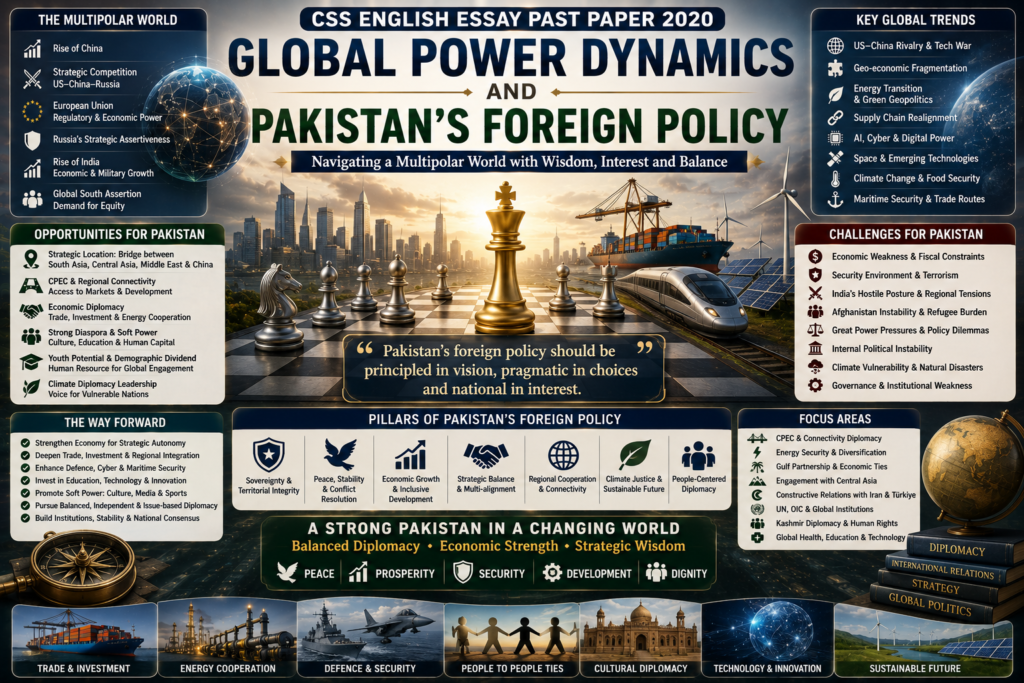
Global power dynamics and Pakistan’s foreign policy is one of the most important themes in Pakistan’s strategic, diplomatic and economic thought. Foreign policy is never made in a vacuum. It is shaped by geography, history, economy, ideology, security, leadership, public opinion and, above all, the changing structure of global power. When the world is bipolar, states align differently. When the world is unipolar, weaker states adjust differently. When the world becomes multipolar, middle and developing powers search for balance, autonomy and opportunity. Pakistan’s foreign policy has always reflected this reality. From the Cold War alliances to the Afghan jihad, from post-9/11 cooperation with the United States to the rise of China and CPEC, from Kashmir diplomacy to climate justice, Pakistan’s external choices have been deeply connected with global power shifts.
The contemporary world is passing through a major transformation. The post-Cold War period of American dominance is weakening, while China is rising as an economic, technological and strategic power. Russia has reasserted itself militarily, especially through the Ukraine war. The European Union remains important in trade, regulation and climate policy, but it faces security and political pressures. India is growing as a major economy and strategic partner of the West. The Gulf states are becoming more assertive through investment, energy diplomacy and regional mediation. The Global South is demanding more voice in global governance. BRICS expansion, de-dollarization debates, energy politics, artificial intelligence competition, climate finance, maritime security and supply-chain restructuring are all reshaping the global order.
For Pakistan, these changes create both opportunities and dangers. Pakistan is located at the crossroads of South Asia, Central Asia, China, Afghanistan, Iran, the Arabian Sea and the Middle East. It is a nuclear state, a major Muslim country, a neighbour of China and India, a long-time partner of the United States, a country deeply affected by Afghanistan, a recipient of Gulf remittances and investment, and a climate-vulnerable developing state. Its geography gives it importance, but its economic weakness limits its diplomatic freedom. Its nuclear capability gives it security relevance, but its fiscal dependence restricts strategic autonomy. Therefore, Pakistan’s foreign policy must be realistic, balanced, economically grounded and diplomatically agile.
The topic Global power dynamics and Pakistan’s foreign policy demands a serious understanding of the link between external pressure and internal capacity. A country cannot pursue an independent foreign policy with a dependent economy. It cannot claim regional leadership without political stability. It cannot benefit from CPEC without security and industrial productivity. It cannot balance the United States and China without diplomatic skill. It cannot defend Kashmir effectively without national credibility. It cannot demand climate justice without improving domestic disaster governance. Bellum Report’s essay on Global Politics and International Relations is directly connected with this topic because Pakistan’s foreign policy must be read within the changing world order.
Bellum Report’s essay on CPEC and Indo–Middle East–Europe New War Fronts also supports this discussion because economic corridors have become tools of geopolitical competition. Ports, roads, energy routes, digital infrastructure and maritime chokepoints are no longer only commercial assets; they are strategic instruments. Similarly, Bellum Report’s essay on Pathways to Pakistan’s Prosperity shows that foreign policy must ultimately serve national development. Diplomacy that does not improve security, trade, investment, climate resilience and human development remains incomplete.
Central Argument: Global power dynamics and Pakistan’s foreign policy are linked through a changing international system marked by multipolarity, US-China rivalry, regional conflicts, economic fragmentation, climate insecurity and technological competition. Pakistan must avoid emotional, reactive and bloc-based foreign policy. It should pursue pragmatic, balanced, interest-based diplomacy by strengthening ties with China without alienating the United States, improving regional stability without compromising national security, using CPEC for industrial growth, maintaining strategic deterrence against India, engaging Afghanistan through security and trade, deepening Gulf economic partnerships, promoting climate diplomacy, and strengthening domestic economic capacity as the foundation of external autonomy.
Show Table of Contents
- Introduction
- CSS Essay Outline
- Thesis Statement
- Quotable Lines for CSS Essay
- Meaning of Global Power Dynamics
- Evolution of Global Power and Pakistan’s Foreign Policy
- Current Global Power Dynamics
- Pakistan’s Strategic Position
- China, CPEC and Pakistan’s Strategic Choices
- United States and Pakistan’s Balancing Challenge
- India Factor in Pakistan’s Foreign Policy
- Afghanistan and Regional Security
- Gulf, Iran and Middle East Diplomacy
- Economic Diplomacy and Strategic Autonomy
- Climate Diplomacy and Global Justice
- Technology, AI and Future Power Politics
- Counterargument
- Way Forward
- Conclusion
- FAQs
- Authentic References
Introduction
Global power dynamics and Pakistan’s foreign policy is a topic that explains how the shifting balance of power in the world influences Pakistan’s diplomatic choices. Foreign policy is the method through which a state protects its sovereignty, security, economy, ideology and international standing. But the options available to any state depend on the global environment. A powerful country may shape the environment; a weaker or middle power must adapt to it wisely. Pakistan belongs to the second category. It is important enough to matter, but not strong enough to ignore global pressures. Therefore, Pakistan’s foreign policy must combine principle with pragmatism.
Pakistan’s foreign policy has historically been shaped by external alignments and internal needs. In the early decades, Pakistan joined Western-led alliances partly because of security concerns against India and partly because of economic and military needs. During the Cold War, Pakistan’s location made it valuable to the United States. During the Afghan jihad, Pakistan became a frontline state. After 9/11, Pakistan again became central to US security strategy in Afghanistan. In the twenty-first century, China’s rise and CPEC made Pakistan an important partner in Beijing’s regional connectivity strategy. These phases show that Pakistan’s foreign policy has always responded to global power dynamics.
However, the world of 2026 is more complicated than the Cold War. The old bipolar structure has not returned exactly, and the unipolar moment has weakened. The world is moving toward contested multipolarity. The United States remains the strongest military and technological power, but China has become a major economic and strategic competitor. Russia challenges Western security assumptions. India is rising and is increasingly courted by the West as a counterweight to China. The Gulf states are diversifying beyond oil and investing globally. The Global South seeks autonomy. International institutions are under pressure. Military spending is rising. Trade and investment are increasingly affected by security concerns. Climate change has become a diplomatic and security issue.
For Pakistan, this new environment is full of delicate choices. Pakistan cannot afford to choose complete alignment with one bloc against another. Its relationship with China is strategic and central, especially due to CPEC, defence cooperation and diplomatic support. Its relationship with the United States remains important for finance, technology, education, trade, diaspora, security and international institutions. Its relations with the Gulf are crucial for remittances, energy and investment. Its relationship with Iran requires balance because of geography, energy and regional security. Its relations with Afghanistan affect internal security. Its rivalry with India remains the core security challenge. Therefore, Pakistan’s foreign policy must be multi-vector and interest-based.
This essay argues that Pakistan’s foreign policy should not be guided by slogans, emotions or dependency. It must be guided by national interest, economic strength, regional peace, strategic deterrence, diplomatic balance and internal reform. In a changing world order, the best foreign policy is not loud; it is effective. It does not merely declare independence; it builds the economic capacity that makes independence possible.
CSS Essay Outline: Global Power Dynamics and Pakistan’s Foreign Policy
- Introduction: Pakistan’s foreign policy in a changing world order
- Meaning of global power dynamics
- Foreign policy as protection of national interest
- Pakistan’s strategic geography and historical vulnerability
- Cold War bipolarity and Pakistan’s Western alignment
- Afghan jihad and frontline-state diplomacy
- Post-9/11 era and security-based Pakistan-US relations
- Rise of China and transformation of Pakistan’s strategic outlook
- Transition from unipolarity to contested multipolarity
- US-China rivalry and Pakistan’s balancing challenge
- Russia’s resurgence and changing Eurasian security
- India’s rise and its strategic partnership with the West
- CPEC, BRI and Pakistan’s geo-economic opportunity
- Afghanistan and Pakistan’s security dilemma
- Iran, Gulf and Middle East balancing
- Kashmir issue and India-Pakistan rivalry
- Nuclear deterrence and strategic stability in South Asia
- Economic fragility as Pakistan’s diplomatic constraint
- IMF, World Bank and external financing in foreign policy
- Climate change and Pakistan’s climate diplomacy
- Technology, AI and cyber power in foreign policy
- Global investment decline and Pakistan’s economic diplomacy
- Global military spending and return of hard power
- Pakistan’s role in the Muslim world and OIC
- Pakistan’s participation in multilateral forums
- Counterargument: Pakistan should choose a clear bloc
- Rebuttal: Pakistan’s interests demand balanced and pragmatic diplomacy
- Way forward: economic strength as foundation of foreign policy
- Way forward: balanced relations with China, US, Gulf, Iran and Afghanistan
- Way forward: regional peace, climate diplomacy and technology readiness
- Conclusion: Pakistan must move from security-dependent diplomacy to geo-economic statecraft
Thesis Statement
Global power dynamics and Pakistan’s foreign policy are inseparable because Pakistan’s diplomatic choices are shaped by US-China rivalry, India’s rise, CPEC, Afghanistan’s instability, Gulf politics, climate insecurity, global economic fragmentation and technological competition; therefore, Pakistan must pursue balanced, pragmatic and economically grounded foreign policy rather than emotional alignment or strategic dependency.
Quotable Lines for CSS Essay
The following quotes and essay-ready lines can be used in a CSS essay on Global power dynamics and Pakistan’s foreign policy:
“There are no permanent friends or enemies, only permanent interests.” — Commonly attributed to Lord Palmerston
“The foreign policy of Pakistan is primarily directed to the pursuit of national goals of seeking peace and stability through international cooperation.” — Ministry of Foreign Affairs, Pakistan
“Geography is destiny.” — Commonly attributed to Napoleon Bonaparte
“Diplomacy is the management of international relations by negotiation.” — Traditional definition
“A weak economy makes foreign policy dependent; a strong economy makes foreign policy sovereign.” — Essay line
“Pakistan’s geography is an asset only when supported by governance, economy and stability.” — Essay line
“In a multipolar world, wisdom lies not in choosing enemies but in multiplying options.” — Essay line
“CPEC gives Pakistan connectivity, but only productivity can turn connectivity into power.” — Essay line
“Pakistan cannot balance global powers abroad while remaining internally unstable at home.” — Essay line
“Foreign policy begins at the border, but its strength begins inside the economy.” — Essay line
Meaning of Global Power Dynamics
Global power dynamics mean the changing distribution of power among states and international actors. Power may be military, economic, technological, diplomatic, cultural, financial or institutional. In the past, power was often measured mainly through armies and territory. Today, power also includes trade networks, currencies, technology, data, artificial intelligence, supply chains, energy routes, ports, satellites, media narratives, climate finance and international law. A state may be militarily strong but economically dependent; another may be economically influential but militarily cautious. Therefore, global power dynamics are multi-dimensional.
Foreign policy is the strategy through which a state responds to these dynamics. A country’s foreign policy seeks security, prosperity, sovereignty, international recognition and influence. For a developing country like Pakistan, foreign policy must also attract investment, secure energy, protect exports, gain climate finance, manage debt, strengthen defence, support diaspora communities and maintain regional stability.
Pakistan’s foreign policy is shaped by three major realities. First, Pakistan is located in a strategically sensitive region. It borders India, China, Afghanistan and Iran and has access to the Arabian Sea. Second, Pakistan is a nuclear state facing a larger rival, India. Third, Pakistan has a fragile economy that depends on imports, remittances, external financing and international markets. These realities make Pakistan geopolitically important but economically constrained.
Global power dynamics affect Pakistan in many ways. US-China rivalry affects Pakistan’s choices between strategic partnership with China and engagement with the United States. India’s rise affects Pakistan’s security and Kashmir diplomacy. Afghanistan’s instability affects terrorism, refugees and regional connectivity. Gulf politics affect remittances, energy and investment. Global climate negotiations affect Pakistan’s disaster recovery and adaptation financing. Technology competition affects Pakistan’s digital future. Therefore, Pakistan’s foreign policy must be multidimensional, not limited to traditional security.
Evolution of Global Power and Pakistan’s Foreign Policy
1. Early Cold War and Pakistan’s Western Alignment
After independence, Pakistan faced serious security and economic challenges. The unresolved Kashmir dispute and India’s larger size shaped Pakistan’s strategic thinking. In the Cold War environment, Pakistan aligned with the Western bloc and joined security arrangements such as SEATO and CENTO. The purpose was to gain military and economic assistance and balance India.
This alignment gave Pakistan resources and international relevance, but it also created dependency. Pakistan’s foreign policy became tied to external power politics. The lesson from this period is clear: alliances can provide short-term support, but overdependence can reduce autonomy.
2. Afghan Jihad and Frontline-State Diplomacy
The Soviet invasion of Afghanistan in 1979 transformed Pakistan’s role. Pakistan became a frontline state for the United States, Saudi Arabia and Western-backed resistance against Soviet forces. This gave Pakistan strategic importance, financial assistance and military support. However, it also brought long-term consequences: militancy, weapons, refugees, extremism and internal security challenges.
The Afghan jihad shows how global power struggles can deeply affect domestic society. Pakistan gained strategic relevance, but it also inherited instability. Foreign policy must therefore consider long-term internal consequences, not only short-term geopolitical gains.
3. Post-9/11 Security Partnership with the United States
After the September 11 attacks, Pakistan again became central to US policy in Afghanistan. It joined the US-led war on terror and received aid and security cooperation. Yet this partnership remained troubled by mistrust, drone strikes, terrorism, domestic backlash and differing objectives in Afghanistan. Pakistan suffered enormous human, economic and security costs from terrorism.
This phase reinforced a major lesson: Pakistan should avoid becoming a single-issue security state for global powers. A foreign policy based only on security cooperation cannot produce sustainable development. Pakistan needs economic diplomacy, trade, technology and education partnerships, not only strategic transactions.
4. Rise of China and CPEC
China’s rise has transformed Pakistan’s foreign policy. Pakistan-China relations were already strong, but CPEC gave them a major economic and connectivity dimension. Pakistan’s Ministry of Foreign Affairs describes CPEC as the cornerstone of Pakistan-China All-Weather Strategic Cooperative Partnership. CPEC includes energy, transport infrastructure, Gwadar, industrial cooperation and regional connectivity.
CPEC offers Pakistan an opportunity to move from geopolitics to geo-economics. But this opportunity depends on Pakistan’s ability to ensure security, transparency, industrial productivity, local employment, export growth and debt management. Connectivity without competitiveness will not transform Pakistan.
5. From Unipolarity to Multipolarity
After the Cold War, the United States dominated global politics. However, the world is now more multipolar. China’s economic rise, Russia’s military assertiveness, India’s growth, Gulf states’ strategic activism and Global South diplomacy have created a more complex order. This gives Pakistan more diplomatic options, but also more pressure.
In a multipolar world, Pakistan should not think in old Cold War terms. It must avoid becoming a camp follower. It should build issue-based partnerships: China for infrastructure and strategic cooperation, the United States for trade, technology and education, the Gulf for investment and energy, Europe for exports and climate cooperation, Central Asia for connectivity, and the Muslim world for diplomatic solidarity.
Current Global Power Dynamics
1. US-China Rivalry
The most important global power dynamic today is the rivalry between the United States and China. This rivalry includes trade, technology, military influence, maritime routes, artificial intelligence, semiconductors, supply chains, universities, diplomacy and global institutions. The United States wants to preserve its leadership. China wants greater space, recognition and influence. This rivalry affects almost every region.
Pakistan is directly affected because China is Pakistan’s closest strategic partner, while the United States remains a major global power with influence in international finance, technology, education and diplomacy. Pakistan cannot afford hostility with either. It must maintain strategic depth with China and functional engagement with the United States.
2. Return of Hard Power
The world is witnessing a return of hard power. SIPRI reported that global military spending reached about US$2.89 trillion in 2025, marking continued growth in defence expenditure. This shows that states are preparing for a more uncertain and militarized world. The Russia-Ukraine war, tensions in the Indo-Pacific, Middle East conflicts and nuclear modernization all reinforce this trend.
For Pakistan, this means defence preparedness remains necessary. Pakistan cannot ignore hard security because it faces India, terrorism risks and regional instability. However, excessive security focus without economic growth can weaken national power. The challenge is to maintain deterrence while building human and economic security.
3. Economic Fragmentation
Globalization is changing. Trade continues, but countries are increasingly concerned about security, supply chains, sanctions, tariffs, critical minerals and technology dependence. UNCTAD reported that global FDI fell by 11 percent in 2024, showing pressure on productive investment. Developing countries face a tougher environment for attracting capital.
This affects Pakistan because Pakistan needs investment, exports and technology transfer. Economic diplomacy must become central. Pakistan cannot rely only on loans and remittances. It must become an attractive destination for productive investment through stability, policy consistency, energy reform, tax rationalization and skilled labour.
4. Rise of India
India’s rise is a major factor in global and regional power politics. India is increasingly seen by the United States and other Western powers as an economic partner and strategic counterweight to China. This changes South Asian dynamics. India’s global influence strengthens its diplomatic position, while Pakistan must work harder to present its case on Kashmir, strategic stability and regional peace.
Pakistan must understand that India’s rise cannot be countered by rhetoric alone. Pakistan needs economic strength, political stability, technology, exports, education and international credibility. A weak Pakistan cannot balance a rising India effectively.
5. Middle East Transformation
The Middle East is changing. Gulf states are diversifying economies, investing globally, normalizing or recalibrating regional relations, and becoming more active diplomatic players. Iran remains central to regional security, energy and sectarian balance. The Red Sea, Strait of Hormuz, Gaza, Yemen and energy markets show that Middle East politics affects global stability.
Pakistan depends on Gulf remittances, energy imports and investment. It also shares a border with Iran and has a large Shia population. Therefore, Pakistan must maintain balanced Middle East diplomacy. Bellum Report’s essay on Pakistan Saudi Iran Relations explains why Pakistan must avoid sectarian alignment and pursue balanced national interest.
6. Climate Change as Power Politics
Climate change has become part of global power dynamics. Developed countries hold more finance and technology, while developing countries face heavier climate impacts. Pakistan is highly vulnerable to floods, heatwaves, glacier melt and water stress. Climate diplomacy is therefore a foreign policy priority.
Pakistan must argue for climate justice, adaptation finance and loss-and-damage support. But it must also improve domestic climate governance. Bellum Report’s essay on Climate Change, Floods and Disaster Governance is directly relevant because external climate diplomacy becomes stronger when domestic disaster management is credible.
Pakistan’s Strategic Position
Pakistan’s foreign policy begins with geography. Pakistan connects South Asia with Central Asia, China, the Middle East and the Arabian Sea. This location can make Pakistan a bridge for trade, energy and connectivity. But geography can also make Pakistan vulnerable to conflict, militancy, refugee flows and great-power competition. Therefore, geography is an asset only when supported by stability, governance and economic capacity.
Pakistan’s nuclear capability gives it strategic deterrence against India. However, nuclear weapons cannot solve economic weakness, climate vulnerability or governance problems. Strategic power must be supported by economic power. A nuclear state with fiscal fragility cannot fully convert security into influence.
Pakistan’s Muslim identity also gives it relevance in the Muslim world. It can speak on Palestine, Islamophobia, Kashmir, interfaith understanding and Muslim-world cooperation. However, moral diplomacy requires internal credibility. Pakistan must protect minorities, improve governance and maintain social harmony at home to strengthen its voice abroad.
Pakistan’s diaspora is another asset. Millions of Pakistanis live in the Gulf, Europe, North America and elsewhere. They send remittances, create networks and shape Pakistan’s image. Diaspora diplomacy should be treated as a foreign policy instrument, not merely a remittance source.
Pakistan’s biggest limitation is economic fragility. Frequent IMF dependence, low exports, narrow tax base, energy debt and political instability reduce diplomatic freedom. A country negotiating from financial weakness has limited leverage. Therefore, economic reform is foreign policy reform.
China, CPEC and Pakistan’s Strategic Choices
China is central to Pakistan’s foreign policy. The relationship is built on defence cooperation, diplomatic support, economic partnership, CPEC and strategic convergence. China has supported Pakistan on major international issues, while Pakistan supports China’s core interests. CPEC is the most visible symbol of this relationship.
CPEC offers Pakistan three major opportunities. First, it improves infrastructure and energy supply. Second, it can support industrialization through special economic zones. Third, it can transform Pakistan into a regional connectivity hub through Gwadar and land routes. However, these opportunities are not automatic. Pakistan must ensure security for Chinese workers, reduce bureaucratic delays, improve project transparency, expand local participation, increase exports and use infrastructure for production.
The greatest danger is treating CPEC only as a construction project. CPEC should be treated as an industrial and export strategy. Roads and ports create potential, but factories, skills, logistics and trade policies convert potential into growth. If Pakistan uses CPEC only for imports, it will increase dependency. If it uses CPEC for production and exports, it can build power.
Pakistan must also manage CPEC in the context of US-China rivalry. The United States views China’s Belt and Road Initiative with strategic concern. India opposes CPEC because it passes through disputed territory and because it strengthens Pakistan-China connectivity. Therefore, Pakistan must defend CPEC as an economic development project while ensuring it does not isolate Pakistan from other partners.
United States and Pakistan’s Balancing Challenge
Pakistan’s relationship with the United States has passed through cycles of cooperation and mistrust. The United States has been important for Pakistan’s military modernization, economic assistance, education, diaspora, trade, technology and international financial institutions. However, the relationship has often been security-centered, especially due to Afghanistan and counterterrorism.
In the current era, Pakistan should broaden relations with the United States beyond security. Areas such as trade, IT, education, climate, health, agriculture, clean energy and investment can create a more stable relationship. Pakistan’s Ministry of Foreign Affairs describes relations with the United States as an important element of foreign policy and a broad-based, positive and forward-looking relationship. This language should be converted into practical economic cooperation.
At the same time, Pakistan must manage US concerns about China, nuclear issues, democracy, human rights and regional security. Pakistan should not allow any relationship to become zero-sum. It should communicate clearly that its partnership with China is not hostility toward the United States. Similarly, engagement with the United States should not weaken its strategic partnership with China.
The art of Pakistan’s foreign policy lies in balance. Balance does not mean equal distance from all powers. It means maximizing national interest while avoiding unnecessary confrontation. Pakistan should avoid becoming either an anti-China outpost or an anti-US slogan state. It should be a sovereign state with multiple partnerships.
India Factor in Pakistan’s Foreign Policy
India remains the central security factor in Pakistan’s foreign policy. The unresolved Kashmir dispute, military imbalance, water concerns, cross-border accusations, political nationalism and nuclear deterrence define South Asian instability. India’s growing global influence increases Pakistan’s diplomatic challenge.
Pakistan must maintain credible deterrence because peace without security is fragile. However, deterrence alone is not foreign policy. Pakistan should also pursue diplomatic engagement where possible, crisis communication, regional trade possibilities, people-to-people contact and international advocacy on Kashmir. War between nuclear neighbours would be disastrous.
India’s rise also means Pakistan must compete in economic and diplomatic terms. The world listens more carefully to countries with strong economies and stable institutions. Therefore, Pakistan’s India policy should include internal strengthening. Better exports, better universities, better governance and better investment climate are also tools of strategic competition.
Kashmir remains a moral, legal and diplomatic issue for Pakistan. Pakistan should continue to support the rights of Kashmiris through international law, human rights language and diplomatic forums. However, effective Kashmir diplomacy requires consistency, credibility and international engagement, not only domestic slogans.
Afghanistan and Regional Security
Afghanistan is one of the most sensitive issues in Pakistan’s foreign policy. Pakistan shares a long border with Afghanistan and has been affected by Afghan wars for decades. Refugees, terrorism, border management, trade, smuggling, militancy and regional connectivity all connect Pakistan’s stability with Afghanistan.
Pakistan’s policy toward Afghanistan must be realistic. It should combine security concerns with humanitarian responsibility and economic engagement. Pakistan cannot ignore terrorism threats from Afghan soil. At the same time, instability in Afghanistan harms Pakistan. A peaceful Afghanistan can open routes to Central Asia and reduce refugee and militancy pressures.
Pakistan should work with China, Central Asian states, Iran, Türkiye, Qatar and international organizations to encourage stability, counterterrorism cooperation and economic connectivity. However, Pakistan must also strengthen border management and internal security. Good foreign policy cannot substitute for strong domestic counterterrorism capacity.
Afghanistan also tests Pakistan’s image. Refugee management should be lawful, humane and orderly. Harsh or chaotic policies can damage Pakistan’s international standing. Security and dignity must go together.
Gulf, Iran and Middle East Diplomacy
The Gulf region is vital for Pakistan. Millions of Pakistani workers live in Saudi Arabia, the UAE, Qatar, Kuwait, Oman and Bahrain. Their remittances support Pakistan’s economy. Gulf countries are also important for oil, gas, investment, defence cooperation and religious ties. Pakistan cannot afford weak relations with the Gulf.
At the same time, Iran is Pakistan’s neighbour. Pakistan shares border, energy interests, security concerns and cultural-religious links with Iran. Tensions between Iran and Gulf states, or between Iran and the United States, create difficult choices for Pakistan. Pakistan should avoid becoming a party to regional rivalries. It should support dialogue, de-escalation and regional stability.
Energy security is also part of foreign policy. Pakistan depends heavily on imported energy, and disruptions in the Strait of Hormuz can affect its economy. Recent reporting has highlighted Pakistan’s vulnerability because a large share of its oil and LNG imports passes through Hormuz. This shows that Pakistan’s foreign policy must include strategic reserves, diversified energy sources, regional diplomacy and renewable energy transition.
Pakistan’s Middle East policy should be balanced, not sectarian. It should protect relations with Saudi Arabia and the Gulf while maintaining respectful ties with Iran. It should support Palestine diplomatically, avoid military entanglements, and use its position as a Muslim nuclear state responsibly.
Economic Diplomacy and Strategic Autonomy
Economic diplomacy is now the heart of modern foreign policy. Pakistan’s Ministry of Foreign Affairs itself emphasizes economic diplomacy to take advantage of globalization and face twenty-first-century challenges. This is essential because Pakistan’s diplomatic autonomy is limited by economic dependence. A country that repeatedly faces balance-of-payments crises cannot make fully independent choices.
The World Bank projected Pakistan’s current account surplus at 0.2 percent of GDP in FY25, the first annual surplus in 15 years, driven by stronger worker remittances. This was positive, but the same analysis warned that deficits could return as growth and imports rise. This shows the structural problem: Pakistan’s external stability often depends on remittances, import compression and financing rather than strong exports.
Pakistan must therefore use foreign policy to support exports, investment, technology transfer, market access and diaspora networks. Embassies should not only issue visas and attend ceremonies; they should promote trade, find investors, support exporters, help students, connect technology firms and improve Pakistan’s brand.
UNCTAD’s report that global FDI fell by 11 percent in 2024 shows that attracting investment is becoming harder. Pakistan must compete seriously. Investors need political stability, contract enforcement, tax clarity, energy reliability, security and skilled labour. Without domestic reform, foreign policy cannot attract investment.
Bellum Report’s essay on Globalization of Markets is relevant because Pakistan must become a producer in global markets, not merely a consumer of imported goods. Foreign policy should support export-led growth.
Climate Diplomacy and Global Justice
Climate change has become a major foreign policy issue for Pakistan. Pakistan contributes a small share to global greenhouse gas emissions but suffers heavily from floods, heatwaves, glacial melt, droughts and water stress. Therefore, climate justice is central to Pakistan’s diplomacy.
Pakistan should demand climate finance, adaptation support, loss-and-damage funding, technology transfer and debt relief linked with climate resilience. But Pakistan must also improve its own climate governance. International partners are more likely to support countries that present credible plans, transparent projects and measurable outcomes.
Climate diplomacy should connect with agriculture, water, disaster management, renewable energy, urban planning and public health. Pakistan’s embassies should promote green investment and climate partnerships. The country should participate actively in COP negotiations, UN forums, World Bank climate initiatives and regional water dialogue.
Bellum Report’s essay on Climate Change, Floods and Disaster Governance is relevant because external climate diplomacy and internal disaster governance must support each other. Pakistan cannot build climate credibility abroad without resilience at home.
Technology, AI and Future Power Politics
Technology has become a major source of global power. Artificial intelligence, semiconductors, cyber security, satellites, drones, data centres, biotechnology, digital currencies and quantum computing are shaping international relations. Countries that control technology will shape markets, militaries and narratives.
Pakistan’s foreign policy must include technology diplomacy. It should seek partnerships in AI, IT exports, cybersecurity, digital education, semiconductor training, cloud infrastructure, fintech, health technology and agricultural technology. This requires engagement with China, the United States, Gulf investors, Europe, Türkiye, South Korea and other technology hubs.
Pakistan’s youth can benefit from digital globalization, freelancing and IT services. But without education reform and digital skills, Pakistan may remain a technology consumer rather than a technology producer. Bellum Report’s essay on Imagination Is More Important Than Knowledge connects with this challenge because future power will belong to societies that innovate, not merely import.
Cybersecurity is also important. State institutions, banks, energy systems, defence networks and elections can be targeted through cyber means. Foreign policy must therefore include cyber norms, digital sovereignty and data protection. A country that ignores technology will be weak in future diplomacy.
Counterargument
Some argue that Pakistan should choose a clear bloc in global politics. According to this view, Pakistan should fully align with China because China is a reliable strategic partner, CPEC is central to development, and the United States has historically used Pakistan for security purposes and then abandoned it. Others argue the opposite: Pakistan should move closer to the United States and the West because they control advanced technology, finance, education, global institutions and major export markets. Both arguments claim that ambiguity weakens foreign policy.
These arguments have partial truth. China is indeed Pakistan’s closest strategic partner and has supported Pakistan in difficult times. The United States and Western markets are also important for trade, technology, education and international finance. Pakistan cannot ignore either side. But the conclusion that Pakistan must choose one bloc is dangerous.
Pakistan’s interests are too diverse for one-sided alignment. It needs China for strategic partnership and CPEC. It needs the United States for economic, technological and diplomatic engagement. It needs the Gulf for energy, investment and remittances. It needs Europe for exports and climate cooperation. It needs Afghanistan for security and connectivity. It needs Iran for neighbourly stability. It needs multilateral institutions for finance and legitimacy.
Therefore, Pakistan should not follow emotional bloc politics. It should follow issue-based diplomacy. The world is multipolar, and smart states diversify partnerships. Strategic clarity does not mean diplomatic rigidity. Pakistan’s clarity should be about national interest, not permanent hostility toward any major power.
Way Forward
1. Make Economic Strength the Foundation of Foreign Policy
Pakistan must understand that economic weakness is the greatest limitation on foreign policy. Tax reform, export growth, energy reform, industrial productivity, investment climate and human capital are not only domestic issues; they are diplomatic assets. A stronger economy creates stronger foreign policy.
2. Pursue Balanced Relations with China and the United States
Pakistan should deepen strategic and economic cooperation with China while maintaining constructive engagement with the United States. It should avoid presenting one relationship as hostility toward the other. Balance requires professional diplomacy, not slogans.
3. Convert CPEC into Industrial Growth
CPEC should move beyond infrastructure toward industrialization, exports, technology transfer, local employment and regional trade. Special economic zones must become productive. Gwadar should become a real economic hub, not only a symbol.
4. Strengthen Regional Peace Without Weakening Security
Pakistan should maintain credible deterrence against India while supporting crisis communication and dialogue where possible. Peace in South Asia is necessary for development, but peace must be based on dignity, justice and security.
5. Develop a Realistic Afghanistan Policy
Pakistan should combine border security, counterterrorism, trade, humanitarian responsibility and regional diplomacy in Afghanistan. It should work with neighbours and international partners to reduce instability.
6. Maintain Balanced Middle East Diplomacy
Pakistan should protect strong ties with Saudi Arabia and the Gulf while maintaining stable relations with Iran. It should avoid sectarian alignment and support de-escalation in the region.
7. Strengthen Climate Diplomacy
Pakistan should lead climate-vulnerable countries in demanding adaptation finance, loss-and-damage support and technology transfer. It must also present credible domestic climate projects.
8. Professionalize Economic Diplomacy
Pakistan’s missions abroad should be evaluated partly on trade, investment, export promotion, diaspora engagement, tourism and technology partnerships. Diplomacy must serve economic recovery.
9. Invest in Technology Diplomacy
Pakistan should build partnerships in AI, cybersecurity, digital skills, IT exports, agri-tech and clean energy. Future power will depend heavily on technology.
10. Use Multilateral Forums Effectively
Pakistan should strengthen its role in the UN, OIC, SCO, ECO, IMF, World Bank, WTO and climate forums. Multilateral diplomacy helps middle powers protect interests through coalitions and rules.
11. Improve National Image Through Soft Power
Pakistan should promote culture, tourism, education, sports, diaspora success, Sufi heritage, Islamic scholarship, mountain tourism and creative industries. Foreign policy is also about perception.
12. Build Internal Political Stability
No foreign policy can succeed without domestic stability. Political polarization weakens Pakistan’s credibility. Internal consensus on core foreign policy issues is essential.
13. Reform Education for Strategic Capacity
Pakistan needs diplomats, economists, language experts, climate negotiators, technology specialists, regional experts and trade lawyers. Bellum Report’s essay on Meaning Purposive Education is relevant because foreign policy requires skilled human capital.
14. Protect Sovereignty Through Competence
Sovereignty is not protected by slogans alone. It is protected by economic resilience, strong institutions, credible defence, social unity, technological capacity and diplomatic professionalism.
Conclusion
In conclusion, Global power dynamics and Pakistan’s foreign policy are deeply interconnected. Pakistan’s foreign policy has always been shaped by the global order: Cold War bipolarity, Afghan wars, post-9/11 security politics, China’s rise, CPEC, India’s growing influence, Middle East instability, climate change and economic globalization. Today, the world is moving toward contested multipolarity where power is military, economic, technological, financial and narrative-based.
Pakistan faces a difficult but manageable diplomatic environment. It must balance China and the United States, manage rivalry with India, stabilize relations with Afghanistan, maintain Gulf and Iran balance, promote CPEC, seek climate justice, attract investment and strengthen multilateral engagement. But none of this can succeed without internal strength. The foundation of foreign policy is domestic capacity.
Pakistan should avoid emotional foreign policy, dependency politics and bloc-based thinking. It should pursue pragmatic, multi-vector diplomacy based on national interest. It should become a bridge, not a battlefield; a producer, not merely a consumer; a connector, not a proxy; and a responsible nuclear state with economic ambition.
Ultimately, Pakistan’s future foreign policy must shift from security dependency to geo-economic statecraft. Its diplomacy should protect sovereignty, support development, promote peace, attract investment, defend Kashmir, manage climate vulnerability and build technological readiness. In a changing world order, Pakistan’s best foreign policy will be one that combines strategic realism with economic reform and national self-confidence.
FAQs
1. What does Global power dynamics and Pakistan’s foreign policy mean?
Global power dynamics and Pakistan’s foreign policy means the study of how changing global power structures, such as US-China rivalry, multipolarity, India’s rise, CPEC, Afghanistan, Gulf politics and economic fragmentation, shape Pakistan’s diplomatic choices.
2. Why is Pakistan important in global power politics?
Pakistan is important because of its strategic location, nuclear capability, partnership with China, proximity to Afghanistan and Iran, access to the Arabian Sea, Muslim-world identity, diaspora and role in South Asian security.
3. What is Pakistan’s biggest foreign policy challenge today?
Pakistan’s biggest foreign policy challenge is balancing strategic relations with China, functional engagement with the United States, rivalry with India, instability in Afghanistan, Gulf-Iran tensions, climate vulnerability and economic dependence.
4. How does CPEC affect Pakistan’s foreign policy?
CPEC strengthens Pakistan-China relations and offers Pakistan connectivity, infrastructure and industrial opportunities. However, it also places Pakistan within broader US-China and regional power competition, requiring careful diplomacy.
5. What should Pakistan’s foreign policy focus on?
Pakistan’s foreign policy should focus on economic diplomacy, balanced relations with major powers, regional peace, credible deterrence, CPEC productivity, climate diplomacy, technology partnerships, investment, exports and domestic stability.
Authentic References
Pakistan Ministry of Foreign Affairs: Foreign Policy: Pakistan’s Ministry of Foreign Affairs states that Pakistan’s foreign policy seeks peace and stability through international cooperation and lays special emphasis on economic diplomacy. Source: Ministry of Foreign Affairs Pakistan: Foreign Policy.
Pakistan Ministry of Foreign Affairs: China: The Ministry describes CPEC as the cornerstone of Pakistan-China All-Weather Strategic Cooperative Partnership. Source: Ministry of Foreign Affairs Pakistan: China.
Pakistan Ministry of Foreign Affairs: United States: The Ministry describes Pakistan-US relations as an important element of Pakistan’s foreign policy and a broad-based, positive and forward-looking relationship. Source: Ministry of Foreign Affairs Pakistan: United States of America.
SIPRI Global Military Spending 2025: SIPRI reported that global military spending reached about US$2.89 trillion in 2025, reflecting a more militarized global environment. Source: Stockholm International Peace Research Institute.
World Bank Pakistan Development Update 2025: The World Bank projected Pakistan’s current account surplus at 0.2 percent of GDP in FY25, driven by stronger worker remittances, while warning of deficits in the medium term. Source: World Bank Pakistan Development Update April 2025.
UNCTAD World Investment Report 2025: UNCTAD reported that global foreign direct investment fell by 11 percent in 2024, posing challenges for developing countries. Source: UNCTAD World Investment Report 2025.
CPEC Official Portal: The official CPEC portal describes CPEC as a framework of regional connectivity with positive impact on Pakistan, China and the wider region. Source: China-Pakistan Economic Corridor Official Portal.
United Nations Charter: The UN Charter provides the international legal framework for sovereign equality, peaceful settlement of disputes and prohibition of threat or use of force. Source: United Nations Charter.
United Nations Climate Financing and Pakistan: UN Pakistan’s climate financing analysis discusses frameworks for securing global financing in line with Pakistan’s climate adaptation targets. Source: UN Pakistan Climate Financing and Policy Recommendations.
Follow educational updates: Salar Computer Academy on Facebook.
The Indus Odyssey from Debal to Islamabad
The Ultimate Guide to Pakistan Affairs (711-2025). A focused Kindle guide for CSS, PMS, PCS, PPSC and FPSC Pakistan Affairs preparation.