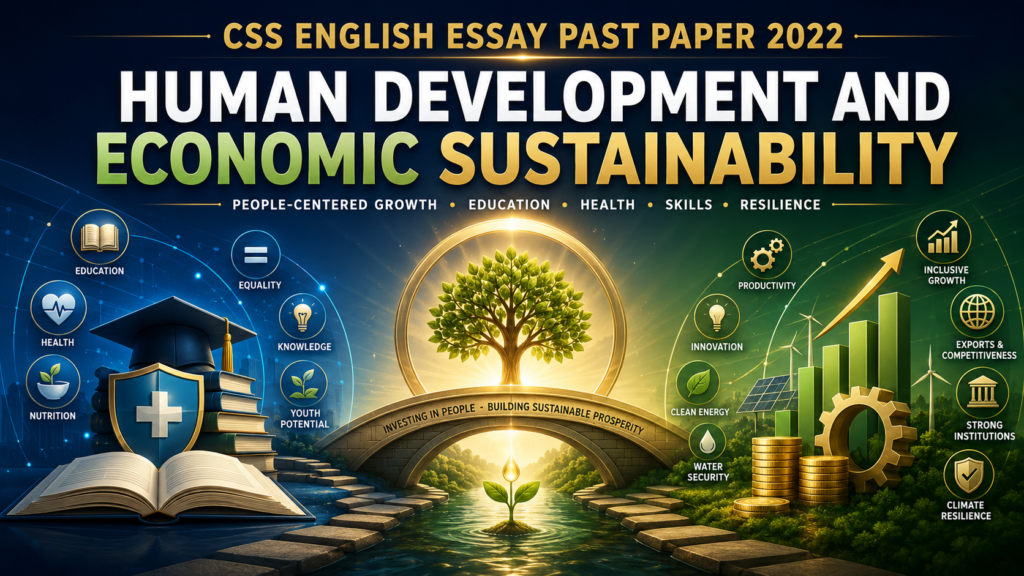
Human development and economic sustainability is not a decorative development phrase; it is the central question of survival for modern states. In the present world, countries are not judged only by the size of their GDP, the height of their buildings, the length of their motorways, or the volume of their exports. They are judged by the quality of life they provide to their citizens, the resilience of their economies, the strength of their institutions, the education of their youth, the health of their children, the dignity of their workers, the inclusion of women, the protection of the environment, and the ability to grow without destroying the future.
The world has learned a hard lesson: growth without people is hollow, and development without sustainability is self-destructive. A country may increase production, attract investment and build infrastructure, but if its children remain malnourished, its youth remain unskilled, its women remain excluded, its poor remain vulnerable, and its natural resources are exhausted, such growth cannot be called real development. Similarly, a country may spend on welfare, education and health, but if it fails to build a productive economy, stable public finance, energy security, climate resilience and export capacity, its human development becomes fiscally fragile. Therefore, Human development and economic sustainability must be understood together, not separately.
For Pakistan, this essay topic is not theoretical. Pakistan faces a double challenge: a human-development crisis and an economic-sustainability crisis. UNDP’s 2025 Human Development Report places Pakistan in the low human-development category, with a Human Development Index value of 0.544 and rank 168 out of 193 countries. World Bank material on Pakistan repeatedly links inclusive and sustainable development with building human capital, durable private-sector growth and resilience. UNICEF Pakistan highlights major challenges in child nutrition, while the World Bank’s learning-poverty data show that foundational learning remains a serious concern. These facts prove that Pakistan cannot treat education, health, nutrition and skills as social-sector leftovers after economic planning; they are the foundation of economic survival.
Bellum Report’s essay on Pathways to Pakistan’s Prosperity makes a related point: Pakistan’s prosperity cannot come from slogans, loans, temporary relief or elite consumption; it requires productivity, exports, education, institutional reform and policy continuity. This essay develops the same argument through the lens of Human development and economic sustainability. A society that fails to invest in its people cannot build a sustainable economy. An economy that fails to create jobs, protect the environment and distribute opportunities fairly cannot sustain human development.
In the present global scenario, the link between people and sustainability has become even stronger. Climate change is damaging agriculture, water security, housing and public health. Artificial intelligence is changing labour markets. Debt burdens are reducing fiscal space for education and health. Energy transitions are reshaping industry. Globalization is rewarding skilled economies and punishing weak ones. Bellum Report’s essay on Globalization and National Economies explains how global trade, energy routes, technology and supply chains affect national economies. The same logic applies here: only countries with skilled, healthy and resilient citizens can survive global economic shocks.
Central Argument: Human development and economic sustainability are mutually reinforcing. Human development provides educated, healthy, skilled and productive citizens; economic sustainability provides the stable income, institutions, environment and fiscal capacity needed to maintain that development. Pakistan must stop treating economic growth as a number and human welfare as charity. It must build a development model based on education, health, nutrition, women’s inclusion, youth employment, climate resilience, taxation reform, productive investment, exports, digital skills and institutional justice.
Show Table of Contents
- Introduction
- CSS Essay Outline
- Thesis Statement
- Quotable Lines for CSS Essay
- Meaning of Human Development
- Meaning of Economic Sustainability
- Relationship between Human Development and Economic Sustainability
- Current Global Context
- Pakistan’s Context
- Challenges for Pakistan
- Counterargument
- Way Forward
- Conclusion
- FAQs
- Authentic References
Introduction
Human development and economic sustainability are two sides of the same development coin. Human development means expanding people’s choices, capabilities and freedoms through education, health, nutrition, dignity, equality, employment and security. Economic sustainability means maintaining growth, productivity, public finance, natural resources, institutions and environmental balance in a way that does not destroy future prosperity. A country cannot achieve one without the other. Human development without economic sustainability becomes dependent on debt, aid and temporary welfare. Economic sustainability without human development becomes unjust, unequal and socially unstable.
The old idea that economic growth alone would automatically solve social problems has proved incomplete. Growth can reduce poverty, but only when it creates jobs, raises wages, improves public services and distributes opportunities. Otherwise, growth may benefit only elites. Similarly, welfare spending without productivity can create short-term relief but not long-term progress. The real development challenge is to build a society where growth improves human lives and human capability strengthens growth.
The modern world has widened the meaning of development. The United Nations 2030 Agenda recognizes sustainable development in three integrated dimensions: economic, social and environmental. This means that a nation cannot call itself developed if it grows economically while destroying the environment, excluding women, producing unemployed graduates, ignoring child nutrition, weakening public health and increasing inequality. A sustainable economy must be people-centered, inclusive and future-oriented.
Pakistan’s situation proves the urgency of this debate. The country has young people, agricultural potential, strategic geography, mineral resources, ports, a diaspora, a growing digital sector and a large domestic market. Yet it also faces low human development, learning poverty, child malnutrition, weak exports, debt pressure, energy problems, climate disasters, gender gaps and institutional instability. Bellum Report’s post on Youth Unemployment and Job Creation in Pakistan is directly connected with this essay because youth can become an economic asset only when they are educated, skilled, healthy and productively employed.
This essay argues that Human development and economic sustainability must be pursued together. Pakistan needs a development model that invests in people, protects the environment, raises productivity, expands exports, improves taxation, empowers women, creates jobs, strengthens institutions and builds climate resilience. Without human development, the economy remains weak. Without economic sustainability, human development remains fragile. True progress requires both.
CSS Essay Outline: Human Development and Economic Sustainability
- Introduction: Development as people-centered and future-oriented progress
- Meaning of human development
- Meaning of economic sustainability
- Human development as expansion of capabilities and freedoms
- Economic sustainability as productive, inclusive and resilient growth
- Why GDP alone cannot measure real development
- Relationship between education and productivity
- Health and nutrition as economic investments
- Women’s empowerment and sustainable growth
- Youth skills and job creation
- Climate resilience and economic stability
- Social protection as human security
- Human capital and export competitiveness
- Digital transformation and future work
- Good governance as the bridge between people and prosperity
- Global context: SDGs, climate change, AI and inequality
- Pakistan’s low human development ranking
- Pakistan’s learning poverty and education crisis
- Child malnutrition and stunting as economic losses
- Population growth and pressure on public services
- Youth unemployment and skills mismatch
- Gender inequality and exclusion of women from the economy
- Debt burden and limited fiscal space
- Energy crisis and unsustainable growth model
- Climate change, floods and disaster vulnerability
- Brain drain and loss of human capital
- Counterargument: economic growth should come first
- Rebuttal: growth without human development becomes unequal and unstable
- Policy recommendations for Pakistan
- Conclusion: Sustainable economies are built by developed human beings
Thesis Statement
Human development and economic sustainability are inseparable because education, health, nutrition, skills, equality and human dignity create productive citizens, while sustainable economic policies provide the fiscal, institutional and environmental capacity to maintain human progress; therefore, Pakistan must move from debt-led, consumption-led and elite-centered growth toward a people-centered, productive, inclusive and climate-resilient development model.
Quotable Lines for CSS Essay
The following quotes and essay-ready lines can be used in a CSS essay on Human development and economic sustainability:
“People are the real wealth of a nation.” — UNDP Human Development Report 1990
“The basic objective of development is to create an enabling environment for people to enjoy long, healthy and creative lives.” — UNDP Human Development Report 1990
“Sustainable development is development that meets the needs of the present without compromising the ability of future generations to meet their own needs.” — Brundtland Commission, Our Common Future
“We are committed to achieving sustainable development in its three dimensions — economic, social and environmental — in a balanced and integrated manner.” — UN 2030 Agenda
“Development is not the accumulation of wealth; it is the expansion of human capability.” — Essay line
“An economy that ignores its children mortgages its future.” — Essay line
“Human capital is not a social expense; it is the engine of sustainable growth.” — Essay line
“GDP may measure production, but human development measures whether production has improved life.” — Essay line
“A nation cannot borrow its way into sustainability; it must educate, produce and reform its way into it.” — Essay line
“Economic sustainability begins where short-term consumption gives way to long-term capability.” — Essay line
Meaning of Human Development
Human development is a people-centered concept of progress. It goes beyond income and measures whether people can live long, healthy, educated, secure and dignified lives. It asks whether citizens have access to schools, hospitals, clean water, nutritious food, jobs, justice, political participation and personal freedom. It shifts the focus of development from things to people. Roads, factories, buildings and exports are important, but they are means, not ends. The end of development is the improvement of human life.
The Human Development Index reflects this wider understanding. It includes life expectancy, education and income. This is important because a country may have income growth but weak education and health. Another country may have modest income but stronger social indicators. Therefore, human development reminds policymakers that economic success must be judged by its impact on human capability.
Human development includes several dimensions. First, it includes health. A malnourished child, a sick worker and an unhealthy mother cannot fully contribute to society. Second, it includes education. A person who cannot read, think and communicate remains excluded from modern economic life. Third, it includes skills. In the age of AI, digital platforms and global competition, unskilled labour is increasingly vulnerable. Fourth, it includes equality. Development is incomplete if women, minorities, rural communities and the poor are excluded. Fifth, it includes dignity and rights. People are not merely workers or consumers; they are citizens and human beings.
In Pakistan, human development must be treated as a national-security issue, not merely a welfare issue. A population that is unhealthy, uneducated and unemployed creates pressure on the economy, politics and society. It increases poverty, crime, extremism, migration pressure and social frustration. A population that is healthy, educated and skilled creates innovation, productivity, social stability and national resilience.
Meaning of Economic Sustainability
Economic sustainability means the ability of an economy to grow, generate jobs, maintain public services, protect natural resources, manage debt, raise revenue, absorb shocks and provide prosperity without damaging the future. It is not simply about high growth in one year. It is about growth that can continue without creating financial, social or environmental collapse.
An unsustainable economy may appear strong for a short period. It may grow through foreign loans, real-estate speculation, elite consumption, imported fuel, subsidies, tax exemptions and environmental destruction. But such growth eventually creates debt crises, inflation, inequality, unemployment and ecological damage. Sustainable growth, by contrast, is based on productivity, exports, innovation, taxation, energy efficiency, human capital and institutional quality.
Economic sustainability has at least five dimensions. The first is fiscal sustainability: the state must raise enough revenue to finance public services without endless borrowing. The second is productive sustainability: the economy must produce valuable goods and services rather than depend only on consumption. The third is environmental sustainability: growth must not destroy water, soil, forests, air and climate stability. The fourth is social sustainability: growth must reduce inequality and create opportunities. The fifth is institutional sustainability: policies must be stable, transparent and accountable.
Pakistan’s economy has often suffered because growth has been temporary and consumption-driven. Periods of expansion have been followed by balance-of-payments crises, IMF programmes, inflation, currency pressure and public-spending cuts. This cycle proves that economic sustainability cannot be achieved through short-term borrowing and imports. It requires investment in people and productivity.
Relationship between Human Development and Economic Sustainability
1. Education Creates Productivity
Education is the strongest bridge between human development and economic sustainability. An educated population can adopt technology, improve productivity, start businesses, participate in democracy and demand accountability. Education improves labour quality and allows economies to move from low-value work to high-value production.
Countries that invested in mass education were able to industrialize faster and compete globally. East Asian economies did not become strong merely because they built factories; they built human capital. They created disciplined, literate and skilled workers. Pakistan cannot compete in the twenty-first century with low literacy, weak science education, poor technical skills and rote learning.
Bellum Report’s essay on Instruction in Youth Is Like Engraving in Stone is relevant here because early education shapes lifelong learning. If foundational education is weak, later technical training becomes difficult. A child who cannot read properly cannot become a competitive worker in a digital economy. Therefore, education is not only a social service; it is an economic strategy.
2. Health and Nutrition Are Economic Investments
Health is also an economic issue. A sick population cannot build a strong economy. Malnutrition reduces physical growth, cognitive development and learning capacity. Poor health increases household poverty and reduces labour productivity. Public health crises can damage entire economies, as the COVID-19 pandemic proved.
UNICEF Pakistan notes that nearly 10 million Pakistani children suffer from stunting. Stunting is not only a medical problem; it is a development tragedy. It affects learning, productivity and future earnings. A child who suffers chronic malnutrition may never fully develop his cognitive and physical potential. Therefore, spending on nutrition is not charity; it is investment in future productivity.
Pakistan’s economic sustainability depends on improving maternal health, child nutrition, vaccination, clean water, sanitation and primary healthcare. A country cannot build a productive workforce if millions of children enter school with weak bodies and underdeveloped minds.
3. Women’s Inclusion Strengthens Sustainability
No economy can be sustainable while excluding half of its population. Women’s education, health, safety and economic participation are essential for human development and economic sustainability. Educated women improve child health, household income, family planning, education outcomes and social stability. When women work, economies expand their productive base.
Pakistan’s female labour-force participation remains low compared with its potential. Social restrictions, safety concerns, lack of transport, unpaid care work, poor workplace conditions and limited skills reduce women’s participation. This is not only a gender issue; it is an economic loss. Bellum Report’s essay on Women Empowerment in Pakistan connects directly with this argument because empowerment is not a Western slogan; it is an economic necessity.
4. Youth Skills and Job Creation
Human development becomes meaningful when education leads to capability and employment. Pakistan has a large youth population, but a young population is not automatically an asset. It becomes an asset only when it is educated, skilled, healthy and employed. Otherwise, youth becomes a source of frustration and instability.
Bellum Report’s post on Youth Unemployment and Job Creation in Pakistan shows that job creation must be linked with skills, industry, entrepreneurship and digital opportunity. Pakistan needs technical education, vocational training, freelancing skills, IT exports, agriculture modernization and small-business support. A degree without skill does not create sustainability. A young person must be able to produce value.
5. Climate Resilience Protects Development
Economic sustainability is impossible without environmental resilience. Climate change damages agriculture, water security, infrastructure, housing, public health and livelihoods. Pakistan is highly vulnerable to floods, heatwaves, droughts, glacial melt and water stress. Every climate disaster pushes people back into poverty and forces the state to spend on recovery instead of development.
Bellum Report’s essay on Climate Change, Floods and Disaster Governance is directly linked with this topic because disaster governance is part of economic sustainability. A country cannot sustain human development if floods repeatedly destroy schools, clinics, homes, crops and roads. Climate resilience must be included in planning, agriculture, housing, drainage, health and local government.
Current Global Context
The global context has made Human development and economic sustainability more urgent than ever. The world is facing overlapping crises: climate change, debt stress, inequality, technological disruption, geopolitical conflict, food insecurity and energy transitions. These challenges show that development cannot be measured only by income growth. A country must be resilient, inclusive and adaptive.
The UN Sustainable Development Goals represent a global recognition that development must be integrated. Poverty reduction, quality education, gender equality, decent work, climate action, clean energy, health and strong institutions are not separate boxes. They are interconnected. A child cannot learn without nutrition. A worker cannot be productive without health. A woman cannot contribute fully without safety and opportunity. An economy cannot sustain growth if climate disasters destroy its productive base.
Artificial intelligence and digital transformation have added another layer. The UNDP Human Development Report 2025 discusses development choices in the age of AI. Technology can expand opportunity, but it can also increase inequality if only skilled groups benefit. Countries with strong education systems will use AI to improve productivity. Countries with weak human capital may become consumers of technology rather than producers of value.
Debt is another global challenge. Many developing countries spend large portions of revenue on debt service, leaving limited space for education, health and climate adaptation. This creates a vicious cycle. Low human development weakens productivity; weak productivity reduces revenue; low revenue increases borrowing; debt service reduces spending on people; and human development remains weak. Breaking this cycle requires structural reform, not temporary relief.
The current global economy rewards countries that build human capability. Skilled workers can participate in global services. Healthy populations reduce public-health costs. Educated citizens support democratic stability. Climate-resilient infrastructure protects investment. Strong institutions attract capital. Therefore, human development is not separate from economic competition; it is the foundation of it.
Pakistan’s Context
1. Low Human Development Ranking
Pakistan’s human-development position is a serious warning. UNDP’s 2025 report places Pakistan in the low human-development category with an HDI value of 0.544 and rank 168 out of 193 countries. This rank reflects weaknesses in education, health and income. It also shows that Pakistan’s growth model has not sufficiently translated into human capability.
A country with nuclear capability, strategic geography and a large population cannot afford low human development. Such a position weakens economic competitiveness, social cohesion and national confidence. Pakistan must understand that human development is not a soft issue; it is the foundation of state capacity.
2. Learning Poverty
Pakistan’s education challenge is not only about school enrollment. It is about learning. The World Bank’s Pakistan Learning Poverty Brief reports that 80 percent of children at late primary age are not proficient in reading, adjusted for out-of-school children. This means many children spend years in school without acquiring basic reading skills.
This is disastrous for economic sustainability. A child who cannot read properly cannot easily learn science, technology, mathematics, entrepreneurship or digital skills. A country with weak foundational learning cannot build a knowledge economy. Pakistan must shift from enrollment targets to learning outcomes.
3. Child Nutrition and Stunting
Child malnutrition is one of Pakistan’s greatest hidden economic losses. UNICEF Pakistan reports that nearly 10 million children suffer from stunting. Stunting affects physical growth, brain development, learning capacity and future productivity. It reduces the quality of human capital before children even enter the labour market.
Nutrition policy must therefore be treated as economic policy. Maternal health, breastfeeding, clean water, sanitation, food security and primary healthcare are not secondary issues. They determine whether Pakistan’s future workforce will be strong or weak.
4. Poverty and Fiscal Stress
The World Bank’s Pakistan Development Update shows that poverty remains a serious concern and that weak labour-market conditions affect poor households. Poverty reduces human development because poor families cannot invest adequately in education, nutrition and healthcare. At the same time, weak human development keeps people trapped in low-productivity work. This is a poverty trap.
Pakistan’s fiscal stress worsens this trap. Low tax collection, high debt servicing, subsidies, losses in state-owned enterprises and energy-sector problems reduce the state’s ability to invest in people. Economic sustainability requires a fair tax system, better public spending and stronger accountability.
5. Brain Drain
When skilled citizens leave the country because of weak opportunities, insecurity, low wages or lack of merit, the economy loses human capital. Migration can bring remittances, but permanent loss of doctors, engineers, IT professionals, teachers and researchers weakens national capacity. Bellum Report’s essay on Brain Drain in Pakistan explains that talent moves toward systems that reward merit. Pakistan must create an environment where talent can stay, serve and prosper.
6. Climate Vulnerability
Pakistan’s climate vulnerability threatens both human development and economic sustainability. Floods damage schools, hospitals, crops, livestock, houses and roads. Heatwaves affect labour productivity and public health. Water stress affects agriculture and urban life. Climate shocks push poor families into deeper poverty.
Therefore, sustainable development in Pakistan must include climate-smart agriculture, resilient housing, flood management, water conservation, renewable energy and local disaster preparedness. A development model that ignores climate risk is no longer realistic.
Challenges for Pakistan
1. Growth without Inclusion
Pakistan has experienced periods of growth, but the benefits have often remained uneven. Urban elites, real estate, consumption and imports have benefited more than workers, farmers, small businesses and marginalized communities. Growth that does not reduce inequality creates resentment and instability. Inclusive growth requires jobs, wages, social protection and regional balance.
2. Weak Taxation
Economic sustainability requires revenue. Pakistan’s tax system is narrow and often unfair. Heavy reliance on indirect taxes hurts the poor, while many powerful groups remain undertaxed. Without fair taxation, the state cannot finance education, health, infrastructure and climate resilience. Sustainable development requires a social contract: citizens pay taxes, and the state delivers services.
3. Education-Employment Mismatch
Pakistan produces many degree holders but not enough skilled workers. The education system often fails to match labour-market needs. Rote learning, weak technical education and limited career counseling create unemployable graduates. This damages both human development and economic sustainability.
4. Energy Insecurity
Energy is central to economic sustainability. High energy costs reduce industrial competitiveness, hurt exports and increase inflation. Pakistan’s dependence on imported fuels creates external vulnerability. The country must move toward renewable energy, efficiency, grid reform and reduction of circular debt.
5. Institutional Weakness
Good policies fail when institutions are weak. Corruption, political instability, policy reversal, elite capture and poor implementation reduce development outcomes. Human development requires schools and hospitals that actually work. Economic sustainability requires courts, regulators, tax authorities and local governments that function honestly.
6. Population Pressure
Rapid population growth increases pressure on schools, hospitals, jobs, housing, water and food. Human development becomes difficult when population growth outpaces public-service capacity. Pakistan needs family planning, women’s education, reproductive health and social awareness.
Counterargument
Some argue that economic growth should come first and human development will follow later. According to this view, a poor country should focus on industry, infrastructure, investment and exports before spending heavily on education, health and social welfare. They claim that once the economy grows, the state will have more resources to invest in people.
This argument has some merit. Without economic growth, a state cannot finance public services. Poverty cannot be removed by welfare alone. Jobs require investment. Infrastructure matters. Exports matter. Industry matters. A country cannot distribute wealth that it does not create. Therefore, economic growth is necessary.
However, the argument becomes flawed when it treats human development as a later luxury. In the modern world, human development is a precondition for growth, not merely its result. Skilled workers are needed for industry. Healthy citizens are needed for productivity. Educated women are needed for demographic balance. Nutrition is needed for cognitive development. Public health is needed for labour efficiency. Climate resilience is needed for investment security.
Therefore, the correct position is not growth first or human development first. The correct position is integrated development. Pakistan must grow by investing in people and invest in people by building a sustainable economy. The two goals must move together.
Way Forward
1. Make Human Capital the Core of Economic Policy
Pakistan must place human capital at the center of economic planning. Education, health, nutrition and skills should not be treated as social-sector leftovers. They should be central to budgets, planning and performance evaluation. Ministries of finance, planning, education, health, climate and industry must work together.
2. Fix Foundational Learning
Every child must be able to read with understanding and do basic mathematics by the end of primary school. Pakistan needs teacher training, mother-tongue support where needed, early-grade reading programmes, school monitoring and learning-based assessments. Enrollment without learning is not development.
3. Fight Child Malnutrition
Nutrition must become a national emergency. Pakistan should invest in maternal health, breastfeeding support, school meals, clean water, sanitation, food fortification and community health workers. A stunted child represents a damaged future.
4. Create Jobs for Youth
Youth employment should be linked with industrial policy, digital skills, technical education, agriculture modernization and entrepreneurship. Pakistan must support small businesses, startups, IT exports, vocational institutes and apprenticeship programmes. Degrees must be converted into skills.
5. Empower Women
Women’s education, safety, transport, digital access, workplace protection and entrepreneurship should be national priorities. Economic sustainability is impossible when half the population is excluded from productive participation.
6. Reform Taxation and Public Spending
Pakistan needs fair taxation, reduction of wasteful subsidies, better targeting of social protection and stronger accountability in spending. Public money must move from elite privileges to human development and productive infrastructure.
7. Build Climate-Resilient Development
Pakistan must integrate climate resilience into agriculture, water policy, urban planning, housing, health and infrastructure. Flood protection, drainage, early-warning systems, climate-smart crops and renewable energy are essential for sustainable growth.
8. Strengthen Local Government
Human development happens locally. Schools, clinics, sanitation, water, drainage and local roads require empowered local governments. Centralized governance cannot solve every community problem. Local institutions must be financed, accountable and capable.
9. Promote Export-Oriented Growth
Sustainable growth requires exports. Pakistan must diversify beyond traditional sectors by improving IT services, value-added textiles, agriculture processing, engineering goods, pharmaceuticals, sports goods and digital services. Export growth provides foreign exchange and jobs.
10. Stop Brain Drain through Merit
Pakistan must create opportunities for skilled citizens through merit-based recruitment, research funding, startup support, professional dignity and security. The diaspora should be engaged for investment, mentorship and technology transfer. Brain drain should become brain circulation.
Conclusion
In conclusion, Human development and economic sustainability are inseparable foundations of real progress. Human development gives people health, education, skills, dignity and opportunity. Economic sustainability gives society the productive capacity, fiscal stability, institutional strength and environmental balance needed to preserve those gains. A country that grows without developing its people becomes unequal and unstable. A country that spends on people without building a sustainable economy becomes dependent and fragile.
Pakistan’s future depends on understanding this relationship. Low human development, learning poverty, child malnutrition, youth unemployment, gender exclusion, climate vulnerability and fiscal weakness are not separate problems. They are interconnected signs of an unsustainable development model. Pakistan must stop chasing temporary growth and start building durable national capability.
The solution is not impossible. Pakistan has youth, geography, agriculture, talent, diaspora, digital potential and cultural resilience. But these strengths must be organized through education, health, skills, women’s inclusion, climate resilience, taxation reform, exports and institutional justice. Development must move from elite comfort to public capability.
Therefore, Human development and economic sustainability should be the central vision of Pakistan’s national policy. The real wealth of Pakistan is not only in land, minerals, roads or buildings. It is in its children, youth, women, workers, farmers, teachers, doctors, entrepreneurs and citizens. If Pakistan develops its people, it can sustain its economy. If it neglects its people, no economy can remain sustainable for long.
FAQs
1. What does Human development and economic sustainability mean?
Human development and economic sustainability means building an economy that improves people’s health, education, skills, dignity and opportunities while maintaining long-term growth, fiscal stability, environmental balance and institutional strength.
2. Why is Human development and economic sustainability important for Pakistan?
It is important because Pakistan faces low human development, learning poverty, child malnutrition, youth unemployment, debt pressure and climate vulnerability. Without human development, the economy cannot become productive; without sustainability, human progress cannot last.
3. What is the link between human development and economic growth?
Human development improves economic growth by creating educated, healthy, skilled and productive citizens. Economic growth supports human development by generating revenue, jobs and resources for public services.
4. Why is GDP alone not enough to measure development?
GDP measures production but does not fully measure health, education, inequality, dignity, environmental quality or sustainability. A country may have GDP growth but still suffer from poverty, malnutrition and weak public services.
5. What should Pakistan do to achieve sustainable development?
Pakistan should invest in education, health, nutrition, women’s empowerment, youth skills, climate resilience, fair taxation, exports, renewable energy, local government and institutional reform.
Authentic References
UNDP Human Development Report 2025: Pakistan is placed in the low human-development category with HDI value 0.544 and rank 168 out of 193 countries. Source: UNDP Pakistan: Human Development Report 2025.
UNDP Human Development Report 1990: The report begins with the line “People are the real wealth of a nation.” Source: UNDP Human Development Report 1990.
UN 2030 Agenda: The agenda commits to sustainable development in economic, social and environmental dimensions in a balanced and integrated manner. Source: United Nations 2030 Agenda for Sustainable Development.
Brundtland Commission: Sustainable development is defined as meeting present needs without compromising future generations. Source: Our Common Future: Brundtland Report.
World Bank Pakistan Development Update: Pakistan’s poverty and growth challenges are discussed in the April 2025 Pakistan Development Update. Source: World Bank Pakistan Development Update 2025.
World Bank Pakistan Learning Poverty Brief: The brief reports that 80 percent of children in Pakistan at late primary age are not proficient in reading, adjusted for out-of-school children. Source: World Bank Pakistan Learning Poverty Brief 2024.
UNICEF Pakistan Nutrition: UNICEF reports that nearly 10 million Pakistani children suffer from stunting. Source: UNICEF Pakistan: Nutrition.
World Bank Pakistan Human Capital Review: The review explains that Pakistan needs a healthy, skilled and resilient population for sustainable and inclusive growth. Source: World Bank Pakistan Human Capital Review.
Follow educational updates: Salar Computer Academy on Facebook.
The Indus Odyssey from Debal to Islamabad
The Ultimate Guide to Pakistan Affairs (711-2025). A focused Kindle guide for CSS, PMS, PCS, PPSC and FPSC Pakistan Affairs preparation.