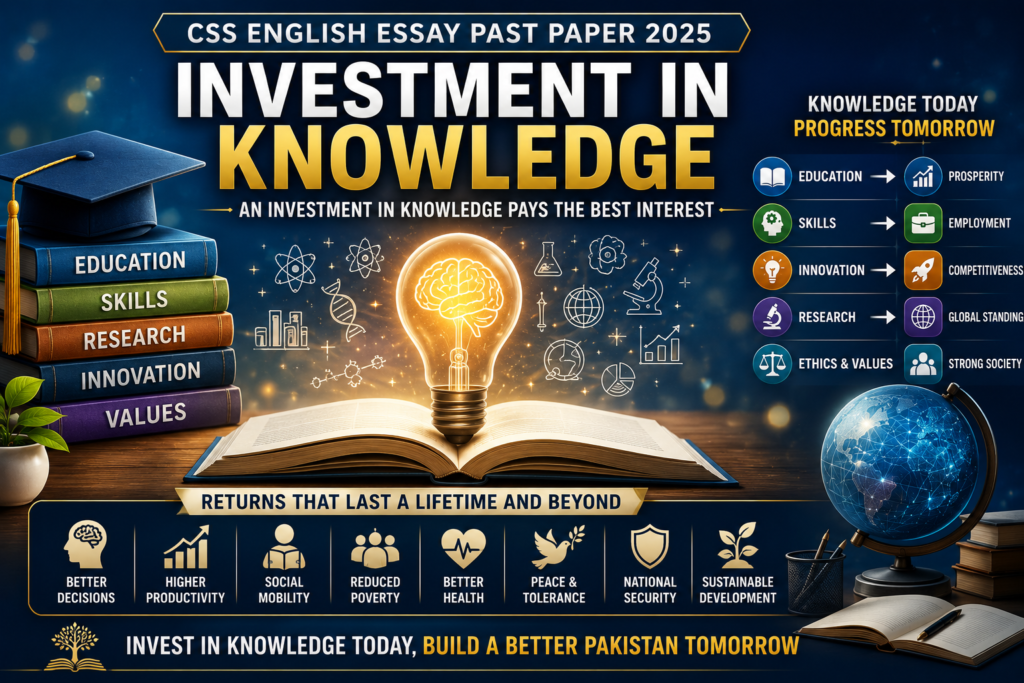
Investment in Knowledge is one of the most powerful ideas in human civilization because knowledge is the only form of wealth that increases when it is shared, multiplies when it is used and continues to benefit society across generations. The CSS English Essay Past Paper 2025 topic “An investment in knowledge pays the best interest” is not merely a quotation about education; it is a complete philosophy of development. It means that money spent on education, skills, research, books, science, technology, libraries, universities, teachers, critical thinking and innovation produces returns greater than ordinary financial investment.
The phrase is commonly attributed to Benjamin Franklin, and its wisdom remains timeless. Land can be lost, natural resources can be exhausted, military power can decline, but knowledge continues to create wealth, dignity, power and progress. Countries that invest in knowledge become strong economies, innovative societies and respected nations. Countries that neglect knowledge remain dependent, poor, divided and vulnerable. Therefore, Investment in Knowledge is the foundation of personal success, social mobility, democratic maturity, economic growth and national power.
For Pakistan, the topic has special importance. Pakistan is a young country with a large population, but population alone cannot build national strength. A nation becomes strong when its people are educated, skilled, healthy, innovative and productive. Pakistan’s major challenge is not only poverty of money; it is also poverty of learning, research, skills, scientific thinking and institutional capacity. In this sense, Investment in Knowledge is not a luxury for Pakistan. It is a national survival requirement.
Central Argument: Investment in Knowledge pays the best interest because it improves human capital, reduces poverty, strengthens democracy, promotes innovation, increases productivity, supports economic growth, improves health, empowers women, counters extremism and builds national resilience. However, knowledge pays interest only when education is accessible, high-quality, skill-oriented, research-based and linked with ethical citizenship. For Pakistan, investing in knowledge is the only sustainable path from dependency to dignity and from crisis management to national development.
Show Table of Contents
Table of Contents
- Introduction
- CSS Essay Outline
- Thesis Statement
- Meaning of Investment in Knowledge
- Why Investment in Knowledge Pays the Best Interest
- Individual Benefits of Knowledge
- Social Benefits of Knowledge
- Knowledge and Economic Growth
- Human Capital and National Development
- Science, Research and Innovation
- Knowledge and Democracy
- Knowledge, Ethics and Character
- Women’s Education and Social Progress
- Investment in Knowledge in Pakistan
- Pakistan’s Education Crisis
- Skills Gap and Employability
- Digital Knowledge Economy
- Knowledge as Defence Against Extremism
- Major Challenges to Investment in Knowledge
- Policy Recommendations for Pakistan
- Counterargument
- Conclusion
- FAQs
Introduction
Human history proves that the real wealth of a nation is not hidden only in its soil, minerals, rivers, armies or markets. The real wealth of a nation lives in the minds of its people. A society becomes powerful when its citizens can read, think, question, create, invent, organize, solve problems and improve institutions. This is why the statement “An investment in knowledge pays the best interest” remains one of the most meaningful ideas for individuals and nations alike.
Investment in Knowledge means spending time, money, energy and institutional effort on education, learning, research, skills, science, technology, moral training and intellectual development. It includes schools, colleges, universities, libraries, laboratories, teachers, books, digital learning, vocational training, critical thinking, innovation and lifelong learning. It also includes the culture of inquiry, debate, evidence, reason and creativity. Knowledge is not limited to degrees. It is the ability to understand reality and use that understanding for personal, social and national progress.
The word “interest” in the quotation is extremely important. In finance, interest means return on investment. If a person deposits money in a bank or invests in business, he expects profit. Similarly, knowledge produces returns. It gives individuals better income, dignity, confidence and decision-making ability. It gives society tolerance, awareness, health, productivity and innovation. It gives nations economic growth, political stability, scientific advancement and global respect. Unlike ordinary interest, the interest of knowledge is not temporary. It continues across generations.
A person may lose material wealth, but education remains with him. A family may escape poverty if even one generation receives quality education. A nation may overcome resource scarcity if it develops knowledge, technology and human capital. Japan, Singapore, South Korea and Finland did not rise because of huge natural resources. They rose because they invested in people. Their example proves that Investment in Knowledge pays better than investment in raw power or short-term consumption.
In the modern world, knowledge has become even more important. The twenty-first century is shaped by artificial intelligence, biotechnology, cyber security, renewable energy, robotics, data science, digital finance, advanced manufacturing and research-based decision-making. Countries that control knowledge control the future. Countries that fail to educate their people become consumers of other nations’ inventions. They import technology, borrow money, depend on foreign experts and remain vulnerable in global competition.
For Pakistan, this essay is particularly relevant. Pakistan has a large youth population and enormous potential, but its education and knowledge systems remain weak. Pakistan faces out-of-school children, poor learning outcomes, low research productivity, weak technical training, limited innovation, gender gaps in education, madrassa-mainstream divide, low public spending and mismatch between degrees and jobs. These problems show that Pakistan has not yet treated Investment in Knowledge as its highest national priority.
The World Bank’s Pakistan Learning Poverty Brief 2024 highlights the serious challenge of learning poverty, while Pakistan Education Statistics 2023–24 and Pakistan Economic Survey education chapters show the scale of Pakistan’s education system and its persistent gaps. These facts matter because no country can build a knowledge economy if children cannot learn properly, teachers are not trained, schools lack facilities and universities remain disconnected from research and industry.
Therefore, the topic “An investment in knowledge pays the best interest” should not be treated as a decorative moral statement. It is a complete roadmap for national development. It tells Pakistan that motorways without minds, buildings without books, and projects without people cannot create sustainable progress. Real development begins when a nation invests in human beings.
CSS Essay Outline
- Introduction
- Meaning of Investment in Knowledge
- Knowledge as the highest form of human capital
- Why knowledge pays the best interest
- Individual benefits of knowledge
- Knowledge and social mobility
- Knowledge and poverty reduction
- Knowledge and economic productivity
- Knowledge economy in the twenty-first century
- Science, research and innovation as national power
- Knowledge and democratic maturity
- Knowledge and ethical citizenship
- Women’s education and national progress
- Knowledge as defence against extremism and misinformation
- Investment in Knowledge in Pakistan
- Pakistan’s education crisis
- Out-of-school children and learning poverty
- Low education spending and weak governance
- Skills gap and unemployment
- Higher education and research challenges
- Digital knowledge economy and Pakistan’s opportunity
- Role of teachers, libraries and universities
- Challenges to Investment in Knowledge
- Policy recommendations for Pakistan
- Counterargument: material infrastructure is more urgent
- Rebuttal: infrastructure without knowledge cannot sustain progress
- Conclusion
Thesis Statement
Investment in Knowledge pays the best interest because it transforms individuals into productive citizens, societies into tolerant communities and nations into innovative economies. It reduces poverty, strengthens democracy, promotes scientific progress, improves health, empowers women, creates jobs and builds national resilience. For Pakistan, the real path to sustainable development lies not in short-term consumption or symbolic projects, but in long-term Investment in Knowledge through quality education, skills, research, technology, ethics and human capital development.
Meaning of Investment in Knowledge
Investment in Knowledge means devoting resources to learning and intellectual development. It includes formal education in schools, colleges and universities, but it is broader than schooling. It also includes technical training, vocational education, research, scientific inquiry, digital skills, professional development, libraries, laboratories, teacher training, reading culture, civic education and moral development.
Investment means sacrifice today for benefit tomorrow. A family that spends on a child’s education sacrifices current consumption for future progress. A government that builds schools and trains teachers sacrifices political glamour for long-term national strength. A society that encourages research and debate sacrifices ignorance for enlightenment. In all these cases, the return is greater than the cost.
Knowledge is different from information. Information is raw data or facts. Knowledge is the ability to understand, interpret and apply information wisely. A person may have access to the internet but still lack knowledge if he cannot think critically. A student may memorize textbooks but still lack knowledge if he cannot solve real problems. Therefore, Investment in Knowledge must focus on understanding, creativity and application, not rote memorization.
Knowledge also includes moral wisdom. Education without ethics can produce clever criminals, corrupt officials and destructive technologies. True knowledge improves judgment, responsibility and humanity. A society needs scientists and engineers, but it also needs honest citizens, tolerant minds and responsible leaders.
Why Investment in Knowledge Pays the Best Interest
Investment in Knowledge pays the best interest because its returns are multidimensional. A financial investment may produce profit for one person. Knowledge produces profit for individuals, families, communities, institutions and nations. It increases earning capacity, improves health choices, reduces crime, strengthens democracy, creates innovation and improves social behaviour.
The interest of knowledge is also long-lasting. A road may break, a building may decay and a machine may become outdated, but an educated mind continues to produce value. A teacher can educate hundreds of students. A scientist can discover a cure. An engineer can improve infrastructure. A doctor can save lives. A skilled worker can raise productivity. A literate mother can educate a family. Thus, knowledge multiplies itself.
Knowledge pays interest because it improves decision-making. An educated farmer uses better seeds and water management. An educated mother understands health and nutrition. An educated voter chooses leaders more wisely. An educated worker uses technology efficiently. An educated entrepreneur identifies markets. An educated society resists rumors and extremism.
Knowledge also gives independence. A person with skills depends less on charity. A country with knowledge depends less on foreign technology and loans. A society with intellectual strength can solve its own problems. Therefore, Investment in Knowledge creates dignity and self-reliance.
Individual Benefits of Knowledge
At the individual level, Investment in Knowledge changes life chances. Education improves employment opportunities, income potential, confidence, health awareness and social status. A person who can read, write, calculate and communicate has more options than a person who cannot. A skilled person can earn, adapt and grow.
Knowledge also creates social mobility. Poor families often escape poverty through education. A child from a humble background can become a teacher, doctor, engineer, civil servant, entrepreneur or skilled professional if quality education is available. This is why education is considered the most peaceful and dignified path to equality.
Knowledge gives confidence. An educated person can understand contracts, laws, rights, health instructions, financial systems and political debates. He is less likely to be deceived by false promises or exploitation. Knowledge gives voice to the voiceless.
However, the quality of knowledge matters. A degree without skill may not improve life. A certificate without learning may create frustration. Therefore, investment must focus on real knowledge, not paper qualifications.
Social Benefits of Knowledge
At the social level, Investment in Knowledge builds healthier, safer and more tolerant communities. Educated societies are more likely to value law, hygiene, dialogue, gender respect and civic responsibility. Knowledge reduces superstition, prejudice and blind obedience.
Education improves public health. Literate citizens understand vaccination, nutrition, sanitation, family planning and disease prevention. Educated mothers are more likely to support children’s schooling and health. This creates benefits across generations.
Knowledge also improves social harmony. People who learn history, ethics, citizenship and critical thinking are better able to understand diversity. They are less likely to fall prey to hate propaganda. Education alone cannot eliminate intolerance, but ignorance certainly increases it.
A knowledgeable society also solves problems better. Communities with awareness can demand clean water, better schools, local accountability and environmental protection. They can participate in governance rather than remain passive recipients of authority.
Knowledge and Economic Growth
Modern economic growth depends increasingly on knowledge. In the past, land, labour and capital were considered the main factors of production. Today, knowledge, innovation, skills and technology are equally important. Countries that invest in education and research produce higher-value goods and services.
A knowledge economy is an economy in which growth depends on information, skills, innovation and technology. Software, biotechnology, pharmaceuticals, artificial intelligence, engineering, financial services, renewable energy and advanced manufacturing are all knowledge-driven sectors. These sectors create high incomes and global competitiveness.
Pakistan’s economy suffers partly because it remains low-productivity and low-skill. It exports many low-value goods and imports high-value technology. This imbalance keeps the country dependent. Investment in Knowledge can change this by improving productivity, innovation and export competitiveness.
For example, agriculture can become more productive through research, mechanization, water management and biotechnology. Industry can improve through skilled workers and modern technology. Services can grow through IT, finance, design, education, health and digital platforms. All these require knowledge.
Human Capital and National Development
Human capital means the education, health, skills and capabilities of people. The World Bank’s Human Capital Project emphasizes that health and education contribute to the productivity of the next generation of workers. In simple terms, people are a country’s most important asset.
Investment in Knowledge is a direct investment in human capital. A country may have minerals, rivers, ports and fertile land, but without educated people it cannot use these resources effectively. Human capital turns resources into wealth.
Pakistan’s human capital challenge is serious. Many children face poor nutrition, weak schooling and limited access to quality health. These weaknesses reduce future productivity. A child who is malnourished, out of school or poorly taught may never reach full potential. The loss is not only personal; it is national.
Therefore, Pakistan must connect education policy with health, nutrition, social protection and employment. A child’s mind cannot learn if the body is hungry. A school cannot succeed if teachers are absent. A degree cannot create income if the economy has no jobs. Human capital development requires integrated policy.
Science, Research and Innovation
No nation can become powerful without science and research. Investment in Knowledge must include laboratories, universities, research centres, technology parks, scientific education and innovation funding. Countries that invest in research create patents, industries, medicines, defence technologies and digital platforms.
Pakistan has talented scientists, doctors, engineers and students, but the research ecosystem remains weak. Universities often focus more on degrees than discovery. Research is sometimes disconnected from industry and national problems. Laboratories lack funds. Students memorize rather than experiment. This weakens innovation.
Pakistan needs research in agriculture, water, climate change, energy, medicine, artificial intelligence, cybersecurity, minerals, education technology and public policy. Research should solve real problems. Universities should not be isolated islands; they should work with industry, government and communities.
Innovation also requires tolerance for questions. A society that discourages questioning cannot produce science. Scientific progress begins when people ask why, how and what if. Therefore, a culture of inquiry is essential for Investment in Knowledge.
Knowledge and Democracy
Democracy cannot function properly without knowledgeable citizens. Voting is not enough; citizens must understand issues, rights, responsibilities and institutions. Investment in Knowledge strengthens democracy by creating informed voters and responsible leaders.
An educated citizen is more likely to question corruption, reject fake news, understand constitutional rights and demand accountability. A knowledgeable society is harder to manipulate through slogans, fear and misinformation. It can judge policies rather than personalities.
Pakistan’s democracy suffers partly because civic education is weak. Many citizens vote on the basis of biradari, patronage, emotion or propaganda. Political debate often lacks evidence and tolerance. Education can improve democratic culture by teaching constitutionalism, pluralism, rule of law and peaceful disagreement.
Knowledge also improves leadership. Leaders who understand history, economics, law, science and public administration make better decisions. A state led by ignorance cannot solve complex problems. Therefore, Investment in Knowledge is also an investment in better governance.
Knowledge, Ethics and Character
Knowledge without ethics can be dangerous. A corrupt educated person may cause more harm than an honest uneducated person. Therefore, Investment in Knowledge must include character, values and responsibility. Education should produce not only skilled workers but also good human beings.
Ethical knowledge teaches honesty, justice, compassion, tolerance and responsibility. It helps individuals use their skills for public good rather than selfish exploitation. A doctor needs ethics, not only medical knowledge. An engineer needs responsibility, not only technical ability. A civil servant needs integrity, not only administrative knowledge.
Pakistan’s crisis is partly moral and institutional. Corruption, dishonesty, intolerance and misuse of authority cannot be solved by technical education alone. Schools and universities must teach civic duty, public service, empathy and respect for law.
True Investment in Knowledge therefore combines intellect with character. The best interest of knowledge is not only wealth; it is wisdom.
Women’s Education and Social Progress
No society can receive the full interest of knowledge while excluding women. Women’s education is one of the highest-return investments. An educated woman improves her own life, supports family health, educates children and contributes to the economy.
In Pakistan, girls’ education remains a major challenge in many areas. Poverty, distance from schools, lack of female teachers, early marriage, insecurity and social attitudes prevent many girls from receiving quality education. This reduces national progress.
Investment in Knowledge must therefore prioritize girls and women. Educating girls is not only a gender issue; it is a national development issue. Countries that educate women improve health, reduce population pressure, increase productivity and strengthen social stability.
Women also need access to higher education, digital skills, vocational training and safe workplaces. Knowledge should lead to opportunity. If educated women are kept outside the workforce, society loses a major part of its human capital.
Investment in Knowledge in Pakistan
Investment in Knowledge in Pakistan remains insufficient compared with the country’s needs. Pakistan has a large population, youth bulge and development challenges, but education has not consistently received the priority it deserves. Policy statements often praise education, but budgets, governance and outcomes remain weak.
Pakistan’s education system is divided across public schools, private schools, elite institutions, madrassas and informal learning spaces. This creates inequality. A child’s future often depends on family income and location. Such inequality weakens national unity and social mobility.
Pakistan also faces a quality crisis. Many students attend school but do not learn enough. Rote memorization dominates. Examinations reward repetition rather than understanding. Teachers often lack training and support. Schools may lack facilities. Higher education may produce degrees but not employable skills.
For Pakistan, Investment in Knowledge must mean more than increasing enrollment. It must mean quality learning, teacher reform, curriculum improvement, skills development, research, technology and equal opportunity.
Pakistan’s Education Crisis
Pakistan’s education crisis is one of the biggest barriers to national development. The crisis includes out-of-school children, poor learning outcomes, low literacy in some regions, gender gaps, weak school facilities, teacher absenteeism, poor governance and low public confidence.
The Pakistan Economic Survey education chapter and Pakistan Education Statistics 2023–24 show a large education system with persistent challenges of access, quality and governance. The World Bank’s Pakistan Learning Poverty Brief 2024 highlights the seriousness of learning poverty. These references show that Pakistan’s challenge is not only to bring children into schools but also to ensure they learn.
Learning poverty is especially dangerous because it hides behind enrollment statistics. A child may be counted as enrolled but may still be unable to read with understanding. Such children later struggle in higher grades, drop out or enter the labour market without skills.
Pakistan must treat foundational learning as an emergency. Reading, writing, numeracy and comprehension in early grades should become national priorities. Without these foundations, later investment becomes less effective.
Skills Gap and Employability
Pakistan’s youth need skills, not only degrees. The skills gap is one of the clearest signs that Investment in Knowledge has not been properly aligned with the economy. Many graduates cannot find jobs because their education does not match market needs.
Technical and vocational training remains undervalued. Society often prefers traditional degrees even when they do not lead to employment. Pakistan needs skilled workers in construction, energy, agriculture, manufacturing, healthcare, IT, logistics, hospitality and repair services.
Employability also requires soft skills. Communication, teamwork, problem-solving, punctuality, professionalism and digital literacy are essential. These should be taught in schools, colleges and training centres.
Pakistan must link education with industry. Universities and technical institutes should work with employers. Internships, apprenticeships, career counselling and practical training should become normal parts of education. Knowledge pays the best interest only when it becomes usable.
Digital Knowledge Economy
The digital age has created new opportunities for Pakistan. Freelancing, software development, e-commerce, digital marketing, artificial intelligence, cybersecurity, online education and remote work can help Pakistan earn foreign exchange and create jobs. But this requires Investment in Knowledge.
Digital opportunity cannot be captured by slogans. It requires internet access, digital literacy, English communication, coding skills, online payment systems, cybersecurity awareness and professional training. Rural youth and women must also be included in digital opportunities.
Pakistan has already shown potential in freelancing and IT services, but the sector needs stronger support. Schools should teach digital skills early. Universities should update curricula. Government should support startups, innovation centres and export-oriented IT training.
The future economy will reward knowledge workers. If Pakistan invests in digital knowledge, it can create jobs beyond traditional sectors. If it fails, its youth may remain consumers of foreign technology rather than creators of value.
Knowledge as Defence Against Extremism
Investment in Knowledge is also a defence against extremism, intolerance and misinformation. Ignorance makes societies vulnerable to hate, conspiracy theories and manipulation. Knowledge teaches people to question, verify and think critically.
Pakistan has suffered from extremism and polarization. Security operations are necessary against violence, but long-term peace requires education, tolerance and opportunity. A young person with education, employment and hope is less vulnerable to extremist recruitment.
Education should promote critical thinking, constitutional values, respect for diversity and peaceful dialogue. It should not produce narrow minds. Religious education and modern education should both encourage ethics, compassion and intellectual honesty.
In the age of social media, misinformation spreads quickly. Citizens need media literacy and digital awareness. Knowledge helps society distinguish fact from propaganda. This is essential for democracy and national security.
Major Challenges to Investment in Knowledge
Several challenges prevent Pakistan from receiving the full benefit of Investment in Knowledge.
First, education spending remains insufficient compared with the scale of need. Pakistan needs more schools, trained teachers, laboratories, libraries, digital tools and monitoring systems.
Second, governance is weak. Funds are not always used efficiently. Political interference, corruption, poor planning and weak accountability reduce outcomes.
Third, inequality divides the education system. Elite schools prepare students for global opportunities, while many public schools struggle with basic learning. This creates class-based futures.
Fourth, curriculum and examination systems often reward memorization instead of thinking. Students learn to reproduce answers rather than solve problems.
Fifth, teacher training is inadequate. Teachers are the heart of education. Without trained and motivated teachers, reforms fail.
Sixth, research culture is weak. Universities often focus on quantity of publications rather than quality, innovation and national relevance.
Seventh, technical education is undervalued. This creates degree inflation and skills shortage at the same time.
Eighth, girls and marginalized communities face barriers. Without inclusion, knowledge investment remains incomplete.
Policy Recommendations for Pakistan
Pakistan must adopt a serious national strategy for Investment in Knowledge.
First, education should be treated as a national emergency. Political parties, provinces and institutions should agree on a long-term education charter beyond election cycles.
Second, public spending on education should be increased and used efficiently. More money is necessary, but governance reform is equally important.
Third, foundational learning should be prioritized. Every child should learn reading, writing and numeracy in early grades.
Fourth, teacher training and accountability should be improved. Teachers need professional development, respect and performance monitoring.
Fifth, curriculum should promote critical thinking, science, ethics, creativity, digital literacy and civic responsibility.
Sixth, technical and vocational education should be expanded. Skills should be linked with local and global labour markets.
Seventh, girls’ education must be protected and promoted. Safe schools, female teachers, transport and scholarships can improve access.
Eighth, universities should be connected with research, industry and national problems. Higher education should produce solutions, not only degrees.
Ninth, libraries, reading culture and digital learning should be revived. A society that does not read cannot become a knowledge society.
Tenth, Pakistan should invest in science, technology and innovation. Research in agriculture, climate, health, energy, AI and water should be supported.
Eleventh, education must be linked with jobs. Career counselling, internships, apprenticeships and entrepreneurship support should be expanded.
Twelfth, knowledge policy should include moral and civic education. Pakistan needs skilled citizens, but it also needs honest and responsible citizens.
Counterargument: Material Infrastructure Is More Urgent
Some critics argue that developing countries like Pakistan should prioritize roads, energy, dams, industry and physical infrastructure before investing heavily in knowledge. They claim that without infrastructure, education alone cannot create growth. According to this view, material development is more urgent than intellectual development.
This argument has some truth. Roads, electricity, water, transport and industry are important. A country cannot grow without infrastructure. Schools need buildings, industries need energy and markets need roads.
However, the argument is incomplete. Infrastructure without knowledge cannot sustain development. Roads require engineers. Dams require scientists. Industries require skilled workers. Hospitals require doctors. Courts require trained lawyers. Government requires competent administrators. Technology requires researchers. Therefore, physical infrastructure itself depends on knowledge.
The real solution is not to choose between infrastructure and knowledge. The solution is to place knowledge at the centre of all development. Infrastructure built without human capital becomes underused, mismanaged or dependent on foreign expertise. Investment in Knowledge improves the quality and sustainability of every other investment.
Conclusion
Investment in Knowledge pays the best interest because it transforms human potential into personal success, social progress and national power. It gives individuals dignity, income and confidence. It gives families a path out of poverty. It gives societies tolerance, health and awareness. It gives nations productivity, innovation, democracy and global competitiveness.
The modern world belongs to knowledge-based societies. Countries that invest in education, science, skills and research lead the world. Countries that neglect knowledge remain dependent on others. They may possess resources, but they cannot convert them into sustainable prosperity without human capital.
For Pakistan, the lesson is clear. The country cannot solve its crises through loans, slogans or short-term projects alone. It must invest in its people. Pakistan’s schools, teachers, universities, libraries, laboratories, technical institutes and research centres are more important for long-term security than many visible symbols of power. A strong Pakistan will be built not only by roads and buildings but by minds and ideas.
However, Investment in Knowledge must be serious and meaningful. It must focus on access, quality, equity, skills, ethics and innovation. It must include girls, rural children, poor families and marginalized communities. It must connect education with employment and research with national needs.
Thus, the statement “An investment in knowledge pays the best interest” is not only a moral lesson; it is a national development strategy. Pakistan’s future depends on whether it continues to underinvest in minds or finally makes knowledge the foundation of progress. The best interest a nation can earn is not from banks, loans or temporary projects. It is earned from educated citizens, skilled workers, honest leaders, creative scientists and thoughtful communities.
Important Facts and Figures for CSS Essay
| Fact / Figure | Relevance |
|---|---|
| World Bank Pakistan Learning Poverty Brief 2024 highlights serious learning poverty in Pakistan. | Shows that access to school alone is not enough; quality learning is essential. |
| Pakistan Economic Survey education chapter highlights education sector challenges and public-sector education data. | Shows that education remains a major national policy issue. |
| Pakistan Education Statistics 2023–24 provides official education data on institutions, enrollment and teachers. | Useful for CSS essays and policy analysis. |
| The World Bank Human Capital Project links education and health with future worker productivity. | Shows why knowledge is central to national development. |
| Pakistan’s digital economy and youth population create opportunities in IT, freelancing and skills development. | Shows how knowledge can create new employment paths. |
Quotations for CSS Essay
- “An investment in knowledge pays the best interest.” — Benjamin Franklin
- “Knowledge is the only wealth that increases when shared.”
- “A nation is as strong as the minds of its citizens.”
- “Education is not expenditure; it is national investment.”
- “Infrastructure builds roads, but knowledge builds civilizations.”
Short CSS Essay Summary
Investment in Knowledge pays the best interest because it creates long-term benefits for individuals, society and the state. Knowledge improves income, reduces poverty, strengthens democracy, promotes innovation, empowers women, improves health and builds national resilience. In Pakistan, the topic is especially important because the country faces poor learning outcomes, skills gaps, weak research culture and education inequality. Pakistan can achieve sustainable development only by investing in quality education, teacher training, technical skills, research, digital literacy, girls’ education and ethical citizenship. Roads, buildings and short-term projects cannot replace human capital. The best future investment for Pakistan is investment in knowledge.
Relevant Internal Links
For more CSS English Essay and current affairs analysis, visit Bellum Report. You may also read related essays on Youth Bulge in Pakistan, Local Government System in Pakistan, cyber security, emerging multipolar world order, governance reforms and education challenges.
Follow Bellum Report updates on Facebook: https://web.facebook.com/salarcomputeracademy/
External Authoritative Sources
- World Bank: Pakistan Learning Poverty Brief 2024
- Pakistan Economic Survey: Education Chapter
- Pakistan Education Statistics 2023–24
- World Bank Human Capital Project
FAQs
What is meant by Investment in Knowledge?
Investment in Knowledge means spending time, money and institutional effort on education, skills, research, science, technology, libraries, teachers and intellectual development.
Why does Investment in Knowledge pay the best interest?
Investment in Knowledge pays the best interest because it improves income, productivity, health, democracy, innovation, social mobility and national development across generations.
How is Investment in Knowledge important for Pakistan?
Investment in Knowledge is important for Pakistan because the country faces education inequality, learning poverty, skills gaps, unemployment and weak research capacity. Knowledge can help Pakistan build human capital and sustainable growth.
What is the role of education in Investment in Knowledge?
Education is the foundation of Investment in Knowledge. Quality education develops literacy, critical thinking, skills, citizenship, innovation and employability.
How can Pakistan improve Investment in Knowledge?
Pakistan can improve Investment in Knowledge by increasing education spending, improving teacher training, reforming curriculum, promoting technical skills, supporting research, educating girls and linking education with jobs.
Is Investment in Knowledge more important than physical infrastructure?
Physical infrastructure is important, but Investment in Knowledge is more fundamental because educated and skilled people design, build, maintain and improve infrastructure.
The Indus Odyssey from Debal to Islamabad
The Ultimate Guide to Pakistan Affairs (711-2025). A focused Kindle guide for CSS, PMS, PCS, PPSC and FPSC Pakistan Affairs preparation.