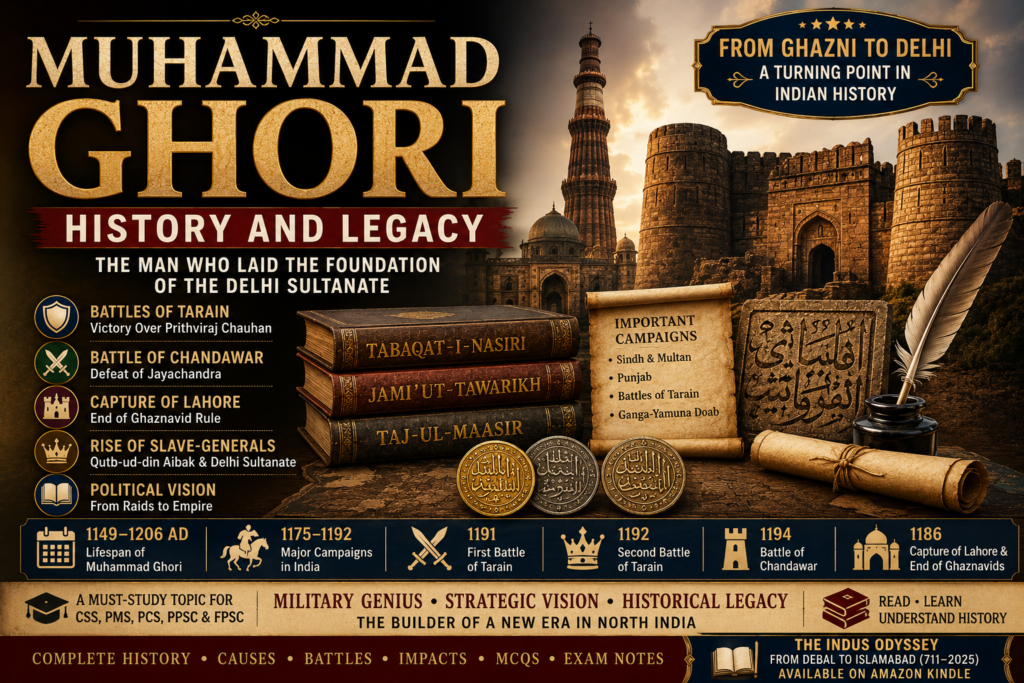
Ghorid Dynasty is one of the most important topics in the medieval history of India and Pakistan because it explains how military expeditions turned into permanent Muslim rule in North India. The Ghorid Dynasty, also called the Ghorid Empire, rose from the mountainous region of Ghor in present-day Afghanistan and replaced the declining Ghaznavids as the leading power on the north-western frontier of the subcontinent. Its most famous ruler, Muhammad Ghori, changed the direction of South Asian history through territorial conquest, political planning, military innovation and the use of slave-generals who later founded the Delhi Sultanate.
The Ghorid Dynasty should not be studied only as the story of Muhammad Ghori and Prithviraj Chauhan. It is a wider historical subject. It includes the rise of Ghor after the decline of Ghazni, the role of Ghiyasuddin Ghori, the campaigns of Muizzuddin Muhammad Ghori, the defeat at Kayadara, the capture of Lahore in 1186 AD, the First and Second Battles of Tarain, the Battle of Chandawar, the role of Qutb-ud-din Aibak, the eastern expansion of Bakhtiyar Khilji, the Iqta system, the slave-general tradition and the birth of the Delhi Sultanate.
For students in India and Pakistan, the Ghorid Dynasty history is highly useful because it answers several common questions: who were the Ghorids, where did Muhammad Ghori come from, what was the difference between Mahmud of Ghazni and Muhammad Ghori, who defeated Muhammad Ghori in the First Battle of Tarain, how did Muhammad Ghori defeat Prithviraj Chauhan, who killed Muhammad Ghori, and how did the Delhi Sultanate begin?
To understand the Ghorid Dynasty in sequence, readers should also study the earlier historical phases. Bellum Report’s Ghaznavi Empire contains related history and exam-focused material, while the Bellum Report book landing page introduces The Indus Odyssey from Debal to Islamabad, a chronological guide that connects the Arab conquest of Sindh, the Ghaznavids, the Ghorids, the Delhi Sultanate, the Mughals, British India, the Pakistan Movement and modern Pakistan.
Recommended Book: If you want the full historical timeline from 711 to 2025 in one compact guide, buy The Indus Odyssey from Debal to Islamabad: The Ultimate Guide to Pakistan Affairs on Amazon Kindle.
Main Idea: The Ghorid Dynasty matters because it converted temporary invasion into permanent rule. The Ghaznavids had opened the door to North India through repeated raids, but the Ghorids built a political structure that survived them. Muhammad Ghori’s conquests, Qutb-ud-din Aibak’s administration and the Mamluk slave-general system created the foundation of the Delhi Sultanate.
Show Table of Contents
- What Is the Ghorid Dynasty?
- Ghorid Dynasty Origin
- Important Ghorid Dynasty Rulers
- Alauddin Husayn Jahansoz and the Rise of Ghor
- Ghiyasuddin Ghori and Western Expansion
- Muhammad Ghori and Indian Expansion
- Early Campaigns: Multan, Uch and Kayadara
- Capture of Lahore and the End of Ghaznavid Rule
- Muhammad Ghori and Prithviraj Chauhan
- First Battle of Tarain 1191
- Second Battle of Tarain 1192
- Battle of Chandawar 1194
- Slave-Generals of the Ghorid Dynasty
- Qutb-ud-din Aibak and the Delhi Sultanate
- Bakhtiyar Khilji and Bengal Expansion
- Iqta System and Administration
- Military Innovation of the Ghorids
- Lakshmi Coins of Muhammad Ghori
- Muhammad Ghori Death
- Muhammad Ghori and Mahmud of Ghazni
- Legacy of the Ghorid Dynasty
- Important Exam Points
- Recommended Book for Students
- FAQs
What Is the Ghorid Dynasty?
The Ghorid Dynasty was a medieval Muslim dynasty that rose from the region of Ghor in present-day Afghanistan. The dynasty became powerful during the twelfth century and expanded into Afghanistan, eastern Iran, parts of Central Asia, Punjab and North India. It succeeded the Ghaznavids as the dominant power in the region and played a decisive role in the beginning of permanent Muslim rule in North India.
The Ghorid Dynasty is especially remembered because of Muhammad Ghori, also known as Shahabuddin Ghori, Shihabuddin Ghori, Mohammed Ghori and Muizzuddin Muhammad bin Sam. However, the dynasty was not built by him alone. Its rise was shaped by earlier rulers such as Alauddin Husayn Jahansoz and by the partnership of two brothers: Ghiyasuddin Ghori and Muhammad Ghori.
The Ghorids were different from the Ghaznavids in their Indian policy. Mahmud of Ghazni had conducted many campaigns into India, but most of them were raids for wealth, prestige and imperial financing. Muhammad Ghori, however, focused on territorial annexation. He wanted to control Punjab, Delhi, Ajmer and the Gangetic plains in a lasting political structure.
This is why the Ghorid Dynasty is historically more important than its short life suggests. Its direct rule did not last very long in India, but its institutions and generals created a political order that continued through the Delhi Sultanate.
Ghorid Dynasty Origin
The Ghorid Dynasty origin lies in the mountainous region of Ghor. The region was rugged, difficult to control and located between larger powers. For a long time, Ghor remained less famous than Ghazni, but its rulers gradually developed military strength and political ambition.
The Ghorids were of Tajik-Afghan origin. Their rise took place during the weakening of the Ghaznavid Empire. Once the Ghaznavids began to lose control over their western and eastern territories, the rulers of Ghor found an opportunity to expand.
The early Ghorids had to struggle against the Ghaznavids. The conflict between Ghor and Ghazni was not only a local rivalry. It represented a transition of power from one historical centre to another. Ghazni had dominated the earlier phase; Ghor became the new force.
By the time Muhammad Ghori emerged, the Ghorids had already become a serious political power. Their rise changed the future of Punjab and North India because they did not stop at raiding. They moved toward annexation and administration.
Important Ghorid Dynasty Rulers
The Ghorid Dynasty rulers are important for students because the dynasty is often reduced to Muhammad Ghori alone. In reality, several rulers and military figures shaped the Ghorid rise and its legacy.
| Ruler or Figure | Importance |
|---|---|
| Alauddin Husayn Jahansoz | Known for destroying Ghazni in 1151 AD and weakening Ghaznavid prestige. |
| Ghiyasuddin Ghori | Managed the western side of the Ghorid Empire and strengthened the dynasty. |
| Muizzuddin Muhammad Ghori | Led the eastern expansion into India and laid the foundation of permanent Muslim rule in North India. |
| Qutb-ud-din Aibak | Muhammad Ghori’s leading slave-general in India and later the first Sultan of Delhi. |
| Tajuddin Yildiz | A major Ghorid slave-general who controlled Ghazni after Muhammad Ghori’s death. |
| Nasiruddin Qabacha | A Ghorid slave-general who controlled Multan and Sindh after the breakup of Ghorid power. |
| Ikhtiyar-ud-din Bakhtiyar Khilji | Expanded Ghorid influence into Bihar and Bengal. |
The most famous ruler of the Ghorid Dynasty was Muhammad Ghori. However, the dynasty’s historical importance becomes clearer when we study its rulers, generals and successors together.
Alauddin Husayn Jahansoz and the Rise of Ghor
Alauddin Husayn was an important early ruler of the Ghorid Dynasty. He is remembered by the title Jahansoz, meaning “World Burner.” He earned this title because of his destructive attack on Ghazni in 1151 AD.
The attack on Ghazni was a turning point in the rivalry between the Ghorids and the Ghaznavids. Ghazni had been a symbol of power since the time of Mahmud of Ghazni. Its destruction weakened the prestige of the Ghaznavids and showed that Ghor had become a serious force.
Alauddin Husayn’s role is important because he helped raise the political status of Ghor. He did not build the Indian empire, but his actions weakened the old order and prepared the way for later Ghorid expansion.
Students should remember Alauddin Husayn Jahansoz because he shows that the Ghorid Dynasty had a history before Muhammad Ghori. The dynasty was already rising before its famous Indian campaigns.
Ghiyasuddin Ghori and Western Expansion
Ghiyasuddin Ghori was the elder brother of Muhammad Ghori and one of the most important rulers of the Ghorid Dynasty. He managed the western part of the empire while Muhammad Ghori focused on the eastern expansion into India.
This division of responsibility was one reason for Ghorid success. Ghiyasuddin handled western conflicts and administration, while Muhammad Ghori could concentrate on Punjab, Delhi and the Indo-Gangetic plains. The brothers worked in cooperation rather than rivalry.
Ghiyasuddin Ghori strengthened the empire’s western base and helped the Ghorids compete with other powers such as the Khwarazmians. His role is sometimes ignored in student notes, but he was essential to the survival and expansion of Ghorid power.
Without Ghiyasuddin’s western management, Muhammad Ghori would not have been able to devote so much attention to the Indian campaigns. Therefore, Ghiyasuddin Ghori should be included in any complete account of the Ghorid Dynasty history.
Muhammad Ghori and Indian Expansion
Muhammad Ghori was the most famous ruler of the Ghorid Dynasty. His formal name was Muizzuddin Muhammad bin Sam. He is also known as Shahabuddin Ghori, Shihabuddin Ghori and Mohammed Ghori. His importance lies in the fact that he changed the nature of Muslim campaigns in North India.
Unlike Mahmud of Ghazni, Muhammad Ghori did not focus only on raids. His aim was to establish territorial control. He realized that if he wanted to rule North India, he had to control Punjab first. This is why the capture of Lahore in 1186 AD was so important.
Muhammad Ghori’s early career included both failure and success. He captured Multan and Uch in 1175 AD, but he was defeated at the Battle of Kayadara in 1178 AD. Instead of giving up, he changed his strategy and shifted toward the Khyber Pass and Punjab route.
This ability to learn from defeat was one of his greatest strengths. Muhammad Ghori’s success was not accidental. It came from strategic adjustment, military discipline, political patience and the use of loyal slave-generals.
Early Campaigns: Multan, Uch and Kayadara
The early Indian campaigns of Muhammad Ghori began with Multan and Uch. In 1175 AD, he captured these important centres and established his first foothold in the subcontinent. Multan and Uch were strategically useful because they connected the Ghorids with the lower Indus region and the routes into western India.
However, Muhammad Ghori’s first attempt to move deeper into India failed. In 1178 AD, he was defeated at the Battle of Kayadara near Mount Abu by the Solanki ruler Raja Bhimdev II. This defeat was serious because it showed that the desert route into India was dangerous and difficult.
The defeat at Kayadara forced Muhammad Ghori to change his strategy. Instead of trying to enter through the desert route, he shifted toward Punjab and the Khyber Pass. This decision became one of the most important strategic turning points in his career.
The lesson from Kayadara is simple: Muhammad Ghori became successful not because he never failed, but because he learned from failure. His later success at Tarain came after tactical and strategic improvement.
Capture of Lahore and the End of Ghaznavid Rule
The capture of Lahore in 1186 AD was one of the most decisive events in the history of the Ghorid Dynasty. Lahore was controlled by Khusrau Malik, the last Ghaznavid ruler. When Muhammad Ghori captured Lahore, he effectively ended Ghaznavid rule in Punjab.
Lahore was not just another city. It was the gateway to North India. It gave Muhammad Ghori a strong base for future campaigns against the Rajput powers. Without Lahore, his movement toward Delhi and Ajmer would have been much harder.
The fall of Lahore also marks the transition from the Ghaznavids to the Ghorids. It ended one historical phase and began another. The Ghaznavids had dominated Punjab before, but now the Ghorids became the new power.
After 1186 AD, Punjab became the launching ground for Muhammad Ghori’s campaigns. This is why Lahore is central to the history of the Ghorid Dynasty and the later Delhi Sultanate.
Muhammad Ghori and Prithviraj Chauhan
The most famous conflict in the career of Muhammad Ghori was his struggle against Prithviraj Chauhan, the Rajput ruler of Ajmer and Delhi. This conflict is often searched as Muhammad Ghori and Prithviraj Chauhan, Prithviraj Chauhan vs Ghori, Ghori vs Prithviraj, and did Prithviraj Chauhan kill Ghori.
Muhammad Ghori and Prithviraj Chauhan fought two major battles at Tarain, near modern Karnal. The First Battle of Tarain took place in 1191 AD, and the Second Battle of Tarain took place in 1192 AD.
The First Battle of Tarain was a victory for Prithviraj Chauhan. Muhammad Ghori was seriously wounded and had to retreat. However, he returned the next year with a better strategy and defeated Prithviraj Chauhan in the Second Battle of Tarain.
The Second Battle of Tarain changed the political direction of North India. It opened Delhi and Ajmer to Ghorid control and prepared the ground for permanent Muslim rule through the Delhi Sultanate.
First Battle of Tarain 1191
The First Battle of Tarain was fought in 1191 AD between Muhammad Ghori and Prithviraj Chauhan. In this battle, Prithviraj Chauhan defeated Muhammad Ghori. Ghori was wounded and narrowly escaped from the battlefield.
This defeat showed the strength of Rajput resistance. The Rajput army had numerical power, local support and confidence. Muhammad Ghori realized that a direct attack against such forces would not be enough.
The First Battle of Tarain is important because it shows that Muhammad Ghori’s success was not immediate. He had to learn, reorganize and return with a new plan.
For students, this battle should be remembered as a major setback that led to a stronger Ghorid response. The defeat did not end Muhammad Ghori’s ambition; it sharpened it.
Second Battle of Tarain 1192
The Second Battle of Tarain was fought in 1192 AD and became one of the most important battles in medieval Indian history. This time, Muhammad Ghori returned with a stronger plan and a more disciplined army.
He used Turkish horse archers, mobility and feigned retreat tactics. His cavalry harassed the Rajput forces, tired them out and broke their formation. When the Rajput lines weakened, Ghori launched a decisive attack with reserves.
The result was a major Ghorid victory. Prithviraj Chauhan was defeated, and the road to Delhi and Ajmer opened. This victory transformed Muhammad Ghori from a defeated invader into a ruler with a permanent political future in North India.
The Second Battle of Tarain is important because it did not only defeat one ruler. It changed the balance of power in North India and helped create the conditions for the Delhi Sultanate.
Battle of Chandawar 1194
The Battle of Chandawar was fought in 1194 AD between Muhammad Ghori and Raja Jaichandra of Kannauj. After the victory at Tarain, Jaichandra remained one of the strongest rulers in the Gangetic plains. Muhammad Ghori wanted to remove this obstacle.
The battle ended in a Ghorid victory. Raja Jaichandra was defeated, and the Gahadavala power in North India weakened. This victory expanded Ghorid influence into the fertile Gangetic region.
The Battle of Chandawar is often less famous than Tarain, but it was equally important for consolidation. Tarain opened the road to Delhi and Ajmer; Chandawar weakened the next major power in the east.
For students, Chandawar should be studied as the second major step in Muhammad Ghori’s Indian success. It completed the political breakthrough created by the Second Battle of Tarain.
Slave-Generals of the Ghorid Dynasty
One of the most important features of the Ghorid Dynasty was its reliance on slave-generals, also known as Mamluks. These were not ordinary slaves. They were elite military and administrative men trained from childhood for war, loyalty and governance.
Muhammad Ghori had no sons. He relied on his slave-generals as his political heirs. He is traditionally associated with the idea that his trained slaves were like his “sons.” This system became one of the greatest strengths of the Ghorids.
The most important slave-generals included Qutb-ud-din Aibak, Tajuddin Yildiz and Nasiruddin Qabacha. Aibak controlled Delhi and North India, Yildiz controlled Ghazni, and Qabacha controlled Multan and Sindh after Muhammad Ghori’s death.
This slave-general system later shaped the Delhi Sultanate. The first dynasty of the Delhi Sultanate is called the Mamluk or Slave Dynasty because it emerged from this Ghorid military-administrative tradition.
Qutb-ud-din Aibak and the Delhi Sultanate
Qutb-ud-din Aibak was the most important slave-general of Muhammad Ghori in India. He was responsible for consolidating Ghorid power after the victories of Tarain and Chandawar. He captured important forts, managed territories and strengthened Ghorid authority in North India.
Aibak was known as Lakh-Bakhsh, meaning “Giver of Lakhs,” because of his generosity. Between 1194 and 1202, he captured important forts such as Kalinjar and Mahoba, weakening the power of the Chandela Rajputs.
After Muhammad Ghori’s death in 1206 AD, Qutb-ud-din Aibak became the first Sultan of Delhi. He was crowned at Lahore in June 1206 AD, marking the beginning of the Mamluk or Slave Dynasty.
This is the strongest proof of Muhammad Ghori’s long-term importance. His own dynasty did not continue in India, but his slave-general established a new state that lasted and expanded.
Bakhtiyar Khilji and Bengal Expansion
Ikhtiyar-ud-din Bakhtiyar Khilji was another important military figure connected with Ghorid expansion. While Aibak consolidated power around Delhi, Bakhtiyar Khilji pushed further east into Bihar and Bengal.
His campaigns are famous for two major events. The first was the fall of Nalanda around 1193 AD. Nalanda had been a famous Buddhist university-monastery. Its destruction marked a major blow to organized Buddhist scholarship in that region.
The second major event was the capture of Nadia in 1204 AD. According to traditional accounts, Bakhtiyar Khilji entered the palace of Lakshmana Sena with a very small force disguised as horse-traders. The surprise attack was so complete that Bengal came under Ghorid influence.
These events show that the impact of the Ghorid Dynasty was not limited to Punjab, Delhi and Ajmer. Its military network reached Bihar and Bengal through ambitious commanders like Bakhtiyar Khilji.
Iqta System and Administration
The Iqta system was one of the most important administrative contributions associated with the Ghorid period. Under this system, land revenue rights were assigned to military officers in return for service. The officer who received an Iqta was called a Muqti.
The Muqti collected revenue from peasants, maintained troops, paid administrative expenses and sent surplus revenue to the central treasury. This system allowed the state to maintain a large army without paying every officer directly in cash.
The Iqta system also linked military service with local administration. Officers had an interest in maintaining agricultural production because their income depended on revenue from the land.
The Iqta system later became an important feature of the Delhi Sultanate. This shows that the Ghorid Dynasty did not only conquer territory; it also introduced administrative practices that shaped later rule.
Military Innovation of the Ghorids
The military success of the Ghorid Dynasty was based on mobility, discipline and tactical intelligence. The Ghorids used Turkish horse archers, fast cavalry and the Central Asian composite bow. These weapons and tactics gave them an advantage over slower infantry and elephant-based armies.
The Second Battle of Tarain is the best example of Ghorid military innovation. Muhammad Ghori used mounted archers to weaken the Rajput formation. He used feigned retreat tactics to draw the enemy out and then attacked with reserves when the Rajput lines broke.
The Ghorids also relied on superior horses imported from Arabia and Central Asia. These horses were faster and more agile than many local breeds used in Indian warfare.
The military lesson is clear: the Ghorid Dynasty succeeded not only because of bravery, but because of organization, mobility, planning and tactical adaptation.
Lakshmi Coins of Muhammad Ghori
One of the most interesting details about Muhammad Ghori is his use of local coinage. To gain local legitimacy and facilitate trade, he issued coins that featured the image of the Hindu goddess Lakshmi, with his name inscribed in Devanagari script.
These Lakshmi coins are important because they show political pragmatism. Muhammad Ghori did not simply impose a completely foreign system. He understood that a ruler needed to communicate legitimacy to local subjects and traders.
The coins also show that medieval rulers often adapted to local economic habits. Currency had to be accepted in markets. If local people trusted familiar symbols and scripts, a practical ruler could use them to stabilize rule.
For students, the Lakshmi coins of Muhammad Ghori are a useful exam point because they show the difference between conquest and administration. A conqueror can win a battle, but a ruler must run an economy.
Muhammad Ghori Death
Muhammad Ghori death is one of the most searched topics about him. He was assassinated on March 15, 1206 AD at Dhamiak, near modern Jhelum in Punjab, while returning to Ghazni after suppressing the Khokhar rebellion.
There are different historical accounts about who killed Muhammad Ghori. Some traditions attribute the assassination to Khokhars or Gakkhars seeking revenge for their defeat. Some Persian chroniclers point toward Ismaili Fidaiyan. Because of these different accounts, the safest historical answer is that Muhammad Ghori was assassinated near Dhamiak in 1206 AD, while historians differ over the exact identity of the killers.
A popular legend says that Prithviraj Chauhan killed Muhammad Ghori after being taken prisoner. However, this story is not accepted as reliable history by most serious historical accounts. The historically safer position is that Muhammad Ghori died in 1206 AD near Dhamiak, long after the Second Battle of Tarain.
His death ended direct Ghorid control over India, but it did not end the political structure he had created. His slave-generals carried his work forward, especially Qutb-ud-din Aibak in Delhi.
Muhammad Ghori and Mahmud of Ghazni
The comparison between Muhammad Ghori and Mahmud of Ghazni is one of the most important student topics. Both rulers entered India from the north-west, but their aims and legacies were different.
| Point | Mahmud of Ghazni | Muhammad Ghori |
|---|---|---|
| Main Aim | Wealth, prestige, frontier control and financing of his Central Asian wars. | Territorial annexation and permanent rule in North India. |
| Nature of Invasion | Quick raids followed by return to Ghazni. | Systematic conquest followed by administrative control. |
| Indian Base | Punjab and Lahore became important, but Ghazni remained central. | Lahore and Delhi became bases for future rule. |
| Long-Term Impact | Opened the door to North India. | Built the foundation of the Delhi Sultanate. |
| Successors | His empire weakened after his death. | His slave-generals founded lasting Muslim rule in India. |
The simplest way to remember the difference is this: Mahmud of Ghazni opened the door; Muhammad Ghori built the house. Mahmud’s campaigns shook North India, but Muhammad Ghori’s conquests changed its political structure.
Legacy of the Ghorid Dynasty
The legacy of the Ghorid Dynasty is much greater than the length of its rule. It defeated the last Ghaznavid ruler in Lahore, broke major Rajput power at Tarain, weakened the Gahadavala kingdom at Chandawar, and created the administrative and military structure that led to the Delhi Sultanate.
The Ghorids shifted the centre of Muslim political power from Ghazni and Ghor toward Delhi. Before 1206 AD, Punjab and Sindh were often frontier provinces of Afghan-based empires. After 1206 AD, Delhi became the centre of a new Indo-Muslim political order.
The Ghorid Dynasty also contributed to the rise of the Mamluk or Slave Dynasty. Qutb-ud-din Aibak, Iltutmish and later rulers built upon the foundation created by Muhammad Ghori and his military system.
In historical terms, the Ghorids were not merely invaders. They were transition-makers. They connected the Ghaznavid phase with the Delhi Sultanate phase and changed the political history of South Asia.
Important Exam Points on the Ghorid Dynasty
| Question | Answer |
|---|---|
| Where did the Ghorid Dynasty originate? | From the mountainous region of Ghor in present-day Afghanistan. |
| Who was known as Jahansoz? | Alauddin Husayn, who destroyed Ghazni in 1151 AD. |
| Who were the two important Ghorid brothers? | Ghiyasuddin Ghori and Muhammad Ghori. |
| What was the full name of Muhammad Ghori? | Muizzuddin Muhammad bin Sam. |
| When did Muhammad Ghori capture Multan and Uch? | 1175 AD. |
| Where was Muhammad Ghori defeated in 1178 AD? | Battle of Kayadara near Mount Abu. |
| When did Muhammad Ghori capture Lahore? | 1186 AD. |
| Who was the last Ghaznavid ruler? | Khusrau Malik. |
| Who defeated Muhammad Ghori in the First Battle of Tarain? | Prithviraj Chauhan. |
| When was the Second Battle of Tarain? | 1192 AD. |
| Who won the Second Battle of Tarain? | Muhammad Ghori. |
| When was the Battle of Chandawar? | 1194 AD. |
| Who was defeated at Chandawar? | Raja Jaichandra of Kannauj. |
| Who captured Bihar and Bengal? | Ikhtiyar-ud-din Bakhtiyar Khilji. |
| What was the Iqta system? | A system of assigning land revenue rights to military officers in return for service. |
| When did Muhammad Ghori die? | March 15, 1206 AD. |
| Where was Muhammad Ghori assassinated? | Dhamiak, near modern Jhelum. |
| Who became the first Sultan of Delhi after Muhammad Ghori? | Qutb-ud-din Aibak. |
Recommended Book for Students
The Ghorid Dynasty becomes easier to understand when it is studied as part of a complete timeline. Students who read only scattered notes often confuse the Ghaznavids, Ghorids, Mamluks and Delhi Sultanate. A chronological guide helps solve this problem.
The Indus Odyssey from Debal to Islamabad: The Ultimate Guide to Pakistan Affairs connects early Muslim rule in Sindh, the Ghaznavids, the Ghorids, the Delhi Sultanate, the Mughals, British India, the Pakistan Movement and modern Pakistan in one historical flow. It is useful for CSS, PMS, PCS, PPSC, FPSC, UPSC background reading, university students, teachers and general readers in Pakistan and India.
Buy the Kindle edition:
Buy The Indus Odyssey on Amazon India
Buy The Indus Odyssey on Amazon USA
Recommended for: CSS, PMS, PCS, PPSC, FPSC, UPSC background reading, university students, teachers, history learners and South Asian studies readers.
FAQs
What was the Ghorid Dynasty?
The Ghorid Dynasty was a medieval Muslim dynasty from Ghor in present-day Afghanistan. It became powerful in the twelfth century and played a decisive role in establishing permanent Muslim rule in North India.
Who were the important rulers of the Ghorid Dynasty?
Important figures of the Ghorid Dynasty include Alauddin Husayn Jahansoz, Ghiyasuddin Ghori, Muizzuddin Muhammad Ghori, Qutb-ud-din Aibak, Tajuddin Yildiz, Nasiruddin Qabacha and Bakhtiyar Khilji.
Who was Muhammad Ghori?
Muhammad Ghori, also known as Shahabuddin Ghori and Muizzuddin Muhammad bin Sam, was the most famous ruler of the Ghorid Dynasty and the founder figure behind permanent Muslim rule in North India.
What was the real name of Muhammad Ghori?
The real name of Muhammad Ghori was Muizzuddin Muhammad bin Sam. He is also called Shahabuddin Ghori, Shihabuddin Ghori and Mohammed Ghori.
Who defeated Muhammad Ghori in the First Battle of Tarain?
Prithviraj Chauhan defeated Muhammad Ghori in the First Battle of Tarain in 1191 AD.
Who won the Second Battle of Tarain?
Muhammad Ghori won the Second Battle of Tarain in 1192 AD against Prithviraj Chauhan.
What was the Battle of Chandawar?
The Battle of Chandawar was fought in 1194 AD between Muhammad Ghori and Raja Jaichandra of Kannauj. Muhammad Ghori won the battle and weakened the Gahadavala power in North India.
Did Prithviraj Chauhan kill Muhammad Ghori?
The popular story that Prithviraj Chauhan killed Muhammad Ghori is not accepted as reliable history by most serious historical accounts. Muhammad Ghori was assassinated in 1206 AD near Dhamiak.
Who killed Muhammad Ghori?
Muhammad Ghori was assassinated near Dhamiak in 1206 AD. Historians differ over the exact identity of the killers, with some accounts blaming Khokhars or Gakkhars and others pointing to Ismaili Fidaiyan.
What was the Iqta system?
The Iqta system was an administrative system in which land revenue rights were assigned to military officers in return for service. It later became an important feature of the Delhi Sultanate.
How is the Ghorid Dynasty connected with the Delhi Sultanate?
The Ghorid Dynasty created the political foundation of the Delhi Sultanate. After Muhammad Ghori’s death, his slave-general Qutb-ud-din Aibak became the first Sultan of Delhi in 1206 AD.
Where can I buy The Indus Odyssey from Debal to Islamabad?
You can buy the Kindle edition on Amazon India and Amazon USA using these links: Amazon India and Amazon USA.
“`
The Indus Odyssey from Debal to Islamabad
The Ultimate Guide to Pakistan Affairs (711-2025). A focused Kindle guide for CSS, PMS, PCS, PPSC and FPSC Pakistan Affairs preparation.