Show Table of Contents
- Introduction
- CSS Essay Outline
- Thesis Statement
- Quotable Lines for CSS Essay
- Meaning of the Statement
- Force Versus Reason
- Historical and Political Evidence
- Democracy, Dialogue and Freedom of Expression
- Social and Psychological Dimensions
- Pakistan’s Context
- Counterargument: Is Force Ever Necessary?
- Way Forward
- Conclusion
- FAQs
- Authentic References
Introduction
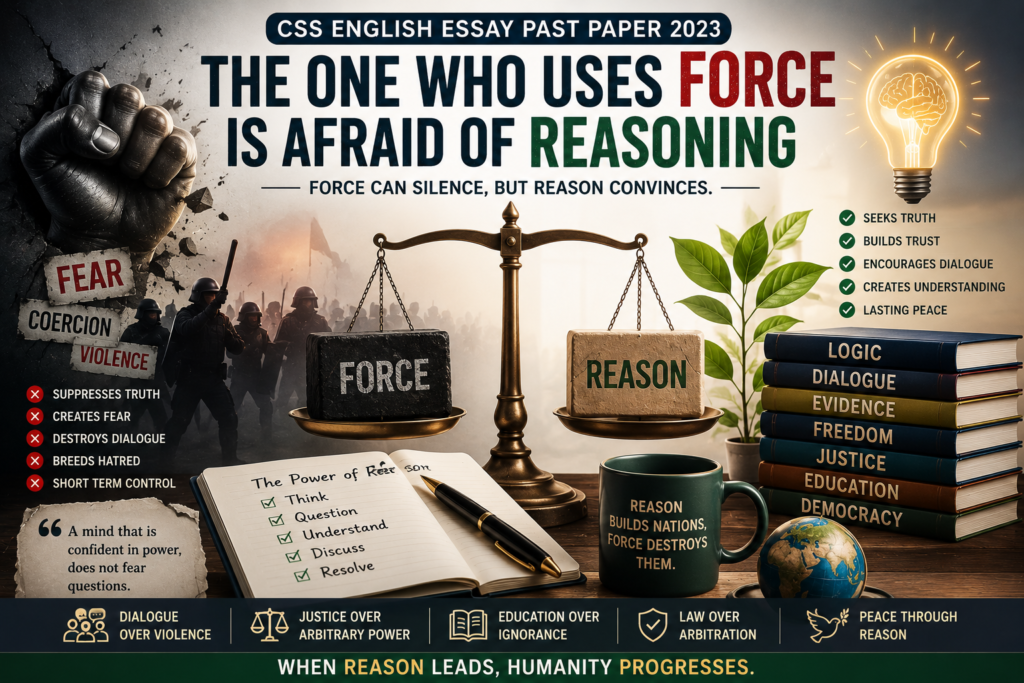
The one who uses force is afraid of reasoning is a profound statement about power, truth, human conduct, politics, family life, education, religion, state authority and civilization. It suggests that the use of force is often not a sign of real strength but a confession of intellectual and moral weakness. A person who possesses truth does not fear questions. A ruler who possesses legitimacy does not fear criticism. A teacher who possesses knowledge does not fear inquiry. A society that possesses justice does not fear debate. Force appears when reasoning fails, when evidence is weak, when authority becomes insecure, and when power wishes to silence what it cannot answer.
The statement The one who uses force is afraid of reasoning does not merely condemn physical violence. It criticizes every form of coercion that tries to replace dialogue with fear. Force may appear as beating, intimidation, censorship, imprisonment, threats, propaganda, mob violence, domestic abuse, institutional pressure, political repression or war. In all these forms, force attempts to end discussion without answering the argument. It commands silence but does not create conviction. It produces obedience but not legitimacy. It may control bodies, but it cannot persuade minds.
Reasoning is the language of confidence. Force is often the language of insecurity. When a person is intellectually strong, he can defend his position through logic, evidence and moral clarity. When he is weak, he shouts, threatens or attacks. When a government is just, it allows free speech, criticism and peaceful opposition. When it is unjust, it censors media, crushes dissent and treats questions as rebellion. When a society is mature, it resolves disagreement through dialogue, law and tolerance. When it is immature, it turns differences into hostility and disagreements into violence.
Human civilization has advanced through the victory of reason over brute force. Philosophers, scientists, prophets, reformers, teachers and democratic leaders have relied on persuasion, moral example, argument and truth. Tyrants, colonizers, extremists and insecure rulers have relied on weapons, prisons, propaganda and fear. Socrates did not command an army; he asked questions. Galileo did not invade a kingdom; he presented evidence. Gandhi did not defeat empire with weapons; he exposed the moral weakness of violence through non-violent resistance. Martin Luther King Jr. did not rely on revenge; he argued that violence destroys community and ends in deeper destruction.
This essay argues that The one who uses force is afraid of reasoning because force is usually used when logic, justice, evidence and legitimacy are weak. However, the essay also recognizes that lawful and limited force may sometimes be necessary to prevent crime, aggression, terrorism or chaos. The real distinction is between legitimate force under law and oppressive force against reason. A civilized society does not abolish authority; it places authority under law, morality and reason. When force serves justice, it protects society. When force suppresses reasoning, it exposes fear.
This topic is highly relevant to Pakistan and the wider world. Political polarization, social intolerance, mob pressure, domestic violence, censorship, weak civic education, online abuse and authoritarian tendencies all show that many individuals and institutions still fear reasoning. Bellum Report’s essay on Pathways to Pakistan’s Prosperity explains that national progress requires institutions, human capital, stability and reform. This essay adds that no country can become truly prosperous if force replaces dialogue and fear replaces reason. A nation cannot build prosperity on intellectual insecurity. It must build it on law, debate, tolerance and truth.
CSS Essay Outline: The One Who Uses Force Is Afraid of Reasoning
- Introduction: Force as fear of reason and reasoning as moral strength
- Meaning of the statement
- Difference between force and reasoning
- Force controls bodies; reason convinces minds
- Force creates obedience; reason creates legitimacy
- Force produces silence; reason produces understanding
- Truth does not fear questions
- Falsehood fears inquiry and debate
- Historical evidence: Socrates and fear of questioning
- Galileo and the victory of evidence over authority
- Colonialism as force without moral reasoning
- Gandhi’s non-violence and moral power against empire
- Martin Luther King Jr. and the failure of violence
- Authoritarian politics and fear of dissent
- Censorship as fear of public reasoning
- Propaganda as an alternative to truth
- War as failure of diplomacy and reason
- UN Charter and the modern legal rejection of aggressive force
- Freedom of expression as protection of reasoning
- Democracy as organized reasoning
- Dictatorship as organized fear
- Domestic violence as fear of equality and dialogue
- Educational punishment versus rational instruction
- Mob violence as collective irrationality
- Digital abuse and online coercion
- Pakistan’s political polarization and weak debate culture
- Pakistan’s need for civic education and rule of law
- Counterargument: lawful force may be necessary
- Difference between legitimate authority and oppressive coercion
- Way forward: education, dialogue, constitutionalism and tolerance
- Conclusion: force may silence the moment, but reasoning commands history
Thesis Statement
The one who uses force is afraid of reasoning because coercion is usually employed when logic, justice, evidence and legitimacy are weak; although lawful and limited force may sometimes be necessary to protect life and order, any person, group or state that suppresses questions, criticism and dialogue exposes its fear of truth, accountability and moral defeat.
Quotable Lines for CSS Essay
The following short quotes can be used in this essay. They are selected because they directly support the argument that force is inferior to reason, dialogue and moral courage.
“Violence ends up defeating itself.” — Martin Luther King Jr.
“Violence is impractical because it is a descending spiral ending in destruction for all.” — Martin Luther King Jr., Nobel Lecture
“Non-violence is the greatest force at the disposal of mankind.” — Mahatma Gandhi
“Everyone has the right to freedom of opinion and expression.” — Universal Declaration of Human Rights, Article 19
“All Members shall refrain… from the threat or use of force.” — United Nations Charter, Article 2(4)
“Force may silence a voice, but it cannot defeat an idea.” — Essay line
“A weak argument needs a weapon; a strong argument needs only reason.” — Essay line
“Where reasoning is respected, power becomes accountable; where force dominates, truth becomes a prisoner.” — Essay line
“The fear of questions is the first sign of the weakness of power.” — Essay line
“Civilization begins where violence submits to reason.” — Essay line
Meaning of the Statement
The statement The one who uses force is afraid of reasoning means that people often use coercion when they cannot defend their position through logic, evidence, fairness or moral argument. It suggests that violence and intimidation are not always signs of strength; they are frequently signs of fear. A person who can reason does not need to threaten. A person who can convince does not need to coerce. A person who stands on truth does not need to silence others.
Reasoning means the ability to explain, justify, debate, question and persuade. It is based on logic, evidence, moral clarity and patience. It allows disagreement without destruction. It respects the other person as a thinking being. It believes that truth becomes stronger when tested. Force, on the other hand, tries to end disagreement without resolving it. It treats the other person not as a mind to be convinced but as a body to be controlled.
For example, a teacher who explains a lesson is using reasoning. A teacher who only beats students is using force. A political leader who answers criticism is using reasoning. A ruler who jails peaceful critics is using force. A parent who explains discipline is using reasoning. A parent who uses cruelty is using force. A state that follows due process is using law-guided authority. A state that abducts, censors or intimidates people is using fear.
The statement does not mean that every use of force is automatically wrong. A state may use lawful force to stop a criminal. A police officer may restrain a violent attacker. A country may defend itself against aggression. But in such cases, force must be guided by law, necessity, proportionality and accountability. The statement criticizes the use of force as a substitute for reasoning, not lawful authority used to protect justice.
At a deeper level, the statement is about moral courage. It tells us that the truly strong person is not the one who can dominate others but the one who can justify his position before reason. The truly strong society is not the one that crushes dissent but the one that can hear criticism without panic. The truly strong state is not the one that silences people but the one that allows law, debate and truth to operate freely.
Force Versus Reason
1. Force Controls; Reason Convinces
The first major difference between force and reasoning is that force controls from outside, while reasoning convinces from within. Force can make a person silent, but it cannot make him agree. It can make a citizen obey, but it cannot make him respect authority. It can make a child fearful, but it cannot make him wise. It can stop protest temporarily, but it cannot remove the grievance behind protest.
Reasoning works differently. It enters the mind. It explains why a rule is necessary, why a law is just, why a policy is useful, why a moral action is good, and why a wrong act must be avoided. When people understand, they cooperate willingly. When they are forced, they obey temporarily but resist inwardly. Therefore, reasoning builds legitimacy, while force builds resentment.
This difference is essential in politics. A government that depends only on fear may look powerful, but its authority remains fragile. The moment fear weakens, resistance appears. A government that earns legitimacy through justice, performance and public reasoning becomes stronger because citizens accept its right to govern. Therefore, democratic governance is superior to authoritarian domination because democracy depends on public reasoning.
2. Force Is Immediate; Reason Is Durable
Force often produces quick results. It can disperse a crowd, silence a critic, punish a child, censor a newspaper or win a battle. But quick results are not always durable results. Force may suppress the symptom without curing the disease. A ruler may stop protest through police action, but if poverty, injustice and corruption remain, unrest returns. A parent may silence a child through anger, but emotional distance grows. A teacher may produce discipline through fear, but curiosity dies.
Reasoning takes time. It requires patience, listening, evidence and explanation. But its results are deeper. A citizen who understands the law respects it. A student who understands a concept remembers it. A child who understands morality internalizes it. A society that debates problems develops solutions. Thus, reasoning may be slower, but it is more durable.
In CSS terms, force is a short-term instrument, while reasoning is a long-term foundation. States that rely only on force remain unstable. Families that rely only on fear become emotionally broken. Schools that rely only on punishment produce obedience without creativity. Societies that rely on debate, law and education produce maturity.
3. Force Fears Questions; Reason Welcomes Them
Truth does not fear questions because questions clarify truth. Science develops through questioning. Democracy improves through criticism. Law becomes fairer through debate. Religion becomes deeper through understanding. Education becomes meaningful through inquiry. A strong idea survives examination. A weak idea demands silence.
This is why insecure power fears questions. It treats questions as disrespect, criticism as rebellion, and debate as danger. Such power does not want people to think; it wants people to obey. But obedience without understanding is not civilization. It is mechanical submission.
The Universal Declaration of Human Rights protects freedom of opinion and expression because human dignity requires the freedom to think, speak, seek information and share ideas. A society that protects expression protects reasoning. A society that criminalizes peaceful disagreement reveals fear of reason. Bellum Report’s essay on Patriotism in Pakistan is relevant here because true patriotism does not mean blind silence. It means responsible criticism, constitutional loyalty and sincere service to the country.
4. Force Creates Fear; Reason Creates Trust
Fear may produce obedience, but it destroys trust. A child afraid of parents may hide mistakes. A student afraid of teachers may stop asking questions. A citizen afraid of the state may remain silent but not loyal. An employee afraid of management may follow orders but lose creativity. Fear creates distance, hypocrisy and resentment.
Reason creates trust because it treats people with dignity. When people are heard, they feel respected. When decisions are explained, they become more acceptable. When institutions answer criticism, they gain legitimacy. When leaders debate rather than intimidate, they show confidence. Trust is the foundation of stable families, effective schools, successful organizations and democratic states.
Historical and Political Evidence
1. Socrates and the Fear of Questions
The trial and death of Socrates remain one of the clearest examples of force being used against reasoning. Socrates did not lead an army. He did not organize violent rebellion. He asked questions about truth, justice, virtue and knowledge. His method exposed the ignorance of those who claimed wisdom. The authorities feared the power of his questioning because it disturbed established assumptions.
Socrates was executed, but his questions survived. This proves that force can kill a thinker, but it cannot kill thought. In fact, the use of force often gives greater life to the idea it tries to destroy. The death of Socrates became a permanent argument against societies that fear reason.
2. Galileo and the Victory of Evidence
Galileo’s conflict with authority also shows how institutions may fear reasoning when evidence challenges established belief. Galileo’s scientific observations disturbed traditional views of the universe. Instead of defeating him through stronger evidence, authority used pressure. Yet science continued to progress because evidence has a power that force cannot permanently suppress.
This example does not mean that faith and reason must be enemies. Rather, it shows that any institution, religious or secular, becomes weak when it fears inquiry. Strong faith, strong science and strong civilization can live with questions. Weak authority cannot.
3. Colonialism and Moral Weakness
Colonialism was one of history’s largest examples of force without moral reasoning. Colonial powers claimed to bring civilization, order and progress, but their rule depended on armies, prisons, racial hierarchy and economic exploitation. If colonialism had been morally justified, it would not have required such violence. Colonized people asked a simple question: by what right does one nation rule another?
Colonial powers could not answer this question honestly. Therefore, they relied on force. Eventually, the reasoning of freedom defeated the violence of empire. Anti-colonial movements exposed the intellectual weakness of imperial domination. Gandhi’s non-violent resistance in India showed that moral force can be stronger than physical force when it exposes injustice before the conscience of the world.
4. Gandhi and Non-Violence
Gandhi’s philosophy of non-violence directly supports the statement The one who uses force is afraid of reasoning. Gandhi understood that violence often strengthens the oppressor’s justification. Non-violence, on the other hand, forces injustice to reveal itself. It turns the battlefield from physical power to moral legitimacy.
Gandhi’s statement that “Non-violence is the greatest force at the disposal of mankind” shows that true strength does not always lie in weapons. It lies in truth, discipline, sacrifice and moral courage. Non-violence is not cowardice. It is courage under self-control. It refuses to imitate the oppressor’s violence and instead exposes the oppressor’s fear of justice.
5. Martin Luther King Jr. and the Failure of Violence
Martin Luther King Jr. also argued that violence cannot create lasting justice. In his Nobel Lecture, he described violence as a destructive spiral. He understood that violence may bring temporary results, but it creates bitterness, hatred and new complications. His civil rights struggle relied on moral argument, peaceful protest and constitutional reasoning.
King’s approach shows that reasoning does not mean passivity. It can be active, organized, courageous and transformative. Peaceful resistance can challenge injustice without becoming unjust itself. Dialogue, protest, law and moral persuasion can defeat systems that rely on fear.
6. Authoritarianism and Fear of Dissent
Authoritarian regimes often claim that they use force to preserve stability, unity and national interest. But their fear of free media, independent courts, opposition parties, student unions and civil society reveals insecurity. If their policies are truly just, why fear criticism? If their legitimacy is strong, why fear elections? If their arguments are sound, why fear debate?
Freedom House’s 2026 report states that global freedom declined for the twentieth consecutive year in 2025, with more countries deteriorating than improving in political rights and civil liberties. This global trend shows that the struggle between force and reason is not only historical; it is current. Modern autocrats often use legal pressure, censorship, surveillance, propaganda and intimidation to weaken public reasoning. They do not always ban discussion openly; sometimes they flood society with fear and confusion.
Democracy, Dialogue and Freedom of Expression
1. Democracy as Organized Reasoning
Democracy is not merely voting. It is a system that allows society to reason collectively. Elections, parliaments, courts, media, political parties, civil society and public debate are instruments through which citizens discuss the direction of the state. Democracy accepts that no ruler is beyond questioning and no policy is beyond criticism.
In democracy, disagreement is not treated as treason. Opposition is not treated as enemy. Citizens are not expected to worship rulers. They are expected to evaluate them. This is why democracy is morally superior to dictatorship. It gives citizens peaceful methods to correct mistakes. When people can speak, vote, protest peacefully and seek justice, they are less likely to turn to violence.
Bellum Report’s essay on Pathways to Pakistan’s Prosperity highlights the importance of institutions and reform for national development. Those institutions cannot function without reasoning. A parliament without debate, a court without independence, a media without freedom and a university without inquiry cannot build prosperity.
2. Dictatorship as Organized Fear
Dictatorship is organized fear. It may build roads, hold ceremonies and speak of unity, but it fears independent reasoning. It prefers slogans to questions and obedience to accountability. It may control newspapers, limit assemblies, punish critics and glorify power. But such control does not prove strength; it proves fear.
The dictator fears reasoning because reasoning asks difficult questions: Why should one person rule without accountability? Why should citizens remain silent? Why should public money be used without transparency? Why should law apply to the weak but not the powerful? These questions are dangerous to unjust power because they expose its weak foundations.
3. Freedom of Expression as Protection of Reason
Freedom of expression protects the process of reasoning. It allows citizens to criticize policies, expose corruption, defend rights, share research, question traditions and propose reforms. Without expression, reasoning remains locked inside the mind. A society that silences expression silences its own capacity for correction.
However, freedom of expression also requires responsibility. It should not be used for incitement to violence, hatred or deliberate falsehood. But restrictions must be narrow, legal and necessary. Governments often misuse the language of order to suppress criticism. Therefore, a balance is required: protect free reasoning while preventing direct harm.
4. Propaganda as Fear of Truth
Propaganda is another form of force. It may not beat bodies, but it attacks minds. It replaces facts with slogans, arguments with emotions, and reality with manipulation. A regime, group or party that relies on propaganda often fears independent reasoning. It does not want citizens to think; it wants them to react.
Bellum Report’s essay on The Power of Propaganda and Muslim World is relevant here because propaganda becomes especially dangerous where education, media literacy and critical thinking are weak. The antidote to propaganda is not counter-hate; it is evidence, education and reasoning.
Social and Psychological Dimensions
1. Domestic Violence as Fear of Equality
At the personal level, domestic violence often reflects insecurity, not strength. A person who uses violence inside the family is usually afraid of equality, communication and emotional maturity. He cannot persuade, so he threatens. He cannot explain, so he dominates. He cannot earn respect, so he demands fear.
A healthy family is built on love, consultation, patience and moral example. Force may make children silent, but it can also create trauma. It may make a spouse quiet, but it cannot create love. It may preserve outward control, but it destroys inner trust. Reasoning, kindness and justice are the real foundations of family life.
2. Education: Punishment Versus Understanding
In education, excessive punishment reflects failure of teaching. A good teacher explains, motivates, guides and corrects. A weak teacher humiliates, threatens and beats. Fear may force students to memorize, but it cannot create curiosity. It may produce temporary examination results, but it kills creativity and confidence.
Bellum Report’s essay on Instruction in Youth Is Like Engraving in Stone connects with this point because early education leaves lasting marks. If youth are instructed through fear, fear becomes engraved. If they are instructed through reasoning, dignity and discipline, they become confident citizens.
3. Mob Violence as Collective Irrationality
Mob violence is one of the most dangerous forms of force. A mob does not reason; it reacts. It does not examine evidence; it follows emotion. It does not respect law; it replaces justice with rage. Societies that tolerate mob violence weaken the rule of law and encourage collective irrationality.
The person who trusts justice goes to court. The person who fears legal reasoning gathers a mob. Therefore, mob violence is not public courage; it is public cowardice. It shows that society has failed to train citizens in patience, law and evidence.
4. Social Media Abuse as Digital Force
In the digital age, force is not always physical. Online harassment, trolling, threats, character assassination, doxing and misinformation are forms of digital coercion. Instead of answering arguments, people attack personalities. Instead of presenting evidence, they use labels. Instead of debating ideas, they organize digital mobs.
This modern behaviour proves that the fear of reasoning still exists. The medium has changed, but the psychology remains the same. A person who cannot defeat an argument may try to destroy the arguer. Digital literacy, ethical education and legal accountability are necessary to protect reasoning in online spaces.
Pakistan’s Context
The statement The one who uses force is afraid of reasoning has deep relevance for Pakistan. Pakistan is a constitutional democracy with a young population, strong religious traditions, active media, political energy and enormous potential. Yet the country has often struggled with intolerance, weak debate culture, institutional imbalance, political polarization, mob pressure, censorship, domestic violence and emotional public discourse.
1. Political Polarization
Pakistan’s politics often suffers from the absence of reasoned dialogue. Political opponents are frequently treated as enemies rather than competitors. Instead of debating economy, education, taxation, climate change, local government, agriculture, foreign policy and governance, public discourse often becomes emotional and personal. Abuse replaces argument. Loyalty replaces analysis. Forceful rhetoric replaces policy reasoning.
This weakens democracy. A mature democracy requires parties to present manifestos, defend policies, accept criticism and respect constitutional processes. When politics becomes pressure, insult and threat, democracy loses its moral foundation. Bellum Report’s post on Pragmatism vs Passion in Politics is relevant because politics needs passion guided by reason, not passion turned into force.
2. Weak Culture of Debate
Many institutions in Pakistan still discourage questioning. Students are often taught what to think rather than how to think. Offices sometimes reward obedience more than creativity. Social elders may confuse respect with silence. Religious and political discussions may become emotional rather than analytical. This weak culture of reasoning creates space for force.
Pakistan needs a culture where disagreement is not treated as disloyalty. A citizen may criticize a policy and still love the country. A student may ask a question and still respect the teacher. A believer may seek understanding and still have faith. A society that cannot tolerate questions cannot progress.
3. Rule of Law Versus Rule of Pressure
When people lose trust in courts, police, parliament and administration, they may turn to pressure tactics. This is dangerous. Rule of law means disputes are resolved through evidence, procedure and justice. Rule of force means the powerful, loud or violent win. Pakistan’s future depends on strengthening institutions so that citizens do not feel compelled to use pressure or fear.
Law must be stronger than mobs, personalities and institutions. Courts must be accessible. Police must be professional. Administration must be impartial. Parliament must debate seriously. Media must inform responsibly. When institutions work, reasoning replaces force.
4. Education as the Main Reform
The long-term solution is education. Pakistan must promote critical thinking, constitutional literacy, ethics, tolerance, research, reading culture and civic responsibility. CSS and PMS aspirants especially must learn that strong arguments are more powerful than loud claims. Competitive exams reward clarity, logic and balance, not emotional extremism.
Bellum Report’s essay on Online Learning Is Not Only Convenient But Often More Effective Than Traditional Classroom Instruction can also be linked with this discussion because modern instruction must develop reasoning whether delivered online or in traditional classrooms. Education that does not develop reasoning cannot defeat force.
5. Climate, Crisis and Public Reasoning
Public reasoning is also necessary in crises such as climate change, floods and disasters. Panic, rumours and blame games cannot solve national crises. Citizens need scientific awareness, civic discipline and trust in institutions. Bellum Report’s essay on Climate Change, Floods and Disaster Governance shows that governance requires both state capacity and public responsibility. Force may manage crowds temporarily, but reasoning prepares citizens for long-term resilience.
Counterargument: Is Force Ever Necessary?
A balanced CSS essay must address an important counterargument. Is all force wrong? The answer is no. Lawful and limited force may be necessary to stop crime, terrorism, aggression, violence and disorder. A state must protect citizens from criminals. Police may use lawful force to stop a violent attacker. Courts may punish offenders. A country may defend itself against invasion. Society cannot survive without authority.
However, there is a clear difference between legitimate authority and oppressive force. Legitimate force is guided by law, reason, justice, accountability and proportionality. Oppressive force is used to avoid questions, protect privilege, suppress truth or silence criticism. The first protects society; the second destroys it.
For example, arresting a violent criminal after due process is not fear of reasoning. Beating a peaceful critic is fear of reasoning. Defending a country from aggression is not fear of reasoning. Invading another country to dominate it is fear of moral argument. Enforcing law against rioters is not fear of reasoning. Silencing peaceful protest is fear of accountability.
Thus, the statement The one who uses force is afraid of reasoning should not be interpreted as rejection of law or authority. It is a rejection of coercion that replaces reason. The goal of civilization is not to abolish authority but to place authority under law, ethics and reason.
Way Forward
1. Promote Critical Thinking in Education
Schools, colleges and universities must promote critical thinking. Students should learn to ask questions, verify information, compare viewpoints, write arguments and respect disagreement. Debate clubs, essay competitions, model parliaments, research projects and reading programmes can strengthen reasoning.
2. Strengthen Rule of Law
When justice is quick, fair and accessible, people rely less on force. Pakistan must improve policing, courts, prosecution, legal aid and administrative accountability. A society governed by law is a society governed by reason.
3. Protect Freedom of Expression
Freedom of expression allows societies to correct mistakes peacefully. Criticism should not be treated as rebellion. Responsible speech must be protected, while incitement to violence should be dealt with through law. A confident state listens before it punishes.
4. Encourage Democratic Dialogue
Political parties, media and civil society should promote issue-based debate. Economy, education, climate change, population, agriculture, foreign policy and governance deserve serious discussion. Abuse and polarization must be replaced with evidence and policy reasoning.
5. Reform Family and Social Culture
Families should teach children that respect does not mean fear. Parents should explain, listen and guide. Violence against women, children and weaker groups must be rejected. Social reform begins at home.
6. Make Media Responsible
Media should promote informed discussion rather than emotional confrontation. Talk shows, digital platforms and newspapers should encourage evidence-based analysis. Responsible media can train society in reasoning.
7. Promote Religious and Moral Understanding
Religion should be taught with wisdom, compassion and understanding. Moral authority grows through character, not coercion. A society that understands faith deeply does not fear questions; it answers them with knowledge and ethics.
8. Build Institutions Stronger Than Personalities
When institutions are weak, personalities use force. When institutions are strong, decisions are made through rules. Parliament, courts, local governments, universities, media bodies and administrative institutions must be strengthened so that reason, not pressure, guides national life.
Conclusion
In conclusion, The one who uses force is afraid of reasoning is a timeless truth about individuals, societies, governments and civilizations. Force may appear powerful, but when it replaces argument, it reveals weakness. It shows that the user of force lacks confidence in truth, justice or legitimacy. Reasoning, on the other hand, reflects intellectual courage, moral strength and civilized maturity.
History proves that force can silence people temporarily but cannot permanently defeat ideas. Socrates was killed, but his questions survived. Galileo was pressured, but science advanced. Colonial empires used armies, but freedom movements prevailed. Gandhi’s non-violence exposed the moral weakness of empire. Martin Luther King Jr.’s peaceful struggle showed that violence destroys community while moral reasoning builds justice. Dictators may suppress dissent, but the desire for dignity returns. Families may impose fear, but love cannot grow without respect. Schools may punish questions, but creativity requires freedom.
Yet society must distinguish between oppressive force and lawful authority. Force used under law to protect life and justice may be necessary. But force used to suppress questions, criticism and truth is a sign of fear. The goal of civilization is not to abolish authority but to place authority under reason.
For Pakistan and the wider world, the message is clear: progress requires dialogue, tolerance, education, constitutionalism, rule of law and critical thinking. Nations that reason rise. Societies that silence reasoning decline. The future belongs not to those who shout, threaten or dominate, but to those who persuade through truth. Force may command the moment, but reasoning commands history.
FAQs
1. What does “The one who uses force is afraid of reasoning” mean?
The one who uses force is afraid of reasoning means that people, groups or institutions often use force when they cannot defend their position through logic, justice, evidence or dialogue.
2. Is the use of force always wrong?
No. Lawful and limited force may be necessary to stop crime, terrorism, aggression or violence. However, force becomes wrong when it is used to silence criticism, suppress truth or avoid accountability.
3. How is this essay relevant to democracy?
Democracy depends on debate, voting, law, criticism and public reasoning. When rulers or groups use force against dissent, they show fear of democratic reasoning.
4. How can Pakistan replace force with reasoning?
Pakistan can promote reasoning through critical education, rule of law, freedom of expression, responsible media, civic awareness, tolerance, institutional reform and issue-based political debate.
5. What are good quotes for this essay?
Useful quotes include Martin Luther King Jr.’s “Violence ends up defeating itself,” Gandhi’s “Non-violence is the greatest force at the disposal of mankind,” and the UDHR’s protection of freedom of opinion and expression.
Authentic References
United Nations Charter: Article 2(4) restricts the threat or use of force in international relations. Source: United Nations Charter Full Text.
Universal Declaration of Human Rights: Article 19 protects freedom of opinion and expression. Source: Universal Declaration of Human Rights.
Martin Luther King Jr.: His Nobel Lecture explains why violence is destructive and morally weak. Source: Martin Luther King Jr. Nobel Lecture.
Mahatma Gandhi: Gandhi’s writings describe non-violence as a powerful moral force. Source: The Mind of Mahatma Gandhi: The Power of Non-Violence.
Freedom House: Freedom in the World 2026 reports continuing global decline in political rights and civil liberties. Source: Freedom House: Freedom in the World 2026.
Follow educational updates: Salar Computer Academy on Facebook.
The Indus Odyssey from Debal to Islamabad
The Ultimate Guide to Pakistan Affairs (711-2025). A focused Kindle guide for CSS, PMS, PCS, PPSC and FPSC Pakistan Affairs preparation.