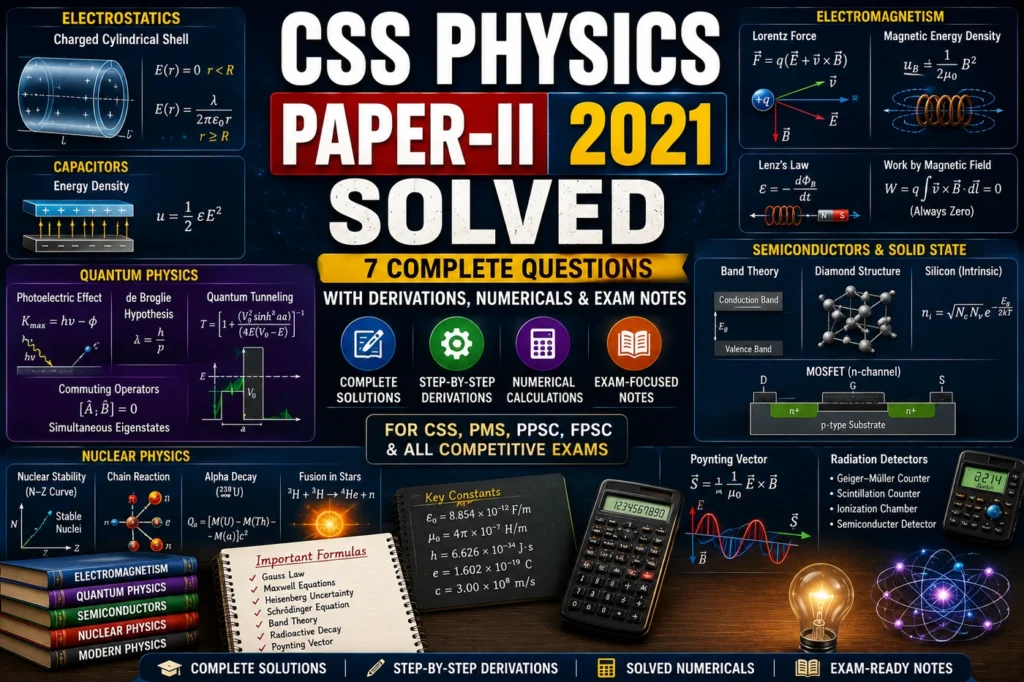
CSS Physics Paper-II 2021 Solved is a complete solved guide for CSS aspirants who need real answers, not short hints. This post solves the subjective section question by question with definitions, derivations, formulas, numerical substitutions, final answers, tables and exam-ready explanations. It covers Gauss law for a charged cylindrical shell, capacitor energy density, Lorentz force, magnetic energy density, Lenz law, work done by magnetic field, dual nature of electron and light, de Broglie hypothesis, photoelectric effect numerical, quantum tunneling through a rectangular barrier, commuting operators, band theory of solids, diamond crystal structure, intrinsic carrier concentration of silicon, nuclear stability, chain reaction in reactors, expected radioactivity of potassium isotope, Poynting vector, fusion in stars and MOSFET.
Central Argument: A CSS Physics solved paper should not only name the topic. It should define the principle, derive the equation, show the numerical working and explain the physical meaning. Therefore, this CSS Physics Paper-II 2021 Solved post gives the complete route to each answer so students can reproduce the solution in the examination hall.
Formatting Note: All equations in this post are written as clean visible equation lines rather than dark formula boxes. This keeps symbols, powers, units, inequalities and numerical values readable inside WordPress on both mobile and desktop screens.
CSS Physics Paper-II 2021 Solved Study Scope
This post covers CSS Physics Paper-II 2021 Solved in a complete, structured and WordPress-ready format. Each question includes the printed question, part-wise solution, formulas, mathematical working, final answer and examiner-friendly explanation.
Use this solved paper as a study document. First revise the formula sheet, then read Q2 to Q8 one by one. After reading, close the post and rewrite each solution from memory. CSS Physics rewards clean definitions, correct assumptions, dimensional accuracy, correct units and disciplined presentation.
Show Table of Contents
- Overview
- Study Scope
- Important Formula Sheet
- Question Map
- Question 2: Cylindrical Charged Shell, Capacitor Energy Density and Lorentz Force
- Question 3: Magnetic Energy Density, Lenz Law and Magnetic Work
- Question 4: Dual Nature, de Broglie Hypothesis and Photoelectric Effect
- Question 5: Rectangular Barrier and Commuting Operators
- Question 6: Band Theory, Diamond Structure and Silicon Carrier Concentration
- Question 7: Nuclear Stability, Chain Reaction and Potassium Radioactivity
- Question 8: Poynting Vector, Fusion in Stars and MOSFET
- Revision Plan
- Internal and External Resources
- FAQs
Important Formula Sheet for CSS Physics Paper-II 2021 Solved
Electrostatics
∮E·dA = Qenc/ε0
E(2πrL) = Qenc/ε0
uE = (1/2)εE²
F = q(E + v×B)
Magnetism
U = (1/2)LI²
uB = B²/(2μ)
ε = -N dΦB/dt
FB = q(v×B)
Quantum Physics
λ = h/p
Eγ = hc/λ
Kmax = hf - φ
κ = √[2m(V0-E)]/ℏ
Solid State and Nuclear Physics
ni = √(NcNv)e^[-Eg/(2kT)]
N/Z stability ratio
k = neutrons in one generation / neutrons in previous generation
4¹H → ⁴He + 2e⁺ + 2ν + energy
Question Map of CSS Physics Paper-II 2021 Solved
| Question | Main Area | What Is Fully Solved |
|---|---|---|
| Q2 | Electrostatics and charged particles | Electric field of charged cylindrical shell with axial line charge, capacitor energy density and Lorentz force. |
| Q3 | Electromagnetism | Magnetic energy density of an inductor, Lenz law and reason magnetic force does no work. |
| Q4 | Modern physics | Dual nature of electron and light, de Broglie hypothesis and photoelectric-effect numerical. |
| Q5 | Quantum mechanics | Transmission coefficient for rectangular potential barrier and meaning of commuting operators. |
| Q6 | Solid state physics | Band theory of conduction, diamond crystal structure and intrinsic carrier concentration of silicon. |
| Q7 | Nuclear physics | Nuclear stability factors, N-Z stability curve, chain reaction in nuclear reactors and expected potassium isotope radioactivity. |
| Q8 | Notes | Poynting vector, fusion in stars and MOSFET explained in exam-note style. |
Question 2: Cylindrical Charged Shell, Capacitor Energy Density and Lorentz Force
Full Question
Q.2. (a) Consider an infinitely long cylindrical insulating shell of inner radius a and outer radius b having uniform volume charge density ρ. If a line of charge density λ is placed along the axis of the shell, determine the electric field intensity at a point r such that: (i) a < r < b and (ii) r > b.
Q.2. (b) Determine the energy density for a capacitor.
Q.2. (c) Discuss the Lorentz force.
Q2(a): Electric Field of Cylindrical Shell with Axial Line Charge
The charge distribution is cylindrically symmetric. Therefore, the electric field is radial and depends only on the distance r from the common axis. We use Gauss law with a coaxial cylindrical Gaussian surface of radius r and length L.
∮E·dA = Qenc/ε0
For a cylindrical Gaussian surface, the curved area is 2πrL, and the electric field is constant on that surface.
∮E·dA = E(2πrL)
Case 1: a < r < b
For a point inside the material of the cylindrical shell, the Gaussian surface encloses the axial line charge and the volume charge from radius a to radius r.
Charge due to line charge:
Qline = λL
Charge due to cylindrical volume from a to r:
Qvolume = ρπ(r²-a²)L
Total enclosed charge:
Qenc = λL + ρπ(r²-a²)L
Apply Gauss law:
E(2πrL) = [λL + ρπ(r²-a²)L]/ε0
Cancel L:
E(2πr) = [λ + ρπ(r²-a²)]/ε0
Therefore:
E = [λ + ρπ(r²-a²)]/(2πε0r)
a<r<b: E = [λ + ρπ(r²-a²)]/(2πε0r), directed radially outward if the enclosed charge is positive.Case 2: r > b
For a point outside the shell, the Gaussian surface encloses the entire shell and the axial line charge.
Volume charge of the full shell per length L is:
Qvolume = ρπ(b²-a²)L
Total enclosed charge is:
Qenc = [λ + ρπ(b²-a²)]L
Apply Gauss law:
E(2πrL) = [λ + ρπ(b²-a²)]L/ε0
Cancel L:
E = [λ + ρπ(b²-a²)]/(2πε0r)
r>b: E = [λ + ρπ(b²-a²)]/(2πε0r).Q2(b): Energy Density for a Capacitor
Energy stored in a capacitor is:
U = (1/2)CV²
For a parallel plate capacitor:
C = εA/d
The electric field between the plates is:
E = V/d
Therefore:
V = Ed
Substitute C=εA/d and V=Ed in the energy expression:
U = (1/2)(εA/d)(Ed)²
U = (1/2)(εA/d)(E²d²)
U = (1/2)εE²Ad
The volume between the plates is:
Volume = Ad
Energy density is energy per unit volume:
u = U/(Ad)
Therefore:
u = (1/2)εE²
u=(1/2)εE². In vacuum, it is u=(1/2)ε0E².Q2(c): Lorentz Force
The Lorentz force is the total force acting on a charged particle moving in electric and magnetic fields.
F = q(E + v×B)
Here q is charge, E is electric field, v is velocity and B is magnetic field.
Electric Part
The electric force is:
FE = qE
It acts along the electric field for a positive charge and opposite to the field for a negative charge. It can change both the speed and direction of a charged particle.
Magnetic Part
The magnetic force is:
FB = q(v×B)
Its magnitude is:
FB = qvB sinθ
The magnetic force is perpendicular to both v and B. Therefore, it changes the direction of velocity but not the kinetic energy if only the magnetic field acts.
F=q(E+v×B). It explains the motion of charged particles in electric and magnetic fields.Question 3: Magnetic Energy Density, Lenz Law and Magnetic Work
Full Question
Q.3. (a) Find the magnetic energy density for the magnetic field of the inductor.
Q.3. (b) State and explain Lenz’s law.
Q.3. (c) Why is the work done by a magnetic field on a charged particle always zero?
Q3(a): Magnetic Energy Density of an Inductor
The energy stored in an inductor carrying current I is:
U = (1/2)LI²
To find the magnetic energy density, consider a long solenoid. Its inductance is:
L = μ0n²Al
where n is number of turns per unit length, A is cross-sectional area and l is length.
The magnetic field inside a long solenoid is:
B = μ0nI
So:
I = B/(μ0n)
Substitute L and I into U=(1/2)LI²:
U = (1/2)(μ0n²Al)(B²/μ0²n²)
Simplify:
U = B²Al/(2μ0)
The volume of the solenoid is:
Volume = Al
Therefore, magnetic energy density is:
uB = U/(Al)
uB = B²/(2μ0)
In a magnetic medium of permeability μ:
uB = B²/(2μ)
uB=B²/(2μ0) in vacuum and uB=B²/(2μ) in a magnetic medium.Q3(b): Lenz’s Law
Lenz’s law states that the direction of induced current is always such that it opposes the change in magnetic flux that produces it.
Faraday’s law is:
ε = -N dΦB/dt
The negative sign represents Lenz’s law.
Explanation
If magnetic flux through a coil increases, the induced current flows in such a direction that its own magnetic field opposes the increase. If magnetic flux decreases, the induced current flows in such a direction that its own magnetic field tries to maintain the original flux.
Physical Basis
Lenz’s law is a consequence of conservation of energy. If induced current helped the change that produced it, energy would be created from nothing. Since this is impossible, the induced effect must oppose the cause.
Example
When the north pole of a magnet moves toward a coil, the coil produces a north pole facing the magnet to oppose the approach. When the magnet moves away, the coil produces a south pole to oppose the separation.
ε=-N dΦB/dt.Q3(c): Why Magnetic Field Does No Work
The magnetic force on a moving charge is:
FB = q(v×B)
This force is always perpendicular to velocity v. Work done is:
dW = F·dr
Since displacement dr is along velocity and magnetic force is perpendicular to velocity:
FB·dr = 0
or:
W = Fs cos90° = 0
Therefore, a magnetic field cannot change the kinetic energy of a charged particle. It can only change the direction of motion.
Question 4: Dual Nature, de Broglie Hypothesis and Photoelectric Effect
Full Question
Q.4. (a) Describe the properties of an electron and light that show their dual nature.
Q.4. (b) State and explain the de Broglie hypothesis.
Q.4. (c) Metals A, B and C have work functions 2.2 eV, 3.6 eV and 4.8 eV. If light of wavelength 320 nm is incident on these metals, find: (i) which metals exhibit photoelectric effect, and (ii) maximum kinetic energy of photoelectrons in each case.
Q4(a): Dual Nature of Electron and Light
Dual nature means that microscopic entities can show both particle-like and wave-like behaviour. Electrons and light both show this dual character.
Dual Nature of Electron
| Electron as Particle | Electron as Wave |
|---|---|
| It has mass and charge. | It has de Broglie wavelength. |
| It produces tracks in cloud chambers. | It produces diffraction patterns. |
| It is deflected by electric and magnetic fields. | Electron diffraction confirms wave nature. |
| It collides with other particles. | It shows interference under suitable conditions. |
Dual Nature of Light
| Light as Wave | Light as Particle |
|---|---|
| Shows interference. | Shows photoelectric effect. |
| Shows diffraction. | Shows Compton effect. |
| Shows polarization. | Travels in photons of energy E=hf. |
| Explained by electromagnetic wave theory. | Photon momentum is p=h/λ. |
Q4(b): de Broglie Hypothesis
De Broglie proposed that every moving particle has an associated matter wave. The wavelength associated with a particle is called de Broglie wavelength.
λ = h/p
For a non-relativistic particle:
p = mv
Therefore:
λ = h/(mv)
Here, h is Planck’s constant and p is momentum.
Significance
- It connected matter and waves.
- It explained why electrons produce diffraction patterns.
- It became a foundation of wave mechanics.
- It was experimentally confirmed by electron diffraction experiments.
λ=h/p.Q4(c): Photoelectric Effect Numerical
Given:
φA = 2.2 eV
φB = 3.6 eV
φC = 4.8 eV
λ = 320 nm
Photon energy in electron-volts is:
E = hc/λ
Using:
hc = 1240 eV nm
So:
E = 1240/320
E = 3.875 eV
Photoelectric emission occurs if:
E ≥ φ
Metal A
Kmax = E - φA
Kmax = 3.875 - 2.2
Kmax = 1.675 eV
Metal B
Kmax = E - φB
Kmax = 3.875 - 3.6
Kmax = 0.275 eV
Metal C
E = 3.875 eV < 4.8 eV
Therefore, metal C does not emit photoelectrons.
| Metal | Work Function | Photoelectric Emission? | Maximum Kinetic Energy |
|---|---|---|---|
| A | 2.2 eV |
Yes | 1.675 eV |
| B | 3.6 eV |
Yes | 0.275 eV |
| C | 4.8 eV |
No | No emission |
Kmax(A)=1.675 eV and Kmax(B)=0.275 eV.Question 5: Rectangular Barrier and Commuting Operators
Full Question
Q.5. (a) Determine the transmission coefficient for a particle having energy E incident on a rectangular barrier, so that E<V0. The barrier is given by V(x)=+V0 for -a<x<a and V(x)=0 for |x|>a.
Q.5. (b) For an operator Â, we know [Ĥ,Â]=0, where Ĥ is the Hamiltonian operator. What can we conclude about the eigenstates of  and the expectation value <Â>?
Q.5. (c) Give two examples for the operator  in part (b).
Q5(a): Transmission Coefficient for Rectangular Barrier
The barrier has height V0 and extends from x=-a to x=+a. Therefore, its width is:
L = 2a
The particle energy is less than the barrier height:
E < V0
Classically, the particle cannot cross the barrier. Quantum mechanically, the wave function penetrates the barrier and there is a finite probability of transmission.
| Region | Potential | Wave Behaviour |
|---|---|---|
Region I: x<-a |
V=0 |
Incident and reflected travelling waves. |
Region II: -a<x<a |
V=V0 |
Exponentially decaying and growing waves. |
Region III: x>a |
V=0 |
Transmitted travelling wave. |
Define:
k = √(2mE)/ℏ
Inside the barrier:
κ = √[2m(V0-E)]/ℏ
The exact transmission coefficient for a rectangular barrier of width L is:
T = [1 + {V0²sinh²(κL)}/{4E(V0-E)}]⁻¹
Since L=2a:
T = [1 + {V0²sinh²(2κa)}/{4E(V0-E)}]⁻¹
Thick Barrier Approximation
For a thick barrier, the approximate expression is:
T ≈ [16E(V0-E)/V0²] e^(-2κL)
Since L=2a:
T ≈ [16E(V0-E)/V0²] e^(-4κa)
-a to a, T=[1+V0²sinh²(2κa)/(4E(V0-E))]⁻¹, where κ=√[2m(V0-E)]/ℏ.Q5(b): Meaning of [Ĥ,Â]=0
The commutator of two operators is:
[Ĥ,Â] = ĤÂ - ÂĤ
If:
[Ĥ,Â] = 0
then the Hamiltonian and operator  commute.
Main Conclusions
- Simultaneous eigenstates: The Hamiltonian
Ĥand operatorÂcan have common eigenstates. - Conserved quantity: If
Âhas no explicit time dependence, then the expectation value<Â>is constant in time. - Compatible observables: The physical quantities represented by
ĤandÂcan be measured simultaneously with definite values in common eigenstates.
The time variation of expectation value is:
d<A>/dt = (i/ℏ)<[H,A]> + <∂A/∂t>
If:
[H,A] = 0
and:
∂A/∂t = 0
then:
d<A>/dt = 0
[H,A]=0, then A can share eigenstates with H. If A has no explicit time dependence, <A> is constant in time.Q5(c): Examples of Operators That Commute with Hamiltonian
| Operator | When It Commutes with Hamiltonian | Meaning |
|---|---|---|
Linear momentum p |
For a free particle or translationally invariant system. | Momentum is conserved. |
Angular momentum L² or Lz |
For central potentials with spherical symmetry. | Angular momentum is conserved. |
| Parity operator | For symmetric potentials V(x)=V(-x). |
Parity is conserved. |
Question 6: Band Theory, Diamond Structure and Silicon Carrier Concentration
Full Question
Q.6. (a) Describe electrical conduction in different types of solids in terms of band theory.
Q.6. (b) Explain the crystal structure of diamond.
Q.6. (c) Find the carrier concentration of electrons in silicon at a temperature of 25°C.
Q6(a): Electrical Conduction in Solids by Band Theory
Band theory explains electrical conduction in solids using allowed and forbidden energy bands. When atoms combine to form a crystal, individual atomic energy levels split into closely spaced bands.
Important Bands
- Valence band: Highest energy band normally filled with electrons.
- Conduction band: Higher band where electrons are free to move and conduct current.
- Forbidden energy gap: Energy gap between valence and conduction bands.
Conductors
In conductors, the valence band and conduction band overlap, or the conduction band is partially filled. Therefore, many electrons are available for conduction even at ordinary temperatures.
Semiconductors
In semiconductors, the forbidden gap is small. At room temperature, some electrons can jump from the valence band to the conduction band, leaving holes behind. Both electrons and holes contribute to conduction.
Insulators
In insulators, the forbidden gap is large. Electrons cannot easily move from the valence band to the conduction band at ordinary temperatures, so conductivity is very low.
| Solid Type | Band Gap | Conduction | Examples |
|---|---|---|---|
| Conductor | No gap or overlapping bands | High conductivity | Copper, silver, aluminium |
| Semiconductor | Small gap | Moderate conductivity; increases with temperature | Silicon, germanium |
| Insulator | Large gap | Very low conductivity | Diamond, glass, rubber |
Q6(b): Crystal Structure of Diamond
Diamond has a diamond cubic crystal structure. It can be described as a face-centered cubic lattice with a two-atom basis.
Important Features
- Each carbon atom is covalently bonded to four nearest carbon atoms.
- The bonding is tetrahedral.
- Carbon atoms are
sp³hybridized. - The coordination number is 4.
- The structure is very rigid, making diamond extremely hard.
- Diamond has a large band gap, so it behaves as an insulator at ordinary conditions.
Diamond Cubic Description
The diamond structure can be represented as an FCC lattice with two atoms in the basis:
(0,0,0) and (1/4,1/4,1/4)
This means the second atom is displaced by one quarter of the body diagonal from the first.
C
/|\
/ | \
C–C–C
\ | /
\|/
C
Each carbon atom bonds with four neighbours.
sp³ covalent bonding. Each carbon atom has four nearest neighbours.Q6(c): Carrier Concentration of Electrons in Silicon at 25°C
Data Note: The paper text does not provide semiconductor constants. Therefore, the standard room-temperature intrinsic silicon value is used. If detailed constants are required, the carrier concentration may be calculated from ni=√(NcNv)e^[-Eg/(2kT)].
For intrinsic silicon at room temperature, electron concentration equals hole concentration:
n = p = ni
At about 25°C or 300 K, the commonly accepted intrinsic carrier concentration of silicon is approximately:
ni ≈ 1.5×10¹⁰ cm⁻³
Converting into m⁻³:
1 cm⁻³ = 10⁶ m⁻³
ni ≈ 1.5×10¹⁶ m⁻³
Using the Formula
The intrinsic carrier concentration is:
ni = √(NcNv)e^[-Eg/(2kT)]
For silicon near room temperature:
Eg ≈ 1.12 eV
Using standard values gives a result of the order:
ni ≈ 10¹⁰ cm⁻³
25°C is approximately 1.5×10¹⁰ cm⁻³, or 1.5×10¹⁶ m⁻³.Question 7: Nuclear Stability, Chain Reaction and Potassium Radioactivity
Full Question
Q.7. (a) What factors contribute to the stability of a nucleus? Draw and explain the plot of neutron number N versus atomic number Z for stable nuclei.
Q.7. (b) Explain the use of chain reaction in relation to a nuclear reactor.
Q.7. (c) The stable isotope of potassium is given in the scanned text as 19K. What kind of radioactivity do you expect from the isotope written as 18K? Give reasons.
Q7(a): Factors Contributing to Nuclear Stability
Nuclear stability depends on the balance between attractive nuclear force and repulsive electrostatic force between protons. The following factors are important.
1. Neutron-Proton Ratio
For light nuclei, stability usually occurs when:
N ≈ Z
For heavy nuclei, more neutrons are needed to reduce proton-proton repulsion, so stable nuclei have:
N > Z
2. Binding Energy per Nucleon
A nucleus is more stable if its binding energy per nucleon is high. Iron and nickel region nuclei have very high binding energy per nucleon.
3. Pairing Effect
Nuclei with even numbers of protons and even numbers of neutrons are generally more stable than odd-odd nuclei.
4. Magic Numbers
Nuclei with magic numbers of protons or neutrons show extra stability. Common magic numbers are:
2, 8, 20, 28, 50, 82, 126
5. Coulomb Repulsion
In heavy nuclei, repulsion between many protons reduces stability. Extra neutrons help provide nuclear attraction without adding electric repulsion.
N-Z Stability Curve
^
| stable heavy nuclei
| /
| /
| /
| /
| /
| /
| /
| /
| /
|__________/____________________> Z
light nuclei near N = Z
For light nuclei: N ≈ Z
For heavy nuclei: N > Z
Nuclei above the stability band are neutron-rich and tend to undergo beta-minus decay. Nuclei below the stability band are proton-rich and tend to undergo beta-plus decay or electron capture.
N≈Z, while stable heavy nuclei have N>Z.Q7(b): Chain Reaction in a Nuclear Reactor
A nuclear chain reaction occurs when neutrons produced by one fission event cause further fission events. In a reactor, this chain reaction is controlled so that energy is released steadily.
Fission Chain Reaction
For uranium-235:
²³⁵U + ¹n → fission fragments + 2 or 3 neutrons + energy
The released neutrons can strike other uranium nuclei and continue the reaction.
Multiplication Factor
The multiplication factor k describes the chain reaction:
k = neutrons in one generation / neutrons in previous generation
| Condition | Meaning |
|---|---|
k<1 |
Subcritical; reaction dies out. |
k=1 |
Critical; steady controlled reaction. |
k>1 |
Supercritical; reaction increases rapidly. |
Role of Reactor Parts
| Part | Function |
|---|---|
| Fuel | Fissile material such as uranium-235. |
| Moderator | Slows fast neutrons to thermal energies. |
| Control rods | Absorb excess neutrons and control the reaction. |
| Coolant | Removes heat from reactor core. |
| Shielding | Protects surroundings from radiation. |
k=1 using moderator and control rods, so nuclear energy is released in a controlled way.Q7(c): Expected Radioactivity from Potassium Isotope
Interpretation Note: Potassium has atomic number Z=19. The scanned paper phrase “stable isotope of potassium is 19K” appears to refer to potassium by atomic number. The “18K” expression is best interpreted as a proton-deficient or neighbouring potassium-related unstable notation. In standard nuclear-stability logic, if a potassium isotope is proton-rich or neutron-deficient, it tends to move toward stability by positron emission or electron capture.
Stable potassium is mainly ³⁹K. If the intended comparison is between stable potassium and neutron-deficient potassium such as ³⁸K, then:
³⁹K: Z=19, N=20
³⁸K: Z=19, N=19
Compared with stable potassium, ³⁸K is neutron-deficient or proton-rich. Proton-rich nuclei move toward stability by converting a proton into a neutron.
This can occur by positron emission:
p → n + e⁺ + ν
or by electron capture:
p + e⁻ → n + ν
Therefore, the expected radioactivity is:
β⁺ decay or electron capture
β⁺ emission or electron capture to move toward stability.Question 8: Poynting Vector, Fusion in Stars and MOSFET
Full Question
Q.8. Write notes on any two of the following:
(a) Poynting Vector
(b) Fusion in stars
(c) MOSFET
Exam Strategy: The paper asks for any two notes, but all three are solved below so students can choose the two they understand best.
Q8(a): Poynting Vector
The Poynting vector represents the flow of electromagnetic energy per unit area per unit time. It gives both magnitude and direction of energy propagation in an electromagnetic field.
S = E×H
In vacuum:
S = (1/μ0)E×B
The direction of S is perpendicular to both electric field and magnetic field. In an electromagnetic wave, E, B and the direction of propagation are mutually perpendicular.
Unit
Unit of S = W/m²
Energy Density
The electromagnetic energy density is:
u = (1/2)ε0E² + B²/(2μ0)
Poynting Theorem
Poynting theorem is:
∂u/∂t + ∇·S + J·E = 0
It expresses conservation of electromagnetic energy.
S=(1/μ0)E×B gives electromagnetic energy flow per unit area per second.Q8(b): Fusion in Stars
Fusion in stars is the process by which light nuclei combine to form heavier nuclei, releasing enormous energy. In main-sequence stars like the Sun, hydrogen nuclei fuse to form helium.
Main Fusion Reaction
The overall proton-proton chain can be summarized as:
4¹H → ⁴He + 2e⁺ + 2ν + energy
The energy released is about:
26.7 MeV per helium nucleus formed
Why Fusion Requires High Temperature
Protons repel each other due to Coulomb repulsion. Very high temperature and pressure in stellar cores allow protons to come close enough for the nuclear force to act. Quantum tunneling also helps fusion occur at stellar temperatures.
Energy Source of Stars
The mass of the helium nucleus is slightly less than the total mass of four hydrogen nuclei. This mass defect is converted into energy according to Einstein’s relation:
E = Δmc²
Importance of Fusion
- It powers the Sun and stars.
- It produces heavier elements in the universe.
- It maintains hydrostatic equilibrium in stars.
- It explains stellar luminosity and lifetime.
Q8(c): MOSFET
MOSFET stands for Metal-Oxide-Semiconductor Field-Effect Transistor. It is a voltage-controlled device widely used in digital electronics, switching circuits and integrated circuits.
Main Terminals
- Gate: Controls the channel.
- Source: Supplies charge carriers.
- Drain: Collects charge carriers.
- Body/Substrate: Semiconductor base.
Structure
The gate is separated from the semiconductor by a thin oxide layer, usually silicon dioxide. This insulation makes gate current extremely small and input resistance very high.
Working
When gate voltage is applied, it controls the conductivity of the channel between source and drain. In an n-channel enhancement MOSFET, positive gate voltage attracts electrons and forms a conducting channel.
Types of MOSFET
| Type | Explanation |
|---|---|
| n-channel MOSFET | Electrons are main carriers. |
| p-channel MOSFET | Holes are main carriers. |
| Enhancement MOSFET | Normally off; channel forms with gate voltage. |
| Depletion MOSFET | Normally on; gate voltage can reduce channel conduction. |
Applications
- Microprocessors and memory chips.
- Digital logic gates.
- Power switching circuits.
- Amplifiers.
- Voltage regulators and motor control.
Revision Plan for CSS Physics Paper-II 2021 Solved
After reading this complete CSS Physics Paper-II 2021 Solved guide, revise it in three rounds. In the first round, learn the definitions and formulas. In the second round, reproduce each derivation without looking. In the third round, solve the numerical questions again with units and compare your answer with the final result.
| Question | Revision Task |
|---|---|
| Q2 | Derive electric field for a<r<b and r>b, then derive capacitor energy density. |
| Q3 | Derive uB=B²/(2μ0), explain Lenz law and prove magnetic field does no work. |
| Q4 | Compare wave-particle duality, write de Broglie relation and recalculate photoelectric answers. |
| Q5 | Memorize exact barrier transmission coefficient and explain [H,A]=0. |
| Q6 | Compare conductors, semiconductors and insulators; revise diamond structure and silicon carrier concentration. |
| Q7 | Draw the N-Z curve, explain reactor chain reaction and revise potassium isotope radioactivity. |
| Q8 | Prepare any two notes, but revise all three: Poynting vector, fusion in stars and MOSFET. |
Related Resources for CSS Physics Paper-II 2021 Solved
Internal Bellum Report Reading
- CSS Physics Paper-II 2020 Solved
- CSS Physics Paper-II 2022 Solved
- CSS Physics Paper-II 2023 Solved
- CSS Physics Paper-II 2024 Solved
- CSS Physics Paper-I 2026 Solved
- CSS Physics Paper-I 2025 Solved
- CSS Physics Paper-I 2024 Solved
- CSS English Essay Past Paper
- Regulating Act 1773
- Pitt’s India Act 1784
- Charter Act 1853
- Government of India Act 1935
Exam Note: For CSS Physics Paper-II, many answers combine theory and equations. Write definitions first, then formula, then derivation or explanation, and close with one application. This makes answers clearer and more examiner-friendly.
FAQs About CSS Physics Paper-II 2021 Solved
What does CSS Physics Paper-II 2021 Solved include?
CSS Physics Paper-II 2021 Solved includes complete solved answers for Q2 to Q8 with definitions, derivations, numerical calculations, formulas, final answers and exam-ready notes.
What is the electric field for the charged cylindrical shell in Question 2?
For a<r<b, E=[λ+ρπ(r²-a²)]/(2πε0r). For r>b, E=[λ+ρπ(b²-a²)]/(2πε0r).
What is the energy density of a capacitor?
The electric energy density of a capacitor is u=(1/2)εE². In vacuum, it is u=(1/2)ε0E².
What is magnetic energy density?
The magnetic energy density in vacuum is uB=B²/(2μ0). In a medium, it is uB=B²/(2μ).
Which metals show photoelectric effect in Question 4?
For λ=320 nm, photon energy is 3.875 eV. Metals A and B emit photoelectrons; metal C does not.
What are the maximum kinetic energies in the photoelectric question?
For metal A, Kmax=1.675 eV. For metal B, Kmax=0.275 eV. For metal C, there is no emission.
What does [H,A]=0 mean in quantum mechanics?
It means the Hamiltonian and operator A commute. If A has no explicit time dependence, it is conserved and its expectation value remains constant.
What is the intrinsic carrier concentration of silicon at 25°C?
The standard intrinsic carrier concentration of silicon at about room temperature is approximately 1.5×10¹⁰ cm⁻³, or 1.5×10¹⁶ m⁻³.
What radioactivity is expected from neutron-deficient potassium?
Under the standard interpretation, neutron-deficient potassium is proton-rich and is expected to decay by positron emission β⁺ or electron capture.
Can I paste this HTML into WordPress?
Yes. The post avoids an H1 heading so your WordPress post title can remain the only H1. The internal structure begins with H2 and continues with H3/H4 headings.
“`
The Indus Odyssey from Debal to Islamabad
The Ultimate Guide to Pakistan Affairs (711-2025). A focused Kindle guide for CSS, PMS, PCS, PPSC and FPSC Pakistan Affairs preparation.