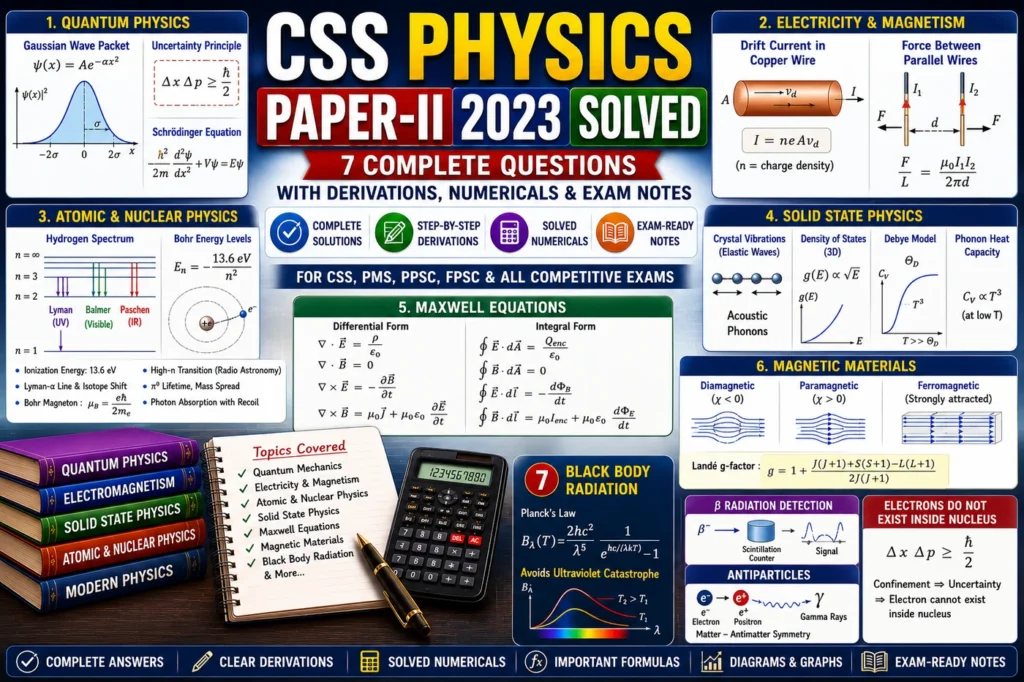
CSS Physics Paper-II 2023 Solved is a complete solved guide for CSS aspirants who need real answers, full derivations and numerical working instead of short hints. This post solves the subjective section question by question with definitions, formulas, substitutions, clean equation lines, final answers, tables and exam-ready explanations. It covers a Gaussian quantum state, normalization, Schrödinger equation, potential energy function, expectation values, uncertainty principle, drift current in copper wires, magnetic force between parallel wires, expressions in fundamental constants, photon absorption with recoil, hydrogen atom energy levels, high-n hydrogen radio transition, elastic vibrations of crystals, density of states in three dimensions, Debye model, phonon heat capacity, Maxwell equations, magnetic materials and black-body radiation.
Central Argument: A CSS Physics solved paper should not only give the final answer. It should show the physical law, the mathematical route, the correct symbols, the unit conversion, the final result and the short interpretation that makes the answer exam-ready. Therefore, this CSS Physics Paper-II 2023 Solved post is written as a complete solution rather than a short answer key.
Symbol Note: The uploaded draft contains OCR distortions in mathematical notation. In this rewritten version, the Gaussian state in Question 2 is interpreted as ψ(x,t)=A exp[-a(mx²/ℏ + it)]. This is the standard minimum-uncertainty Gaussian form consistent with the printed symbols. The final uncertainty part is written as σx and σp, because the uncertainty relation is between position and momentum, not position and y.
CSS Physics Paper-II 2023 Solved Study Scope
This post covers CSS Physics Paper-II 2023 Solved in a complete, structured and WordPress-ready format. Each question includes the printed question, part-wise solution, mathematical working, final answer and examiner-friendly explanation.
The equation style in this post is intentionally simple. Equations are written as normal visible lines, not dark boxes, so every number, symbol, exponent, power and unit remains readable on mobile and desktop WordPress pages.
Show Table of Contents
- Overview
- Study Scope
- Important Formula Sheet
- Question Map
- Question 2: Gaussian Wave State and Uncertainty
- Question 3: Drift Current and Magnetic Force Between Wires
- Question 4: Fundamental Constants Expressions
- Question 5: Photon Absorption and Hydrogen Atom Transitions
- Question 6: Elastic Vibrations of Crystal
- Question 7: Density of States and Debye Model
- Question 8: Maxwell Equations, Magnetic Materials and Black-Body Radiation
- Revision Plan
- Internal and External Resources
- FAQs
Important Formula Sheet for CSS Physics Paper-II 2023 Solved
Quantum Mechanics
∫ |ψ|² dx = 1
<x> = ∫ ψ* x ψ dx
<p> = ∫ ψ* (-iℏ d/dx) ψ dx
σx σp ≥ ℏ/2
Current and Magnetism
I = n e A vd
F/L = μ0 I1 I2/(2πd)
μ0 = 4π×10⁻⁷ N/A²
J = n e vd
Atomic Physics
En = -13.6 eV/n²
ν = R c (1/nf² - 1/ni²)
λ = c/ν
μB = e h/(4πme)
Solid-State Physics
g(k) dk = V k² dk/(2π²)
g(ω) dω = 3Vω² dω/(2π²v³)
ωD³ = 6π²Nv³/V
CV → 3NkB at high temperature
Question Map of CSS Physics Paper-II 2023 Solved
| Question | Main Area | What Is Fully Solved |
|---|---|---|
| Q2 | Quantum mechanics | Normalization constant, potential function, expectation values, uncertainty product and minimum-uncertainty result. |
| Q3 | Electromagnetism | Drift-current calculation, current in copper wire, magnetic force per unit length and current definition. |
| Q4 | Atomic and particle physics | Hydrogen ionization energy, Lyman-alpha isotope shift, Bohr magneton and π0 mass spread from lifetime. |
| Q5 | Atomic physics | Photon absorption with recoil, Bohr derivation of hydrogen energy levels and n=109 to n=108 radio transition. |
| Q6 | Solid-state physics | Elastic wave frequency in a monoatomic crystal and physical description of crystal vibrations. |
| Q7 | Solid-state physics | Density of states in three dimensions, Debye density of states and phonon heat capacity. |
| Q8 | Notes | Maxwell equations, ferro-dia-para magnetic materials and black-body radiation. |
Question 2: Gaussian Wave State and Uncertainty
Full Question
Q.2. A particle of mass m is in the state ψ(x,t)=A e^{-a[(mx²/ℏ)+it]}, where A and a are positive constants. (a) Find A. (b) For what potential energy function V(x) does ψ(x,t) satisfy the Schrödinger equation? (c) Calculate the expectation values of x, x², p and p². (d) Find σx and σp. Is their product consistent with the uncertainty principle?
Q2(a): Normalization Constant A
The given wave function is interpreted as:
ψ(x,t) = A exp[-a(mx²/ℏ + it)]
This can be written as:
ψ(x,t) = A exp[-(am/ℏ)x²] exp[-iat]
Let:
α = am/ℏ
Then:
ψ(x,t) = A e^{-αx²} e^{-iat}
The probability density is:
|ψ(x,t)|² = A² e^{-2αx²}
Normalization requires:
∫₋∞∞ |ψ(x,t)|² dx = 1
So:
A² ∫₋∞∞ e^{-2αx²} dx = 1
Using the Gaussian integral:
∫₋∞∞ e^{-βx²} dx = √(π/β)
Here β=2α, therefore:
A² √(π/(2α)) = 1
Thus:
A² = √(2α/π)
and:
A = (2α/π)¹/⁴
Substitute α=am/ℏ:
A = (2am/(πℏ))¹/⁴
A = (2am/(πℏ))¹/⁴.Q2(b): Potential Energy Function V(x)
The time-dependent Schrödinger equation is:
iℏ ∂ψ/∂t = [-(ℏ²/2m) ∂²/∂x² + V(x)]ψ
For the time part:
ψ(x,t) = ψ(x) e^{-iat}
Therefore:
∂ψ/∂t = -ia ψ
Then:
iℏ ∂ψ/∂t = iℏ(-ia)ψ = ℏa ψ
So the energy eigenvalue is:
E = ℏa
The spatial wave function is:
ψ(x) = A e^{-αx²}
Differentiate:
dψ/dx = -2αx ψ
Differentiate again:
d²ψ/dx² = (-2α + 4α²x²)ψ
Put this in the time-independent Schrödinger equation:
[-(ℏ²/2m)d²/dx² + V(x)]ψ = Eψ
Substitute d²ψ/dx²:
-(ℏ²/2m)(-2α + 4α²x²)ψ + V(x)ψ = Eψ
So:
[(ℏ²α/m) - (2ℏ²α²/m)x² + V(x)]ψ = Eψ
Since α=am/ℏ:
ℏ²α/m = ℏa
and:
2ℏ²α²/m = 2ma²
Therefore:
[ℏa - 2ma²x² + V(x)]ψ = ℏa ψ
Hence:
V(x) = 2ma²x²
This is the potential of a harmonic oscillator because:
V(x) = (1/2)mω²x²
Comparing:
(1/2)mω² = 2ma²
So:
ω = 2a
V(x)=2ma²x². It is a harmonic oscillator potential with angular frequency ω=2a.Q2(c): Expectation Values of x, x², p and p²
The wave function is even in x. Therefore, by symmetry:
<x> = 0
For a normalized Gaussian ψ=Ae^{-αx²}:
<x²> = 1/(4α)
Since α=am/ℏ:
<x²> = ℏ/(4am)
The momentum operator is:
p = -iℏ d/dx
Again by symmetry, the average momentum is:
<p> = 0
The operator for momentum squared is:
p² = -ℏ² d²/dx²
Using:
d²ψ/dx² = (-2α + 4α²x²)ψ
we get:
<p²> = ℏ²α
Substitute α=am/ℏ:
<p²> = amℏ
<x>=0, <x²>=ℏ/(4am), <p>=0, and <p²>=amℏ.Q2(d): σx, σp and Uncertainty Principle
Standard deviation is:
σx = √(<x²> - <x>²)
Since <x>=0:
σx = √(ℏ/(4am))
So:
σx = (1/2)√(ℏ/(am))
Similarly:
σp = √(<p²> - <p>²)
Since <p>=0:
σp = √(amℏ)
Now multiply:
σx σp = [(1/2)√(ℏ/(am))][√(amℏ)]
Therefore:
σx σp = ℏ/2
The uncertainty principle states:
σx σp ≥ ℏ/2
σx=(1/2)√(ℏ/(am)), σp=√(amℏ), and σxσp=ℏ/2. The state satisfies the uncertainty principle exactly and is a minimum-uncertainty Gaussian state.Question 3: Drift Current and Magnetic Force Between Wires
Full Question
Q.3. (a) Consider a pair of copper wires 1 mm in diameter and 5 cm apart. In copper the number of conduction electrons per cubic metre is 8.45×10²⁸. Suppose their mean drift velocity is 0.3 cm/s. Calculate current in each wire. (b) If the wires are 20 cm apart, calculate the magnetic force on the wires. (c) Define electric current in a wire with respect to number of charges and their drift velocity.
Q3(a): Current in Each Copper Wire
The drift-current formula is:
I = n e A vd
Given:
n = 8.45×10²⁸ m⁻³
e = 1.60×10⁻¹⁹ C
diameter = 1 mm = 1×10⁻³ m
radius = 0.5 mm = 0.5×10⁻³ m
vd = 0.3 cm/s = 0.003 m/s
Cross-sectional area is:
A = πr²
A = π(0.5×10⁻³)²
A = 7.85×10⁻⁷ m²
Now calculate current:
I = (8.45×10²⁸)(1.60×10⁻¹⁹)(7.85×10⁻⁷)(0.003)
I ≈ 31.9 A
31.9 A.Q3(b): Magnetic Force Between the Wires
The magnetic force per unit length between two long parallel wires is:
F/L = μ0 I1 I2/(2πd)
Since both wires carry the same current:
I1 = I2 = I = 31.9 A
Given separation:
d = 20 cm = 0.20 m
Also:
μ0 = 4π×10⁻⁷ N/A²
Substitute:
F/L = (4π×10⁻⁷)(31.9)²/(2π×0.20)
F/L ≈ 1.02×10⁻³ N/m
If the currents are in the same direction, the force is attractive. If the currents are in opposite directions, the force is repulsive.
1.02×10⁻³ N/m.Q3(c): Electric Current in Terms of Charges and Drift Velocity
Electric current is the rate of flow of charge through a cross-section of a conductor.
I = dQ/dt
For a wire with charge-carrier number density n, cross-sectional area A, charge of each carrier e, and drift velocity vd, the current is:
I = n e A vd
The current density is:
J = I/A = n e vd
I=neAvd.Question 4: Fundamental Constants Expressions
Full Question
Q.4. Give expressions for the following quantities in terms of e, h, c, k, me and mp: (a) the energy needed to ionize a hydrogen atom; (b) the difference in frequency of the Lyman-alpha line in hydrogen and deuterium atoms; (c) the magnetic moment of the electron; (d) the spread in measurement of the π0 mass, given that the π0 lifetime is τ.
Notation: Here k is used as Coulomb’s constant, k=1/(4πε0). For hydrogen and deuterium, reduced mass is included because the question provides both me and mp.
Q4(a): Energy Needed to Ionize Hydrogen Atom
The ground-state energy of hydrogen-like atom is:
E1 = -2π²k²μe⁴/h²
Therefore, the ionization energy is the magnitude of the ground-state energy:
EI = 2π²k²μH e⁴/h²
For hydrogen:
μH = me mp/(me + mp)
Therefore:
EI(H) = [2π²k²e⁴/h²][me mp/(me + mp)]
EI(H) = [2π²k²e⁴/h²][me mp/(me+mp)].Q4(b): Difference in Frequency of Lyman-Alpha Line in Hydrogen and Deuterium
The Lyman-alpha line corresponds to the transition:
n = 2 → n = 1
The frequency for a transition is:
ν = ΔE/h
For the Lyman-alpha transition:
ΔE = (3/4)(2π²k²μe⁴/h²)
Thus:
ν = (3/4)(2π²k²μe⁴/h³)
For hydrogen:
μH = me mp/(me + mp)
For deuterium, using deuteron mass approximately 2mp:
μD = me(2mp)/(me + 2mp)
Therefore, the difference in frequency is:
Δν = (3/4)(2π²k²e⁴/h³)(μD - μH)
Substitute reduced masses:
Δν = (3/4)(2π²k²e⁴/h³)[2me mp/(me+2mp) - me mp/(me+mp)]
Δν = (3/4)(2π²k²e⁴/h³)(μD-μH), where μH=me mp/(me+mp) and μD=2me mp/(me+2mp).Q4(c): Magnetic Moment of the Electron
The standard magnetic moment unit for the electron is the Bohr magneton:
μB = eℏ/(2me)
Since:
ℏ = h/(2π)
we get:
μB = eh/(4πme)
μB = eh/(4πme).Q4(d): Spread in π0 Mass from Lifetime τ
The energy-time uncertainty relation gives natural energy width:
ΔE ≈ ℏ/τ
Since:
E = mc²
the corresponding mass spread is:
Δm ≈ ΔE/c²
Therefore:
Δm ≈ ℏ/(τc²)
Using ℏ=h/(2π):
Δm ≈ h/(2πτc²)
Δm ≈ h/(2πτc²). Some uncertainty estimates may use ΔEΔt ≥ ℏ/2, but natural linewidth is commonly written as Γ≈ℏ/τ.Question 5: Photon Absorption and Hydrogen Atom Transitions
Full Question
Q.5. (a) An atom is capable of existing in two states: a ground state of mass M and an excited state of mass M+Δ. If the transition from ground to excited state proceeds by absorption of a photon, what must be the photon frequency in the laboratory where the atom is initially at rest? (b) Derive the energy levels of the hydrogen atom from Coulomb’s law and simple quantization of angular momentum. (c) In radio astronomy, hydrogen atoms are observed in radiative transitions from n=109 to n=108. What are the frequency and wavelength of the emitted radiation?
Q5(a): Photon Frequency Required for Absorption
Initial atom is at rest with rest energy:
Ei = Mc² + hν
The photon momentum is:
pγ = hν/c
After absorption, the excited atom has rest mass M+Δ and recoils with momentum equal to photon momentum:
p = hν/c
The final relativistic energy is:
Ef = √[(M+Δ)²c⁴ + p²c²]
Substitute p=hν/c:
Ef = √[(M+Δ)²c⁴ + (hν)²]
Energy conservation gives:
Mc² + hν = √[(M+Δ)²c⁴ + (hν)²]
Let:
x = hν
Then:
Mc² + x = √[(M+Δ)²c⁴ + x²]
Square both sides:
M²c⁴ + 2Mc²x + x² = (M+Δ)²c⁴ + x²
Cancel x²:
2Mc²x = [(M+Δ)² - M²]c⁴
Simplify:
2Mc²x = (2MΔ + Δ²)c⁴
Therefore:
x = Δc²(1 + Δ/(2M))
Since x=hν:
ν = [Δc²/h][1 + Δ/(2M)]
ν = (Δc²/h)(1 + Δ/(2M)). The frequency is slightly higher than Δc²/h because the atom must also recoil.Q5(b): Bohr Derivation of Hydrogen Energy Levels
For an electron in a circular orbit around the proton, Coulomb force provides centripetal force:
ke²/r² = mv²/r
Thus:
mv² = ke²/r
Bohr’s angular momentum quantization condition is:
mvr = nℏ = nh/(2π)
From this:
v = nh/(2πmr)
Substitute into mv² = ke²/r:
m[n²h²/(4π²m²r²)] = ke²/r
Simplify:
n²h²/(4π²mr²) = ke²/r
Therefore:
rn = n²h²/(4π²mke²)
Total energy is:
E = K + U
From the force equation:
K = (1/2)mv² = ke²/(2r)
Potential energy is:
U = -ke²/r
Therefore:
E = ke²/(2r) - ke²/r
E = -ke²/(2r)
Substitute rn:
En = -2π²mk²e⁴/(n²h²)
For hydrogen, this is commonly written as:
En = -13.6 eV/n²
En=-2π²mk²e⁴/(n²h²), or En=-13.6 eV/n².Q5(c): Frequency and Wavelength for n=109 to n=108
For hydrogen spectral transitions:
ν = Rc(1/nf² - 1/ni²)
Here:
ni = 109
nf = 108
R = 1.097×10⁷ m⁻¹
c = 3.00×10⁸ m/s
Therefore:
ν = (1.097×10⁷)(3.00×10⁸)(1/108² - 1/109²)
Calculate:
ν ≈ 5.15×10⁹ Hz
Wavelength is:
λ = c/ν
λ = (3.00×10⁸)/(5.15×10⁹)
λ ≈ 5.82×10⁻² m
λ ≈ 5.82 cm
5.15×10⁹ Hz and wavelength approximately 5.82 cm.Question 6: Elastic Vibrations of Crystal
Full Question
Q.6. (a) Consider the elastic vibrations of a crystal with one atom in the primitive cell and calculate the frequency of an elastic wave in terms of the wavevector that describes the wave and in terms of the elastic constants. (b) Describe vibrations of crystal.
Q6(a): Frequency of Elastic Wave in a Monoatomic Crystal
A crystal with one atom in the primitive cell has three acoustic vibration branches: one longitudinal and two transverse branches. In the long-wavelength limit, lattice vibrations behave like elastic waves in a continuous medium.
The equation of motion for an elastic medium is:
ρ ∂²ui/∂t² = Cijkl ∂²uk/(∂xj∂xl)
Here:
ρis mass density.uiis displacement component.Cijklare elastic constants.
Assume a plane-wave solution:
ui = ui0 exp[i(k·r - ωt)]
Then:
∂²ui/∂t² = -ω²ui
and:
∂²uk/(∂xj∂xl) = -kjkl uk
Substitute into the elastic equation:
ρ ω² ui = Cijkl kj kl uk
This is the Christoffel equation:
(Cijkl kj kl - ρ ω² δik)uk = 0
For non-zero displacement, determinant must vanish:
det|Cijkl kj kl - ρ ω²δik| = 0
This equation gives the allowed frequencies ω for a given wavevector k.
Isotropic Solid Result
For an isotropic medium, there are longitudinal and transverse sound waves.
Longitudinal wave:
ωL = vL k
vL = √[(λ + 2μ)/ρ]
Transverse wave:
ωT = vT k
vT = √(μ/ρ)
Here λ and μ are Lamé elastic constants. In a cubic crystal along a principal axis, the common simplified forms are:
ωL = k√(C11/ρ)
ωT = k√(C44/ρ)
ω=vk. For isotropic crystals, ωL=k√[(λ+2μ)/ρ] and ωT=k√(μ/ρ). In cubic crystals along a principal direction, ωL=k√(C11/ρ) and ωT=k√(C44/ρ).Q6(b): Vibrations of Crystal
Crystal vibrations are collective oscillations of atoms about their equilibrium positions in the lattice. Atoms in a crystal are not fixed permanently; they vibrate due to thermal energy and interatomic forces.
Acoustic and Optical Modes
If a crystal has one atom per primitive cell, it has only acoustic branches. If it has more than one atom per primitive cell, it can also have optical branches.
| Mode | Meaning | Feature |
|---|---|---|
| Acoustic mode | Neighbouring atoms move nearly in phase at long wavelength. | Frequency approaches zero as k→0. |
| Optical mode | Atoms in the basis move against each other. | Frequency remains finite at k=0. |
Phonons
Quantized crystal vibrations are called phonons. A phonon is a quantum of lattice vibrational energy.
E = ℏω
Phonons are important because they explain:
- Specific heat of solids.
- Thermal conductivity in insulators.
- Sound propagation in crystals.
- Electron-phonon interaction.
- Thermal expansion.
Question 7: Density of States and Debye Model
Full Question
Q.7. (a) Discuss density of states in three dimensions. (b) Describe Debye model for density of states. (c) Define phonon heat capacity.
Q7(a): Density of States in Three Dimensions
Density of states means the number of allowed quantum states available in a given interval of wavevector, frequency or energy.
For a particle or wave in a cube of volume V=L³, allowed states in k-space are separated by:
2π/L
The volume occupied by one state in k-space is:
(2π/L)³ = (2π)³/V
The number of states in a spherical shell between k and k+dk is:
g(k)dk = [V/(2π)³] 4πk² dk
Therefore:
g(k)dk = V k² dk/(2π²)
This is the density of states in wavevector space per polarization or per independent branch.
For Free Particles in Energy Space
For free particles:
E = ℏ²k²/(2m)
This means:
k = √(2mE)/ℏ
Therefore, the three-dimensional density of states in energy is proportional to:
g(E) ∝ √E
k-space is g(k)dk=Vk²dk/(2π²). For free particles, g(E)∝√E.Q7(b): Debye Model for Density of States
The Debye model describes lattice vibrations in a solid by treating the solid as a continuous elastic medium at long wavelengths. It replaces the real phonon spectrum with acoustic waves up to a maximum cutoff frequency called the Debye frequency.
For phonons with linear dispersion:
ω = vk
Using k=ω/v and dk=dω/v, the density of states becomes:
g(ω)dω = 3Vω² dω/(2π²v³)
The factor 3 accounts for three acoustic branches.
The total number of vibrational modes in a solid containing N atoms must be:
3N
Therefore, Debye chooses a cutoff frequency ωD such that:
∫₀ωD g(ω)dω = 3N
Using the Debye density of states:
∫₀ωD [3Vω²/(2π²v³)] dω = 3N
This gives:
ωD³ = 6π²Nv³/V
The Debye density of states can also be written as:
g(ω) = 9Nω²/ωD³
for:
0 ≤ ω ≤ ωD
g(ω)=9Nω²/ωD³ up to cutoff frequency ωD, chosen so that the total number of modes is 3N.Q7(c): Phonon Heat Capacity
Phonon heat capacity is the contribution of lattice vibrations to the heat capacity of a solid.
The phonon internal energy is:
U = ∫₀ωD [ℏω/(e^(ℏω/kBT)-1)] g(ω)dω
The phonon heat capacity at constant volume is:
CV = (∂U/∂T)V
Important Results
At high temperature, Debye model gives the Dulong-Petit law:
CV → 3NkB
At low temperature, it gives Debye’s T³ law:
CV = (12π⁴/5)NkB(T/θD)³
3NkB at high temperature and follows CV∝T³ at low temperature.Question 8: Maxwell Equations, Magnetic Materials and Black-Body Radiation
Full Question
Q.8. Write notes on any two of the following: (a) Maxwell’s equations, (b) magnetic materials: ferro-dia-para, (c) black-body radiation.
Exam Strategy: The paper asks for any two notes, but all three are solved below so students can choose the two they understand best.
Q8(a): Maxwell’s Equations
Maxwell’s equations are the four fundamental equations of classical electromagnetism. They combine electricity, magnetism and optics into one unified theory.
| Equation | Integral Form | Differential Form | Meaning |
|---|---|---|---|
| Gauss’s law for electricity | ∮E·dA = Qenc/ε0 |
∇·E = ρ/ε0 |
Electric charges produce electric field. |
| Gauss’s law for magnetism | ∮B·dA = 0 |
∇·B = 0 |
There are no isolated magnetic monopoles. |
| Faraday’s law | ∮E·dl = -dΦB/dt |
∇×E = -∂B/∂t |
A changing magnetic field produces an electric field. |
| Ampere-Maxwell law | ∮B·dl = μ0Ienc + μ0ε0 dΦE/dt |
∇×B = μ0J + μ0ε0∂E/∂t |
Current and changing electric field produce magnetic field. |
Prediction of Electromagnetic Waves
In free space, Maxwell’s equations lead to electromagnetic waves travelling with speed:
c = 1/√(μ0ε0)
This result showed that light is an electromagnetic wave.
c=1/√(μ0ε0).Q8(b): Magnetic Materials — Diamagnetic, Paramagnetic and Ferromagnetic
Magnetic materials are classified according to their response to an external magnetic field.
| Property | Diamagnetic | Paramagnetic | Ferromagnetic |
|---|---|---|---|
| Response | Weakly repelled | Weakly attracted | Strongly attracted |
| Susceptibility | Negative | Small positive | Large positive |
| Magnetic moments | No permanent net moments | Unpaired moments align weakly | Domains align strongly |
| After field removal | No magnetization retained | No magnetization retained | May retain magnetization |
| Examples | Cu, Bi, water | Al, Pt, O₂ | Fe, Co, Ni |
Diamagnetic Materials
Diamagnetic materials develop weak magnetization opposite to the applied magnetic field. Their susceptibility is negative.
Paramagnetic Materials
Paramagnetic materials have atoms or ions with unpaired magnetic moments. These moments align weakly with an applied magnetic field.
Ferromagnetic Materials
Ferromagnetic materials contain magnetic domains. When domains align, strong magnetization appears. They show hysteresis and can form permanent magnets.
Q8(c): Black-Body Radiation
A black body is an ideal body that absorbs all radiation incident on it and emits radiation depending only on its temperature. The radiation emitted by a black body is called black-body radiation.
Experimental Features
- The spectrum is continuous.
- As temperature increases, total emitted energy increases.
- The peak wavelength shifts toward shorter wavelengths at higher temperature.
- The spectrum depends only on temperature, not on material.
Stefan-Boltzmann Law
Total energy radiated per unit area per unit time is:
E = σT⁴
Wien’s Displacement Law
The wavelength of maximum intensity is:
λmax T = b
Rayleigh-Jeans Law and Ultraviolet Catastrophe
Classical physics predicted that energy density should increase without limit at short wavelengths. This failure was called the ultraviolet catastrophe.
Planck’s Quantum Hypothesis
Planck solved the problem by assuming that radiation energy is emitted and absorbed in discrete packets:
E = nhf
where n=1,2,3,.... The energy of one quantum is:
E = hf
Planck Radiation Law
Planck’s formula correctly describes black-body radiation:
u(ν,T)dν = [8πhν³/c³][1/(e^(hν/kBT)-1)]dν
E=hf.Revision Plan for CSS Physics Paper-II 2023 Solved
After reading this complete CSS Physics Paper-II 2023 Solved guide, revise it in three rounds. First, learn the formulas. Second, reproduce each derivation without looking. Third, solve the numerical questions again with units.
| Question | Revision Task |
|---|---|
| Q2 | Normalize the Gaussian, derive V(x)=2ma²x², and prove σxσp=ℏ/2. |
| Q3 | Recalculate I=31.9 A and F/L=1.02×10⁻³ N/m. |
| Q4 | Memorize expressions for hydrogen ionization, Lyman-alpha isotope shift, Bohr magneton and π0 mass spread. |
| Q5 | Derive photon absorption recoil formula, Bohr levels and radio transition frequency. |
| Q6 | Write elastic wave equation and explain acoustic phonons. |
| Q7 | Derive g(k), Debye g(ω) and low-temperature heat capacity law. |
| Q8 | Prepare any two notes, but revise all three for safety. |
Related Resources for CSS Physics Paper-II 2023 Solved
Internal Bellum Report Reading
- CSS Physics Paper-II 2020 Solved
- CSS Physics Paper-II 2021 Solved
- CSS Physics Paper-II 2022 Solved
- CSS Physics Paper-II 2024 Solved
- CSS Physics Paper-I 2026 Solved
- CSS Physics Paper-I 2025 Solved
- CSS Physics Paper-I 2024 Solved
- CSS English Essay Past Paper
- Regulating Act 1773
- Pitt’s India Act 1784
- Government of India Act 1935
Exam Note: For CSS Physics Paper-II, do not write only formulas. Define the concept, state the law, show the equation, substitute values carefully and end with the final answer plus unit. In derivation questions, every symbol should be introduced before use.
FAQs About CSS Physics Paper-II 2023 Solved
What does CSS Physics Paper-II 2023 Solved include?
CSS Physics Paper-II 2023 Solved includes complete solved answers for Q2 to Q8 with definitions, derivations, numerical calculations, equations, final answers and exam-ready notes.
What is the normalization constant in Question 2?
For the interpreted Gaussian state ψ=Ae^{-(am/ℏ)x²}e^{-iat}, the normalization constant is A=(2am/(πℏ))¹/⁴.
What potential energy function satisfies the Schrödinger equation in Question 2?
The required potential energy function is V(x)=2ma²x², which is a harmonic oscillator potential with angular frequency ω=2a.
What is the uncertainty product for the Gaussian state?
The result is σxσp=ℏ/2, so the state is a minimum-uncertainty wave packet.
What is the current in each copper wire in Question 3?
Using I=neAvd, the current is approximately 31.9 A.
What is the magnetic force per unit length between the wires?
For separation 0.20 m, the force per unit length is approximately 1.02×10⁻³ N/m.
What is the hydrogen transition frequency from n=109 to n=108?
The transition frequency is approximately 5.15×10⁹ Hz, and the wavelength is approximately 5.82 cm.
What is the Debye density of states?
In Debye model, the phonon density of states can be written as g(ω)=9Nω²/ωD³ for 0≤ω≤ωD.
Can I paste this HTML into WordPress?
Yes. The post avoids an H1 heading so your WordPress post title can remain the only H1. The internal structure begins with H2 and continues with H3/H4 headings.
“`
The Indus Odyssey from Debal to Islamabad
The Ultimate Guide to Pakistan Affairs (711-2025). A focused Kindle guide for CSS, PMS, PCS, PPSC and FPSC Pakistan Affairs preparation.