Assistant Registrar Cooperative Societies English Essay Outline
- CSS Physics Paper-II 2026 Solved
- CSS Physics Paper-II 2025 Solved
- CSS Physics Paper-II 2024 Solved
- CSS Physics Paper-II 2023 Solved
- CSS Physics Paper-II 2021 Solved
- Introduction: cooperation as a democratic instrument of rural transformation
- Thesis statement
- Meaning of cooperative societies
- Principles of cooperation: voluntary membership, democratic control and mutual benefit
- Meaning of rural development
- Why rural development matters for Pakistan
- Pakistan’s rural demography and development challenge
- Agriculture as the backbone of rural Pakistan
- Cooperatives as a bridge between small farmers and markets
- Cooperative societies and access to credit
- Role in reducing dependence on informal moneylenders
- Cooperatives and collective purchase of inputs
- Fertilizer, seed, machinery and pesticide access through cooperatives
- Cooperatives and agricultural mechanization
- Cooperative marketing and better prices for farmers
- Dairy cooperatives and livestock development
- Women’s participation through rural cooperatives
- Cooperatives and youth employment
- Cooperatives and poverty reduction
- Cooperatives and food security
- Cooperatives and climate-resilient agriculture
- Water-user associations and irrigation management
- Cooperatives and rural savings culture
- Cooperatives and community infrastructure
- Punjab’s cooperative movement: potential and decline
- Cooperative societies in Punjab: figures, members and working capital
- Lessons from successful cooperative models such as Amul
- Why cooperatives remain weak in Pakistan
- Political interference and elite capture
- Weak governance, poor audits and lack of transparency
- Limited access to modern finance and technology
- Low literacy and lack of cooperative awareness
- Digital cooperatives and new rural economy
- Counterargument: cooperatives often fail in Pakistan
- Response: failure is due to governance, not the cooperative idea
- Policy recommendations
- Conclusion: cooperatives as engines of inclusive rural development
Essay
Rural development is not possible through individual struggle alone. In villages, most people are small farmers, tenants, livestock owners, labourers, artisans, shopkeepers and women working in informal economic roles. They often lack capital, bargaining power, modern technology, market access, storage facilities, transport, insurance and institutional support. A single small farmer cannot bargain effectively with input dealers, middlemen, banks, mill owners or exporters. A single milk producer cannot easily build a cold chain. A single woman in a village cannot easily access credit, training or markets. But when rural people organize themselves collectively, their weakness can become strength. This is the central philosophy of cooperative societies.
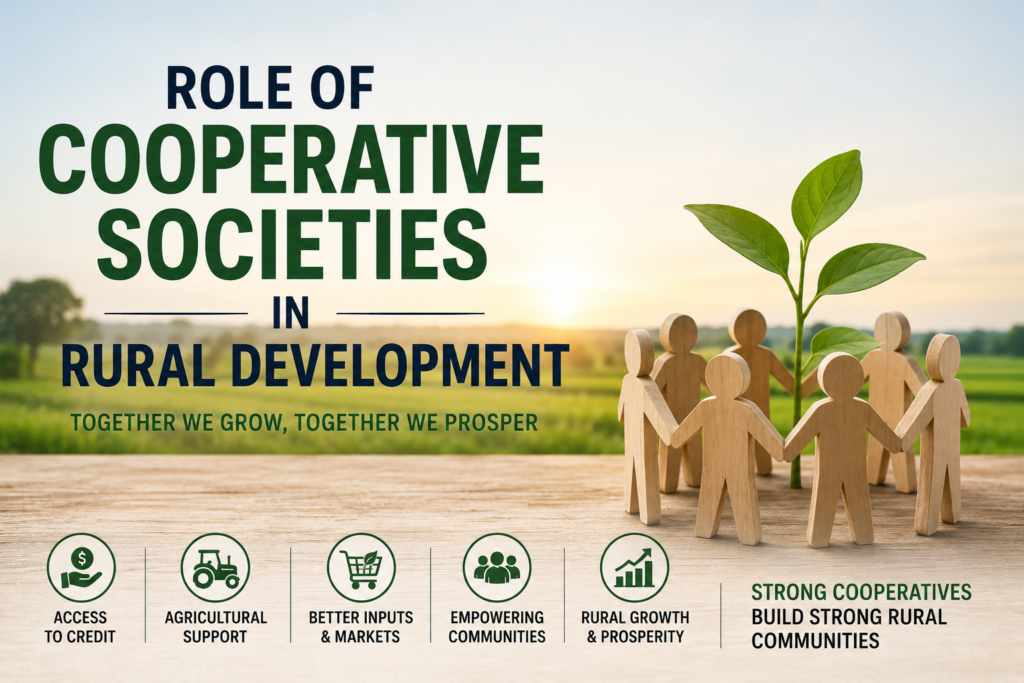
Cooperative societies are democratic, member-owned and community-based institutions created by people who voluntarily unite to meet common economic, social and cultural needs. They are not charity organizations, nor are they ordinary profit-maximizing companies. Their purpose is mutual benefit. In rural areas, they can provide credit, inputs, marketing, storage, machinery, dairy collection, irrigation management, women’s enterprise, savings, insurance and community services. Properly governed, cooperatives can convert scattered rural producers into organized economic actors.
The thesis of this essay is that cooperative societies can play a transformative role in rural development by empowering small farmers, improving access to credit, reducing exploitation by middlemen, supporting agricultural modernization, strengthening food security, promoting women’s participation, creating rural employment and building community resilience. However, in Pakistan, especially Punjab, their potential has been weakened by political interference, poor governance, elite capture, weak audits, limited modernization and lack of public trust. Therefore, rural development requires a revival of cooperatives through transparency, digitalization, professional management, inclusive membership, financial reform and strong regulatory oversight.
The cooperative idea is based on simple but powerful principles: voluntary membership, democratic control, economic participation, autonomy, education, cooperation among cooperatives and concern for community. These principles distinguish cooperatives from both state-run departments and private corporations. A private company generally works for shareholders. A government department works through bureaucracy. A cooperative works for its members, who are both owners and users of the institution. This dual identity makes cooperatives especially suitable for rural societies, where trust, community networks and shared needs are important.
Rural development refers to the improvement of economic, social and institutional conditions in rural areas. It includes better agricultural productivity, higher incomes, employment, education, health, roads, irrigation, drinking water, women’s empowerment, local enterprise, digital connectivity and reduced poverty. It is not limited to agriculture, although agriculture remains central. Rural development means giving village communities the capacity to live with dignity, produce efficiently, participate in markets and benefit from national progress.
For Pakistan, rural development is not optional. The World Bank’s data show that around 61.6 percent of Pakistan’s population was rural in 2024, meaning that a majority of Pakistanis still live outside urban centres. Pakistan’s Economic Survey records the 2023 census population at about 241.5 million, with a large youth population; this makes rural employment and productivity central to national stability. A country where most people remain connected to rural life cannot achieve inclusive development if villages remain poor, under-financed and disconnected from markets.
Agriculture is the backbone of rural Pakistan. The Pakistan Economic Survey 2024–25 reported that agriculture showed only 0.56 percent growth in FY2025, mainly supported by livestock, while important crops faced pressure. Earlier official survey data show agriculture contributing around 24 percent of GDP and 37.4 percent of employment, demonstrating its importance for growth, jobs and poverty reduction. When agriculture performs poorly, rural income falls, food prices rise, industrial raw materials decline and poverty deepens. Therefore, strengthening rural institutions is an economic necessity.
Cooperative societies are important because Pakistan’s rural economy is dominated by small and fragmented producers. Small farmers often cannot buy inputs in bulk, cannot store produce, cannot wait for better market prices, cannot access formal banks easily and cannot negotiate with powerful buyers. Middlemen exploit this weakness by providing informal credit at high cost and then buying crops cheaply. Cooperatives can break this cycle by pooling demand, resources and bargaining power.
One of the most important roles of cooperative societies is providing access to credit. Rural credit is essential for seeds, fertilizers, pesticides, livestock, tube wells, machinery, transport and household needs between sowing and harvesting. Formal banks often avoid small farmers because they lack collateral, documentation or credit history. Informal moneylenders fill the gap but charge exploitative rates or tie farmers into unfair crop-sale arrangements. A well-run cooperative credit society can mobilize savings, assess local creditworthiness, provide loans on reasonable terms and recover through community accountability.
In Punjab’s history, cooperative credit has been one of the major functions of cooperative institutions. The Punjab Cooperative Bank and primary cooperative societies were created to provide agricultural credit and support small farmers. Academic analysis of cooperatives in Pakistan notes that Punjab’s cooperative credit system was historically linked with loans released to primary societies through institutional arrangements backed by the provincial government. However, this system has often struggled due to weak recovery, politicized lending and limited savings mobilization. The lesson is not that cooperative credit is useless; the lesson is that it must be professionally managed and transparently supervised.
Cooperatives can also reduce the cost of agricultural inputs. Fertilizer, certified seed, pesticides, diesel, electricity, animal feed and machinery services are expensive for small farmers. When purchased individually, farmers have little bargaining power. Cooperative societies can buy inputs in bulk and distribute them to members at fair prices. They can also reduce fake or low-quality inputs by dealing directly with certified suppliers. In a country where input prices strongly influence crop productivity and farmer income, cooperative input supply can make a real difference.
Agricultural mechanization is another area where cooperatives matter. Small farmers often cannot afford tractors, harvesters, laser land levellers, planters, threshers, rice transplanters, silage machines or modern irrigation tools. If every farmer tries to buy machinery individually, costs become unbearable and machines remain underutilized. Cooperative machinery pools or custom-hiring centres can allow farmers to rent equipment at affordable rates. This improves productivity, reduces labour bottlenecks and helps timely sowing and harvesting.
Punjab’s experience with crop residue machinery shows both the promise and weakness of collective models. Reporting on Punjab’s stubble-management machinery noted that custom hiring centres received higher subsidies than individual ownership, but many farmers still preferred personal machines because some centres failed to provide timely services during the short window between paddy harvesting and wheat sowing. The same report stated that thousands of custom hiring centres and machines had been supported, while cooperative societies also received machinery. This example proves that cooperative mechanization can work only if machinery centres are efficient, well-maintained, professionally staffed and accountable to members.
Cooperative marketing is perhaps the most powerful instrument of rural development. Farmers often sell immediately after harvest because they need cash and lack storage. Middlemen buy at low prices and earn higher margins later. Cooperatives can help farmers grade, store, process, transport and market produce collectively. They can connect farmers with mills, supermarkets, exporters and government procurement systems. Collective marketing increases bargaining power and allows farmers to capture a higher share of the final price.
Dairy cooperatives provide a strong example of how cooperation can transform rural economies. Milk is produced daily by millions of small households, especially women. Without cold chains and organized collection, farmers sell milk to local collectors at low prices. Dairy cooperatives can collect milk, test quality, chill it, process it and sell it under a collective brand. India’s Amul model is globally recognized for transforming small milk producers into an organized dairy economy. Reuters reported in 2025 that Amul is owned by 3.6 million Indian farmers and is often cited as a successful cooperative model that maintained farmer returns while building processing and marketing infrastructure. Pakistan, with its large livestock base, can learn from this model.
Livestock is especially important for rural Pakistan. The Economic Survey 2024–25 reported that livestock growth was 4.72 percent, making it the main driver of agriculture’s positive performance in FY2025. Livestock supports milk, meat, hides, transport, manure and household income. Women are deeply involved in livestock care. Cooperative dairy societies can therefore promote both income generation and women’s economic participation. If milk collection, veterinary support, feed supply and chilling facilities are organized cooperatively, rural households can earn more stable income.
Women’s empowerment is one of the most important but neglected dimensions of cooperative development. Rural women work in livestock management, crop care, seed cleaning, kitchen gardening, embroidery, food processing and household enterprise. Yet they often lack property rights, bank accounts, mobility, training and market access. Women’s cooperatives can provide savings groups, microcredit, skill development, collective marketing and social support. They can help women sell dairy products, handicrafts, pickles, garments, poultry and processed foods. Economic participation strengthens women’s voice within households and communities.
Cooperatives can also create youth employment. Pakistan’s youth bulge is both an opportunity and a threat. If rural youth remain unemployed, they migrate to cities or abroad, or become trapped in low-wage informal work. Modern cooperatives can create jobs in input supply, digital recordkeeping, machinery services, storage, food processing, dairy collection, packaging, e-commerce, transport and renewable energy. A village cooperative can become a small rural enterprise hub if connected with technology and finance.
Poverty reduction is another central contribution. Rural poverty is often caused by low productivity, debt, lack of assets, market exploitation and vulnerability to shocks. Cooperatives address these problems collectively. They reduce transaction costs, improve access to services, strengthen savings and increase bargaining power. The United Nations has recognized cooperatives as contributors to poverty reduction, employment generation and social integration, and 2025 was declared the International Year of Cooperatives under the theme “Cooperatives Build a Better World.” This global recognition shows that cooperatives remain relevant in the modern development agenda.
Cooperatives also support food security. Food security depends on production, affordability, access and stability. By helping farmers access inputs, credit, technology and markets, cooperatives can increase production and reduce losses. Storage cooperatives can reduce post-harvest waste. Dairy cooperatives can improve milk supply. Seed cooperatives can distribute climate-resilient varieties. Marketing cooperatives can improve farmer income and stabilize supply chains. In a country facing food inflation and climate shocks, cooperative organization can make food systems more resilient.
Climate change makes cooperatives even more necessary. Small farmers face floods, droughts, heatwaves, pests, water stress and changing rainfall patterns. Individually, they cannot easily invest in adaptation. Cooperatives can support climate-smart agriculture by promoting drought-resistant seeds, shared irrigation technology, weather advisories, crop insurance, collective water management and disaster recovery funds. They can also organize community-level responses during floods by identifying vulnerable households, protecting livestock and coordinating relief.
Water-user associations and irrigation cooperatives are important for water management. Pakistan’s agriculture depends heavily on irrigation, but water distribution is often inefficient and unequal. Tail-end farmers may receive less water. Watercourses may be poorly maintained. Cooperatives can help manage local irrigation channels, schedule water turns, repair watercourses, promote efficient irrigation and reduce conflicts. Since water scarcity is becoming one of Pakistan’s greatest rural challenges, cooperative water governance should be strengthened.
Cooperatives can promote a rural savings culture. Many rural households save informally in livestock, gold, cash or rotating committees. Cooperative savings societies can mobilize small savings and convert them into local investment. This reduces dependence on external credit and creates community-owned capital. However, savings cooperatives require strict regulation, transparent accounts and trust. If mismanaged, they can destroy public confidence. Therefore, financial cooperatives must be audited professionally and monitored carefully.
Community infrastructure is another area where cooperatives can help. Villagers can organize cooperatives for rural roads, drinking water schemes, sanitation, solar energy, storage houses, small markets and community centres. In many countries, cooperatives have contributed to electricity distribution, housing, water supply and health services. In Pakistan, rural communities often wait for government schemes that are delayed or politicized. Cooperative self-help, supported by government matching grants, can accelerate local development.
Punjab’s cooperative movement has both history and potential. The Punjab Cooperatives Department defines a cooperative as an autonomous association of persons voluntarily cooperating for mutual social, economic and cultural benefit. The Cooperative Societies Act, 1925, as applicable and amended in Punjab, provides the legal basis for registration and regulation of societies. This legal foundation shows that cooperatives are not new to Punjab. They are an established institutional model that needs revival and modernization.
Punjab’s cooperative network remains numerically significant. A 2025 report in The Nation stated that Punjab had 32,792 cooperative societies, 1.71 million members, and working capital of about Rs 29.138 billion. The same report argued that despite this scale, the cooperative movement had struggled to keep pace with changing economic dynamics and had become increasingly dormant in many areas. These figures are important because they show both capacity and underperformance. Punjab does not need to invent cooperatives from zero; it needs to reactivate and reform them.
The global cooperative movement also offers important lessons. The United Nations International Year of Cooperatives 2025 emphasized that cooperatives support sustainable development and help achieve the Sustainable Development Goals. Reuters reported in 2025 that more than three million cooperatives operate globally and employ around 10 percent of the global workforce, showing that cooperatives are not outdated institutions but major economic actors. Pakistan should study successful models in dairy, fertilizer, credit, housing, fisheries and worker cooperatives rather than treating cooperatives as old bureaucratic files.
However, the cooperative movement in Pakistan has faced serious weaknesses. Political interference is one of the biggest. Cooperative societies are supposed to be member-controlled, but they can be captured by local elites, politically connected individuals or dominant families. When leadership becomes unaccountable, ordinary members lose trust. Loans may be distributed politically. Elections may become symbolic. Records may be manipulated. Instead of empowering the poor, a captured cooperative can reproduce village inequality.
Weak governance and poor audits are another major problem. Cooperatives depend on trust. If accounts are not transparent, members suspect corruption. If audits are delayed, mismanagement grows. If regulators are weak or corrupt, dishonest office bearers exploit members. Many cooperative failures are not failures of the cooperative principle but failures of governance. Professional accounting, digital records, annual public audits and member access to financial information are essential.
Another weakness is lack of professional management. Rural cooperatives often rely on volunteers or local office bearers without training in finance, marketing, law, technology or business planning. In the modern economy, cooperatives must compete with private firms, digital platforms, banks and supply chains. Good intentions are not enough. Cooperative managers need training in bookkeeping, procurement, marketing, digital payments, inventory management and conflict resolution.
Limited access to capital also restricts cooperatives. Many societies lack funds to invest in machinery, storage, processing units, cold chains or digital systems. Commercial banks may not trust them. Government support may be insufficient or politicized. Development finance institutions and provincial governments should design special credit lines for well-governed cooperatives, linked with strict auditing and performance standards. Capital should reward transparency.
Low literacy and lack of cooperative awareness are also barriers. Many rural people do not fully understand their rights as members. They may not attend meetings, question accounts or participate in elections. This allows elites to dominate. Cooperative education is therefore essential. Members should know that a cooperative is not a government subsidy office; it is their own institution. They must understand membership rights, voting, profit-sharing, savings, loan obligations and accountability.
Digitalization offers a new opportunity. Modern cooperatives should use mobile banking, digital ledgers, biometric membership verification, online procurement, e-commerce, weather apps and transparent dashboards. A farmer cooperative can send market prices to members through mobile messages. A dairy cooperative can record milk quality and payments digitally. A machinery cooperative can schedule equipment bookings through an app. Digital tools can reduce corruption, improve efficiency and attract youth.
Cooperatives can also support rural industrialization. Pakistan’s villages produce raw materials but often lose value addition to urban centres. Cotton becomes textiles elsewhere; milk becomes packaged products elsewhere; fruits and vegetables are sold unprocessed; livestock products are marketed through informal chains. Rural cooperatives can establish small processing units for milk, fruit drying, flour milling, oil extraction, embroidery, handicrafts, packaging and cold storage. This creates jobs near villages and reduces migration pressure.
A strong counterargument is that cooperatives often fail in Pakistan. Critics say they become corrupt, politicized, inefficient and dormant. They argue that private markets are more efficient and that government-backed cooperatives become another source of patronage. This criticism cannot be ignored. Pakistan has seen many weak societies, poor recoveries, elite capture and mistrust. However, the failure of some cooperatives does not prove the failure of the cooperative idea. It proves the failure of governance, regulation and modernization. Private markets also fail when monopolies exploit farmers, and government departments also fail when bureaucracy becomes inefficient. The correct response is reform, not abandonment.
For cooperatives to play their role in rural development, Pakistan needs a clear reform agenda. First, cooperative laws should be updated to reflect modern needs while preserving democratic principles. Second, all societies should maintain digital records of membership, accounts, loans, assets and meetings. Third, independent audits should be mandatory and publicly accessible to members. Fourth, cooperative elections should be transparent and protected from local elite manipulation. Fifth, women and small farmers should be guaranteed meaningful representation.
Sixth, the state should support cooperative education. Training centres should teach members and managers about governance, finance, marketing, digital tools and legal rights. Seventh, cooperative credit should be linked with repayment discipline and business planning, not political pressure. Eighth, government subsidies for machinery, storage and inputs should prioritize well-performing cooperatives with transparent accounts. Ninth, agricultural universities, extension departments and cooperatives should work together to spread climate-smart agriculture.
Tenth, Punjab should launch a cooperative revival programme focused on dairy, machinery pools, seed production, water-user groups, women’s enterprise and crop marketing. Since Punjab already has a large number of societies and members, reform can produce quick gains if properly implemented. The provincial government should identify active, inactive and dormant societies, merge or close non-functional ones, and support viable cooperatives with technology and credit. Cooperative development should be connected with food security, climate adaptation and rural employment.
Eleventh, Pakistan should learn from international models without copying them blindly. Amul’s success in India came from farmer ownership, professional management, quality control, branding, processing infrastructure and political support without destroying cooperative autonomy. Pakistan can develop its own dairy cooperatives in Punjab and Sindh, but they must be built around transparency and market competitiveness. Cooperative branding can help Pakistani farmers capture more value.
Twelfth, cooperatives should be connected with export opportunities. Rice growers, mango producers, citrus farmers, dairy producers, fish farmers and handicraft workers can benefit from collective quality control and certification. Export markets require standards, packaging, traceability and consistency. Individual small producers cannot easily meet these requirements. Cooperatives can aggregate supply and ensure compliance.
Finally, rural cooperatives should be seen not as old-fashioned institutions but as modern platforms of inclusive development. In an age of climate shocks, food insecurity, rural poverty and youth unemployment, cooperation is not backward. It is practical. The individual small farmer is weak in the market, but organized farmers can become powerful. The isolated rural woman is excluded, but women’s cooperatives can create voice and income. The unemployed rural youth is frustrated, but digital cooperatives can create new services and enterprises.
In conclusion, cooperative societies can play a vital role in rural development by transforming scattered individuals into organized communities. They can provide credit, inputs, machinery, marketing, dairy services, savings, women’s enterprise, water management, climate adaptation and rural employment. They can reduce poverty, improve food security and strengthen local democracy. For Pakistan, where a majority of people still live in rural areas and agriculture remains central to employment and livelihoods, cooperatives are not merely desirable; they are necessary.
However, cooperatives will not automatically produce development. They require honest leadership, transparent accounts, professional management, member participation and supportive regulation. Pakistan’s experience shows that cooperatives can become dormant or captured when governance is weak. Punjab’s cooperative network, with thousands of societies and more than a million members, represents a major opportunity, but only if revived through reform.
The final lesson is clear: rural development cannot be achieved only through top-down schemes or individual struggle; it requires organized community power. Cooperative societies provide that power. If Pakistan modernizes them, protects them from elite capture and connects them with technology, finance and markets, they can become engines of inclusive rural transformation. If neglected, they will remain files in government offices. The choice before Pakistan is therefore between a dormant cooperative past and a dynamic cooperative future.
The Indus Odyssey from Debal to Islamabad
The Ultimate Guide to Pakistan Affairs (711-2025). A focused Kindle guide for CSS, PMS, PCS, PPSC and FPSC Pakistan Affairs preparation.