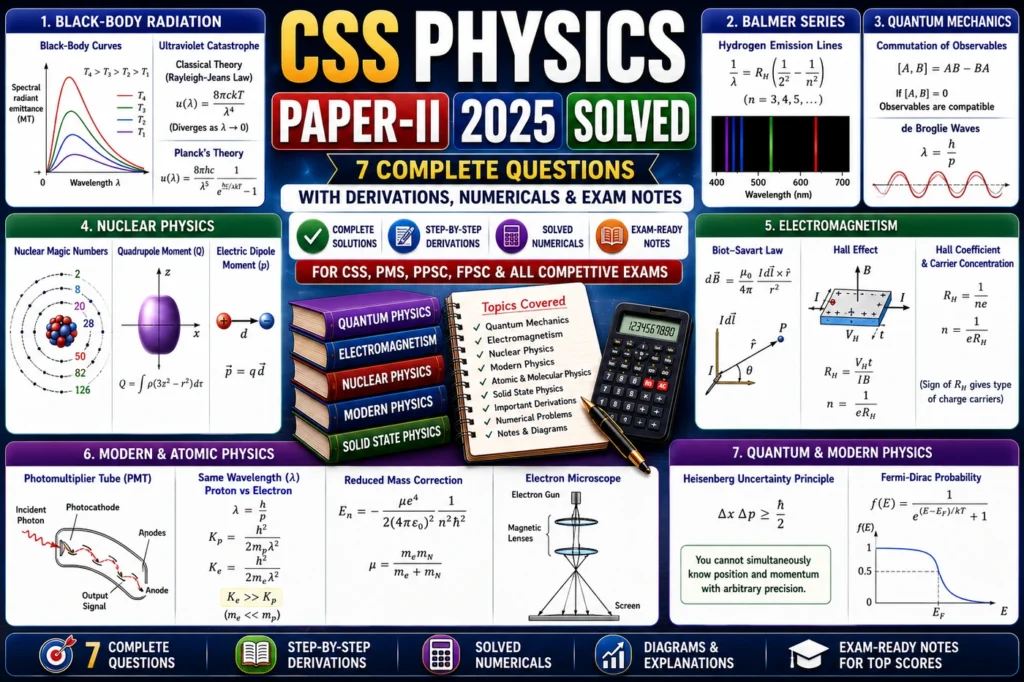
CSS Physics Paper-II 2025 Solved is a complete solved guide for CSS aspirants who need real derivations, correct numerical working and exam-ready explanations. This post solves the subjective section question by question and covers black-body radiation, ultraviolet catastrophe, Balmer series calculation, commutation of observables, de Broglie wave-particle duality, uncertainty principle, nuclear magic numbers, nuclear quadrupole moment, electric dipole moment, Biot-Savart law, Hall effect, carrier concentration, photomultiplier tube, proton-electron kinetic-energy comparison for the same de Broglie wavelength, reduced mass correction, electron microscope and Heisenberg uncertainty principle.
Central Argument: A solved CSS Physics paper should not only give short hints. It should define the concept, show the law, derive the expression, solve the numerical part and close with the physical meaning. This CSS Physics Paper-II 2025 Solved post is written as a full study document for serious CSS Physics revision.
Keyword and Formatting Note: The focus keyword is used naturally in the SEO title, introduction, study scope, FAQ and schema, but it is not repeated in every paragraph. Equations are written as clean visible equation lines, not dark boxes, so symbols, powers and units remain readable in WordPress.
CSS Physics Paper-II 2025 Solved Study Scope
This guide reconstructs the major subjective questions of the paper and provides complete answers in a structured format. Each question includes the printed question, part-wise explanation, derivation, formula work, numerical calculation and final answer wherever numerical data is given.
The post avoids an H1 inside the body so your WordPress post title can remain the only H1. The internal structure begins with H2 and continues through H3 and H4 headings.
Show Table of Contents
- Overview
- Study Scope
- Important Formula Sheet
- Question Map
- Question 2: Black-Body Radiation, Ultraviolet Catastrophe and Balmer Series
- Question 3: Commutation, de Broglie Waves and Uncertainty Principle
- Question 4: Nuclear Magic Numbers and Nuclear Quadrupole Moment
- Question 5: Electric Dipole Moment and Biot-Savart Law
- Question 6: Hall Effect, Sign of Charge Carriers and Carrier Concentration
- Question 7: Photomultiplier Tube and Proton-Electron Energies
- Question 8: Reduced Mass, Electron Microscope and Heisenberg Principle
- Revision Plan
- Internal and External Resources
- FAQs
Important Formula Sheet for CSS Physics Paper-II 2025 Solved
Black-Body Radiation and Spectra
E = hf
E = nhf
λmaxT = b
1/λ = R(1/2² - 1/n²)
Quantum Mechanics
[A,B] = AB - BA
[x,px] = iℏ
λ = h/p
ΔxΔp ≥ ℏ/2
Electromagnetism and Hall Effect
p = qd
τ = p×E
dB = (μ0/4π)(I dl×r̂/r²)
RH = 1/(nq)
de Broglie Energy and Reduced Mass
K = p²/(2m)
K = h²/(2mλ²)
μ = mM/(m+M)
R_M = R∞(μ/me)
Question Map of CSS Physics Paper-II 2025 Solved
| Question | Main Area | What Is Fully Solved |
|---|---|---|
| Q2 | Modern physics and spectra | Black-body radiation properties, ultraviolet catastrophe, Planck explanation and Balmer series fifth and seventh member calculation. |
| Q3 | Quantum mechanics | Commutation between observables, simultaneous measurement, de Broglie matter waves and uncertainty principle. |
| Q4 | Nuclear physics | Magic numbers, nuclear shell model, nuclear quadrupole moment and its significance for nuclear shape. |
| Q5 | Electromagnetism | Electric dipole moment derivation, applications, Biot-Savart law and schematic explanation. |
| Q6 | Solid-state electromagnetism | Hall effect, sign of charge carriers, Hall coefficient and carrier concentration formula. |
| Q7 | Instrumentation and matter waves | PMT construction and working, de Broglie wavelength, electron/proton kinetic-energy comparison for 1 Å. |
| Q8 | Short notes | Reduced mass correction in spectroscopy, electron microscope and Heisenberg uncertainty principle. |
Question 2: Black-Body Radiation, Ultraviolet Catastrophe and Balmer Series
Full Question
Q.2. (a) Discuss the spectral properties of perfect black-body radiation. Explain the ultraviolet catastrophe.
Q.2. (b) Find the fifth and seventh member of Balmer spectral series if the third member is 1200 Å.
Q2(a): Spectral Properties of Perfect Black-Body Radiation
A perfect black body is an ideal body that absorbs all incident radiation and emits the maximum possible radiation at a given temperature. The emitted radiation depends only on temperature, not on the material or surface composition.
Main Spectral Properties
- The spectrum is continuous and contains all wavelengths.
- For a fixed temperature, intensity first increases with wavelength, reaches a maximum and then decreases.
- As temperature increases, the total emitted energy increases rapidly.
- The peak wavelength shifts toward shorter wavelengths when temperature rises.
- The spectral distribution depends only on absolute temperature.
The shift of peak wavelength is described by Wien’s displacement law:
λmaxT = b
Total emitted power per unit area is given by Stefan-Boltzmann law:
E = σT⁴
Ultraviolet Catastrophe
Classical physics tried to explain black-body radiation using the Rayleigh-Jeans law. It worked at long wavelengths but failed badly at short wavelengths. According to the classical result, intensity should increase without limit as wavelength becomes very small.
This impossible prediction of infinite energy at ultraviolet wavelengths is called the ultraviolet catastrophe.
Planck’s Explanation
Max Planck solved the problem by proposing that energy is not emitted continuously. Instead, it is emitted and absorbed in discrete packets called quanta.
E = nhf
For one quantum:
E = hf
This quantum assumption produced the correct black-body spectrum and started quantum theory.
E=hf.Q2(b): Fifth and Seventh Members of Balmer Series
The Balmer series corresponds to electronic transitions ending at n=2. The formula is:
1/λ = R(1/2² - 1/n²)
In the Balmer series:
| Member | Upper Level n |
|---|---|
| 1st member | n=3 |
| 2nd member | n=4 |
| 3rd member | n=5 |
| 5th member | n=7 |
| 7th member | n=9 |
The third member is given as:
λ3 = 1200 Å
For the third member, n=5:
1/λ3 = R(1/4 - 1/25)
1/1200 = R(25-4)/100
1/1200 = R(21/100)
So:
R = 1/[1200(21/100)]
Instead of calculating R separately, use ratio method:
λn = λ3[(1/4 - 1/25)/(1/4 - 1/n²)]
Fifth Member: n=7
λ5 = 1200[(1/4 - 1/25)/(1/4 - 1/49)]
λ5 = 1200[(0.25 - 0.04)/(0.25 - 0.02041)]
λ5 = 1200[0.21/0.22959]
λ5 ≈ 1098 Å
Seventh Member: n=9
λ7 = 1200[(1/4 - 1/25)/(1/4 - 1/81)]
λ7 = 1200[(0.21)/(0.25 - 0.01235)]
λ7 = 1200[0.21/0.23765]
λ7 ≈ 1061 Å
1098 Å and the seventh member is approximately 1061 Å.Exam Note: In the actual hydrogen Balmer series, the third member is normally not 1200 Å. Here the paper’s given value is used as a scaling value, so the answer follows the paper statement.
Question 3: Commutation, de Broglie Waves and Uncertainty Principle
Full Question
Q.3. (a) In quantum mechanics, explain the term commutation between the observables.
Q.3. (b) Explain how de Broglie wave-particle duality laid down the fundamentals of uncertainty principle.
Q3(a): Commutation Between Observables
In quantum mechanics, physical observables such as position, momentum, energy and angular momentum are represented by operators. Two observables commute if the order of applying their operators does not change the result.
The commutator of two operators A and B is:
[A,B] = AB - BA
If:
[A,B] = 0
then the two observables commute.
Meaning of Commuting Observables
- They can have simultaneous eigenfunctions.
- They can be measured simultaneously with definite values.
- No uncertainty relation of the same type is forced between them.
- The order of measurement does not disturb the result in the same way as non-commuting observables.
Non-Commuting Observables
If:
[A,B] ≠ 0
then the observables are generally incompatible. They cannot both have exact definite values in the same state.
A famous example is position and momentum:
[x,px] = iℏ
This non-zero commutator leads to the uncertainty relation:
ΔxΔp ≥ ℏ/2
[A,B]=AB-BA. If [A,B]=0, observables are compatible and may have simultaneous eigenstates. If not, an uncertainty relation may arise.Q3(b): de Broglie Wave-Particle Duality and Uncertainty Principle
De Broglie proposed that every moving particle has an associated matter wave. The wavelength of this wave is:
λ = h/p
where h is Planck’s constant and p is momentum.
This means that particles such as electrons are not merely localized points. They have wave character. A perfectly definite momentum corresponds to a single wavelength, but a single wavelength extends over all space and cannot represent a sharply localized particle.
Wave Packet Argument
To localize a particle, many waves of different wavelengths must be superposed to form a wave packet. The narrower the wave packet in position, the wider the spread of wavelengths and momenta.
Therefore:
- Small uncertainty in position gives large uncertainty in momentum.
- Small uncertainty in momentum gives large uncertainty in position.
This leads to Heisenberg uncertainty principle:
ΔxΔp ≥ ℏ/2
It is not a weakness of measuring instruments. It is a fundamental property of matter waves.
λ=h/p shows that matter has wave nature. A localized particle requires a wave packet with many momentum components, leading directly to ΔxΔp≥ℏ/2.Question 4: Nuclear Magic Numbers and Nuclear Quadrupole Moment
Full Question
Q.4. (a) In the context of nuclear physics, explain the magic numbers.
Q.4. (b) Explain nuclear quadrupole moment and explain its significance.
Q4(a): Magic Numbers in Nuclear Physics
Magic numbers are special numbers of protons or neutrons that make a nucleus unusually stable. They are explained by the nuclear shell model, which says that nucleons occupy shells in a way similar to electrons in atomic shells.
The common nuclear magic numbers are:
2, 8, 20, 28, 50, 82, 126
When a nucleus has a magic number of protons or neutrons, a nuclear shell is complete. Such nuclei are more stable than neighbouring nuclei.
Evidence for Magic Numbers
- Nuclei with magic numbers have higher binding energy.
- They are often more abundant in nature.
- They have lower tendency to capture additional nucleons.
- They often have spherical shapes.
- They show extra stability against nuclear deformation.
Examples
| Nucleus | Magic Feature | Explanation |
|---|---|---|
⁴He |
Z=2, N=2 |
Doubly magic and very stable. |
¹⁶O |
Z=8, N=8 |
Doubly magic nucleus. |
⁴⁰Ca |
Z=20, N=20 |
Doubly magic nucleus. |
²⁰⁸Pb |
Z=82, N=126 |
Heavy doubly magic nucleus. |
2, 8, 20, 28, 50, 82, 126. Nuclei with these numbers show extra stability.Q4(b): Nuclear Quadrupole Moment
Nuclear quadrupole moment measures how much the charge distribution of a nucleus deviates from spherical symmetry. If a nucleus is perfectly spherical, its quadrupole moment is zero.
In simplified form, quadrupole moment is related to charge distribution by:
Q = ∫ρ(r)(3z²-r²)dτ
where ρ(r) is nuclear charge density.
Physical Meaning
| Quadrupole Moment | Nuclear Shape |
|---|---|
Q = 0 |
Spherical charge distribution |
Q > 0 |
Prolate shape, elongated like a rugby ball |
Q < 0 |
Oblate shape, flattened like a discus |
Significance
- It gives information about nuclear shape.
- It helps test the nuclear shell model and collective model.
- It explains hyperfine splitting in atomic spectra.
- It shows interaction of nuclear charge distribution with electric field gradients.
- It helps identify nuclear deformation.
Question 5: Electric Dipole Moment and Biot-Savart Law
Full Question
Q.5. (a) Derive the expression for electric dipole moment. Discuss two uses in modern science.
Q.5. (b) Discuss Biot and Savart law and derive its expression using a suitable schematic figure.
Q5(a): Electric Dipole Moment
An electric dipole consists of two equal and opposite charges separated by a small distance. If charges +q and -q are separated by vector distance d, then electric dipole moment is defined as:
p = qd
The direction of electric dipole moment is from negative charge to positive charge.
-q ——————– +q
separation vector d
Dipole moment p = qd
Direction: from -q to +q
Derivation from Torque in Uniform Electric Field
Place an electric dipole in a uniform electric field E. The positive charge experiences force:
F = qE
The negative charge experiences equal and opposite force:
F = -qE
The net force is zero, but the two forces form a couple and produce torque.
If the dipole makes angle θ with electric field, torque magnitude is:
τ = qEd sinθ
Since:
p = qd
we get:
τ = pE sinθ
Vector form:
τ = p×E
Potential energy of a dipole in electric field is:
U = -p·E
p=qd, directed from negative to positive charge. In a uniform electric field, τ=p×E and U=-p·E.Two Uses in Modern Science
| Use | Explanation |
|---|---|
| Molecular polarity and chemistry | Dipole moment helps determine whether molecules are polar or non-polar, affecting solubility, bonding and intermolecular forces. |
| Dielectric materials and electronics | Polarization of dipoles explains dielectric behaviour in capacitors, sensors, memory devices and insulating materials. |
| Microwave spectroscopy | Rotational spectra of polar molecules depend on electric dipole moments. |
| Biophysics | Protein folding, membrane potentials and molecular interactions often involve electric dipoles. |
Q5(b): Biot-Savart Law
Biot-Savart law gives the magnetic field produced by a small current element. It is the magnetic equivalent of Coulomb-type field calculation for steady currents.
Current element: I dl
Observation point: P
Distance from current element to P: r
Unit vector toward P: r̂
Angle between dl and r̂: θ
P
*
/
/ r
/
I dl —–>
The magnetic field due to current element I dl is:
dB = (μ0/4π)(I dl×r̂/r²)
Magnitude form:
dB = (μ0/4π)(I dl sinθ/r²)
Direction is given by right-hand rule.
Features of Biot-Savart Law
- Magnetic field is directly proportional to current
I. - It is directly proportional to length element
dl. - It is directly proportional to
sinθ. - It is inversely proportional to
r². - The field direction is perpendicular to the plane containing
dlandr̂.
Integral Form
For a complete current distribution:
B = (μ0/4π) ∫ I dl×r̂/r²
dB=(μ0/4π)(I dl×r̂/r²). It gives the magnetic field due to a current element.Question 6: Hall Effect, Sign of Charge Carriers and Carrier Concentration
Full Question
Q.6. (a) Explain how Hall effect could be used to find the sign of charge carriers.
Q.6. (b) Explain Hall effect. How can it calculate the number of charge carriers in a material?
Q6(a): Hall Effect and Sign of Charge Carriers
Hall effect occurs when a current-carrying conductor or semiconductor is placed in a magnetic field perpendicular to the current. Moving charge carriers experience magnetic force and accumulate on one side of the sample, creating a transverse voltage called Hall voltage.
The magnetic force on charge carriers is:
F = q(vd×B)
This force pushes positive and negative carriers in opposite directions. Therefore, the sign of Hall voltage tells whether the majority charge carriers are positive or negative.
Carrier Sign Identification
| Majority Carrier | Hall Coefficient | Meaning |
|---|---|---|
| Electrons | Negative | n-type conduction or negative carriers dominate. |
| Holes | Positive | p-type conduction or positive carriers dominate. |
Q6(b): Hall Effect and Carrier Concentration
Consider a rectangular sample carrying current I along the x-direction. Magnetic field B is applied along the z-direction. Charge carriers are deflected sideways and a Hall electric field EH develops along the y-direction.
At equilibrium, electric and magnetic forces balance:
qEH = qvdB
Cancel q:
EH = vdB
Current density is:
J = nqvd
So:
vd = J/(nq)
Substitute into Hall field:
EH = (J/(nq))B
Hall coefficient is defined as:
RH = EH/(JB)
Therefore:
RH = 1/(nq)
Thus carrier concentration is:
n = 1/(qRH)
Using Hall Voltage
If sample thickness is t, Hall voltage is:
VH = EH w
Using standard Hall geometry, carrier concentration can be written as:
n = IB/(qVHt)
where I is current, B is magnetic field, VH is Hall voltage and t is sample thickness.
RH=1/(nq), so carrier concentration is n=1/(qRH). In terms of Hall voltage, n=IB/(qVHt).Question 7: Photomultiplier Tube and Proton-Electron Energies
Full Question
Q.7. (a) Explain the construction and working of photomultiplier tube (PMT).
Q.7. (b) Compare the energies of a proton and electron having the same de Broglie wavelength of 1 Å.
Q7(a): Photomultiplier Tube Construction and Working
A photomultiplier tube is a very sensitive light detector. It converts weak light into an electrical signal and amplifies that signal through secondary electron emission.
Main Parts of PMT
| Part | Function |
|---|---|
| Photocathode | Emits electrons when photons strike it. |
| Dynodes | Multiply electrons through secondary emission. |
| Anode | Collects final multiplied electron current. |
| Evacuated tube | Allows electrons to move without gas collisions. |
| Voltage divider | Provides increasing positive potential to dynodes. |
Working
- A photon enters the PMT and strikes the photocathode.
- The photocathode emits a photoelectron due to photoelectric effect.
- The electron accelerates toward the first dynode.
- On striking the dynode, it releases several secondary electrons.
- These electrons move to the next dynode and multiply again.
- After several stages, a large number of electrons reach the anode.
- The anode current pulse is measured electronically.
Applications
- Scintillation counters.
- Nuclear radiation detection.
- Low-light measurement.
- Spectroscopy.
- Medical imaging and photon counting.
Q7(b): Energies of Proton and Electron with Same de Broglie Wavelength
Given de Broglie wavelength:
λ = 1 Å = 1×10⁻¹⁰ m
de Broglie relation is:
λ = h/p
So momentum is:
p = h/λ
Using:
h = 6.626×10⁻³⁴ J s
we get:
p = (6.626×10⁻³⁴)/(1×10⁻¹⁰)
p = 6.626×10⁻²⁴ kg m/s
For non-relativistic kinetic energy:
K = p²/(2m)
Electron Energy
Electron mass:
me = 9.11×10⁻³¹ kg
Electron kinetic energy:
Ke = p²/(2me)
Ke = (6.626×10⁻²⁴)²/[2(9.11×10⁻³¹)]
Ke ≈ 2.41×10⁻¹⁷ J
Convert into electron-volts:
Ke = (2.41×10⁻¹⁷)/(1.602×10⁻¹⁹) eV
Ke ≈ 150 eV
Proton Energy
Proton mass:
mp = 1.67×10⁻²⁷ kg
Proton kinetic energy:
Kp = p²/(2mp)
Kp = (6.626×10⁻²⁴)²/[2(1.67×10⁻²⁷)]
Kp ≈ 1.31×10⁻²⁰ J
Convert into electron-volts:
Kp = (1.31×10⁻²⁰)/(1.602×10⁻¹⁹) eV
Kp ≈ 0.082 eV
Comparison
For the same wavelength, electron and proton have the same momentum, but kinetic energy depends inversely on mass:
K = p²/(2m)
Since proton is much heavier than electron, its kinetic energy is much smaller.
The ratio is:
Ke/Kp = mp/me ≈ 1836
λ=1 Å, electron energy is approximately 150 eV, while proton energy is approximately 0.082 eV. The electron has about 1836 times larger kinetic energy for the same de Broglie wavelength.Question 8: Reduced Mass, Electron Microscope and Heisenberg Principle
Full Question
Q.8. Write short notes on any two of the following:
(a) Reduced mass correction in spectroscopy
(b) Electron microscope
(c) Heisenberg uncertainty principle
Exam Strategy: The paper asks for any two notes, but all three are solved below so students can choose the two they can reproduce best in the exam.
Q8(a): Reduced Mass Correction in Spectroscopy
In simple Bohr theory, the nucleus is often assumed to be fixed and the electron is assumed to revolve around it. In reality, both electron and nucleus move around their common center of mass. Therefore, electron mass must be replaced by reduced mass.
Reduced mass is:
μ = mM/(m+M)
where m is electron mass and M is nuclear mass.
For hydrogen-like atoms, energy levels become:
En = -[μk²e⁴/(2ℏ²)](1/n²)
The Rydberg constant is also corrected:
RM = R∞(μ/me)
Significance
- It improves accuracy of spectral line calculations.
- It explains isotope shifts in hydrogen and deuterium spectra.
- It shows that the nucleus is not perfectly fixed.
- It is important in high-resolution spectroscopy.
μ=mM/(m+M) because electron and nucleus both move around their center of mass.Q8(b): Electron Microscope
An electron microscope uses accelerated electrons instead of visible light to form highly magnified images. It works because electrons have de Broglie wavelength:
λ = h/p
When electrons are accelerated to high speed, their wavelength becomes much smaller than visible light wavelength. Since resolving power improves when wavelength decreases, electron microscopes can resolve much smaller details than optical microscopes.
Main Parts
- Electron gun
- Accelerating voltage
- Magnetic or electrostatic lenses
- Specimen chamber
- Detector or fluorescent screen
- Vacuum system
Types
| Type | Working | Use |
|---|---|---|
| Transmission Electron Microscope | Electrons pass through a thin specimen. | Internal structure and very fine details. |
| Scanning Electron Microscope | Electron beam scans the surface. | Surface structure and 3D-like images. |
Advantages
- Very high resolving power.
- Useful in materials science, biology and nanotechnology.
- Can show structures far smaller than optical microscopes can resolve.
Q8(c): Heisenberg Uncertainty Principle
Heisenberg uncertainty principle states that certain pairs of physical quantities cannot both be measured with unlimited precision at the same time.
For position and momentum:
ΔxΔp ≥ ℏ/2
For energy and time:
ΔEΔt ≥ ℏ/2
Physical Meaning
The principle is not merely due to poor instruments. It is a basic property of quantum systems. A particle with a very well-defined position must be represented by a narrow wave packet, and a narrow wave packet requires many wavelengths. Many wavelengths mean a spread in momentum.
Connection with de Broglie Waves
Since:
λ = h/p
uncertainty in wavelength corresponds to uncertainty in momentum. A sharply localized particle therefore cannot have one exact wavelength or one exact momentum.
Importance
- It explains why electrons cannot be treated as classical particles in atoms.
- It supports the wave-packet view of matter.
- It is central to quantum mechanics.
- It helps explain zero-point energy and atomic stability.
- It can be used to show why electrons do not pre-exist inside the nucleus as ordinary confined particles.
ΔxΔp≥ℏ/2. It arises from wave-particle duality and the wave-packet nature of quantum particles.Revision Plan for CSS Physics Paper-II 2025 Solved
After reading this CSS Physics Paper-II 2025 Solved guide, revise it in three rounds. First, memorize the definitions and formulas. Second, reproduce each derivation without looking. Third, solve the numerical questions again with units and compare your results.
| Question | Revision Task |
|---|---|
| Q2 | Explain black-body spectrum, ultraviolet catastrophe and Planck’s solution; recalculate Balmer fifth and seventh members. |
| Q3 | Write commutator definition, explain compatible observables and connect de Broglie waves with uncertainty principle. |
| Q4 | Memorize magic numbers and explain nuclear quadrupole moment with shape interpretation. |
| Q5 | Derive electric dipole moment, write torque and energy, then state Biot-Savart law with diagram. |
| Q6 | Explain Hall voltage sign, Hall coefficient and carrier concentration formula. |
| Q7 | Explain PMT stages and redo electron/proton energy comparison for 1 Å. |
| Q8 | Prepare all three notes, though only two are required in the paper. |
Related Resources for CSS Physics Paper-II 2025 Solved
Internal Bellum Report Reading
- CSS Physics Paper-II 2024 Solved
- CSS Physics Paper-II 2023 Solved
- CSS Physics Paper-II 2022 Solved
- CSS Physics Paper-II 2021 Solved
- CSS Physics Paper-I 2026 Solved
- CSS Physics Paper-I 2025 Solved
- CSS English Essay Past Paper
- Regulating Act 1773
- Pitt’s India Act 1784
- Government of India Act 1935
- Indian Independence Act 1947
Exam Note: For CSS Physics Paper-II, avoid writing only final formulas. Define the concept, write the governing law, show the mathematical route and end with a final answer plus unit. This is especially important in quantum, nuclear and electromagnetism questions.
FAQs About CSS Physics Paper-II 2025 Solved
What does CSS Physics Paper-II 2025 Solved include?
CSS Physics Paper-II 2025 Solved includes complete solved answers for Q2 to Q8 with definitions, derivations, numerical calculations, clean equations, final answers and exam-ready notes.
What is ultraviolet catastrophe?
Ultraviolet catastrophe is the failure of classical Rayleigh-Jeans law, which predicted infinite radiation energy at very short wavelengths. Planck solved it by introducing quantized energy E=hf.
What are the fifth and seventh members of the Balmer series if the third member is 1200 Å?
Using the paper’s given scale, the fifth member is approximately 1098 Å and the seventh member is approximately 1061 Å.
What does commutation mean in quantum mechanics?
Commutation means [A,B]=AB-BA. If [A,B]=0, the observables are compatible and can have simultaneous eigenstates.
What are nuclear magic numbers?
Nuclear magic numbers are 2, 8, 20, 28, 50, 82, 126. They represent closed nuclear shells and give extra stability.
What is electric dipole moment?
Electric dipole moment is p=qd, directed from negative charge to positive charge.
What is Hall coefficient?
For a simple one-carrier material, Hall coefficient is RH=1/(nq). It gives the sign and concentration of charge carriers.
What is the electron energy for de Broglie wavelength 1 Å?
For λ=1 Å, electron kinetic energy is approximately 150 eV.
What is the proton energy for de Broglie wavelength 1 Å?
For λ=1 Å, proton kinetic energy is approximately 0.082 eV.
Can I paste this HTML into WordPress?
Yes. This HTML avoids an H1 inside the body, uses clean H2/H3/H4 structure, includes FAQ/schema, and keeps equations visible without dark formula boxes.
“`
The Indus Odyssey from Debal to Islamabad
The Ultimate Guide to Pakistan Affairs (711-2025). A focused Kindle guide for CSS, PMS, PCS, PPSC and FPSC Pakistan Affairs preparation.