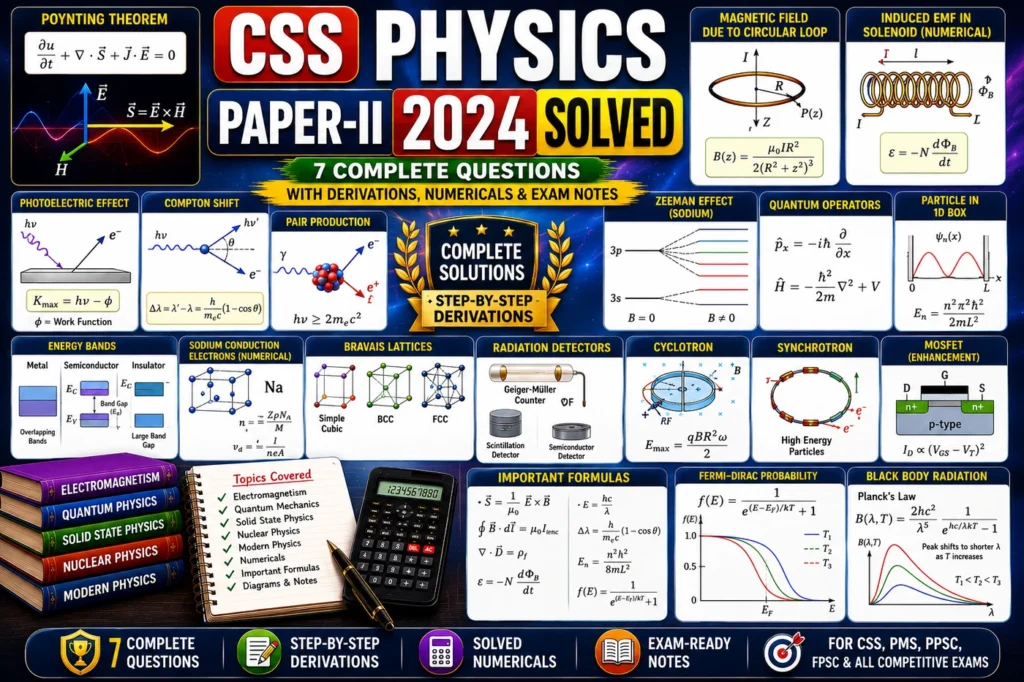
CSS Physics Paper-II 2024 Solved is a complete solved guide for CSS aspirants who need actual derivations, numerical working and exam-ready explanations. This post solves the subjective section question by question and covers Poynting theorem, magnetic vector potential, magnetic field on the axis of a circular current loop, limitations of Gauss law, use of Gauss law in dielectrics, induced emf in a coil placed inside a solenoid, curl of electric field, photoelectric effect, Planck constant from stopping potential, Compton shift, pair production, Zeeman effect, quantum operators, particle in a one-dimensional box, energy bands, sodium conduction electrons, Bravais lattices, radiation detectors, cyclotron, synchrotron, MOSFET and Fermi-Dirac occupancy probability.
Central Argument: A solved CSS Physics paper should not be a short answer key. It should show the principle, equation, substitution, unit conversion, final result and physical meaning. This CSS Physics Paper-II 2024 Solved post is therefore written as a full study document for serious revision.
Keyword and Formatting Note: The focus keyword is used naturally in the title, introduction, study scope, headings, FAQ and schema, but it is not repeated excessively inside every paragraph. All equations are shown as clean visible equation lines, not dark formula boxes, so symbols and powers remain readable in WordPress.
CSS Physics Paper-II 2024 Solved Study Scope
This guide reconstructs the major subjective questions of the paper and provides complete answers in a student-friendly format. Each question includes the printed question, part-wise explanation, derivation, formula work, numerical calculation and final answer wherever the paper gives numerical data.
The post is also structured for SEO and exam usability. It avoids an H1 heading inside the body so your WordPress theme can keep the post title as the only H1. Internal headings begin from H2 and continue with H3 and H4 levels.
Show Table of Contents
- Overview
- Study Scope
- Important Formula Sheet
- Question Map
- Question 2: Poynting Theorem, Vector Potential and Loop Field
- Question 3: Gauss Law, Induced EMF and Curl of Electric Field
- Question 4: Photoelectric Effect, Compton Shift and Pair Production
- Question 5: Zeeman Effect, Quantum Operators and Particle in a Box
- Question 6: Energy Bands, Sodium Electrons and Bravais Lattice
- Question 7: Radiation Detectors, Cyclotron, Synchrotron and Deuteron Energy
- Question 8: MOSFET and Fermi-Dirac Occupancy Probability
- Revision Plan
- Internal and External Resources
- FAQs
Important Formula Sheet for CSS Physics Paper-II 2024 Solved
Electromagnetism
S = E×H = (1/μ0)E×B
u = (1/2)ε0E² + B²/(2μ0)
∂u/∂t + ∇·S = -J·E
B = ∇×A
Induction and Fields
Bsolenoid = μ0nI
|ε| = N|dΦB/dt|
∇×E = -∂B/∂t
∇·D = ρfree
Modern Physics
Kmax = hf - φ
eVs = hf - φ
Δλ = (h/mec)(1-cosθ)
Ethreshold = 2mec² = 1.022 MeV
Solid State and Accelerators
En = n²h²/(8mL²)
f = qB/(2πm)
K = (1/2)mv²
f(E)=1/[e^((E-EF)/kT)+1]
Question Map of CSS Physics Paper-II 2024 Solved
| Question | Main Area | What Is Fully Solved |
|---|---|---|
| Q2 | Electromagnetism | Poynting theorem, Poynting vector, magnetic vector potential, scalar potential comparison and magnetic field on circular loop axis. |
| Q3 | Gauss law and induction | Limitations of Gauss law, dielectrics with bound charge, solenoid-coil induced emf numerical and curl of electric field. |
| Q4 | Modern physics | Photoelectric effect, Planck constant from stopping potential, Compton shift numerical and pair production near a nucleus. |
| Q5 | Quantum mechanics | Zeeman effect in sodium spectral lines, momentum and energy operators and discrete energy levels for particle in a box. |
| Q6 | Solid-state physics | Energy band formation, metals versus semiconductors, sodium conduction electron numerical and 14 Bravais lattices. |
| Q7 | Nuclear instrumentation and accelerators | Radiation detection, GM counter, scintillation counter, cyclotron, synchrotron and deuteron energy numerical. |
| Q8 | Semiconductor physics | MOSFET working, MOSFET applications, Fermi probability numerical and graphical explanation of occupancy and density of states. |
Question 2: Poynting Theorem, Vector Potential and Loop Field
Full Question
Q.2. (a) Derive the work-energy theorem of electrodynamics, also called Poynting theorem, and discuss the Poynting vector.
Q.2. (b) What is magnetic vector potential? Also compare magnetic vector potential and electric scalar potential.
Q.2. (c) Find the magnetic field at a distance z above the center of a circular loop of radius R which carries a steady current I.
Q2(a): Poynting Theorem and Poynting Vector
Poynting theorem is the work-energy theorem of electrodynamics. It expresses conservation of electromagnetic energy. It shows that field energy can decrease because energy flows out of a region or because the field does work on charges.
The electromagnetic energy density in vacuum is:
u = (1/2)ε0E² + B²/(2μ0)
The Poynting vector is:
S = E×H
In vacuum, since H=B/μ0:
S = (1/μ0)E×B
The direction of S gives the direction of electromagnetic energy flow. Its SI unit is:
W/m²
Derivation of Poynting Theorem
Start with the Ampere-Maxwell law:
∇×B = μ0J + μ0ε0 ∂E/∂t
Take dot product with E:
E·(∇×B) = μ0E·J + μ0ε0 E·∂E/∂t
Faraday’s law is:
∇×E = -∂B/∂t
Take dot product with B:
B·(∇×E) = -B·∂B/∂t
Use the vector identity:
∇·(E×B) = B·(∇×E) - E·(∇×B)
Substitute the two Maxwell-equation results into the identity:
∇·(E×B) = -B·∂B/∂t - μ0E·J - μ0ε0E·∂E/∂t
Divide by μ0:
∇·[(1/μ0)E×B] = -(1/μ0)B·∂B/∂t - E·J - ε0E·∂E/∂t
Recognize:
S = (1/μ0)E×B
and:
∂/∂t[(1/2)ε0E² + B²/(2μ0)] = ε0E·∂E/∂t + (1/μ0)B·∂B/∂t
Therefore:
∇·S = -E·J - ∂u/∂t
Rearrange:
∂u/∂t + ∇·S = -J·E
∂u/∂t + ∇·S = -J·E, where u=(1/2)ε0E²+B²/(2μ0) and S=(1/μ0)E×B.Q2(b): Magnetic Vector Potential and Scalar Potential
Magnetic vector potential A is a vector field defined by:
B = ∇×A
This definition automatically satisfies Gauss law for magnetism:
∇·B = 0
because the divergence of a curl is always zero:
∇·(∇×A) = 0
Electric scalar potential V is related to the electrostatic field by:
E = -∇V
In time-varying electromagnetic fields, electric field can be expressed as:
E = -∇V - ∂A/∂t
| Feature | Magnetic Vector Potential A | Electric Scalar Potential V |
|---|---|---|
| Nature | Vector quantity | Scalar quantity |
| Relation to field | B = ∇×A |
E = -∇V in electrostatics |
| Main use | Magnetism, induction, radiation, quantum effects | Electrostatics and potential-energy calculations |
| Automatic condition | Satisfies ∇·B=0 |
Useful when ∇×E=0 |
B=∇×A. Electric scalar potential gives E=-∇V in electrostatics. The first is vector, while the second is scalar.Q2(c): Magnetic Field on the Axis of a Circular Loop
Consider a circular loop of radius R carrying steady current I. We need the magnetic field at a point on the axis of the loop at distance z from the center.
By symmetry, transverse components cancel and only the axial component remains. The Biot-Savart law gives:
dB = (μ0/4π)(I dl sinθ)/r²
For a point on the axis, every current element is at distance:
r = √(R²+z²)
The axial component of the field is:
dBz = dB cosα
where:
cosα = R/√(R²+z²)
After integrating around the loop, the magnetic field on the axis is:
B(z) = μ0IR²/[2(R²+z²)^(3/2)]
At the center of the loop, z=0:
B(0) = μ0I/(2R)
z on the axis of a circular loop is B(z)=μ0IR²/[2(R²+z²)^(3/2)].Question 3: Gauss Law, Induced EMF and Curl of Electric Field
Full Question
Q.3. (a) What are the limitations of Gauss’s law? How can it be applied on a material with bound charges or dielectrics?
Q.3. (b) A long solenoid has 220 turns/m and carries a current i=1.5 A; its diameter D is 3.2 cm. At its center we place a 130-turn closely packed coil C of diameter d=2.1 cm. The current in the solenoid is reduced to zero at a steady rate in 25 ms. What is the magnitude of emf induced in coil C while the current in the solenoid is changing?
Q.3. (c) Calculate the curl of electric field E.
Q3(a): Limitations of Gauss Law and Use in Dielectrics
Gauss law states that electric flux through a closed surface equals the charge enclosed divided by ε0:
∮E·dA = Qenc/ε0
In differential form:
∇·E = ρ/ε0
Limitations of Gauss Law in Practice
Gauss law is always true as a law of electromagnetism, but it is not always convenient for finding electric field. Its practical limitations are:
- It is most useful only for high symmetry such as spherical, cylindrical or planar symmetry.
- It gives total flux easily, but not local electric field in arbitrary charge distributions.
- If
Eis not constant over the Gaussian surface, the integral becomes difficult. - It cannot directly determine the direction of electric field in irregular geometries without additional symmetry arguments.
- In materials, bound charges complicate the use of
Eunless polarization is included.
Application in Dielectrics
In dielectric materials, charges may be free or bound. Bound charges appear due to polarization. Instead of writing Gauss law only in terms of E, we use electric displacement field D:
D = ε0E + P
where P is polarization.
Gauss law in a dielectric is:
∇·D = ρfree
Integral form:
∮D·dA = Qfree,enclosed
For a linear dielectric:
D = εE
where:
ε = Kε0
D field as ∇·D=ρfree or ∮D·dA=Qfree.Q3(b): Induced EMF in Coil Inside Solenoid
Given:
n = 220 turns/m
I = 1.5 A
N = 130 turns
d = 2.1 cm = 0.021 m
r = d/2 = 0.0105 m
Δt = 25 ms = 0.025 s
The magnetic field inside a long solenoid is:
B = μ0nI
Substitute values:
B = (4π×10⁻⁷)(220)(1.5)
B ≈ 4.15×10⁻⁴ T
The area of the small coil is:
A = πr²
A = π(0.0105)²
A ≈ 3.46×10⁻⁴ m²
Magnetic flux through one turn is:
ΦB = BA
The induced emf magnitude is:
|ε| = N A |ΔB/Δt|
The field changes from 4.15×10⁻⁴ T to zero, so:
|ΔB| = 4.15×10⁻⁴ T
Now:
|ε| = 130(3.46×10⁻⁴)(4.15×10⁻⁴)/(0.025)
|ε| ≈ 7.47×10⁻⁴ V
7.47×10⁻⁴ V, or 0.747 mV.Q3(c): Curl of Electric Field
The curl of electric field is given by Faraday’s law of electromagnetic induction:
∇×E = -∂B/∂t
This means that a time-varying magnetic field produces a circulating electric field.
Special Case: Electrostatics
For electrostatic fields, magnetic field is not changing with time:
∂B/∂t = 0
Therefore:
∇×E = 0
∇×E=-∂B/∂t. For electrostatics, ∇×E=0.Question 4: Photoelectric Effect, Compton Shift and Pair Production
Full Question
Q.4. (a) Briefly discuss the phenomenon of photoelectric effect. Deduce the value of Planck’s constant using concepts of stopping potential and work function.
Q.4. (b) X-rays of wavelength λ=22 pm, photon energy 56 keV, are scattered from a carbon target and the scattered rays are detected at 85° to the incident beam. What is the Compton shift of the scattered rays?
Q.4. (c) Describe the significance of a nearby nucleus in pair production. Why is it necessary for the phenomenon to take place?
Q4(a): Photoelectric Effect and Planck Constant
The photoelectric effect is the emission of electrons from a metal surface when light of sufficiently high frequency falls on it. The emitted electrons are called photoelectrons.
Einstein’s photoelectric equation is:
hf = φ + Kmax
where hf is photon energy, φ is work function and Kmax is maximum kinetic energy of emitted electrons.
Stopping potential Vs is the minimum reverse potential needed to stop the fastest photoelectrons. Therefore:
Kmax = eVs
So:
eVs = hf - φ
Rearrange:
Vs = (h/e)f - φ/e
This is a straight-line equation of the form:
y = mx + c
where Vs is plotted against frequency f. The slope is:
slope = h/e
Therefore:
h = e × slope
Vs=(h/e)f-φ/e. Hence h=e×slope.Q4(b): Compton Shift Numerical
Compton shift is given by:
Δλ = (h/mec)(1-cosθ)
The electron Compton wavelength is:
h/mec = 2.426 pm
Given:
θ = 85°
Substitute:
Δλ = 2.426(1-cos85°) pm
Since:
cos85° ≈ 0.0872
Then:
Δλ = 2.426(1-0.0872) pm
Δλ = 2.426(0.9128) pm
Δλ ≈ 2.21 pm
The scattered wavelength is:
λ' = λ + Δλ
λ' = 22 pm + 2.21 pm
λ' ≈ 24.21 pm
2.21 pm. The scattered wavelength is about 24.21 pm.Q4(c): Role of Nearby Nucleus in Pair Production
Pair production is the conversion of a high-energy photon into an electron-positron pair:
γ → e⁻ + e⁺
The minimum photon energy required is the rest energy of electron and positron:
Ethreshold = 2mec²
Ethreshold = 2(0.511 MeV)
Ethreshold = 1.022 MeV
However, pair production cannot occur in empty space with only one photon, because both energy and momentum cannot be conserved simultaneously. A nearby nucleus is needed to take recoil momentum.
The nucleus plays three important roles:
- It provides a strong electromagnetic field in which the photon can transform into a pair.
- It absorbs recoil momentum so momentum conservation is satisfied.
- It makes the process physically possible without violating conservation laws.
1.022 MeV.Question 5: Zeeman Effect, Quantum Operators and Particle in a Box
Full Question
Q.5. (a) Explain the splitting of energy levels of atoms in external magnetic field based on quantum theory by considering the spectral lines of sodium.
Q.5. (b) Discuss the momentum and energy operators in quantum mechanics and write down the significance of these operators.
Q.5. (c) Show that the particle in one dimensional box can only have discrete energy values.
Q5(a): Zeeman Effect and Sodium Spectral Lines
The Zeeman effect is the splitting of atomic spectral lines when atoms are placed in an external magnetic field. It occurs because atomic magnetic moments interact with the applied magnetic field.
The interaction energy is:
ΔE = μB gJ mJ B
where μB is Bohr magneton, gJ is Landé g factor, mJ is magnetic quantum number and B is external magnetic field.
Sodium Spectral Lines
Sodium is famous for its yellow D-lines. In the absence of an external magnetic field, allowed transitions produce characteristic spectral lines. When a magnetic field is applied, energy levels split into sub-levels according to their magnetic quantum numbers. As a result, one spectral line splits into multiple components.
Quantum Explanation
- Atomic electrons possess orbital and spin angular momenta.
- These angular momenta produce magnetic moments.
- In an external magnetic field, different
mJstates have different energies. - Transitions between these split levels produce multiple spectral components.
The selection rule commonly used for Zeeman components is:
Δm = 0, ±1
Q5(b): Momentum and Energy Operators
In quantum mechanics, physical observables are represented by operators. The wave function contains the state information, and operators act on the wave function to extract measurable quantities.
Momentum Operator
In one-dimensional position representation, the momentum operator is:
p̂ = -iℏ d/dx
In three dimensions:
p̂ = -iℏ∇
Energy Operator
The energy operator is:
Ê = iℏ ∂/∂t
For time-independent systems, the Hamiltonian operator represents total energy:
Ĥ = -(ℏ²/2m)∇² + V
Significance of Operators
- Operators connect wave functions with measurable physical quantities.
- Eigenvalues of operators are possible measurement results.
- They form the basis of Schrödinger equation.
- Commutators of operators determine whether observables can be measured simultaneously.
If an operator  satisfies:
Âψ = aψ
then ψ is an eigenfunction and a is the eigenvalue.
p̂=-iℏ∇, energy operator is Ê=iℏ∂/∂t, and Hamiltonian Ĥ gives total energy.Q5(c): Discrete Energy Values of Particle in a Box
Consider a particle of mass m confined in a one-dimensional infinite potential well between x=0 and x=L.
The potential is:
V(x)=0, 0<x<L
V(x)=∞, x≤0 and x≥L
Inside the box, the time-independent Schrödinger equation is:
-(ℏ²/2m)d²ψ/dx² = Eψ
Rearrange:
d²ψ/dx² + (2mE/ℏ²)ψ = 0
Let:
k² = 2mE/ℏ²
Then:
d²ψ/dx² + k²ψ = 0
General solution is:
ψ(x) = A sin(kx) + B cos(kx)
Boundary condition at x=0:
ψ(0)=0
This gives:
B=0
So:
ψ(x)=A sin(kx)
Boundary condition at x=L:
ψ(L)=0
Thus:
A sin(kL)=0
For non-zero A:
sin(kL)=0
Therefore:
kL=nπ
k=nπ/L, where n=1,2,3,...
Since:
E=ℏ²k²/(2m)
we get:
En = n²π²ℏ²/(2mL²)
Using ℏ=h/(2π):
En = n²h²/(8mL²)
En=n²h²/(8mL²), because boundary conditions allow only standing waves with integer n.Question 6: Energy Bands, Sodium Electrons and Bravais Lattice
Full Question
Q.6. (a) How do the energy levels in crystalline solids form energy bands? Differentiate between metals and semiconductors on the basis of band gap pattern and electrical properties.
Q.6. (b) How many conduction electrons are in a cube of sodium-23 of volume 2×10⁻⁶ m³? Sodium atoms are monovalent. Density and molar mass of sodium are 0.968 g/cm³ and 22.98 g/mol respectively.
Q.6. (c) What is a Bravais lattice? Write down types of Bravais lattice in three-dimensional space.
Q6(a): Formation of Energy Bands in Crystalline Solids
When isolated atoms come together to form a crystal, their atomic energy levels interact. Because of the Pauli exclusion principle, many closely spaced levels are formed instead of a single level. These closely spaced allowed levels form energy bands.
The two most important bands are:
- Valence band: The highest occupied band at low temperature.
- Conduction band: A higher band where electrons can move freely and conduct current.
The energy difference between them is the forbidden energy gap:
Eg = conduction band minimum - valence band maximum
Metals and Semiconductors
| Feature | Metals | Semiconductors |
|---|---|---|
| Band gap | No gap, overlapping bands or partially filled band | Small forbidden gap |
| Conductivity | High | Moderate |
| Temperature effect | Resistance usually increases with temperature | Conductivity usually increases with temperature |
| Carrier availability | Many free electrons already available | Carriers generated thermally or by doping |
| Examples | Copper, sodium, silver | Silicon, germanium |
Q6(b): Number of Conduction Electrons in Sodium
Given:
Volume = 2×10⁻⁶ m³
Density = 0.968 g/cm³
Molar mass = 22.98 g/mol
Convert density into SI units:
0.968 g/cm³ = 968 kg/m³
Molar mass in kg/mol:
22.98 g/mol = 0.02298 kg/mol
Mass of sodium sample:
m = ρV
m = (968)(2×10⁻⁶)
m = 1.936×10⁻³ kg
Number of moles:
n = m/M
n = (1.936×10⁻³)/(0.02298)
n ≈ 0.0842 mol
Number of atoms:
N = nNA
N = (0.0842)(6.022×10²³)
N ≈ 5.07×10²² atoms
Sodium is monovalent, so each atom contributes one conduction electron.
Number of conduction electrons ≈ 5.07×10²²
5.07×10²² conduction electrons.Q6(c): Bravais Lattice and Its Types
A Bravais lattice is an infinite periodic arrangement of points in space such that every point has the same surroundings. It represents the translational symmetry of a crystal.
A lattice point can be generated by:
R = n1a1 + n2a2 + n3a3
where n1, n2 and n3 are integers, and a1, a2, a3 are primitive vectors.
14 Bravais Lattices in Three Dimensions
| Crystal System | Bravais Lattices |
|---|---|
| Cubic | Simple cubic, body-centered cubic, face-centered cubic |
| Tetragonal | Simple tetragonal, body-centered tetragonal |
| Orthorhombic | Simple orthorhombic, base-centered orthorhombic, body-centered orthorhombic, face-centered orthorhombic |
| Monoclinic | Simple monoclinic, base-centered monoclinic |
| Triclinic | Simple triclinic |
| Hexagonal | Simple hexagonal |
| Rhombohedral / Trigonal | Rhombohedral |
Question 7: Radiation Detectors, Cyclotron, Synchrotron and Deuteron Energy
Full Question
Q.7. (a) How are radiations detected? Discuss any two radiation detectors in detail.
Q.7. (b) Explain the working principle of cyclotrons and synchrotrons.
Q.7. (c) Suppose a cyclotron is operated at an oscillator frequency of 12 MHz and has a dee radius R=53 cm. What magnetic field is needed for deuterons to be accelerated? The deuteron mass is m=3.34×10⁻²⁷ kg. What is the resulting kinetic energy of the deuterons?
Q7(a): Detection of Nuclear Radiation
Nuclear radiation is detected through its interaction with matter. Radiation can ionize gas, excite scintillating materials, produce tracks in vapour, blacken photographic plates or create electron-hole pairs in semiconductors.
Common Radiation Detectors
- Geiger-Muller counter
- Scintillation counter
- Cloud chamber
- Bubble chamber
- Ionization chamber
- Semiconductor detector
- Photographic plate
1. Geiger-Muller Counter
A Geiger-Muller counter contains a gas-filled tube with a central anode wire and cylindrical cathode. When radiation enters through a thin window, it ionizes gas atoms. The freed electrons accelerate toward the anode and produce further ionization, creating an avalanche. This produces a voltage pulse that is counted electronically.
Its advantages are:
- Simple and sensitive.
- Useful for detecting alpha, beta and gamma radiation with suitable window design.
- Gives count rate quickly.
Its limitation is that it does not measure particle energy accurately.
2. Scintillation Counter
A scintillation counter uses a material that emits tiny flashes of light when radiation enters it. These flashes are detected by a photomultiplier tube and converted into electrical pulses.
Its advantages are:
- Fast response.
- Useful for gamma rays and charged particles.
- Can provide energy information.
- More suitable than GM counter for spectroscopy.
Q7(b): Cyclotron and Synchrotron
Cyclotron
A cyclotron accelerates charged particles using a perpendicular magnetic field and an alternating electric field between two D-shaped electrodes called dees.
The magnetic force provides centripetal force:
qvB = mv²/r
Thus:
r = mv/(qB)
The cyclotron angular frequency is:
ω = qB/m
So the cyclotron frequency is:
f = qB/(2πm)
The particle gains energy every time it crosses the gap between the dees.
Synchrotron
A synchrotron also accelerates charged particles but keeps them moving in a fixed circular path. As particle energy increases, magnetic field and radiofrequency acceleration are adjusted synchronously.
| Feature | Cyclotron | Synchrotron |
|---|---|---|
| Orbit | Spiral path | Fixed circular path |
| Magnetic field | Usually constant | Varied with energy |
| Frequency | Approximately constant for non-relativistic particles | Adjusted synchronously |
| Use | Moderate-energy particles | High-energy particle physics and synchrotron radiation |
Q7(c): Magnetic Field and Kinetic Energy of Deuterons
Given:
f = 12 MHz = 12×10⁶ Hz
R = 53 cm = 0.53 m
m = 3.34×10⁻²⁷ kg
q = 1.60×10⁻¹⁹ C
Cyclotron frequency is:
f = qB/(2πm)
Rearrange:
B = 2πmf/q
Substitute values:
B = [2π(3.34×10⁻²⁷)(12×10⁶)]/(1.60×10⁻¹⁹)
B ≈ 1.57 T
Maximum speed at dee radius R is:
v = 2πfR
Substitute:
v = 2π(12×10⁶)(0.53)
v ≈ 3.996×10⁷ m/s
Kinetic energy:
K = (1/2)mv²
K = (1/2)(3.34×10⁻²⁷)(3.996×10⁷)²
K ≈ 2.67×10⁻¹² J
Convert into electron-volts:
K = (2.67×10⁻¹²)/(1.60×10⁻¹⁹) eV
K ≈ 1.67×10⁷ eV
K ≈ 16.7 MeV
1.57 T. The resulting deuteron kinetic energy is approximately 16.7 MeV.Question 8: MOSFET and Fermi-Dirac Occupancy Probability
Full Question
Q.8. (a) Discuss the working principle and applications of MOSFET.
Q.8. (b) What is the probability that a quantum state whose energy is 0.10 eV above the Fermi energy will be occupied? Assume sample temperature of 800 K.
Q.8. (c) Graphically show the occupancy probability and density of states as a function of energy.
Q8(a): MOSFET Working Principle and Applications
MOSFET stands for Metal-Oxide-Semiconductor Field-Effect Transistor. It is a voltage-controlled semiconductor device used for switching and amplification.
Main Terminals
- Gate: Controls the channel.
- Source: Supplies charge carriers.
- Drain: Collects charge carriers.
- Body/Substrate: Semiconductor base.
Working Principle
The gate is separated from the semiconductor by a thin oxide layer. Because of this insulation, gate current is extremely small. When a suitable gate voltage is applied, it changes the charge distribution in the semiconductor and controls the conducting channel between source and drain.
For an n-channel enhancement MOSFET, a positive gate voltage attracts electrons near the oxide-semiconductor interface and forms an n-type channel. Once the channel is formed, current can flow from drain to source.
Applications
- Digital logic gates.
- Microprocessors and memory chips.
- Power switching circuits.
- Voltage regulators.
- Amplifiers.
- Motor control circuits.
- Integrated circuits and CMOS technology.
Q8(b): Fermi-Dirac Occupancy Probability
The Fermi-Dirac distribution gives the probability that a quantum state of energy E is occupied by an electron:
f(E) = 1/[e^((E-EF)/kT)+1]
Given:
E - EF = 0.10 eV
T = 800 K
k = 8.617×10⁻⁵ eV/K
Calculate kT:
kT = (8.617×10⁻⁵)(800)
kT = 0.0689 eV
Now:
(E-EF)/kT = 0.10/0.0689
(E-EF)/kT ≈ 1.451
Therefore:
f(E) = 1/[e^(1.451)+1]
e^(1.451) ≈ 4.27
f(E) = 1/(4.27+1)
f(E) ≈ 0.190
0.19, or 19%.Q8(c): Occupancy Probability and Density of States Graph
The Fermi-Dirac occupancy probability decreases as energy increases above the Fermi level. At E=EF, the probability is:
f(EF) = 1/2
At lower temperatures, the curve becomes sharper. At higher temperatures, the transition around EF becomes smoother.
f(E)
1.0 |───────────────╲
| ╲
0.5 |—————–╲———- E = EF
| ╲
0.0 |___________________╲____________> E
EF
Density of states tells how many available quantum states exist per unit energy interval. For free electrons in three dimensions, density of states increases with energy approximately as:
g(E) ∝ √E
g(E)
^
| /
| /
| /
| /
| /
|___________/____________________> E
g(E) increases approximately as √E.
The actual number of occupied states is obtained from the product:
Occupied states = g(E)f(E)
EF. Density of states in the 3D free-electron model increases approximately as √E.Revision Plan for CSS Physics Paper-II 2024 Solved
After reading this CSS Physics Paper-II 2024 Solved guide, revise it in three rounds. First, memorize definitions and formulas. Second, reproduce derivations without looking. Third, solve the numerical questions again with unit conversion.
| Question | Revision Task |
|---|---|
| Q2 | Derive Poynting theorem, explain S=(1/μ0)E×B, compare A and V, and revise circular loop field. |
| Q3 | Write Gauss law limitations, derive dielectric form ∇·D=ρfree, and recalculate induced emf 7.47×10⁻⁴ V. |
| Q4 | Derive Planck constant from stopping potential graph, solve Compton shift and explain why nucleus is needed in pair production. |
| Q5 | Revise Zeeman splitting, write momentum and energy operators, and derive particle-in-box energy levels. |
| Q6 | Compare metals and semiconductors, recalculate sodium conduction electrons and memorize 14 Bravais lattices. |
| Q7 | Explain GM and scintillation counters, compare cyclotron and synchrotron, and solve deuteron energy numerical again. |
| Q8 | Explain MOSFET working, calculate Fermi probability and draw occupancy/density-of-states graphs. |
Related Resources for CSS Physics Paper-II 2024 Solved
Internal Bellum Report Reading
- CSS Physics Paper-II 2020 Solved
- CSS Physics Paper-II 2021 Solved
- CSS Physics Paper-II 2022 Solved
- CSS Physics Paper-II 2023 Solved
- CSS Physics Paper-II 2025 Solved
- CSS Physics Paper-I 2026 Solved
- CSS English Essay Past Paper
- Regulating Act 1773
- Pitt’s India Act 1784
- Government of India Act 1935
- Indian Independence Act 1947
Exam Note: For CSS Physics Paper-II, avoid writing only final formulas. Define the concept, write the governing law, show the mathematical route, substitute values carefully and end with the final answer plus unit.
FAQs About CSS Physics Paper-II 2024 Solved
What does CSS Physics Paper-II 2024 Solved include?
CSS Physics Paper-II 2024 Solved includes complete solved answers for Q2 to Q8 with definitions, derivations, numerical calculations, clean equations, final answers and exam-ready notes.
What is Poynting theorem?
Poynting theorem is ∂u/∂t + ∇·S = -J·E. It expresses conservation of electromagnetic energy.
What is the magnetic field on the axis of a circular loop?
The magnetic field at distance z above the center of a loop of radius R carrying current I is B(z)=μ0IR²/[2(R²+z²)^(3/2)].
What is the induced emf in the solenoid-coil numerical?
The induced emf is approximately 7.47×10⁻⁴ V, or about 0.747 mV.
What is the Compton shift in Question 4?
For scattering angle 85°, the Compton shift is approximately 2.21 pm.
How many conduction electrons are in the sodium cube?
The sodium cube contains approximately 5.07×10²² conduction electrons, because sodium is monovalent.
What magnetic field is needed in the cyclotron numerical?
The required magnetic field is approximately 1.57 T.
What is the deuteron kinetic energy in the cyclotron question?
The deuteron kinetic energy is approximately 16.7 MeV.
What is the Fermi occupancy probability in Question 8?
For a state 0.10 eV above the Fermi energy at 800 K, the occupancy probability is approximately 0.19, or 19%.
Can I paste this HTML into WordPress?
Yes. This HTML avoids an H1 inside the body, uses clean H2/H3/H4 structure, includes FAQ/schema, and keeps equations visible without dark formula boxes.
“`
The Indus Odyssey from Debal to Islamabad
The Ultimate Guide to Pakistan Affairs (711-2025). A focused Kindle guide for CSS, PMS, PCS, PPSC and FPSC Pakistan Affairs preparation.