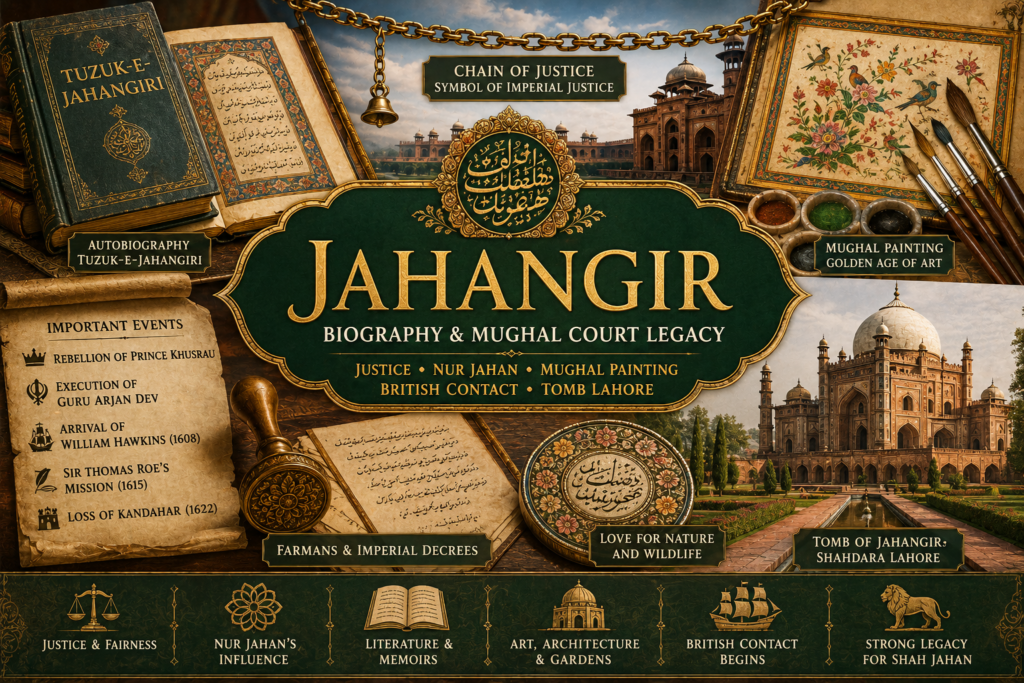
Jahangir was the fourth Mughal emperor and one of the most refined personalities of the Mughal age. His full name was Nur-ud-din Muhammad Jahangir, and before becoming emperor he was known as Prince Salim. He ruled from 1605 to 1627, after the death of his father Akbar. His reign is remembered for the Chain of Justice, the influence of Nur Jahan, the rebellion of Prince Khusrau, the execution of Guru Arjan Dev, early British contact through William Hawkins and Sir Thomas Roe, the loss of Kandahar, and the golden age of Mughal painting.
Jahangir inherited one of the strongest empires in the world. Zahir ud din Babar had founded Mughal power, Humayun had restored it after exile, and Akbar had consolidated it through administration, Rajput alliances, Mansabdari, revenue reform and religious accommodation. Jahangir did not need to build the empire from ruins; he inherited a mature imperial system. His task was to preserve Akbar’s settlement while managing succession politics, court factions, imperial justice, foreign relations and artistic culture.
The reign of Jahangir stands between Akbar’s age of consolidation and Shah Jahan’s age of architectural splendour. He maintained much of Akbar’s policy of Sulh-i-Kul, but he also faced religious and political tensions. He loved justice, nature, painting, gardens, wine, memoir writing and imperial ceremony. His autobiography, the Tuzuk-e-Jahangiri, gives important insight into his mind, court and reign. Yet his personal weaknesses, especially addiction to wine and opium, allowed powerful figures around him—especially Nur Jahan—to influence imperial politics.
To understand Jahangir properly, his reign should be placed in the full sequence of South Asian history. Bellum Report has already published connected guides on Muhammad Bin Qasim, the Ghaznavid Empire, Muhammad Ghori, the Slave Dynasty, the Khalji Dynasty, the Tughlaq Dynasty, the Sayyid Dynasty, the Lodhi Dynasty, Babur, Humayun and Akbar. Jahangir’s reign belongs to the mature Mughal phase that came after Akbar’s consolidation.
Recommended Book: If you want the full historical timeline from 711 to 2025 in one compact guide, buy The Indus Odyssey from Debal to Islamabad: The Ultimate Guide to Pakistan Affairs on Amazon Kindle.
Main Idea: Jahangir matters because his reign preserved Akbar’s imperial structure while giving Mughal culture a new artistic refinement. His age saw the rise of Nur Jahan, early English entry into Mughal trade, the golden age of Mughal painting, the loss of Kandahar, and the beginning of succession tensions that later shaped the politics of Shah Jahan and Aurangzeb.
Show Table of Contents
- Who Was Jahangir?
- Jahangir Early Life
- Jahangir Full Name and Meaning
- Jahangir Father Name and Mother Name
- Accession of Jahangir in 1605
- Prince Khusrau’s Rebellion
- Guru Arjan Dev and Sikh-Mughal Relations
- Chain of Justice and Twelve Ordinances
- Jahangir and Noor Jahan
- The Nur Jahan Junta
- Foreign Relations and British Arrival
- Persia and the Loss of Kandahar
- Golden Age of Mughal Painting
- Ustad Mansur, Abul Hasan and Naturalism
- Prince Khurram’s Rebellion
- Mahabat Khan’s Coup
- Jahangir Family: Wife, Spouse, Sons and Children
- Jahangir Death: How Did Jahangir Died?
- Tomb of Jahangir in Lahore
- Legacy of Jahangir
- Important Exam Points
- Recommended Book for Students
- FAQs
Who Was Jahangir?
Jahangir was the fourth emperor of the Mughal Empire. He was the son of Akbar and the father of Shah Jahan. He ruled from 1605 to 1627 and inherited a powerful empire that stretched across much of North India and beyond.
Before his accession, Jahangir was known as Prince Salim. His life before kingship was marked by tension with Akbar, court politics and the ambition of different noble groups. Akbar had built a vast state, but the question of succession became sensitive near the end of his reign.
Jahangir is often overshadowed by Akbar and Shah Jahan. Akbar is remembered as the great consolidator, while Shah Jahan is remembered for monumental architecture. Jahangir’s greatness lies in a different field: justice symbolism, memoir writing, naturalistic painting, court refinement and the powerful political role of Nur Jahan.
His reign was not free from conflict. Prince Khusrau rebelled in 1606, Prince Khurram rebelled in 1622, Mahabat Khan briefly captured the emperor in 1626, and Kandahar was lost to Persia. Yet the Mughal Empire remained strong because Akbar’s institutions continued to function.
Jahangir Early Life
Jahangir was born on August 30, 1569, at Fatehpur Sikri. His birth was deeply meaningful for Akbar, who had long desired a surviving male heir. The child was named Salim in honour of the Sufi saint Sheikh Salim Chishti, whose blessings were believed to have helped Akbar receive an heir.
Prince Salim grew up in a powerful imperial court. He received training in warfare, administration, Persian culture, court etiquette, literature and imperial politics. He also developed a strong interest in art, nature, wine, hunting and royal ceremony.
His relationship with Akbar became strained in later years. Salim wanted power before Akbar’s death and even set up a semi-independent court at Allahabad. This tension did not destroy the dynasty, but it showed that Mughal succession was never simple.
The early life of Jahangir reveals a common Mughal pattern: princes were trained for kingship, but they also became centres of political factions. Nobles often gathered around possible successors, and succession struggles became one of the long-term weaknesses of the Mughal house.
Jahangir Full Name and Meaning
Jahangir full name was Nur-ud-din Muhammad Jahangir. The title Jahangir means “World Seizer” or “Conqueror of the World.” He adopted this title after becoming emperor in 1605.
Before kingship, he was known as Prince Salim. The name Salim connected him with Sheikh Salim Chishti, the famous Sufi saint whose spiritual influence was highly respected by Akbar.
The title Jahangir reflected imperial ambition. Mughal emperors did not present themselves as ordinary regional rulers. They used grand titles that suggested universal kingship, divine favour and world authority.
The name Nur-ud-din means “Light of the Faith.” Together, Nur-ud-din Muhammad Jahangir created an image of a ruler who combined royal power with moral and spiritual symbolism.
Jahangir Father Name and Mother Name
Jahangir father name was Akbar, the third Mughal emperor. The father of Jahangir created the strong imperial structure that Jahangir inherited in 1605. Akbar’s Mansabdari system, Rajput policy, revenue reforms and principle of Sulh-i-Kul gave Jahangir a stable political foundation.
Jahangir mother name was Mariam-uz-Zamani, the Rajput princess of Amber and one of Akbar’s most important wives. In popular tradition, she is often called Jodha Bai, though historians debate the exact use of this name.
The mother of Jahangir represented the Rajput-Mughal alliance that became one of Akbar’s greatest political achievements. Through this family connection, Jahangir himself embodied the integration of the Mughal house with powerful Rajput elites.
This background matters because Jahangir continued Akbar’s broad political order. He inherited not only Timurid blood from his father’s side but also the political legitimacy created through Rajput alliance and imperial accommodation.
Accession of Jahangir in 1605
After Akbar’s death, Prince Salim ascended the Mughal throne at Agra on October 24, 1605. He took the title Nur-ud-din Muhammad Jahangir. His accession was not completely smooth because some nobles had supported his son Prince Khusrau as a possible successor.
To present himself as a fair and just ruler, Jahangir installed the famous Zanjir-i-Adl, or Chain of Justice, at Agra Fort. This golden chain became one of the most memorable symbols of his reign.
Jahangir also issued twelve ordinances, known as Dastur-ul-Amal, soon after his accession. These included measures against illegal taxes, theft, intoxicants and administrative injustice. Although Jahangir himself struggled with wine and opium, the ordinances reflected his desire to project moral kingship.
The accession of Jahangir therefore combined power and image-making. He wanted to show that he was not merely Akbar’s successor but a ruler committed to justice, order and public access to imperial authority.
Prince Khusrau’s Rebellion
One of the first crises of Jahangir’s reign was the rebellion of his son Prince Khusrau in 1606. Khusrau had support among some nobles who preferred him over Jahangir. In April 1606, he fled toward Punjab and gathered a large following.
Khusrau attempted to capture Lahore, but Jahangir personally pursued him. The rebellion was crushed at the Battle of Bhairowal. Khusrau was captured while trying to flee across the Chenab River.
Jahangir punished Khusrau severely. He was brought before the emperor in chains and was eventually partially blinded. This harsh treatment reflected the seriousness of Mughal succession politics.
The rebellion of Prince Khusrau set a dangerous precedent. Later Mughal history would repeatedly witness conflicts between fathers and sons, brothers and brothers, claimants and nobles. The future wars of succession under Shah Jahan and Aurangzeb had early signs in this crisis.
Guru Arjan Dev and Sikh-Mughal Relations
The rebellion of Prince Khusrau is also connected with the execution of Guru Arjan Dev, the fifth Sikh Guru. During his flight, Khusrau sought the blessings of Guru Arjan Dev. Jahangir interpreted this as political support for rebellion.
In May 1606, Guru Arjan Dev was executed in Lahore. This was a major turning point in Sikh-Mughal relations. It marked the beginning of deeper tension between the Sikh community and the Mughal state.
The execution of Guru Arjan Dev had long-term consequences. It contributed to the militarization of the Sikh community under later Gurus and shaped the future history of Punjab.
For Jahangir’s reign, this event shows how political rebellion and religious authority could become intertwined. Jahangir viewed the matter through the lens of imperial security, but its historical impact went far beyond one rebellion.
Chain of Justice and Twelve Ordinances
The Chain of Justice, or Zanjir-i-Adl, was one of the most famous symbols of Jahangir’s rule. It was a golden chain attached to the Agra Fort and connected with bells. Anyone seeking justice could pull the chain and attract the emperor’s attention.
According to the chapter material, the Chain of Justice weighed about 240 kilograms and had sixty bells. Whether understood literally or symbolically, it showed Jahangir’s desire to be remembered as a just ruler.
Jahangir’s twelve ordinances also reflected this image of justice. They addressed illegal taxes, inheritance rights, theft, intoxicants and administrative abuses. These orders were meant to strengthen public confidence in the new emperor.
The Chain of Justice remains central to Jahangir history because it expresses the emperor’s ideal of direct royal justice. It also connects him with the larger Mughal tradition in which the emperor was expected to be the final guardian of order.
Jahangir and Noor Jahan
Jahangir and Noor Jahan form one of the most powerful political partnerships in Mughal history. Nur Jahan was born as Mehr-un-Nissa. She was the widow of the Persian noble Sher Afghan. Jahangir married her in 1611 and gave her the titles Nur Mahal, meaning Light of the Palace, and later Nur Jahan, meaning Light of the World.
Nur Jahan was not merely a royal wife. She was intelligent, politically skilled, courageous, artistic and administratively capable. As Jahangir’s health declined because of wine and opium, she gained increasing influence over imperial affairs.
Nur Jahan became the only Mughal empress to have coins struck in her name and to issue imperial farmans. This shows the extraordinary nature of her power. She also appeared with Jahangir at the imperial balcony and shaped court politics through patronage and alliances.
The age of Nur Jahan was one of the most distinctive phases of Jahangir’s reign. Her influence strengthened some aspects of court culture and patronage, but it also created factional politics and succession tensions.
The Nur Jahan Junta
Between 1611 and 1622, a powerful court group often called the Nur Jahan Junta dominated imperial politics. This group included Nur Jahan, her father Itimad-ud-Daulah, her brother Asaf Khan, and Prince Khurram before their eventual fallout.
Itimad-ud-Daulah, whose original name was Ghias Beg, became chief minister. Asaf Khan became a powerful noble and later the father-in-law of Shah Jahan. Prince Khurram, the future Shah Jahan, was initially favoured because he was married to Arjumand Banu Begum, later known as Mumtaz Mahal.
This court alliance helped Nur Jahan control appointments, patronage and imperial decisions. It also created resentment among traditional nobles who disliked the concentration of power in one family group.
The Nur Jahan Junta eventually weakened because of succession politics. Nur Jahan later supported Prince Shahryar, her son-in-law, while Asaf Khan supported Prince Khurram. This split shaped the succession struggle after Jahangir’s death.
Foreign Relations and British Arrival
Jahangir’s reign saw important early contact between the Mughal court and the English East India Company. The first major Englishman to reach his court was Captain William Hawkins in 1608. Hawkins carried a letter from King James I and sought trading privileges.
Jahangir was impressed by Hawkins because he spoke Turkish, a language the emperor understood. He gave Hawkins the title “English Khan” and a Mansab of 400. However, Portuguese and Jesuit influence at court prevented Hawkins from securing a lasting formal treaty.
The next major English envoy was Sir Thomas Roe, who arrived in 1615 as the official ambassador of King James I. Roe stayed at the Mughal court for several years and left important observations about Jahangir, Mughal administration and court ceremony.
The English gained a stronger position after their naval victory over the Portuguese at the Battle of Swally in 1612 near Surat. Jahangir later allowed the English to establish a factory at Surat. This small commercial foothold would grow into a major historical force in later centuries.
Persia and the Loss of Kandahar
Relations with Persia were important during Jahangir’s reign because of Kandahar. Kandahar was a strategic frontier city connecting India, Afghanistan, Persia and Central Asia. Control of Kandahar was vital for Mughal frontier defence and prestige.
Jahangir initially maintained warm relations with Shah Abbas of Persia. Diplomatic gifts and embassies moved between the two courts. Persian remained the official court language and a major cultural influence in the Mughal Empire.
However, Kandahar remained a point of tension. In 1622, while the Mughal court was distracted by Prince Khurram’s rebellion, the Persians captured Kandahar. This was a serious blow to Mughal prestige and frontier security.
The loss of Kandahar showed that even a powerful empire could lose vital territory when internal politics distracted imperial attention. It also foreshadowed later Mughal-Safavid rivalry over the same region.
Golden Age of Mughal Painting
Jahangir’s reign is widely considered the Golden Age of Mughal Painting. Akbar had built a large imperial painting workshop, but Jahangir refined Mughal art toward individual portraiture, naturalism, botanical precision and realistic detail.
Jahangir had a remarkable eye for painting. In the Tuzuk-e-Jahangiri, he claimed that he could identify the work of different painters even in a single composite painting. This shows his deep connoisseurship.
Under Jahangir, Mughal painting shifted from large manuscript illustration toward albums, portraits, nature studies and highly detailed individual works. Artists captured faces, animals, birds, flowers and symbolic scenes with extraordinary care.
European influence also entered Mughal art through Jesuit missionaries and diplomatic gifts. Artists adopted perspective, shading, halos and three-dimensional realism. Mughal painting under Jahangir therefore became a fusion of Persian style, Indian naturalism and European technique.
Ustad Mansur, Abul Hasan and Naturalism
Ustad Mansur was one of the greatest painters of Jahangir’s court. He received the title Nadir-ul-Asr, meaning Wonder of the Age. He became famous for his paintings of rare animals, birds and plants.
Ustad Mansur painted the dodo brought from Mauritius and the Siberian crane. His work is historically valuable because it provides visual records of species with scientific and artistic precision.
Abul Hasan was another great artist of Jahangir’s reign. He received the title Nadir-uz-Zaman, meaning Wonder of the Time. He became famous for allegorical and symbolic paintings of the emperor.
The art of Jahangir’s age shows his personality clearly. He loved nature, beauty, order and detail. His court painters turned imperial curiosity into visual history.
Prince Khurram’s Rebellion
Prince Khurram, the future Shah Jahan, became one of the most powerful princes of Jahangir’s reign. He was a successful military commander and was initially favoured by the Nur Jahan circle because he was married to Arjumand Banu Begum, later Mumtaz Mahal.
Over time, relations changed. Nur Jahan began promoting Prince Shahryar, her son-in-law, as a possible successor. Prince Khurram saw this as a threat to his future.
In 1622, Prince Khurram rebelled against Jahangir. The rebellion lasted several years and weakened the empire. It also distracted Mughal attention from Kandahar, allowing Persia to capture the strategic city.
The rebellion of Prince Khurram shows how succession politics shaped Mughal history. Even during Jahangir’s lifetime, the future struggle for power was already visible.
Mahabat Khan’s Coup
In 1626, the powerful general Mahabat Khan staged a dramatic coup against Jahangir. He felt threatened by Nur Jahan’s influence and feared losing his position at court.
While the imperial party was crossing the Jhelum River on the way to Kabul, Mahabat Khan captured Jahangir. For a short time, the emperor became a prisoner of his own general.
Nur Jahan responded with political courage and tactical intelligence. After an initial failed rescue attempt, she used diplomacy, espionage and division among Mahabat Khan’s supporters to weaken his position.
Eventually, Jahangir escaped Mahabat Khan’s control, and Mahabat Khan fled to join Prince Khurram. This event shows both the weakness of Jahangir’s later reign and the extraordinary political ability of Nur Jahan.
Jahangir Family: Wife, Spouse, Sons and Children
Jahangir spouse most famous in history was Nur Jahan. Jahangir wife name before she received her imperial title was Mehr-un-Nissa. After marriage, she became Nur Mahal and later Nur Jahan. She was the most powerful woman of the Mughal court during his reign.
Jahangir had several wives, but Nur Jahan became historically the most important because of her political influence. She issued farmans, had coins struck in her name, supervised patronage and shaped succession politics.
Jahangir son and eventual successor was Prince Khurram, who later became Shah Jahan. Jahangir children included Prince Khusrau, Prince Parvez, Prince Khurram and Prince Shahryar. These sons became involved in serious succession politics.
Prince Khusrau rebelled in 1606 and was punished. Prince Khurram rebelled later but eventually became emperor. Prince Shahryar was supported by Nur Jahan after Jahangir’s death but was defeated in the succession struggle.
Jahangir Death: How Did Jahangir Died?
Jahangir death occurred on October 28, 1627. He died near Rajauri while returning from Kashmir to Lahore. His health had declined because of lifelong asthma and heavy consumption of wine and opium.
The question how did Jahangir died is commonly asked because his final years were physically weak and politically unstable. He did not die in battle or assassination. He died after illness while traveling from Kashmir.
After his death, succession politics began immediately. Asaf Khan placed Dawar Bakhsh, a grandson of Jahangir through Prince Khusrau, on the throne as a temporary or “stop-gap” emperor to prevent Shahryar from taking power.
When Prince Khurram reached power as Shah Jahan, Dawar Bakhsh and other rival claimants were removed. Jahangir’s death therefore led directly into the succession settlement that brought Shah Jahan to the throne.
Tomb of Jahangir in Lahore
The tomb of Jahangir, also called Jahangir ka maqbara, is located at Shahdara in Lahore. It stands in the Dilkusha Garden on the banks of the Ravi River. Jahangir is one of the few great Mughals buried outside modern India, along with Babur in Kabul and Bahadur Shah Zafar in Rangoon.
Jahangir Tomb Lahore is closely associated with Nur Jahan. She supervised aspects of its design and completion. The tomb reflects Mughal garden architecture, red sandstone, marble decoration, pietra dura work and imperial symbolism.
The location of Jahangir’s tomb in Lahore is historically fitting. Lahore was one of the most important Mughal cities and a major centre of imperial culture, gardens and politics.
The tomb remains one of Pakistan’s most important Mughal monuments. It connects Jahangir’s memory with Lahore’s architectural and cultural heritage.
Legacy of Jahangir
The legacy of Jahangir is complex. He was not as administratively original as Akbar, nor as architecturally grand as Shah Jahan. Yet he gave the Mughal Empire a refined artistic identity and preserved the imperial system inherited from his father.
His greatest cultural achievement was the flowering of Mughal painting. Under his patronage, miniature painting reached extraordinary naturalistic and psychological depth. Artists such as Ustad Mansur and Abul Hasan made his court one of the finest artistic centres of the early seventeenth century.
His reign also marked the rise of Nur Jahan as one of the most powerful women in Mughal history. Her role in politics, patronage, coinage, architecture and succession made the reign unique.
Jahangir’s period also saw the early commercial foothold of the English East India Company at Surat. At the time, this seemed like a small trading concession. In the long historical view, it became one of the first steps toward British involvement in the subcontinent.
His reign preserved Akbar’s imperial framework while revealing the growing importance of court factions and succession struggles. It was an age of justice symbolism, painting, diplomacy, court intrigue and cultural refinement.
Important Exam Points
| Question | Answer |
|---|---|
| Who was Jahangir? | Jahangir was the fourth Mughal emperor and the son of Akbar. |
| What was Jahangir full name? | Nur-ud-din Muhammad Jahangir. |
| What was Jahangir’s name before accession? | Prince Salim. |
| When was Jahangir born? | August 30, 1569. |
| Where was Jahangir born? | Fatehpur Sikri. |
| What was Jahangir father name? | Akbar. |
| What was Jahangir mother name? | Mariam-uz-Zamani. |
| When did Jahangir become emperor? | October 24, 1605. |
| What was the Chain of Justice? | A golden chain with sixty bells attached to Agra Fort for public petitions. |
| Who rebelled against Jahangir in 1606? | Prince Khusrau. |
| Where was Khusrau’s rebellion crushed? | At the Battle of Bhairowal. |
| Which Sikh Guru was executed during Jahangir’s reign? | Guru Arjan Dev. |
| Who was Jahangir wife most famous in history? | Nur Jahan. |
| What was Nur Jahan’s original name? | Mehr-un-Nissa. |
| Who was Itimad-ud-Daulah? | Nur Jahan’s father and a powerful minister. |
| Who was the first Englishman to reach Jahangir’s court? | Captain William Hawkins in 1608. |
| What title did Jahangir give William Hawkins? | English Khan. |
| Who was Sir Thomas Roe? | The ambassador of King James I to Jahangir’s court from 1615. |
| What was the Battle of Swally? | A 1612 naval victory of the English over the Portuguese near Surat. |
| Which strategic city was lost to Persia in 1622? | Kandahar. |
| Which period is called the Golden Age of Mughal Painting? | Jahangir’s reign. |
| Who was Ustad Mansur? | A Mughal painter titled Nadir-ul-Asr, famous for nature paintings. |
| Who was Abul Hasan? | A Mughal painter titled Nadir-uz-Zaman. |
| Who staged a coup against Jahangir in 1626? | Mahabat Khan. |
| How did Jahangir died? | He died after illness near Rajauri while returning from Kashmir in 1627. |
| Where is the tomb of Jahangir? | At Shahdara, Lahore. |
Recommended Book for Students
Jahangir becomes easier to understand when his reign is studied in a connected historical sequence. He inherited Akbar’s empire, preserved much of its administrative structure, faced rebellion from Prince Khusrau and Prince Khurram, allowed Nur Jahan to become a powerful political figure, received English envoys and patronized the finest phase of Mughal painting.
The Indus Odyssey from Debal to Islamabad: The Ultimate Guide to Pakistan Affairs explains the complete historical flow from 711 to 2025. It connects Muhammad Bin Qasim, the Ghaznavids, Muhammad Ghori, the Slave Dynasty, Khaljis, Tughlaqs, Sayyids, Lodhis, Zahir ud din Babar, Humayun, Akbar, Jahangir, the Mughal Empire, British India, the Pakistan Movement and modern Pakistan in one structured guide. It is useful for CSS, PMS, PCS, PPSC, FPSC, UPSC background reading, university students, teachers and history learners in Pakistan and India.
Buy the Kindle edition:
Buy The Indus Odyssey on Amazon India
Buy The Indus Odyssey on Amazon USA
Recommended for: CSS, PMS, PCS, PPSC, FPSC, UPSC background reading, university students, teachers, history learners and South Asian studies readers.
FAQs
Who was Jahangir?
Jahangir was the fourth Mughal emperor. He was the son of Akbar and ruled the Mughal Empire from 1605 to 1627.
What was Jahangir full name?
Jahangir full name was Nur-ud-din Muhammad Jahangir. Before becoming emperor, he was known as Prince Salim.
What was Jahangir father name?
Jahangir father name was Akbar, the third Mughal emperor and the greatest consolidator of the Mughal Empire.
Who was the father of Jahangir?
The father of Jahangir was Akbar. Jahangir inherited the Mughal throne after Akbar’s death in 1605.
What was Jahangir mother name?
Jahangir mother name was Mariam-uz-Zamani, the Rajput princess of Amber and wife of Akbar.
Who was Jahangir wife?
The most famous Jahangir wife was Nur Jahan, whose original name was Mehr-un-Nissa. She became one of the most powerful women in Mughal history.
What was Jahangir wife name before Nur Jahan?
Jahangir wife name before her imperial title was Mehr-un-Nissa. Jahangir later gave her the titles Nur Mahal and Nur Jahan.
Who was Jahangir son?
The most important Jahangir son was Prince Khurram, who later became Emperor Shah Jahan.
What was Jahangir son name?
Jahangir son name who succeeded him was Prince Khurram, later known as Shah Jahan. His other sons included Khusrau, Parvez and Shahryar.
How did Jahangir died?
Jahangir died on October 28, 1627, near Rajauri while returning from Kashmir. His health had declined due to asthma and heavy consumption of wine and opium.
Where is the tomb of Jahangir?
The tomb of Jahangir is located at Shahdara in Lahore, in the Dilkusha Garden near the Ravi River.
What is Jahangir ka maqbara?
Jahangir ka maqbara refers to Jahangir’s tomb at Shahdara, Lahore. It is one of Pakistan’s most important Mughal monuments.
What is Tuzuk-e-Jahangiri?
Tuzuk-e-Jahangiri is Jahangir’s autobiography, written in Persian. It records important events, observations and reflections from his reign.
Why is Jahangir’s reign called the Golden Age of Mughal Painting?
Jahangir’s reign is called the Golden Age of Mughal Painting because artists produced highly refined portraits, naturalistic studies, botanical paintings and symbolic works under his patronage.
Where can I buy The Indus Odyssey from Debal to Islamabad?
You can buy the Kindle edition on Amazon India and Amazon USA using these links: Amazon India and Amazon USA.
The Indus Odyssey from Debal to Islamabad
The Ultimate Guide to Pakistan Affairs (711-2025). A focused Kindle guide for CSS, PMS, PCS, PPSC and FPSC Pakistan Affairs preparation.