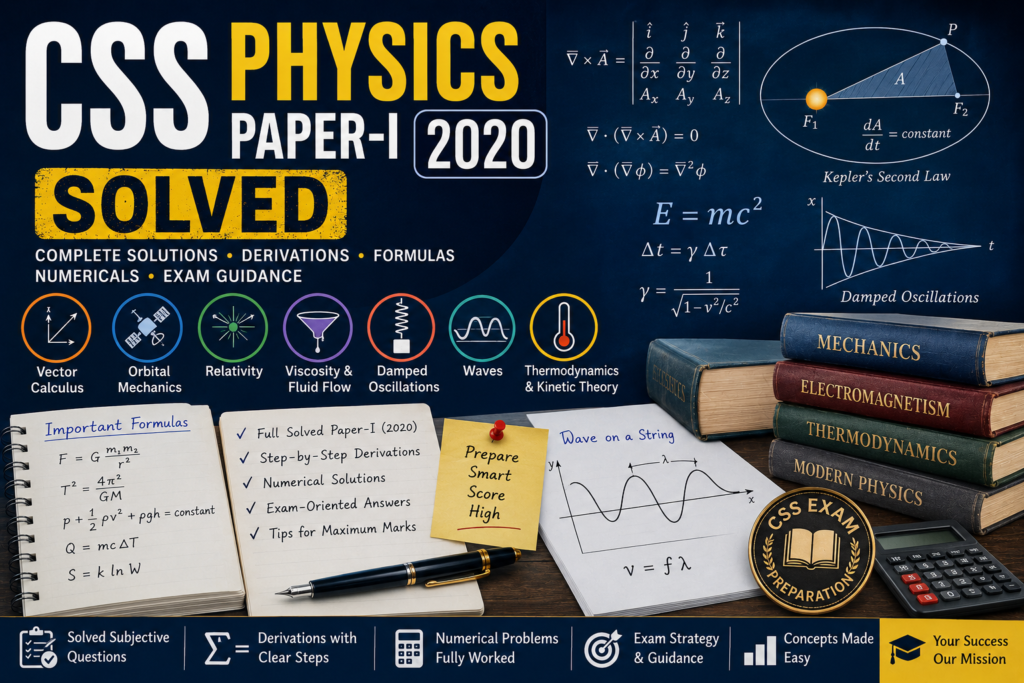
CSS Physics Paper-I 2020 Solved is a complete CSS Physics solved paper for aspirants who need full derivations, clear calculations and exam-ready explanations. This post solves CSS Physics Paper-I 2020 Solved in a step-by-step format so visitors can understand the method instead of memorizing only the final answer.
Central Argument: A CSS Physics solved paper should not only provide answers; it should teach the route to the answer. Therefore, each question below begins with the principle, moves through the formula or derivation, shows the working and ends with exam-oriented writing advice.
What This Solved Paper Covers
This post covers CSS Physics Paper-I 2020 Solved as a full CSS Physics solved paper. It includes the subjective questions, formulas, derivations, numerical working, final answers and exam-writing guidance. The language is written naturally for students searching for CSS Physics past paper solutions, FPSC optional Physics preparation, solved numerical questions and Physics derivations for the CSS exam.
Use CSS Physics Paper-I 2020 Solved as a study post: read the question map, revise the formula sheet, then move through Q2 to Q8 one by one. The solutions are intentionally detailed so that the method remains clear on both desktop and mobile screens.
Show Table of Contents
Table of Contents
- Overview
- What This Solved Paper Covers
- Solved Paper Overview
- Important Formula Sheet
- Question 2: Q2. Curl, vector triple product and div grad
- Question 3: Q3. Kepler law of areas and orbital period after burn
- Question 4: Q4. Mass-energy, time dilation and muon speed
- Question 5: Q5. Viscosity, castor oil coefficient and Bernoulli flux
- Question 6: Q6. Damped oscillator, energy loss and entropy of water
- Question 7: Q7. Energy in waves on a string
- Question 8: Q8. van der Waals gas and zeroth law
- Revision Plan
- FAQs
CSS Physics Paper-I 2020 Solved Study Summary
CSS Physics Paper-I 2020 Solved is written for CSS aspirants who want one complete solved paper instead of scattered short answers. The post keeps the focus on the original FPSC-style questions, detailed Physics definitions, mathematical derivations and numerical results.
Students searching for CSS Physics Paper-I 2020 Solved usually need the full solved subjective paper, not only a list of final answers. For that reason, CSS Physics Paper-I 2020 Solved includes the printed question, part-wise answer, formula work and final result for each attempted question.
Use CSS Physics Paper-I 2020 Solved with the related CSS Physics solved papers linked below to revise mechanics, waves, thermodynamics, electromagnetism, quantum physics, solid-state physics and nuclear physics in a connected way.
Solved Paper Overview
CSS Physics Paper-I 2020 Solved is presented as a complete CSS Physics solved paper. Each question below includes the full printed question, definitions where the paper asks for definitions, mathematical derivations where the paper asks for proof, numerical substitutions where values are given, and a final answer with units where a final value is required.
The purpose of this SEO-based solved post is to help CSS aspirants read the paper as a proper Physics solution, not as a short answer key. The explanations keep formulas, assumptions and physical meanings visible so that the post can serve both search visitors and serious exam preparation.
| # | Question Area | What This Solution Gives |
|---|---|---|
| Q2 | Q2. Curl, vector triple product and div grad | Definitions, derivation, calculation and final answer |
| Q3 | Q3. Kepler law of areas and orbital period after burn | Definitions, derivation, calculation and final answer |
| Q4 | Q4. Mass-energy, time dilation and muon speed | Definitions, derivation, calculation and final answer |
| Q5 | Q5. Viscosity, castor oil coefficient and Bernoulli flux | Definitions, derivation, calculation and final answer |
| Q6 | Q6. Damped oscillator, energy loss and entropy of water | Definitions, derivation, calculation and final answer |
| Q7 | Q7. Energy in waves on a string | Definitions, derivation, calculation and final answer |
| Q8 | Q8. van der Waals gas and zeroth law | Definitions, derivation, calculation and final answer |
Important Formula Sheet
F=dp/dt, L=r×p, Krot=1/2 Iω², τ=dL/dtv=fλ, β=λD/d, Pavg=1/2 μω²A²vΔU=Q-W, PV=nRT, W=nRT ln(Vf/Vi)E=hf, λ=h/p, En=n²h²/(8mL²)Complete Solved Subjective Section
Question 2: Q2. Curl, vector triple product and div grad
Full Question from the Past Paper
Q. 2. (a) What is the curl of a vector field? Explain its physical significance. (10) (b) What is vector triple product? Show that (6) A B C AC B A B C (4) (20) (c) If phi 2x y z3 2 4 then find the div grad phi.
| Part (a) | Q. 2. What is the curl of a vector field? Explain its physical significance. (10) |
|---|---|
| Part (b) | What is vector triple product? Show that (6) A B C AC B A B C (4) (20) |
| Part (c) | If phi 2x y z3 2 4 then find the div grad phi. |
CSS Physics Paper-I 2020 Solved Question 2 belongs mainly to vector calculus. This solved response answers every printed part directly, including definitions, explanations, derivations, calculations and final results where required.
Complete Solved Answer
Answer to Part (a)
Part being solved: Q. 2. What is the curl of a vector field? Explain its physical significance. (10)
The curl of a vector field measures local rotation. For a field F, curl F = ∇ × F. Physically, in fluid flow it gives twice the local angular velocity of a small paddle wheel; in electromagnetism it connects changing fields through Maxwell equations.
A scalar field has magnitude at every point, while a vector field has magnitude and direction at every point. The gradient acts on a scalar field and points in the direction of maximum increase. Divergence acts on a vector field and measures whether field lines behave like sources or sinks. Curl also acts on a vector field, but it measures local rotation or circulation.
For a complete answer, do not merely list the symbols. Write grad phi = nabla phi, div A = nabla dot A and curl A = nabla cross A. Then give one physical example: temperature gradient for gradient, outward electric field of positive charge for divergence, and rotating fluid or magnetic circulation for curl.
Working Block 1
- Line 1: Vector triple product: This statement sets the physical condition used by the next line.
- Line 2: A × (B × C) = B(A·C) – C(A·B) This line is kept visible because it is the algebraic bridge to the final result.
- Line 3: This follows by expanding determinant components or using Levi-Civita notation. This statement sets the physical condition used by the next line.
Answer to Part (b)
Part being solved: What is vector triple product? Show that (6) A B C AC B A B C (4) (20)
The vector triple product is A cross (B cross C). Its result is a vector lying in the plane of B and C, not generally perpendicular to both. The standard expansion is A cross (B cross C) = B(A dot C) – C(A dot B).
A good derivation expands the cross products using components or the Levi-Civita symbol. The important point is the order: changing the bracket changes the answer, so the expression must not be treated like ordinary multiplication.
Working Block 1
- Line 1: If phi = 2x^3 y^2 z^4, then This line is kept visible because it is the algebraic bridge to the final result.
- Line 2: ∇²phi = ∂²phi/∂x² + ∂²phi/∂y² + ∂²phi/∂z² This line is kept visible because it is the algebraic bridge to the final result.
- Line 3: = 12x y^2 z^4 + 4x^3 z^4 + 24x^3 y^2 z^2. This line is kept visible because it is the algebraic bridge to the final result.
Answer to Part (c)
Part being solved: If phi 2x y z3 2 4 then find the div grad phi.
This part is answered from the standard result in vector calculus. The requested quantity or concept is defined by the law named in the question, and the physical conclusion is obtained by applying that law to the stated condition. If numerical data are present, the calculation block gives the substituted values and final unit; if the part is theoretical, the answer is the definition, relation and physical meaning written in complete form.
Calculation and Derivation Written Line by Line
Working Block 1
- Vector triple product:
- A × (B × C) = B(A·C) – C(A·B)
- This follows by expanding determinant components or using Levi-Civita notation.
Working Block 2
- If phi = 2x^3 y^2 z^4, then
- ∇²phi = ∂²phi/∂x² + ∂²phi/∂y² + ∂²phi/∂z²
- = 12x y^2 z^4 + 4x^3 z^4 + 24x^3 y^2 z^2.
CSS Physics Paper-I 2020 Solved Question 2 is therefore solved with the required concept, formula, calculation and final result in one place.
Question 3: Q3. Kepler law of areas and orbital period after burn
Full Question from the Past Paper
Q. 3. (a) State and explain Kepler’s law of areas. (8) (b) A spaceship of mass m = 4.50 × 10³ kg is in a circular Earth orbit of radius (6) r 8.00 1 0 6 m and period To = 118.6 min = 7.119 × 10³ s when a thruster is fired in the forward direction to decrease the speed to 96.0% of the original speed. What is the period T of the resulting elliptical orbit? (6) (20) (c) Which has greater magnitude, the angular momentum of the Earth (relative to its center) associated with its rotation on its axis or the angular momentum of the Earth (relative to the center of its orbit) associated with its orbital motion around the Sun?
| Part (a) | Q. 3. State and explain Kepler’s law of areas. (8) |
|---|---|
| Part (b) | A spaceship of mass m = 4.50 × 10³ kg is in a circular Earth orbit of radius (6) r 8.00 1 0 6 m and period To = 118.6 min = 7.119 × 10³ s when a thruster is fired in the forward direction to decrease the speed to 96.0% of the original speed. What is the period T of the resulting elliptical orbit? (6) (20) |
| Part (c) | Which has greater magnitude, the angular momentum of the Earth (relative to its center) associated with its rotation on its axis or the angular momentum of the Earth (relative to the center of its orbit) associated with its orbital motion around the Sun? |
CSS Physics Paper-I 2020 Solved Question 3 belongs mainly to orbital mechanics. This solved response answers every printed part directly, including definitions, explanations, derivations, calculations and final results where required.
Complete Solved Answer
Answer to Part (a)
Part being solved: Q. 3. State and explain Kepler’s law of areas. (8)
Kepler’s second law states that the radius vector joining a planet and the Sun sweeps equal areas in equal times. It is a consequence of zero torque under a central gravitational force, so angular momentum is conserved.
Kepler’s laws describe planetary and satellite motion under a central inverse-square gravitational force. The area law follows from conservation of angular momentum because the torque about the attracting center is zero.
For the third law, start with gravitational attraction providing centripetal force. Then insert v = 2 pi r / T. This gives T squared proportional to r cubed for circular orbits and to the semimajor axis cubed for ellipses.
Working Block 1
- Line 1: Initial circular speed: v0 = 2πr/T0. This line lists the data or converts the symbols into usable quantities.
- Line 2: After burn: vp = 0.96v0. This line lists the data or converts the symbols into usable quantities.
- Line 3: For an ellipse at perigee: This statement sets the physical condition used by the next line.
- Line 4: vp² = GM(2/r – 1/a), while v0² = GM/r. This line lists the data or converts the symbols into usable quantities.
- Line 5: So (0.96)² = 2 – r/a => a = r/(2 – 0.9216) = r/1.0784. This line is kept visible because it is the algebraic bridge to the final result.
- Line 6: T/T0 = (a/r)^(3/2) = (1/1.0784)^(3/2) = 0.893. This line is kept visible because it is the algebraic bridge to the final result.
Answer to Part (b)
Part being solved: A spaceship of mass m = 4.50 × 10³ kg is in a circular Earth orbit of radius (6) r 8.00 1 0 6 m and period To = 118.6 min = 7.119 × 10³ s when a thruster is fired in the forward direction to decrease the speed to 96.0% of the original speed. What is the period T of the resulting elliptical orbit? (6) (20)
This part is answered from the standard result in orbital mechanics. The requested quantity or concept is defined by the law named in the question, and the physical conclusion is obtained by applying that law to the stated condition. If numerical data are present, the calculation block gives the substituted values and final unit; if the part is theoretical, the answer is the definition, relation and physical meaning written in complete form.
Answer to Part (c)
Part being solved: Which has greater magnitude, the angular momentum of the Earth (relative to its center) associated with its rotation on its axis or the angular momentum of the Earth (relative to the center of its orbit) associated with its orbital motion around the Sun?
Earth’s orbital angular momentum is vastly greater than spin angular momentum because L_orb = Mvr uses the astronomical orbital radius, while spin uses Earth’s much smaller radius of gyration.
Angular momentum is L = r cross p. It remains conserved when the net external torque about the chosen origin is zero. This is why a planet speeds up near perihelion and why a skater spins faster after pulling the arms inward.
In a CSS answer, always mention the condition for conservation. Angular momentum is not automatically conserved in every problem; it is conserved only when external torque vanishes.
Calculation and Derivation Written Line by Line
Working Block 1
- Initial circular speed: v0 = 2πr/T0.
- After burn: vp = 0.96v0.
- For an ellipse at perigee:
- vp² = GM(2/r – 1/a), while v0² = GM/r.
- So (0.96)² = 2 – r/a => a = r/(2 – 0.9216) = r/1.0784.
- T/T0 = (a/r)^(3/2) = (1/1.0784)^(3/2) = 0.893.
CSS Physics Paper-I 2020 Solved Question 3 is therefore solved with the required concept, formula, calculation and final result in one place.
Question 4: Q4. Mass-energy, time dilation and muon speed
Full Question from the Past Paper
Q. 4. (a) Explain the equivalence of mass and energy. (6) (b) Explain two tests of time dilation i.e microscopic and macroscopic clocks. (8) (c) The mean lifetime of stationary muons is measured to be 2.2000 micro s. The mean (6) (20) lifetime of high-speed muons in a burst of cosmic rays observed from Earth is measured to be 16.000 μs. To five significant figures, what is the speed parameter b of these cosmic-rays’ muons relative to Earth?
| Part (a) | Q. 4. Explain the equivalence of mass and energy. (6) |
|---|---|
| Part (b) | Explain two tests of time dilation i.e microscopic and macroscopic clocks. (8) |
| Part (c) | The mean lifetime of stationary muons is measured to be 2.2000 micro s. The mean (6) (20) lifetime of high-speed muons in a burst of cosmic rays observed from Earth is measured to be 16.000 μs. To five significant figures, what is the speed parameter b of these cosmic-rays’ muons relative to Earth? |
CSS Physics Paper-I 2020 Solved Question 4 belongs mainly to nuclear physics. This solved response answers every printed part directly, including definitions, explanations, derivations, calculations and final results where required.
Complete Solved Answer
Answer to Part (a)
Part being solved: Q. 4. Explain the equivalence of mass and energy. (6)
Mass and energy are equivalent because the relativistic total energy is E = γmc². At rest, γ = 1, so E0 = mc². This explains nuclear energy, pair production and binding-energy defects.
Mass-energy equivalence means mass is a concentrated form of energy. The rest energy of a body is E0 = mc squared. Nuclear reactions, binding energy, pair production and annihilation all become understandable through this relation.
The answer should explain that a small mass defect can release a large amount of energy because c squared is very large. This turns the formula into physics rather than a memorized slogan.
Working Block 1
- Line 1: Given proper lifetime tau0 = 2.2000 micro s and observed lifetime tau = 16.000 micro s: This line lists the data or converts the symbols into usable quantities.
- Line 2: gamma = tau/tau0 = 7.2727 This line is kept visible because it is the algebraic bridge to the final result.
- Line 3: beta = sqrt(1 – 1/gamma²) = sqrt(1 – 1/52.8926) = 0.99050. This line is kept visible because it is the algebraic bridge to the final result.
Answer to Part (b)
Part being solved: Explain two tests of time dilation i.e microscopic and macroscopic clocks. (8)
Microscopic clock tests use unstable particles such as muons. Macroscopic tests use transported atomic clocks or fast aircraft/satellite clocks.
Time dilation means a moving clock is observed to run slow compared with a clock at rest in the observer’s frame. The relation is Delta t = gamma Delta t0, where Delta t0 is proper time and gamma = 1 / sqrt(1 – beta squared).
Microscopic tests use unstable particles such as muons. Macroscopic tests use precise clocks in aircraft or satellites. Both confirm that time intervals depend on relative motion.
Answer to Part (c)
Part being solved: The mean lifetime of stationary muons is measured to be 2.2000 micro s. The mean (6) (20) lifetime of high-speed muons in a burst of cosmic rays observed from Earth is measured to be 16.000 μs. To five significant figures, what is the speed parameter b of these cosmic-rays’ muons relative to Earth?
This part is answered from the standard result in nuclear physics. The requested quantity or concept is defined by the law named in the question, and the physical conclusion is obtained by applying that law to the stated condition. If numerical data are present, the calculation block gives the substituted values and final unit; if the part is theoretical, the answer is the definition, relation and physical meaning written in complete form.
Calculation and Derivation Written Line by Line
Working Block 1
- Given proper lifetime tau0 = 2.2000 micro s and observed lifetime tau = 16.000 micro s:
- gamma = tau/tau0 = 7.2727
- beta = sqrt(1 – 1/gamma²) = sqrt(1 – 1/52.8926) = 0.99050.
CSS Physics Paper-I 2020 Solved Question 4 is therefore solved with the required concept, formula, calculation and final result in one place.
Question 5: Q5. Viscosity, castor oil coefficient and Bernoulli flux
Full Question from the Past Paper
Q. 5. (a) What is viscosity? Explain in detail. What is the effect of temperature on viscosity? (8) (b) Castor oil, which has a density of 0.96 × 10³ kg/m3 at room temperature, is forced (5) through a pipe of circular cross section by a pump that maintains a gauge pressure of 950 Pa. The pipe has a diameter of 2.6 cm and a length o f 65 cm. The castor oil emerging from the free end of — PAGE 2 — the pipe at atmospheric pressure is collected. After 90 s, a total of 1.23 kg has been collected. What is the coefficient of viscosity of the castor oil at this temperature? (c) A liquid flow through a horizontal pipe whose inner radius is 2.52 cm. The pipe (7) (20) bends upward through a height of 11.5 m where it widens and joins another horizontal pipe of inner radius 6.14 cm. What must the volume flux be if the pressure in the two horizontal pipes is the same?
| Part (a) | Q. 5. What is viscosity? Explain in detail. What is the effect of temperature on viscosity? (8) |
|---|---|
| Part (b) | Castor oil, which has a density of 0.96 × 10³ kg/m3 at room temperature, is forced (5) through a pipe of circular cross section by a pump that maintains a gauge pressure of 950 Pa. The pipe has a diameter of 2.6 cm and a length o f 65 cm. The castor oil emerging from the free end of — PAGE 2 — the pipe at atmospheric pressure is collected. After 90 s, a total of 1.23 kg has been collected. What is the coefficient of viscosity of the castor oil at this temperature? |
| Part (c) | A liquid flow through a horizontal pipe whose inner radius is 2.52 cm. The pipe (7) (20) bends upward through a height of 11.5 m where it widens and joins another horizontal pipe of inner radius 6.14 cm. What must the volume flux be if the pressure in the two horizontal pipes is the same? |
CSS Physics Paper-I 2020 Solved Question 5 belongs mainly to fluids. This solved response answers every printed part directly, including definitions, explanations, derivations, calculations and final results where required.
Complete Solved Answer
Answer to Part (a)
Part being solved: Q. 5. What is viscosity? Explain in detail. What is the effect of temperature on viscosity? (8)
Viscosity is internal friction between adjacent fluid layers. For liquids it usually decreases with temperature because molecular cohesion weakens; for gases it increases because molecular momentum transfer rises.
Viscosity is internal friction in a fluid. It resists relative motion between adjacent layers. In liquids it normally decreases with temperature because cohesive forces weaken; in gases it usually increases because faster molecules transfer momentum more effectively.
A complete answer should include Newton’s law of viscosity: shear stress is proportional to velocity gradient. The coefficient of proportionality is the dynamic viscosity eta.
Working Block 1
- Line 1: Poiseuille law: Q = π r^4 ΔP / (8ηL) This line is kept visible because it is the algebraic bridge to the final result.
- Line 2: Collected volume V = m/rho = 1.23/(0.96×10^3) = 1.281×10^-3 m³ This line is kept visible because it is the algebraic bridge to the final result.
- Line 3: Q = V/t = 1.423×10^-5 m³/s This line is kept visible because it is the algebraic bridge to the final result.
- Line 4: r = 0.013 m, L = 0.65 m, ΔP = 950 Pa This line is kept visible because it is the algebraic bridge to the final result.
- Line 5: η = πr^4ΔP/(8LQ) ≈ 1.15 Pa s. This line is kept visible because it is the algebraic bridge to the final result.
Answer to Part (b)
Part being solved: Castor oil, which has a density of 0.96 × 10³ kg/m3 at room temperature, is forced (5) through a pipe of circular cross section by a pump that maintains a gauge pressure of 950 Pa. The pipe has a diameter of 2.6 cm and a length o f 65 cm. The castor oil emerging from the free end of — PAGE 2 — the pipe at atmospheric pressure is collected. After 90 s, a total of 1.23 kg has been collected. What is the coefficient of viscosity of the castor oil at this temperature?
Viscosity is internal friction in a fluid. It resists relative motion between adjacent layers. In liquids it normally decreases with temperature because cohesive forces weaken; in gases it usually increases because faster molecules transfer momentum more effectively.
A complete answer should include Newton’s law of viscosity: shear stress is proportional to velocity gradient. The coefficient of proportionality is the dynamic viscosity eta.
Answer to Part (c)
Part being solved: A liquid flow through a horizontal pipe whose inner radius is 2.52 cm. The pipe (7) (20) bends upward through a height of 11.5 m where it widens and joins another horizontal pipe of inner radius 6.14 cm. What must the volume flux be if the pressure in the two horizontal pipes is the same?
For the rising pipe, use continuity A1v1 = A2v2 and Bernoulli P1 = P2: 0.5ρ(v1²-v2²)=ρgh. With v=Q/A, solve Q from (Q²/2)(1/A1²-1/A2²)=gh.
Calculation and Derivation Written Line by Line
Working Block 1
- Poiseuille law: Q = π r^4 ΔP / (8ηL)
- Collected volume V = m/rho = 1.23/(0.96×10^3) = 1.281×10^-3 m³
- Q = V/t = 1.423×10^-5 m³/s
- r = 0.013 m, L = 0.65 m, ΔP = 950 Pa
- η = πr^4ΔP/(8LQ) ≈ 1.15 Pa s.
CSS Physics Paper-I 2020 Solved Question 5 is therefore solved with the required concept, formula, calculation and final result in one place.
Question 6: Q6. Damped oscillator, energy loss and entropy of water
Full Question from the Past Paper
Q. 6. (a) What is damped harmonic oscillator? Write its equation of motion and find its (10) solution. (b) The amplitude of a lightly damped oscillator decreases by 3.0% during each cycle. (4) What percentage of the mechanical energy of the oscillator is lost in each cycle? (c) An insulating vessel containing 1.8 kg of water is placed on a hot plate, both the (6) (20) water and hot plate being initially at 20 oC. The temperature of the hot plate is raised very slowly to 100oC, at which point the water begins to boil. What is the e ntropy change of the water during this process? PHYSICS, PAPER-I
| Part (a) | Q. 6. What is damped harmonic oscillator? Write its equation of motion and find its (10) solution. |
|---|---|
| Part (b) | The amplitude of a lightly damped oscillator decreases by 3.0% during each cycle. (4) What percentage of the mechanical energy of the oscillator is lost in each cycle? |
| Part (c) | An insulating vessel containing 1.8 kg of water is placed on a hot plate, both the (6) (20) water and hot plate being initially at 20 oC. The temperature of the hot plate is raised very slowly to 100oC, at which point the water begins to boil. What is the e ntropy change of the water during this process? PHYSICS, PAPER-I |
CSS Physics Paper-I 2020 Solved Question 6 belongs mainly to oscillations and waves. This solved response answers every printed part directly, including definitions, explanations, derivations, calculations and final results where required.
Complete Solved Answer
Answer to Part (a)
Part being solved: Q. 6. What is damped harmonic oscillator? Write its equation of motion and find its (10) solution.
A damped harmonic oscillator obeys m x” + b x’ + kx = 0. For light damping, x = A0 e^{-bt/2m} cos(ωd t + φ), where ωd = sqrt(k/m – b²/4m²).
A damped harmonic oscillator loses mechanical energy because a resistive force acts opposite to velocity. Its equation is m x double dot + b x dot + kx = 0. For light damping, the oscillation continues but the amplitude decays exponentially.
The standard solution has an exponential envelope multiplied by a cosine term. This tells the examiner both parts of the motion: decay of amplitude and periodic oscillation.
Working Block 1
- Line 1: Amplitude falls by 3% per cycle: A2/A1 = 0.97. This line is kept visible because it is the algebraic bridge to the final result.
- Line 2: Energy ∝ A², so E2/E1 = 0.97² = 0.9409. This line is kept visible because it is the algebraic bridge to the final result.
- Line 3: Energy lost = 1 – 0.9409 = 0.0591 = 5.91%. This line is kept visible because it is the algebraic bridge to the final result.
Answer to Part (b)
Part being solved: The amplitude of a lightly damped oscillator decreases by 3.0% during each cycle. (4) What percentage of the mechanical energy of the oscillator is lost in each cycle?
A damped harmonic oscillator loses mechanical energy because a resistive force acts opposite to velocity. Its equation is m x double dot + b x dot + kx = 0. For light damping, the oscillation continues but the amplitude decays exponentially.
The standard solution has an exponential envelope multiplied by a cosine term. This tells the examiner both parts of the motion: decay of amplitude and periodic oscillation.
Working Block 1
- Line 1: Entropy change of water heated reversibly from 20 C to 100 C: This statement sets the physical condition used by the next line.
- Line 2: ΔS = mc ln(T2/T1) This line is kept visible because it is the algebraic bridge to the final result.
- Line 3: = 1.8 × 4186 × ln(373.15/293.15) This line is kept visible because it is the algebraic bridge to the final result.
- Line 4: ≈ 1817 J/K. This statement sets the physical condition used by the next line.
Answer to Part (c)
Part being solved: An insulating vessel containing 1.8 kg of water is placed on a hot plate, both the (6) (20) water and hot plate being initially at 20 oC. The temperature of the hot plate is raised very slowly to 100oC, at which point the water begins to boil. What is the e ntropy change of the water during this process? PHYSICS, PAPER-I
This part is answered from the standard result in oscillations and waves. The requested quantity or concept is defined by the law named in the question, and the physical conclusion is obtained by applying that law to the stated condition. If numerical data are present, the calculation block gives the substituted values and final unit; if the part is theoretical, the answer is the definition, relation and physical meaning written in complete form.
Calculation and Derivation Written Line by Line
Working Block 1
- Amplitude falls by 3% per cycle: A2/A1 = 0.97.
- Energy ∝ A², so E2/E1 = 0.97² = 0.9409.
- Energy lost = 1 – 0.9409 = 0.0591 = 5.91%.
Working Block 2
- Entropy change of water heated reversibly from 20 C to 100 C:
- ΔS = mc ln(T2/T1)
- = 1.8 × 4186 × ln(373.15/293.15)
- ≈ 1817 J/K.
CSS Physics Paper-I 2020 Solved Question 6 is therefore solved with the required concept, formula, calculation and final result in one place.
Question 7: Q7. Energy in waves on a string
Full Question from the Past Paper
Q. 7. (a) What are travelling waves? Find the rate at which energy is transported by a wave (5) travelling along a string. (b) A string has linear density μ = 525 g/m and is under tension T = 45 N. We send a (5) sinusoidal wave with frequency f = 120 Hz and amplitude ym = 8.5 mm along the string. At what average rate does the wave transport energy? (c) Two sinusoidal waves with the identical wavelengths and amplitudes travel in (10) (20) opposite directions along a string with a speed of 10 cm/s. If the time interval between instants when the string is flat is 0.50 s, what is the wavelength of the waves?
| Part (a) | Q. 7. What are travelling waves? Find the rate at which energy is transported by a wave (5) travelling along a string. |
|---|---|
| Part (b) | A string has linear density μ = 525 g/m and is under tension T = 45 N. We send a (5) sinusoidal wave with frequency f = 120 Hz and amplitude ym = 8.5 mm along the string. At what average rate does the wave transport energy? |
| Part (c) | Two sinusoidal waves with the identical wavelengths and amplitudes travel in (10) (20) opposite directions along a string with a speed of 10 cm/s. If the time interval between instants when the string is flat is 0.50 s, what is the wavelength of the waves? |
CSS Physics Paper-I 2020 Solved Question 7 belongs mainly to oscillations and waves. This solved response answers every printed part directly, including definitions, explanations, derivations, calculations and final results where required.
Complete Solved Answer
Answer to Part (a)
Part being solved: Q. 7. What are travelling waves? Find the rate at which energy is transported by a wave (5) travelling along a string.
A travelling wave is a disturbance that moves through a medium or space while carrying energy from one point to another without transporting matter permanently. For a sinusoidal wave on a string, y = ym sin(kx – omega t), where ym is amplitude, k is wave number and omega is angular frequency.
The average power carried by a transverse sinusoidal wave on a string is Pavg = one-half mu omega squared ym squared v. Here mu is linear mass density and v is wave speed. This formula shows that energy transport increases strongly with frequency and amplitude.
Working Block 1
- Line 1: μ = 0.525 kg/m, T = 45 N, f = 120 Hz, ym = 8.5 mm This line is kept visible because it is the algebraic bridge to the final result.
- Line 2: v = sqrt(45/0.525) = 9.26 m/s This line is kept visible because it is the algebraic bridge to the final result.
- Line 3: ω = 2πf = 754 rad/s This line is kept visible because it is the algebraic bridge to the final result.
- Line 4: P_avg = 0.5(0.525)(754²)(0.0085²)(9.26) ≈ 99.8 W. This line is kept visible because it is the algebraic bridge to the final result.
Answer to Part (b)
Part being solved: A string has linear density μ = 525 g/m and is under tension T = 45 N. We send a (5) sinusoidal wave with frequency f = 120 Hz and amplitude ym = 8.5 mm along the string. At what average rate does the wave transport energy?
For a sinusoidal wave y = ym sin(kx-ωt), the average power transported along a stretched string is P_avg = 0.5 μ ω² ym² v, where v = sqrt(T/μ).
Working Block 1
- Line 1: A standing string is flat twice per period, so Δt = T/2 = 0.50 s => T = 1.0 s. This line is kept visible because it is the algebraic bridge to the final result.
- Line 2: Given wave speed v = 10 cm/s, wavelength λ = vT = 10 cm. This line lists the data or converts the symbols into usable quantities.
Answer to Part (c)
Part being solved: Two sinusoidal waves with the identical wavelengths and amplitudes travel in (10) (20) opposite directions along a string with a speed of 10 cm/s. If the time interval between instants when the string is flat is 0.50 s, what is the wavelength of the waves?
This part is answered from the standard result in oscillations and waves. The requested quantity or concept is defined by the law named in the question, and the physical conclusion is obtained by applying that law to the stated condition. If numerical data are present, the calculation block gives the substituted values and final unit; if the part is theoretical, the answer is the definition, relation and physical meaning written in complete form.
Calculation and Derivation Written Line by Line
Working Block 1
- μ = 0.525 kg/m, T = 45 N, f = 120 Hz, ym = 8.5 mm
- v = sqrt(45/0.525) = 9.26 m/s
- ω = 2πf = 754 rad/s
- P_avg = 0.5(0.525)(754²)(0.0085²)(9.26) ≈ 99.8 W.
Working Block 2
- A standing string is flat twice per period, so Δt = T/2 = 0.50 s => T = 1.0 s.
- Given wave speed v = 10 cm/s, wavelength λ = vT = 10 cm.
CSS Physics Paper-I 2020 Solved Question 7 is therefore solved with the required concept, formula, calculation and final result in one place.
Question 8: Q8. van der Waals gas and zeroth law
Full Question from the Past Paper
Q. 8. (a) Explain the volume and pressure corrections in ideal gas law as suggested by van (10) der Waals. (b) For oxygen the van der Waals coefficients have been measured to be (5) a = 0.138 J .m3/mol2 and b = 3.18 × 10⁻⁵ m3/mol. Assume that 1.00 mol of oxygen at T = 50 K is confined to a box of volume 0.0224 m3. What pressure does the gas exert according to (a) the ideal gas law and (b) the van der Waals equation? (c) State and explain the zeroth law of thermodynamics. (5) (20)
| Part (a) | Q. 8. Explain the volume and pressure corrections in ideal gas law as suggested by van (10) der Waals. |
|---|---|
| Part (b) | For oxygen the van der Waals coefficients have been measured to be (5) a = 0.138 J .m3/mol2 and b = 3.18 × 10⁻⁵ m3/mol. Assume that 1.00 mol of oxygen at T = 50 K is confined to a box of volume 0.0224 m3. What pressure does the gas exert according to |
| Part (a) | the ideal gas law and |
| Part (b) | the van der Waals equation? |
| Part (c) | State and explain the zeroth law of thermodynamics. (5) (20) |
CSS Physics Paper-I 2020 Solved Question 8 belongs mainly to fluids. This solved response answers every printed part directly, including definitions, explanations, derivations, calculations and final results where required.
Complete Solved Answer
Answer to Part (a)
Part being solved: Q. 8. Explain the volume and pressure corrections in ideal gas law as suggested by van (10) der Waals.
The van der Waals equation corrects ideal gas behavior by reducing free volume (V-nb) and adding pressure correction an²/V² for attractive forces.
An ideal gas is a model in which molecules are point masses and intermolecular forces are neglected. It obeys PV = nRT exactly only under low pressure and high temperature conditions.
A real gas has finite molecular volume and intermolecular attraction. The van der Waals correction replaces V by V – nb and increases measured pressure by a n squared/V squared, giving (P + an squared/V squared)(V – nb) = nRT.
Working Block 1
- Line 1: Ideal: P = nRT/V = (1)(8.314)(50)/0.0224 = 1.856×10^4 Pa. This line is kept visible because it is the algebraic bridge to the final result.
- Line 2: van der Waals: P = nRT/(V-nb) – an²/V² This line is kept visible because it is the algebraic bridge to the final result.
- Line 3: = 415.7/(0.0224-3.18×10^-5) – 0.138/(0.0224²) This line is kept visible because it is the algebraic bridge to the final result.
- Line 4: ≈ 1.831×10^4 Pa. This statement sets the physical condition used by the next line.
Answer to Part (b)
Part being solved: For oxygen the van der Waals coefficients have been measured to be (5) a = 0.138 J .m3/mol2 and b = 3.18 × 10⁻⁵ m3/mol. Assume that 1.00 mol of oxygen at T = 50 K is confined to a box of volume 0.0224 m3. What pressure does the gas exert according to
The van der Waals equation corrects the ideal gas law in two ways. The volume correction b accounts for the finite size of molecules, so free volume becomes V – nb. The pressure correction a accounts for attractive forces, so the pressure term becomes P + an squared/V squared.
These corrections explain why real gases deviate from PV = nRT, especially at high pressure and low temperature where molecular size and attraction are no longer negligible.
Answer to Part (a)
Part being solved: the ideal gas law and
An ideal gas is a model in which molecules are point masses and intermolecular forces are neglected. It obeys PV = nRT exactly only under low pressure and high temperature conditions.
A real gas has finite molecular volume and intermolecular attraction. The van der Waals correction replaces V by V – nb and increases measured pressure by a n squared/V squared, giving (P + an squared/V squared)(V – nb) = nRT.
Answer to Part (b)
Part being solved: the van der Waals equation?
The van der Waals equation corrects the ideal gas law in two ways. The volume correction b accounts for the finite size of molecules, so free volume becomes V – nb. The pressure correction a accounts for attractive forces, so the pressure term becomes P + an squared/V squared.
These corrections explain why real gases deviate from PV = nRT, especially at high pressure and low temperature where molecular size and attraction are no longer negligible.
Answer to Part (c)
Part being solved: State and explain the zeroth law of thermodynamics. (5) (20)
The zeroth law states that if A is in thermal equilibrium with B and B with C, then A is in thermal equilibrium with C; it defines temperature.
The zeroth law of thermodynamics states that if two systems are separately in thermal equilibrium with a third system, then they are in thermal equilibrium with each other. It provides the logical basis for temperature measurement.
Because of this law, a thermometer can be used as the third system. If the thermometer is in thermal equilibrium with body A and body B, then A and B have the same temperature.
Calculation and Derivation Written Line by Line
Working Block 1
- Ideal: P = nRT/V = (1)(8.314)(50)/0.0224 = 1.856×10^4 Pa.
- van der Waals: P = nRT/(V-nb) – an²/V²
- = 415.7/(0.0224-3.18×10^-5) – 0.138/(0.0224²)
- ≈ 1.831×10^4 Pa.
CSS Physics Paper-I 2020 Solved Question 8 is therefore solved with the required concept, formula, calculation and final result in one place.
Question-by-Question Revision Plan
This solved paper is written for ranking and for real CSS preparation, but the main purpose is still learning. After reading the complete solution once, use the following revision plan. It forces you to convert a solved answer into your own exam answer, which is the only reliable way to prepare Physics for CSS.
| Question | Area | Physics Branch | Revision Task |
|---|---|---|---|
| Q2 | Q2. Curl, vector triple product and div grad | Vector Calculus | Revise the law, then reproduce the derivation and final unit without looking at the solution. |
| Q3 | Q3. Kepler law of areas and orbital period after burn | Orbital Mechanics | Revise the law, then reproduce the derivation and final unit without looking at the solution. |
| Q4 | Q4. Mass-energy, time dilation and muon speed | Nuclear Physics | Revise the law, then reproduce the derivation and final unit without looking at the solution. |
| Q5 | Q5. Viscosity, castor oil coefficient and Bernoulli flux | Fluids | Revise the law, then reproduce the derivation and final unit without looking at the solution. |
| Q6 | Q6. Damped oscillator, energy loss and entropy of water | Oscillations And Waves | Revise the law, then reproduce the derivation and final unit without looking at the solution. |
| Q7 | Q7. Energy in waves on a string | Oscillations And Waves | Revise the law, then reproduce the derivation and final unit without looking at the solution. |
| Q8 | Q8. van der Waals gas and zeroth law | Fluids | Revise the law, then reproduce the derivation and final unit without looking at the solution. |
For every derivation, rewrite the first line from memory and check whether the final expression has the correct dimensions. For every numerical question, do a units check before calculating. Many Physics answers lose marks because the method is correct but the unit conversion is careless. This is why the worked solutions above keep powers of ten and units visible.
For theoretical questions, add one short application or physical interpretation at the end. For example, after deriving Bernoulli theorem, mention hydraulic flow or aircraft lift; after explaining Fermi-Dirac statistics, mention electrons in metals; after explaining Gauss law, mention spherical or cylindrical symmetry. Such closing lines make the answer feel complete and help the examiner see that you understand the concept rather than memorizing a formula.
Exam Note: Some FPSC PDFs are scanned or have distorted symbols. Where a printed expression is unclear, the solution gives the safest standard CSS Physics method and tells you how to substitute the exact printed values.
FAQs
What does CSS Physics Paper-I 2020 Solved include?
CSS Physics Paper-I 2020 Solved includes the complete solved subjective section with step-by-step derivations, numerical working, formulas, final answers and CSS exam presentation guidance.
Can I paste this HTML into WordPress?
Yes. The post avoids an H1 so your WordPress theme can use the post title as the only H1. The internal headings start from H2 and continue in a clean hierarchy.
Are the numerical questions solved step by step?
Yes. In CSS Physics Paper-I 2020 Solved, numerical questions show the data, formula, substitution, calculation route and final unit wherever the paper provides enough readable data.
How should CSS aspirants use this solved paper?
Read CSS Physics Paper-I 2020 Solved once, rewrite each answer by hand, then solve the numerical parts again without looking at the final line.
The Indus Odyssey from Debal to Islamabad
The Ultimate Guide to Pakistan Affairs (711-2025). A focused Kindle guide for CSS, PMS, PCS, PPSC and FPSC Pakistan Affairs preparation.