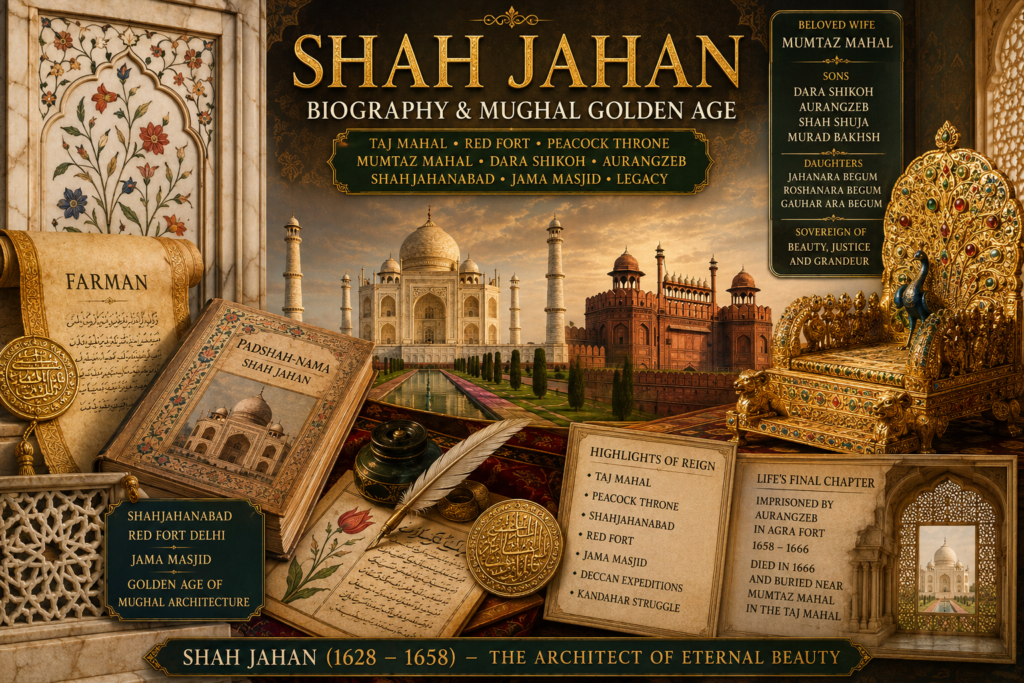
Shah Jahan was the fifth Mughal emperor and one of the most famous rulers in South Asian history. He ruled from 1628 to 1658, and his reign is widely remembered as the golden age of Mughal architecture. His full imperial title was Abul Muzaffar Shihab-ud-Din Muhammad Sahib-i-Qiran-i-Sani. Before becoming emperor, he was known as Prince Khurram, a name given by his grandfather Akbar, meaning “joyous.”
The name Shah Jahan means “King of the World.” He inherited a powerful empire from his father Jahangir, but his accession was not peaceful. After Jahangir’s death in 1627, Nur Jahan tried to place her son-in-law Shahryar on the throne. Asaf Khan, the father-in-law of Shah Jahan, outmaneuvered her by temporarily placing Dawar Bakhsh on the throne and then clearing the way for Prince Khurram. Shah Jahan reached Agra in 1628, eliminated rival claimants, and formally began one of the most magnificent reigns of the Mughal period.
Shah Jahan is best known for the Taj Mahal, built in memory of his beloved wife Mumtaz Mahal. Yet his legacy is much larger than one monument. He founded Shahjahanabad, built the Red Fort in Delhi, commissioned the Peacock Throne, supported the construction of the Jama Masjid, expanded Mughal influence in the Deccan, faced repeated failures in Kandahar, and finally lost power in a brutal war of succession among his sons. His final years were spent as a prisoner in Agra Fort under the rule of his son Aurangzeb.
The reign of Shah Jahan stands in the middle of the Mughal imperial story. Zahir ud din Babar founded Mughal power, Humayun restored it, Akbar consolidated it, and Jahangir preserved it while promoting painting and court refinement. Shah Jahan inherited this mature empire and gave it its most beautiful architectural expression. To understand the long historical path before him, Bellum Report has already covered Muhammad Bin Qasim, the Ghaznavid Empire, Muhammad Ghori, the Slave Dynasty, the Khalji Dynasty, the Tughlaq Dynasty, the Sayyid Dynasty and the Lodhi Dynasty.
Recommended Book: If you want the full historical timeline from 711 to 2025 in one compact guide, buy The Indus Odyssey from Debal to Islamabad: The Ultimate Guide to Pakistan Affairs on Amazon Kindle.
Main Idea: Shah Jahan represents the height of Mughal magnificence and the beginning of imperial strain. His reign produced the Taj Mahal, Red Fort, Shahjahanabad, Jama Masjid and Peacock Throne, but the same age also witnessed costly wars, failed Kandahar campaigns, Deccan pressure, heavy architectural expenditure, and a succession war that ended with Aurangzeb imprisoning his father.
Show Table of Contents
- Who Was Shah Jahan?
- Shah Jahan Early Life
- Full Name of Shah Jahan
- Shah Jahan Parents and Family Background
- Accession and Elimination of Rivals
- Shah Jahan and Mumtaz Mahal
- Taj Mahal of Shah Jahan
- Architectural Features of the Taj Mahal
- Monuments Made by Shah Jahan
- Shahjahanabad and the Red Fort
- Peacock Throne of Shah Jahan
- Deccan Policy and Ahmadnagar
- Kandahar and Central Asian Policy
- Shah Jahan Sons and Children
- War of Succession
- Shah Jahan and Aurangzeb: Imprisonment in Agra Fort
- Shah Jahan Death: How Did Shah Jahan Died?
- Shah Jahan Tomb and Mausoleum
- Legacy of Shah Jahan
- Important Exam Points
- Recommended Book for Students
- FAQs
Who Was Shah Jahan?
Shah Jahan was the fifth emperor of the Mughal Empire. He was the son of Jahangir and the grandson of Akbar. He ruled officially from 1628 to 1658, although his last years were spent in captivity after Aurangzeb took power.
Shah Jahan is usually remembered as the emperor of marble, symmetry and splendour. His reign produced some of the finest buildings in the history of the subcontinent. The Taj Mahal, Red Fort, Jama Masjid and Shahjahanabad represent the peak of Mughal architecture and urban planning.
However, Shah Jahan was not only a builder. He was also a powerful military emperor. He led campaigns during Jahangir’s reign, fought for succession, suppressed rebellions, expanded Mughal authority in the Deccan and pursued the dream of recovering Central Asian territories connected with the Timurid past.
His reign is often described as the golden age of Mughal opulence. This golden age was real in architecture, ceremony, wealth and court culture. Yet beneath the surface, heavy expenditure, military pressure and succession conflict were already creating problems for the empire.
Shah Jahan Early Life
Shah Jahan was born in 1592 in Lahore. His birth name was Prince Khurram. He was the son of Prince Salim, later Emperor Jahangir, and Jagat Gosain, a Rajput princess. He grew up in the Mughal court during the final years of Akbar and the reign of Jahangir.
Prince Khurram received training in warfare, administration, court culture and imperial etiquette. He became one of the most capable Mughal princes of his generation. During Jahangir’s reign, he gained military experience and prestige through campaigns in Mewar and the Deccan.
His early success made him a strong candidate for succession. For a time, he enjoyed the support of the powerful Nur Jahan circle because he was married to Arjumand Banu Begum, the niece of Nur Jahan and daughter of Asaf Khan.
Later, relations changed. Nur Jahan began supporting Shahryar, another son of Jahangir and her son-in-law. This created tension between Prince Khurram and the Nur Jahan faction, eventually leading to rebellion and the politics that shaped the succession after Jahangir’s death.
Full Name of Shah Jahan
The full name of Shah Jahan was Abul Muzaffar Shihab-ud-Din Muhammad Sahib-i-Qiran-i-Sani. The title Sahib-i-Qiran-i-Sani means “Second Lord of the Auspicious Conjunction.” It linked Shah Jahan with Timur, who was also associated with the title Sahib-i-Qiran.
This title was not merely decorative. Mughal rulers used titles to express imperial ideology. Shah Jahan wanted to present himself as a ruler of universal prestige, military glory and Timurid legitimacy.
The name Shah Jahan itself means “King of the World.” It reflected the grandeur of his reign and the confidence of the Mughal court at its height.
Before becoming emperor, he was known as Prince Khurram. The change from Khurram to Shah Jahan marked his transformation from imperial prince to universal sovereign.
Shah Jahan Parents and Family Background
Shah Jahan’s father was Emperor Jahangir, and his grandfather was Akbar. Through this line, Shah Jahan inherited one of the strongest imperial traditions in Asia. Akbar had built the state, Jahangir had preserved it, and Shah Jahan inherited its wealth, army and administrative system.
His mother was Jagat Gosain, also known by later titles such as Bilqis Makani. She belonged to the Rajput ruling house of Marwar. This Rajput connection continued the political integration created during Akbar’s reign.
The Mughal family background gave Shah Jahan both opportunity and danger. As a prince, he enjoyed status and training, but Mughal succession had no fixed rule of primogeniture. Every capable prince could claim the throne.
This absence of a clear succession law shaped Shah Jahan’s own rise and later destroyed peace among his sons. He eliminated rivals to secure his throne in 1628, and decades later his sons fought a brutal war for the same reason.
Accession and Elimination of Rivals
After Jahangir’s death in October 1627, the Mughal Empire entered a succession crisis. Prince Khurram was in the Deccan, while Nur Jahan tried to place Prince Shahryar on the throne in Lahore. Shahryar was her son-in-law and her preferred candidate.
Asaf Khan, the father-in-law of Shah Jahan, acted as kingmaker. He placed Dawar Bakhsh, the son of Prince Khusrau, on the throne temporarily to block Shahryar and buy time for Shah Jahan to return from the Deccan.
When Shah Jahan reached Agra in early 1628, he secured the throne by eliminating possible rivals. Shahryar, Dawar Bakhsh and other male claimants were executed. This harsh policy reflected the Mughal maxim: Takht ya Takhta, meaning “the throne or the coffin.”
On February 4, 1628, Shah Jahan was formally crowned at Agra. His accession showed that Mughal power was magnificent but succession politics remained ruthless.
Shah Jahan and Mumtaz Mahal
Shah Jahan and Mumtaz Mahal are one of the most famous royal couples in history. Mumtaz Mahal’s original name was Arjumand Banu Begum. She was the daughter of Asaf Khan and the niece of Nur Jahan.
Shah Jahan married Mumtaz Mahal in 1612, when he was still Prince Khurram. She became his most beloved wife and closest companion. Although Shah Jahan had other wives, Mumtaz Mahal held a special emotional and political place in his life.
Mumtaz Mahal accompanied Shah Jahan during campaigns and court life. She bore him fourteen children. Her death in 1631 at Burhanpur, during the birth of their fourteenth child, deeply affected the emperor.
The grief of Shah Jahan over Mumtaz Mahal changed the direction of his reign. It led to the construction of the Taj Mahal, one of the most famous monuments in the world and the greatest symbol of Mughal love, grief and architecture.
Taj Mahal of Shah Jahan
The Taj Mahal of Shah Jahan was built as a mausoleum for Mumtaz Mahal. It was conceived as the Rauza-i-Munawwara, or Illuminated Tomb. Construction began in 1632 and continued for more than two decades, with major work completed around 1653.
The Taj Mahal was built with white marble from Makrana in Rajasthan. It involved thousands of workers, master builders, calligraphers, stonecutters, inlay artists and engineers. Ustad Ahmad Lahori is widely considered the lead architect, while Amanat Khan Shirazi was the master calligrapher.
The Taj Mahal represents the peak of Mughal architectural refinement. Its white marble, double dome, perfect symmetry, Quranic calligraphy, pietra dura inlay, charbagh planning and riverside setting combine to create a monument of extraordinary beauty.
For Shah Jahan, the Taj Mahal was a personal memorial. For Mughal history, it became the greatest architectural achievement of the empire. For world heritage, it remains one of the most recognized monuments ever built.
Architectural Features of the Taj Mahal
The Taj Mahal introduced and perfected several architectural features. The double dome allowed the exterior dome to rise high and majestic while keeping the interior chamber proportionate for human scale.
The technique of pietra dura, also called parchin kari, used semi-precious stones such as lapis lazuli, carnelian and jade to create floral patterns in marble. This decorative technique reached its highest beauty in the Taj Mahal.
The four minarets were tilted slightly outward. This was both an optical and safety feature. If an earthquake caused damage, the minarets would fall away from the central mausoleum instead of collapsing onto it.
The monument also uses powerful symbolism. The garden represents paradise, water channels reflect heavenly rivers, and the gateway carries Quranic inscriptions connected with the soul’s journey to rest. The Yamuna River creates a reflective background, giving the tomb a sense of infinite symmetry.
Monuments Made by Shah Jahan
The monuments made by Shah Jahan form the most beautiful architectural phase of the Mughal Empire. He preferred white marble, refined symmetry, delicate ornamentation, floral design and balanced proportions.
| Monument | Location | Importance |
|---|---|---|
| Taj Mahal | Agra | Mausoleum of Mumtaz Mahal and the greatest monument of Mughal architecture. |
| Red Fort | Delhi | Imperial palace-fort of Shahjahanabad, inaugurated in 1648. |
| Jama Masjid | Delhi | One of the largest and most important mosques of Mughal India. |
| Shahjahanabad | Delhi | New Mughal capital founded in 1639. |
| Diwan-i-Khas | Red Fort, Delhi | Hall of Private Audience and seat of the Peacock Throne. |
| Shalimar Gardens | Lahore | Mughal garden associated with imperial pleasure and water engineering. |
| Moti Masjid | Agra Fort | Elegant white marble mosque built during Shah Jahan’s reign. |
These buildings show why Shah Jahan’s reign is called the golden age of Mughal architecture. Akbar built massive and experimental structures, Jahangir refined painting and garden culture, but Shah Jahan perfected marble architecture.
Shahjahanabad and the Red Fort
In 1639, Shah Jahan founded a new capital in Delhi called Shahjahanabad. Agra had served the Mughals well, but its narrow streets and heat were not ideal for the grand ceremonial life of Shah Jahan’s court.
Shahjahanabad was designed as an imperial city on the western bank of the Yamuna River. It was planned with geometric order, markets, gates, mosques, gardens, canals and the great imperial palace-fort.
The Red Fort, originally known as Qila-i-Mubarak, became the administrative and residential heart of the empire. It was built with red sandstone but designed more as a palace-fort than a purely defensive structure. It reflected imperial luxury, aesthetic order and royal ceremony.
The city also included Chandni Chowk, designed under the influence of Jahanara Begum. A central canal reflected moonlight and made the market one of the most famous commercial spaces of Mughal Delhi.
Peacock Throne of Shah Jahan
The Peacock Throne of Shah Jahan was the most famous symbol of Mughal wealth and imperial grandeur. It stood in the Diwan-i-Khas of the Red Fort and was decorated with gold, jewels, enamel, pearls, emeralds, rubies and diamonds.
The throne featured two jeweled peacocks with tails spread out. It also included famous gems such as the Koh-i-Noor diamond as part of its structure or later associated treasure tradition.
The Peacock Throne was far more than furniture. It represented universal kingship, divine favour and the wealth of the Mughal Empire. It was designed to make the emperor appear as the centre of earthly magnificence.
Its cost was enormous. The chapter material notes that it cost around ten million rupees, about ten times the cost of the Red Fort itself. Later, Nadir Shah carried it away from Delhi in 1739, making it a symbol not only of Mughal splendour but also of Mughal vulnerability.
Deccan Policy and Ahmadnagar
Shah Jahan followed a more aggressive Deccan policy than his predecessors. The Deccan was important because it connected the Mughal Empire with the rich southern kingdoms and controlled routes toward Bijapur, Golconda and the broader peninsula.
In 1633, the Nizam Shahi dynasty of Ahmadnagar came to an end. The collapse was helped by internal betrayal, especially the role of Fateh Khan, the son of Malik Ambar. Ahmadnagar was annexed into the Mughal Empire.
In 1636, Shah Jahan personally visited the Deccan to impose Mughal authority. Bijapur and Golconda accepted treaties of submission. They agreed to pay tribute, mention the Mughal emperor’s name in the Khutba and acknowledge Mughal suzerainty.
During this period, the young Aurangzeb was appointed viceroy of the Deccan for the first time. His long association with the Deccan began here and later became central to the history of the Mughal Empire.
Kandahar and Central Asian Policy
Kandahar was one of the most important frontier cities of the Mughal world. It controlled routes between India, Afghanistan, Persia and Central Asia. For the Mughals, Kandahar was not only a fortress; it was a gateway to Kabul and the Timurid homeland.
In 1638, the Persian governor Ali Mardan Khan defected and handed Kandahar to Shah Jahan. Ali Mardan Khan later became one of the empire’s important engineers and helped design canals in Delhi and Lahore.
However, the Safavids recaptured Kandahar in 1649. Shah Jahan sent repeated expeditions under Aurangzeb and Dara Shikoh between 1649 and 1653 to recover the city, but all failed. Persian artillery and fortification proved stronger than Mughal siege efforts.
Shah Jahan also pursued the dream of recovering Balkh and Badakhshan in Central Asia between 1646 and 1647. The campaign was costly and unsuccessful. Harsh climate, Uzbek guerrilla tactics and weak local support made permanent control impossible. These failures strained the treasury and weakened Mughal frontier prestige.
Shah Jahan Sons and Children
Shah Jahan son and succession politics are central to the final phase of his reign. Shah Jahan and Mumtaz Mahal had several children, but four sons became historically decisive: Dara Shikoh, Shuja, Aurangzeb and Murad.
Dara Shikoh was the eldest son and Shah Jahan’s favourite. He was a Sufi-minded scholar and author of Majma-ul-Bahrayn, meaning “The Mingling of Two Oceans.” He represented a broad, philosophical and pluralistic vision.
Shuja was governor of Bengal. Aurangzeb was governor of the Deccan and one of the most capable military commanders of the family. Murad was governor of Gujarat and formed a temporary alliance with Aurangzeb during the war of succession.
Shah Jahan’s daughters also mattered. Jahanara Begum supported Dara Shikoh and remained loyal to her father during imprisonment. Roshanara Begum supported Aurangzeb. The royal family itself was divided by politics.
War of Succession
In September 1657, Shah Jahan fell seriously ill in Delhi. Rumours of his death spread across the empire. This triggered a war of succession among his sons even though the emperor was still alive.
The conflict was not only a struggle for the throne. It was also a clash of personalities and visions. Dara Shikoh represented the emperor’s chosen heir and a more intellectual, Sufi-influenced outlook. Aurangzeb represented military discipline, political caution and orthodox Sunni identity.
The key battles of 1658 decided the future of the empire. At the Battle of Dharmat, Aurangzeb and Murad defeated the imperial army led by Raja Jaswant Singh. At the Battle of Samugarh in May 1658, Aurangzeb defeated Dara Shikoh in the decisive battle for power. Shuja was later defeated at Khajwa, and Dara was finally defeated at Deorai in 1659.
Dara Shikoh was captured, paraded through Delhi and executed on charges of heresy. Aurangzeb emerged victorious and took control of the empire.
Shah Jahan and Aurangzeb: Imprisonment in Agra Fort
The relationship between Shah Jahan and Aurangzeb became one of the most tragic father-son stories in Mughal history. After winning the succession struggle, Aurangzeb placed his father under house arrest in Agra Fort.
Shah Jahan remained imprisoned from 1658 to 1666. He spent his final eight years in the Musamman Burj, an octagonal marble tower within the Agra Fort. From there, he could see the Taj Mahal across the Yamuna River.
His loyal daughter Jahanara Begum stayed with him during captivity. She chose to share his confinement rather than enjoy the honours of Aurangzeb’s court.
During captivity, Shah Jahan was referred to in court documents by the title Shah-i-Buland Iqbal, meaning “King of High Fortune.” The title was respectful, but the reality was painful: the emperor who had built the greatest symbols of Mughal power ended life as a prisoner of his own son.
Shah Jahan Death: How Did Shah Jahan Died?
Shah Jahan death occurred on January 22, 1666, in Agra Fort. He was about seventy-four years old. He had spent the last eight years of his life under house arrest after Aurangzeb seized power.
The question how did Shah Jahan died is commonly asked because his final years were dramatic. He did not die in battle or execution. He died of illness and old age during captivity in Agra Fort.
Aurangzeb did not permit a grand state funeral. Shah Jahan’s body was carried quietly and buried beside Mumtaz Mahal in the Taj Mahal.
The simplicity of his burial contrasted sharply with the magnificence of his reign. The emperor who had built the Taj Mahal, Red Fort, Peacock Throne and Shahjahanabad ended his life in confinement and was buried without the imperial splendour he had once commanded.
Shah Jahan Tomb and Mausoleum
Shah Jahan tomb is inside the Taj Mahal at Agra, beside the tomb of Mumtaz Mahal. The mausoleum of Shah Jahan is therefore part of the same monument he built for his wife.
The placement of Shah Jahan’s cenotaph is architecturally important. The Taj Mahal is a masterpiece of symmetry, but Shah Jahan’s cenotaph was added later and placed to the side of Mumtaz Mahal’s central cenotaph. This is the only major break in the perfect symmetry of the inner chamber.
His actual grave, like that of Mumtaz Mahal, lies in the lower crypt. The upper cenotaphs are symbolic markers, while the real burials are below.
Shah Jahan’s burial in the Taj Mahal completed the monument’s emotional meaning. What began as a memorial to Mumtaz Mahal became the shared resting place of both husband and wife.
Legacy of Shah Jahan
The legacy of Shah Jahan is magnificent and tragic at the same time. His reign produced the most refined architecture of the Mughal period. The Taj Mahal remains the greatest symbol of Mughal beauty, while the Red Fort and Shahjahanabad shaped the political and urban history of Delhi.
His court represented wealth, ceremony and artistic perfection. The Peacock Throne showed the extraordinary resources of the empire. His preference for white marble, symmetry and pietra dura created the final classical style of Mughal architecture.
Yet his reign also exposed imperial weaknesses. The Kandahar campaigns failed. The Central Asian dream wasted money and manpower. Monumental expenditure increased financial pressure. The Mansabdari system required constant revenue. The war of succession showed that the Mughal throne still lacked a peaceful succession mechanism.
Shah Jahan’s life therefore offers a powerful historical lesson. An empire can look most beautiful when it is already beginning to carry hidden burdens. His reign was the golden age of Mughal opulence, but after him the empire entered a more militarized and contested phase under Aurangzeb.
Important Exam Points
| Question | Answer |
|---|---|
| Who was Shah Jahan? | Shah Jahan was the fifth Mughal emperor and the builder of the Taj Mahal. |
| What was Shah Jahan’s birth name? | Prince Khurram. |
| When was Shah Jahan born? | 1592 AD in Lahore. |
| What was the full name of Shah Jahan? | Abul Muzaffar Shihab-ud-Din Muhammad Sahib-i-Qiran-i-Sani. |
| When was Shah Jahan crowned? | February 4, 1628, at Agra. |
| Who acted as kingmaker for Shah Jahan? | Asaf Khan. |
| Who was Shah Jahan wife most famous in history? | Mumtaz Mahal, originally Arjumand Banu Begum. |
| When did Mumtaz Mahal die? | June 1631 at Burhanpur. |
| Why was the Taj Mahal built? | It was built as a mausoleum for Mumtaz Mahal. |
| Who is widely considered the lead architect of the Taj Mahal? | Ustad Ahmad Lahori. |
| Who was the calligrapher of the Taj Mahal? | Amanat Khan Shirazi. |
| Where did the white marble of the Taj Mahal come from? | Makrana in Rajasthan. |
| Which city did Shah Jahan found in 1639? | Shahjahanabad in Delhi. |
| What was the Red Fort originally called? | Qila-i-Mubarak. |
| Who designed Chandni Chowk? | Jahanara Begum. |
| What was the canal inside the Red Fort called? | Nahr-i-Bihisht, or Canal of Paradise. |
| Which Persian governor handed Kandahar to Shah Jahan? | Ali Mardan Khan in 1638. |
| When did Persia recapture Kandahar? | 1649 AD. |
| What was the Month-Scale system? | A salary adjustment system introduced to manage mismatch between estimated and actual Mansabdari revenue. |
| Who were the four main sons of Shah Jahan? | Dara Shikoh, Shuja, Aurangzeb and Murad. |
| Which son was Shah Jahan’s favourite? | Dara Shikoh. |
| Who wrote Majma-ul-Bahrayn? | Dara Shikoh. |
| Which battle decided the succession war in 1658? | Battle of Samugarh. |
| Where was Shah Jahan imprisoned? | Agra Fort, especially the Musamman Burj. |
| Which daughter stayed with Shah Jahan during imprisonment? | Jahanara Begum. |
| When did Shah Jahan die? | January 22, 1666. |
| Where is Shah Jahan buried? | In the Taj Mahal beside Mumtaz Mahal. |
Recommended Book for Students
Shah Jahan becomes easier to understand when his reign is studied as part of the full Mughal sequence. His architecture came after Akbar’s consolidation and Jahangir’s artistic refinement. His political decline prepared the way for Aurangzeb’s long and difficult reign. His life connects the splendour of the Taj Mahal with the tragedy of imprisonment and the cost of succession conflict.
The Indus Odyssey from Debal to Islamabad: The Ultimate Guide to Pakistan Affairs explains the complete historical flow from 711 to 2025. It connects Muhammad Bin Qasim, the Ghaznavids, Muhammad Ghori, the Slave Dynasty, Khaljis, Tughlaqs, Sayyids, Lodhis, Zahir ud din Babar, Humayun, Akbar, Jahangir, Shah Jahan, the later Mughals, British India, the Pakistan Movement and modern Pakistan in one structured guide. It is useful for CSS, PMS, PCS, PPSC, FPSC, UPSC background reading, university students, teachers and history learners in Pakistan and India.
Buy the Kindle edition:
Buy The Indus Odyssey on Amazon India
Buy The Indus Odyssey on Amazon USA
Recommended for: CSS, PMS, PCS, PPSC, FPSC, UPSC background reading, university students, teachers, history learners and South Asian studies readers.
FAQs
Who was Shah Jahan?
Shah Jahan was the fifth Mughal emperor. He ruled from 1628 to 1658 and is best known for building the Taj Mahal in memory of Mumtaz Mahal.
What was the full name of Shah Jahan?
The full name of Shah Jahan was Abul Muzaffar Shihab-ud-Din Muhammad Sahib-i-Qiran-i-Sani. Before becoming emperor, he was known as Prince Khurram.
Who was Shah Jahan wife?
The most famous Shah Jahan wife was Mumtaz Mahal, whose original name was Arjumand Banu Begum. She died in 1631 at Burhanpur.
What was Shah Jahan wife name?
Shah Jahan wife name most associated with history is Mumtaz Mahal. Her birth name was Arjumand Banu Begum.
How many wives did Shah Jahan have?
Shah Jahan had more than one wife, as was common in Mughal royal politics, but Mumtaz Mahal was his most beloved and historically important spouse.
Who were Shah Jahan sons?
The four most important Shah Jahan sons were Dara Shikoh, Shuja, Aurangzeb and Murad. Their war of succession changed Mughal history.
What was Shah Jahan son name who became emperor?
Shah Jahan son name who became emperor was Aurangzeb. He defeated his brothers and imprisoned Shah Jahan in Agra Fort.
Who was Shah Jahan daughter?
The most famous Shah Jahan daughter was Jahanara Begum. She supported Dara Shikoh and stayed with Shah Jahan during his imprisonment.
What is the Taj Mahal of Shah Jahan?
The Taj Mahal of Shah Jahan is the mausoleum built at Agra for Mumtaz Mahal. Shah Jahan was later buried beside her inside the same monument.
What was the Peacock Throne of Shah Jahan?
The Peacock Throne of Shah Jahan was a jeweled imperial throne placed in the Diwan-i-Khas of the Red Fort. It symbolized Mughal wealth and power.
What are the main monuments made by Shah Jahan?
The main monuments made by Shah Jahan include the Taj Mahal, Red Fort, Jama Masjid, Shahjahanabad, Diwan-i-Khas, Moti Masjid and parts of Mughal gardens and palaces.
How did Shah Jahan died?
Shah Jahan died on January 22, 1666, in Agra Fort after years of imprisonment by Aurangzeb. He died of illness and old age, not in battle.
Where is Shah Jahan tomb?
Shah Jahan tomb is inside the Taj Mahal at Agra, beside the tomb of Mumtaz Mahal.
What is the mausoleum of Shah Jahan?
The mausoleum of Shah Jahan is the Taj Mahal, where he was buried beside Mumtaz Mahal after his death in 1666.
Where can I buy The Indus Odyssey from Debal to Islamabad?
You can buy the Kindle edition on Amazon India and Amazon USA using these links: Amazon India and Amazon USA.
The Indus Odyssey from Debal to Islamabad
The Ultimate Guide to Pakistan Affairs (711-2025). A focused Kindle guide for CSS, PMS, PCS, PPSC and FPSC Pakistan Affairs preparation.