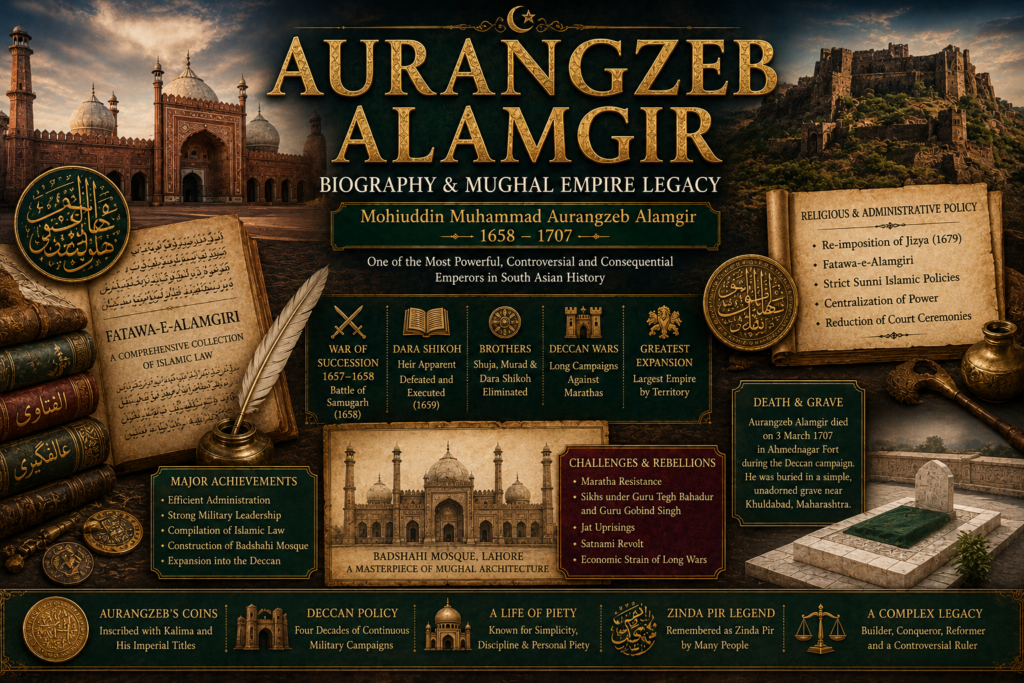
Aurangzeb Alamgir was the sixth Mughal emperor and one of the most powerful, controversial and consequential rulers in South Asian history. He ruled from 1658 to 1707, making his reign one of the longest in Mughal history. His full name was Mohiuddin Muhammad Aurangzeb Alamgir. The title Alamgir means “World Seizer” or “Conqueror of the World,” and he formally adopted it after securing the Mughal throne.
Aurangzeb Alamgir inherited the empire built by his ancestors but ruled it in a very different style. Zahir ud din Babar founded Mughal power, Humayun restored it, Akbar consolidated it, Jahangir refined its court culture, and Shah Jahan gave it architectural magnificence. Aurangzeb Alamgir expanded the empire to its greatest territorial size, but his long wars, strict religious policies, Deccan campaigns and centralizing style also exposed the limits of Mughal power.
The life of Aurangzeb Alamgir cannot be understood only through praise or blame. He was a disciplined administrator, a brave commander, a deeply religious ruler, a skilled strategist and a personally austere emperor. At the same time, he was also a ruler whose policies created serious political tensions with Rajputs, Sikhs, Marathas, Jats, Satnamis and frontier tribes. His reign produced both imperial expansion and imperial exhaustion.
To understand Aurangzeb Alamgir properly, the full historical chain before him should also be clear. Bellum Report has already published connected guides on Muhammad Bin Qasim, the Ghaznavid Empire, Muhammad Ghori, the Slave Dynasty, the Khalji Dynasty, the Tughlaq Dynasty, the Sayyid Dynasty, the Lodhi Dynasty, Babur, Humayun, Akbar, Jahangir and Shah Jahan. Aurangzeb Alamgir comes at the turning point where Mughal power reached its territorial peak but also began to face deep structural strain.
Recommended Book: If you want the full historical timeline from 711 to 2025 in one compact guide, buy The Indus Odyssey from Debal to Islamabad: The Ultimate Guide to Pakistan Affairs on Amazon Kindle.
Main Idea: Aurangzeb Alamgir represents both the territorial height and political overextension of the Mughal Empire. He expanded Mughal rule deep into the Deccan, reintroduced Jizya, commissioned the Fatawa-e-Alamgiri, built the Badshahi Mosque, lived with personal austerity, and died after decades of exhausting campaigns that weakened the imperial structure he had tried to strengthen.
Show Table of Contents
- Who Was Aurangzeb Alamgir?
- Aurangzeb Alamgir Full Name and Meaning
- Aurangzeb Alamgir Early Life
- Aurangzeb Alamgir Father and Family Background
- Aurangzeb Alamgir Brothers
- War of Succession after Shah Jahan’s Illness
- Battle of Dharmat 1658
- Battle of Samugarh 1658
- Dara Shikoh and the Clash of Ideologies
- Murad Bakhsh and Shuja
- Coronation and the Title Alamgir
- Administration under Aurangzeb Alamgir
- Religious Policy of Aurangzeb Alamgir
- Re-imposition of Jizya in 1679
- Fatawa-e-Alamgiri
- Muhtasibs and Moral Policing
- Temple Policy and Historical Debate
- Rajput Rebellion
- Sikh Transformation and Guru Tegh Bahadur
- Jats and Satnamis
- North-West Frontier and Pashtun Revolt
- Ahoms and Battle of Saraighat
- Aurangzeb Alamgir Deccan Policy
- Maratha Conflict and the Deccan Ulcer
- Badshahi Mosque and Architecture
- Aurangzeb Alamgir Coins
- Aurangzeb Alamgir Death
- Aurangzeb Alamgir Grave and Tomb
- Legacy of Aurangzeb Alamgir
- Important Exam Points
- Recommended Book for Students
- FAQs
Who Was Aurangzeb Alamgir?
Aurangzeb Alamgir was the sixth Mughal emperor and the son of Shah Jahan. He ruled the Mughal Empire from 1658 to 1707. His reign lasted nearly fifty years and became one of the most decisive periods in the history of the subcontinent.
He is remembered as a ruler of discipline, austerity and military endurance. Unlike Shah Jahan, who is associated with marble architecture and courtly magnificence, Aurangzeb Alamgir is associated with long campaigns, administrative control, Islamic legalism, personal simplicity and the struggle to hold a vast empire together.
He expanded the Mughal Empire to its greatest territorial extent. Under him, Mughal influence stretched deeper into the Deccan than ever before. Yet this expansion was costly. The empire became too large, too militarized and too dependent on constant campaigning.
Aurangzeb Alamgir remains one of the most debated rulers in South Asian history. Some see him as a pious and hardworking emperor who tried to restore moral order. Others see him as a rigid ruler whose policies damaged the political balance created by Akbar. A serious study of Aurangzeb Alamgir must consider both sides.
Aurangzeb Alamgir Full Name and Meaning
Aurangzeb Alamgir full name was Mohiuddin Muhammad Aurangzeb Alamgir. The word Aurangzeb means “ornament of the throne,” while Alamgir means “world-seizer” or “conqueror of the world.”
Before becoming emperor, he was known as Prince Aurangzeb. After defeating his brothers and securing the throne, he took the imperial title Alamgir. The title was formally associated with his coronation after the war of succession.
The name Badshah Aurangzeb Alamgir became attached to his image as a powerful emperor, strict ruler and defender of imperial authority. His subjects also called him Zinda Pir, meaning “Living Saint,” because of his personal piety and austere lifestyle.
The title Alamgir reflected imperial ambition, but his life also showed the burden of such ambition. He tried to rule almost the whole subcontinent through military force and centralized discipline, but the empire’s size eventually became its weakness.
Aurangzeb Alamgir Early Life
Aurangzeb Alamgir was born on November 3, 1618, at Dahod in present-day Gujarat. He was the third son of Shah Jahan and Mumtaz Mahal. His early life was shaped by Mughal court culture, military training, religious education and imperial politics.
As a prince, Aurangzeb showed seriousness, courage and administrative ability. He was not as artistically inclined as Dara Shikoh, nor as luxurious as many princes of the court. He developed a reputation for discipline and religious devotion from an early age.
He served as governor of the Deccan more than once before becoming emperor. This experience was important because it taught him the geography, politics and military challenges of South India. Later, as emperor, the Deccan would become the centre of his life and the main cause of imperial exhaustion.
Aurangzeb Alamgir also served in Gujarat, Multan and other regions. These governorships gave him practical experience. He understood administration, revenue, frontier politics and military command more deeply than many royal princes.
Aurangzeb Alamgir Father and Family Background
Aurangzeb Alamgir father was Shah Jahan, the fifth Mughal emperor. Shah Jahan ruled during the golden age of Mughal architecture and built the Taj Mahal, Red Fort, Jama Masjid and Shahjahanabad.
Aurangzeb’s mother was Mumtaz Mahal, the beloved wife of Shah Jahan. Her death in 1631 led to the construction of the Taj Mahal. Aurangzeb therefore belonged to the central imperial family at the height of Mughal splendour.
His grandfather was Jahangir, and his great-grandfather was Akbar. Through this lineage, Aurangzeb inherited a strong imperial tradition. However, he did not follow Akbar’s religious and political style. He moved away from Akbar’s broad policy of Sulh-i-Kul and adopted a more orthodox approach.
The family background of Aurangzeb Alamgir also explains the violence of Mughal succession. The Mughal Empire had no fixed law of primogeniture. Every capable son of the emperor could claim the throne. This made war among brothers almost inevitable when Shah Jahan fell ill.
Aurangzeb Alamgir Brothers
Aurangzeb Alamgir brothers were Dara Shikoh, Shah Shuja and Murad Bakhsh. These four sons of Shah Jahan became the main contenders in the war of succession after Shah Jahan’s illness in 1657.
Dara Shikoh was the eldest son and Shah Jahan’s favourite. He was scholarly, Sufi-minded and intellectually curious. He translated the Upanishads into Persian under the title Sirr-i-Akbar, meaning “The Great Secret.”
Shah Shuja was governor of Bengal. He crowned himself emperor when he heard of Shah Jahan’s illness. Murad Bakhsh was governor of Gujarat and also claimed kingship. Aurangzeb was in the Deccan and waited carefully before making his move.
Among the brothers, Aurangzeb was the most capable strategist. He understood that victory required patience, alliances and battlefield discipline. His temporary alliance with Murad helped him defeat Dara, but he later removed Murad as a rival.
War of Succession after Shah Jahan’s Illness
In September 1657, Shah Jahan fell seriously ill in Delhi. Rumours spread that the emperor was dying. This triggered a fierce war of succession among his sons.
The war was not simply a family quarrel. It was a struggle over the future direction of the Mughal Empire. Dara Shikoh represented the continuation of Akbar’s broad, syncretic and Sufi-influenced vision. Aurangzeb Alamgir represented military discipline, orthodox Islam and centralized authority.
Shah Shuja and Murad Bakhsh also claimed the throne, but the real ideological and political contest was between Dara Shikoh and Aurangzeb Alamgir. Dara had the support of Shah Jahan and many court nobles, but Aurangzeb had superior military skill.
The war lasted roughly from 1657 to 1659. It ended with Aurangzeb’s second coronation and the execution or disappearance of his main rivals. The Mughal throne was won, but the moral cost was heavy.
Battle of Dharmat 1658
The Battle of Dharmat was fought in April 1658 near Ujjain. It was one of the first major battles of the war of succession. Aurangzeb and Murad joined forces against the imperial army sent by Dara Shikoh.
The imperial army was led by Raja Jaswant Singh of Marwar and Qasim Khan. Dara’s side had numbers and imperial legitimacy, but Aurangzeb had better planning and battlefield control.
Aurangzeb defeated the imperial forces at Dharmat. The victory opened the road toward Agra and gave him momentum in the succession struggle.
The Battle of Dharmat is important because it showed that Dara’s political position was not enough. In Mughal succession, battlefield success mattered more than nomination or seniority.
Battle of Samugarh 1658
The Battle of Samugarh was fought near Agra in May 1658. It was the decisive battle between Dara Shikoh and Aurangzeb Alamgir.
Dara brought a large army, but it was poorly organized. Aurangzeb used discipline, strategy and artillery more effectively. His forces also used mobile artillery, including zamburaks, and maintained stronger battlefield coordination.
Dara fought bravely, but his army lost morale when he descended from his elephant. In Mughal warfare, the emperor or commander’s visibility on an elephant mattered deeply. When soldiers thought Dara had fled or fallen, confusion spread.
Aurangzeb’s victory at Samugarh opened the road to Agra. Soon after, he seized Agra Fort, cut off the Nahr-i-Bihisht water supply and forced the palace guards to surrender. Shah Jahan was placed under house arrest.
Dara Shikoh and the Clash of Ideologies
Dara Shikoh was not only Aurangzeb’s brother; he was his ideological opposite. Dara was associated with the Qadiriyya Sufi order and believed in spiritual dialogue between Islam and Hindu philosophy. His work Majma-ul-Bahrayn, meaning “The Mingling of Two Oceans,” tried to bring together Sufi and Vedantic ideas.
Dara also translated fifty Upanishads into Persian under the title Sirr-i-Akbar. He believed that the Upanishads contained hidden wisdom connected with divine truth.
Aurangzeb Alamgir viewed Dara’s ideas as dangerous and heretical. After Dara was captured in 1659, he was brought to Delhi and humiliated publicly. A council of theologians condemned him not for rebellion alone, but for apostasy.
Dara Shikoh was executed in August 1659. His execution remains one of the most debated events of Mughal history. It symbolized the defeat of one vision of the Mughal Empire and the victory of another.
Murad Bakhsh and Shuja
Murad Bakhsh initially fought alongside Aurangzeb Alamgir against Dara Shikoh. However, once Dara was weakened, Murad became unnecessary and dangerous. Aurangzeb arrested Murad during a banquet and later had him executed at Gwalior Fort on a charge of murder.
Shah Shuja, the governor of Bengal, also claimed the throne. He was defeated at the Battle of Khajwa in 1659. After defeat, he fled toward Arakan in Burma, where he disappeared from history.
By removing Dara, Murad and Shuja, Aurangzeb Alamgir eliminated all serious rival claimants. This secured the throne but also showed the ruthless nature of Mughal succession politics.
The war of succession left deep scars. It imprisoned Shah Jahan, killed Dara and Murad, destroyed Shuja’s claim and placed Aurangzeb on the throne through blood and strategy.
Coronation and the Title Alamgir
Aurangzeb Alamgir first took power in 1658, but his formal and more secure coronation came after the removal of Dara Shikoh. In July 1659, he took the title Alamgir, meaning World Seizer.
The title reflected his political ambition and military success. He had defeated his brothers, imprisoned his father and secured the Mughal throne. He now presented himself as the legitimate emperor of the Islamic and imperial order.
His accession also marked a shift in Mughal policy. The court culture of Shah Jahan had celebrated architecture, music, luxury and ceremony. Aurangzeb Alamgir preferred austerity, religious discipline and military administration.
This did not mean that the empire immediately collapsed. In fact, under Aurangzeb Alamgir the Mughal Empire became territorially larger than ever before. But the style of rule changed significantly.
Administration under Aurangzeb Alamgir
Aurangzeb Alamgir inherited Akbar’s administrative framework, especially the Mansabdari and Jagirdari systems. He did not destroy Mughal administration, but he ruled it under greater military pressure and religious seriousness.
The Mansabdari system continued to organize imperial nobles by rank and cavalry obligation. However, the empire’s expansion created a serious Jagirdari Crisis. There were more nobles needing assignments than there were profitable lands to distribute.
This crisis weakened the loyalty of nobles and reduced the efficiency of revenue collection. Many Jagirdars squeezed peasants to recover their expected income, creating agrarian distress.
Aurangzeb Alamgir worked hard and personally supervised many matters, but his rigid centralism made adaptation difficult. A vast empire needed flexibility, but the emperor tried to control too much from the centre, especially during his long Deccan campaigns.
Religious Policy of Aurangzeb Alamgir
The religious policy of Aurangzeb Alamgir is one of the most debated subjects in South Asian history. He was personally devout and followed a strict Sunni outlook. He belonged intellectually to the orthodox current and was influenced by the Naqshbandiyya tradition.
He ended several practices he considered un-Islamic innovations. He discouraged Jharokha Darshan, the public appearance of the emperor for ritual viewing. He also stopped Tuladan, the weighing of the emperor against gold, because he saw it as connected with personality cult and courtly excess.
He appointed Muhtasibs to regulate public morality and tried to bring law and administration closer to Islamic principles. He also supported the compilation of the Fatawa-e-Alamgiri.
However, his religious policy created political consequences. The re-imposition of Jizya, temple destructions during rebellions, pressure on some religious communities and conflicts with Sikh and Rajput groups weakened the emotional bond between the Mughal crown and many subjects.
Re-imposition of Jizya in 1679
In 1679, Aurangzeb Alamgir re-imposed Jizya on non-Muslim subjects. Akbar had abolished Jizya more than a century earlier as part of his policy of broad political inclusion.
Aurangzeb’s supporters saw Jizya as a legitimate Islamic tax and a way to strengthen the moral identity of the state. It also brought revenue to the treasury at a time when wars were becoming costly.
However, the tax created resentment among many non-Muslim subjects, especially Rajputs and Hindu merchant communities. Even if the poor paid less and the wealthy paid more, its symbolic meaning was politically damaging.
The re-imposition of Jizya marked a clear departure from Akbar’s Sulh-i-Kul. It became one of the most remembered and criticized decisions of Aurangzeb Alamgir’s reign.
Fatawa-e-Alamgiri
The Fatawa-e-Alamgiri was one of the greatest legal projects of Aurangzeb Alamgir’s reign. It was a comprehensive digest of Hanafi Islamic law compiled under imperial patronage.
Aurangzeb assembled hundreds of scholars under the leadership of Sheikh Nizam Burhanpuri. The project reportedly cost around 200,000 rupees and aimed to standardize legal guidance across the empire.
The Fatawa-e-Alamgiri became an important source for Islamic law in South Asia. It covered matters of worship, social conduct, property, contracts, crime, administration and judicial procedure.
This work shows Aurangzeb Alamgir’s desire to create a law-governed Islamic imperial order. It also shows the difference between his worldview and Akbar’s more flexible imperial philosophy.
Muhtasibs and Moral Policing
Aurangzeb Alamgir appointed Muhtasibs, or censors of public morals, in major cities. Their duty was to enforce moral order in public life.
They were expected to prevent the sale and consumption of alcohol and intoxicants, regulate gambling dens, check public misconduct and ensure honesty in weights and measures.
The appointment of Muhtasibs reflected Aurangzeb’s belief that the emperor was responsible not only for military and revenue affairs but also for public morality.
However, moral policing also created resentment among sections of society that were used to the more relaxed courtly culture of earlier Mughal periods. It strengthened Aurangzeb’s image as Zinda Pir but also deepened his image as a strict ruler.
Temple Policy and Historical Debate
The temple policy of Aurangzeb Alamgir remains one of the most sensitive and debated topics in South Asian history. Some prominent temples, including temples associated with Kashi Vishwanath and Mathura, were destroyed during his reign, usually in the context of political rebellion, imperial punishment or assertions of state authority.
At the same time, historical records also show that grants and protection were given to some temples and priests in places such as Ujjain, Guwahati and Chitrakoot. The Mughal administration continued to employ high-ranking Hindu officials.
Under Aurangzeb Alamgir, Hindu representation in the Mughal nobility did not disappear. In fact, Hindu Mansabdars increased in number, partly because Maratha nobles were inducted into imperial service.
A balanced view is necessary. Aurangzeb’s temple policy cannot be reduced to one sentence. It included religious conviction, political punishment, administrative continuity, local variation and imperial calculation. Yet it is also clear that his symbolic departure from Akbar’s inclusive style damaged Mughal political harmony.
Rajput Rebellion
The Rajput alliance had been one of the foundations of Mughal stability since Akbar. Under Aurangzeb Alamgir, this alliance weakened seriously after the death of Maharaja Jaswant Singh of Marwar in 1678.
The succession issue in Marwar led to conflict. Aurangzeb’s handling of the matter angered the Rathores. The re-imposition of Jizya in 1679 further increased resentment.
The Rajput rebellion was led by the legendary Durgadas Rathore, who protected Ajit Singh, the son of Jaswant Singh, and fought for Marwar’s autonomy for decades.
The Rajput conflict forced Aurangzeb Alamgir to divert important military resources. It also weakened the old Mughal-Rajput trust that Akbar had carefully built.
Sikh Transformation and Guru Tegh Bahadur
The Sikh community underwent a major transformation during the reign of Aurangzeb Alamgir. In 1675, the ninth Sikh Guru, Guru Tegh Bahadur, was executed in Delhi. Sikh tradition remembers him as Hind-di-Chadar, the Shield of India.
This event deeply affected Sikh-Mughal relations. It increased Sikh resistance to Mughal authority and strengthened the community’s sense of religious and political identity.
In 1699, Guru Gobind Singh founded the Khalsa at Anandpur Sahib. The Khalsa transformed the Sikh community into a disciplined military-religious order with the ideal of the Sant-Sipahi, or saint-soldier.
The Sikh transformation became a permanent challenge to Mughal authority in Punjab, a vital corridor for imperial communication. Aurangzeb Alamgir’s reign therefore marks a major turning point in Sikh history.
Jats and Satnamis
Aurangzeb Alamgir also faced agrarian uprisings. In 1669, the Jats of the Mathura-Agra region rebelled under Gokula. In 1688, another Jat leader, Raja Ram, went so far as to desecrate Akbar’s tomb at Sikandra.
The Jat rebellions were linked with agrarian pressure, local resentment, revenue demands and resistance to Mughal authority. These uprisings showed that discontent was not limited to princes and nobles.
The Satnamis also rebelled in 1672 near Narnaul. They were a community of peasants and artisans. Although the Mughal army suppressed the revolt, it revealed growing tensions between local communities and imperial authority.
These rebellions were smaller than the Deccan wars, but they mattered. They showed that the empire faced unrest in its heartland, not only on distant frontiers.
North-West Frontier and Pashtun Revolt
The north-west frontier was another serious challenge for Aurangzeb Alamgir. Between 1672 and 1675, Afridi and Yusufzai tribes rose in rebellion under leaders such as Akmal Khan.
The Khyber Pass was vital for communication, trade and military movement between India, Kabul and Central Asia. When the frontier tribes rebelled, Mughal authority suffered a major setback.
The Mughals faced a severe defeat at the Ali Masjid Pass and lost men, money and prestige. Aurangzeb Alamgir had to move his court to Hasan Abdal for two years to supervise diplomacy and military operations personally.
Khushhal Khan Khattak, the famous Pashtun poet-warrior, became a literary and political voice of resistance against Mughal power. The frontier conflict drained resources and weakened Mughal confidence in a strategic region.
Ahoms and Battle of Saraighat
In the eastern frontier, the Mughals faced the Ahom kingdom of Assam. The Mughal general Mir Jumla captured the Ahom capital Garhgaon in 1662, but the victory was temporary.
The climate, terrain and local resistance made permanent Mughal control extremely difficult. The Ahoms used geography, river warfare and guerrilla tactics effectively.
In 1671, the Ahoms under Lachit Borphukan defeated the Mughals at the Battle of Saraighat. This was one of the most important defeats of Mughal expansion in the north-east.
The Battle of Saraighat marked the limit of Mughal power in Assam. It forced the empire onto the defensive in Bengal and showed that local geography could defeat imperial ambition.
Aurangzeb Alamgir Deccan Policy
Aurangzeb Alamgir Deccan policy became the defining feature of the last half of his reign. He spent about twenty-five to twenty-six years in the Deccan, trying to crush the Marathas and annex the Deccan Sultanates.
He annexed Bijapur in 1686 and Golconda in 1687. These victories expanded the empire, but they also destroyed buffer states that had previously helped maintain balance in the Deccan.
Once Bijapur and Golconda were gone, the Mughals had to directly face the Marathas across a vast and difficult terrain. Forts, hills, forests, monsoon conditions and local resistance made Mughal warfare extremely costly.
The Deccan became known as the “Deccan Ulcer” because it slowly drained Mughal wealth, manpower and energy. Aurangzeb Alamgir won many forts but failed to destroy Maratha mobility and political will.
Maratha Conflict and the Deccan Ulcer
The Maratha conflict was the most exhausting struggle of Aurangzeb Alamgir’s reign. Shivaji had already created a powerful Maratha challenge during the reign of Shah Jahan and the early reign of Aurangzeb.
After Shivaji’s death, his son Sambhaji continued resistance. Aurangzeb captured and executed Sambhaji in 1689, but this did not end Maratha power. Instead, Maratha resistance became more decentralized and difficult to suppress.
Rajaram, Tarabai and other Maratha leaders continued guerrilla warfare. The Marathas avoided direct confrontation when necessary, attacked supply lines, recovered forts and drained Mughal resources.
Aurangzeb Alamgir personally remained in the Deccan until his final years. His determination was extraordinary, but the result was imperial exhaustion. The Mughal Empire expanded on paper but weakened in practice.
Badshahi Mosque and Architecture
Although Aurangzeb Alamgir did not encourage courtly arts and architecture like Shah Jahan, he left important monuments. The most famous is the Badshahi Mosque in Lahore, completed in 1673.
The Badshahi Mosque was built with red sandstone and white marble domes. It became the largest mosque in the world for more than three centuries and remains one of the greatest symbols of Mughal Lahore.
Unlike the delicate marble beauty of Shah Jahan’s Taj Mahal, the Badshahi Mosque reflects grandeur, scale, power and religious identity. It fits Aurangzeb’s personality: serious, imperial, disciplined and deeply religious.
Another monument associated with his period is Bibi Ka Maqbara in Aurangabad, built by Prince Azam Shah for his mother Dilras Banu Begum in 1678. It is often described as a smaller and less refined imitation of the Taj Mahal.
Aurangzeb Alamgir Coins
Aurangzeb Alamgir coins are important because they reflect his religious outlook. Earlier Mughal coins often carried the Kalma or other Islamic inscriptions. Aurangzeb removed the Kalma from some coins to prevent it from being dishonoured by being dropped, touched by non-believers or handled improperly.
This decision reflected his personal reverence for sacred words. It also showed how even coinage could become part of religious policy.
Coinage under Aurangzeb Alamgir continued to show imperial authority across a vast territory. Mints operated in many cities, including important centres in the north, west, Deccan and frontier regions.
For exams, the key point is that Aurangzeb Alamgir is associated with removing the Kalma from coins out of religious respect.
Aurangzeb Alamgir Death
Aurangzeb Alamgir death occurred on March 3, 1707, near Ahmednagar in the Deccan. He died after spending the final decades of his life in continuous military campaigning.
The question Aurangzeb Alamgir died in is often answered in two ways: he died in 1707, and he died near Ahmednagar in the Deccan. His death marked the end of the age of the Great Mughals.
His final letters show a ruler burdened by age, regret and spiritual anxiety. One famous line attributed to his last testament says: “I came alone and I go as a stranger. I do not know who I am, nor what I have been doing. I have brought nothing into this world, but carry with me the fruits of my sins.”
After his death, a war of succession began among his sons. Prince Muazzam emerged victorious and became Bahadur Shah I. But the empire he inherited was tired, overstretched and internally divided.
Aurangzeb Alamgir Grave and Tomb
Aurangzeb Alamgir grave is located at Khuldabad near Aurangabad, close to the shrine of the Sufi saint Zain-ud-din Shirazi. His grave is famous for its extreme simplicity.
Unlike earlier Mughal emperors who were buried in grand mausoleums, Aurangzeb Alamgir ordered that no large tomb should be built for him. His grave remained open-air and simple, reflecting his austere personality.
The cost of his burial cloth was paid from the money he earned by sewing caps, while money earned from copying the Quran was distributed to the poor. This story became central to his image as Zinda Pir.
The tomb of Aurangzeb Alamgir is therefore not a monument of imperial grandeur. It is a monument of personal humility. It stands in sharp contrast to the Taj Mahal of Shah Jahan and reflects the difference between father and son.
Legacy of Aurangzeb Alamgir
The legacy of Aurangzeb Alamgir is one of the most contested in the history of the subcontinent. He expanded the Mughal Empire to its greatest territorial extent, yet the empire began to weaken after his death.
Traditionally, many historians blamed Aurangzeb for the decline of the Mughal Empire because of his religious intolerance, Deccan wars and failure to maintain the Rajput alliance. The term “Deccan Ulcer” became a symbol of his exhausting southern campaigns.
Modern historians take a more complex view. They point to structural problems such as the Jagirdari Crisis, the limits of pre-modern administration, regional identities, agrarian pressure, military overextension and the difficulty of ruling such a vast empire.
Aurangzeb Alamgir was personally hardworking, disciplined and religious. But his rigid centralism and long wars made it difficult for the Mughal Empire to adapt. His rule reached the empire’s territorial peak, but it also exposed the administrative and political limits of Mughal power.
Important Exam Points
| Question | Answer |
|---|---|
| Who was Aurangzeb Alamgir? | Aurangzeb Alamgir was the sixth Mughal emperor who ruled from 1658 to 1707. |
| What was Aurangzeb Alamgir full name? | Mohiuddin Muhammad Aurangzeb Alamgir. |
| What does Alamgir mean? | Alamgir means World Seizer or Conqueror of the World. |
| When was Aurangzeb Alamgir born? | November 3, 1618. |
| Who was Aurangzeb Alamgir father? | Shah Jahan. |
| Who was Aurangzeb Alamgir mother? | Mumtaz Mahal. |
| Who were Aurangzeb Alamgir brothers? | Dara Shikoh, Shah Shuja and Murad Bakhsh. |
| Which battle was fought near Ujjain in 1658? | Battle of Dharmat. |
| Which battle decided the Mughal throne in Aurangzeb’s favour? | Battle of Samugarh in 1658. |
| Who wrote Sirr-i-Akbar? | Dara Shikoh translated the Upanishads under the title Sirr-i-Akbar. |
| When did Aurangzeb take the title Alamgir? | At his formal coronation in July 1659. |
| When did Aurangzeb Alamgir re-impose Jizya? | 1679. |
| What was Fatawa-e-Alamgiri? | A comprehensive digest of Hanafi Islamic law compiled under Aurangzeb’s patronage. |
| Who were Muhtasibs? | Censors of public morals appointed to regulate moral conduct in cities. |
| Which Sikh Guru was executed in 1675? | Guru Tegh Bahadur. |
| When was the Khalsa founded? | 1699 at Anandpur Sahib by Guru Gobind Singh. |
| Who led Rajput resistance in Marwar? | Durgadas Rathore. |
| Who was the Pashtun poet-warrior against Mughal authority? | Khushhal Khan Khattak. |
| Which battle was a major Mughal defeat against the Ahoms? | Battle of Saraighat in 1671. |
| Which Deccan states were annexed by Aurangzeb? | Bijapur in 1686 and Golconda in 1687. |
| Which Maratha king was captured and executed in 1689? | Sambhaji. |
| Which mosque is Aurangzeb’s greatest architectural legacy in Lahore? | Badshahi Mosque, completed in 1673. |
| When did Aurangzeb Alamgir die? | March 3, 1707. |
| Where is Aurangzeb Alamgir grave? | Khuldabad near Aurangabad. |
| Who succeeded Aurangzeb Alamgir? | Prince Muazzam, who became Bahadur Shah I. |
Recommended Book for Students
Aurangzeb Alamgir becomes easier to understand when his reign is studied in a complete historical sequence. His rule cannot be separated from Shah Jahan’s splendour, Dara Shikoh’s intellectual world, Akbar’s policy of Sulh-i-Kul, the Deccan problem, Maratha resistance, Sikh transformation, Rajput discontent and the later decline of Mughal power.
The Indus Odyssey from Debal to Islamabad: The Ultimate Guide to Pakistan Affairs explains the complete historical flow from 711 to 2025. It connects Muhammad Bin Qasim, the Ghaznavids, Muhammad Ghori, the Slave Dynasty, Khaljis, Tughlaqs, Sayyids, Lodhis, Zahir ud din Babar, Humayun, Akbar, Jahangir, Shah Jahan, Aurangzeb Alamgir, the later Mughals, British India, the Pakistan Movement and modern Pakistan in one structured guide. It is useful for CSS, PMS, PCS, PPSC, FPSC, UPSC background reading, university students, teachers and history learners in Pakistan and India.
Buy the Kindle edition:
Buy The Indus Odyssey on Amazon India
Buy The Indus Odyssey on Amazon USA
Recommended for: CSS, PMS, PCS, PPSC, FPSC, UPSC background reading, university students, teachers, history learners and South Asian studies readers.
FAQs
Who was Aurangzeb Alamgir?
Aurangzeb Alamgir was the sixth Mughal emperor. He ruled from 1658 to 1707 and expanded the Mughal Empire to its greatest territorial size.
What was Aurangzeb Alamgir full name?
Aurangzeb Alamgir full name was Mohiuddin Muhammad Aurangzeb Alamgir.
What does Aurangzeb Alamgir mean?
Aurangzeb means ornament of the throne, while Alamgir means world-seizer or conqueror of the world.
Who was Aurangzeb Alamgir father?
Aurangzeb Alamgir father was Shah Jahan, the fifth Mughal emperor and builder of the Taj Mahal.
Who were Aurangzeb Alamgir brothers?
Aurangzeb Alamgir brothers were Dara Shikoh, Shah Shuja and Murad Bakhsh. They fought in the Mughal war of succession after Shah Jahan’s illness.
What was the Battle of Samugarh?
The Battle of Samugarh was fought in 1658 between Aurangzeb Alamgir and Dara Shikoh. Aurangzeb’s victory opened the road to Agra and decided the succession struggle in his favour.
Why did Aurangzeb Alamgir execute Dara Shikoh?
Dara Shikoh was executed after being captured in 1659. Aurangzeb’s court condemned him for rebellion and apostasy, especially because of his religious writings and translation of the Upanishads.
When did Aurangzeb Alamgir re-impose Jizya?
Aurangzeb Alamgir re-imposed Jizya in 1679 after more than a century since Akbar had abolished it.
What was Fatawa-e-Alamgiri?
Fatawa-e-Alamgiri was a major compilation of Hanafi Islamic law prepared under the patronage of Aurangzeb Alamgir by a board of scholars.
What was Aurangzeb Alamgir Deccan policy?
Aurangzeb Alamgir Deccan policy aimed to annex Bijapur and Golconda and crush Maratha power. It expanded the empire but exhausted Mughal finances and manpower.
What was the Deccan Ulcer?
The Deccan Ulcer refers to Aurangzeb Alamgir’s long and draining conflict with the Marathas in the Deccan, which consumed imperial resources and weakened the Mughal state.
What mosque did Aurangzeb Alamgir build in Lahore?
Aurangzeb Alamgir commissioned the Badshahi Mosque in Lahore, completed in 1673. It remains one of the greatest Mughal monuments in Pakistan.
When did Aurangzeb Alamgir die?
Aurangzeb Alamgir death occurred on March 3, 1707, near Ahmednagar in the Deccan.
Where is Aurangzeb Alamgir grave?
Aurangzeb Alamgir grave is located at Khuldabad near Aurangabad, close to the shrine of Zain-ud-din Shirazi.
Why is Aurangzeb Alamgir called Zinda Pir?
Aurangzeb Alamgir was called Zinda Pir, meaning Living Saint, because of his personal piety, simple lifestyle and religious devotion.
Who succeeded Aurangzeb Alamgir?
After Aurangzeb Alamgir’s death, his son Prince Muazzam won the succession struggle and ruled as Bahadur Shah I.
Where can I buy The Indus Odyssey from Debal to Islamabad?
You can buy the Kindle edition on Amazon India and Amazon USA using these links: Amazon India and Amazon USA.
The Indus Odyssey from Debal to Islamabad
The Ultimate Guide to Pakistan Affairs (711-2025). A focused Kindle guide for CSS, PMS, PCS, PPSC and FPSC Pakistan Affairs preparation.