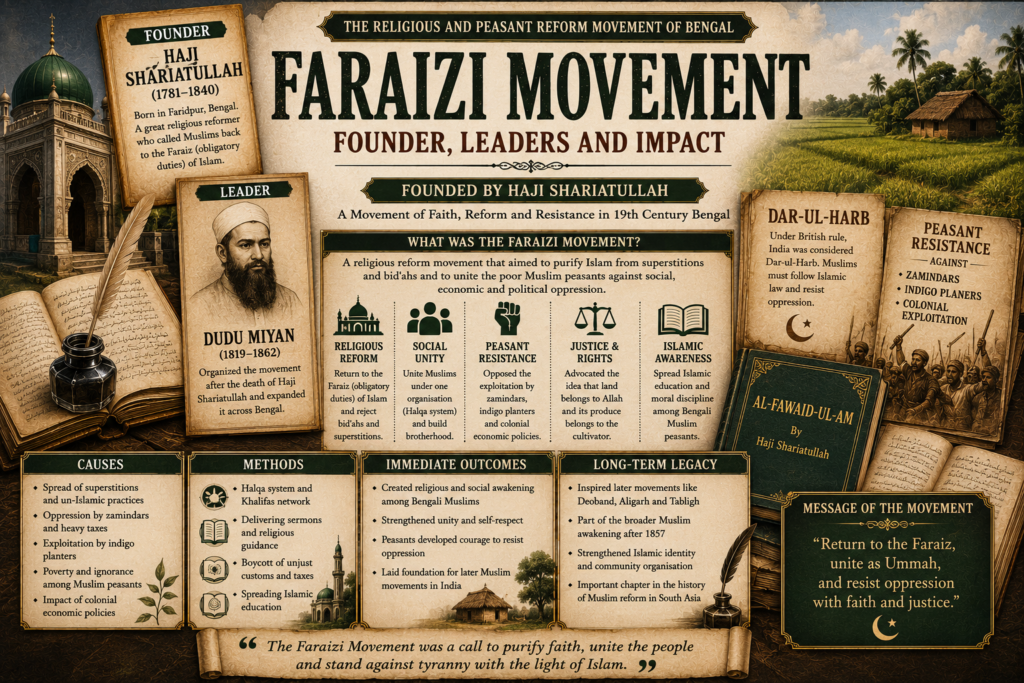
Faraizi Movement was one of the most important Muslim religious and socio-economic reform movements in nineteenth-century Bengal. It was founded by Haji Shariatullah, who was born in 1781 in Faridpur, Bengal. The movement took its name from the Arabic word Faraiz, meaning obligatory duties. Its basic message was that Muslims must return to the essential obligations of Islam and remove local customs, superstitions and un-Islamic practices from their lives.
The Faraizi Movement was not only a religious reform movement. It also became a peasant resistance movement. Bengali Muslim peasants were suffering under zamindars, indigo planters and colonial economic pressure. The Permanent Settlement of 1793 had strengthened landlords and increased the burden on cultivators. Many poor Muslims of East Bengal lived under poverty, debt and social humiliation. The Faraizi Movement gave them religious discipline, social organization and a language of resistance.
The movement belongs to the larger history of Muslim reform in South Asia. Earlier Muslim political authority had passed through Muhammad Bin Qasim, the Ghaznavid Empire, Muhammad Ghori, the Slave Dynasty, the Khalji Dynasty, the Tughlaq Dynasty, the Sayyid Dynasty and the Lodhi Dynasty. Mughal rule began with Zahir ud din Babar, was restored by Humayun, consolidated by Akbar, refined by Jahangir, beautified by Shah Jahan, remembered through cultural stories such as Anarkali, and expanded under Aurangzeb Alamgir. But after the decline of Mughal Empire, Muslims increasingly turned toward reformist, educational and religious revival movements.
The later Revolt of 1857, the failure of revolt, the consequences of revolt, and the rise of the Aligarh Movement all show the same historical pattern: Muslim society had to find new ways to protect identity, dignity and education after political decline. In Bengal, the Faraizi Movement was one of the earliest powerful examples of that response.
Recommended Book: For a complete historical timeline from 711 to 2025, buy The Indus Odyssey from Debal to Islamabad: The Ultimate Guide to Pakistan Affairs on Amazon Kindle.
Main Idea: The Faraizi Movement was a religious revival movement and a peasant resistance movement. It called Bengali Muslims back to Islamic obligations while resisting exploitation by zamindars, indigo planters and colonial economic structures.
Show Table of Contents
- What Is Faraizi Movement?
- Founder of Faraizi Movement
- Meaning of Faraizi Movement
- Background of Faraizi Movement in Bengal
- Dar-ul-Harb Concept
- Dudu Miyan and Organization
- Causes of Faraizi Movement
- Objectives of Faraizi Movement
- Economic Resistance and Land Philosophy
- Impact of Faraizi Movement
- Important Exam Points
- FAQs
What Is Faraizi Movement?
The Faraizi Movement was a Muslim reform movement that began in Bengal in the early nineteenth century. It aimed to bring Muslims back to the obligatory duties of Islam and remove practices that had entered Muslim life through local culture and Hindu-Muslim social mixing.
Its followers were called Faraizis because they emphasized Faraiz, the obligatory religious duties of Islam. These duties included prayer, fasting, zakat, moral discipline and rejection of practices considered un-Islamic.
Although it began with religious reform, the movement became closely connected with peasant rights. Many of its followers were poor cultivators who faced exploitation from zamindars and indigo planters.
Founder of Faraizi Movement
The founder of Faraizi Movement was Haji Shariatullah. He was born in 1781 in Faridpur, Bengal. As a young man, he traveled to Makkah and spent many years there. During his stay, he studied Islamic teachings and came under the influence of reformist ideas.
After returning to Bengal in 1818, Haji Shariatullah found that many Bengali Muslims had drifted away from Islamic obligations. He began preaching religious reform and urged Muslims to purify their practices.
His message was simple but powerful: Muslims must return to the essentials of Islam and reject social customs that contradicted Islamic teachings.
Meaning of Faraizi Movement
The word Faraizi comes from Faraiz, meaning obligatory duties. Therefore, the Faraizi Movement means a movement based on fulfilling Islamic obligations.
Haji Shariatullah believed that without fulfilling religious duties, Muslims could not regain moral strength. For him, reform had to begin from daily life, worship, discipline and community identity.
The name itself shows the movement’s focus. It was not built around luxury, court politics or elite scholarship. It was built around the religious duties of ordinary Muslims.
Background of Faraizi Movement in Bengal
The background of the Faraizi Movement in Bengal was shaped by poverty, colonial rule and social change. After British control expanded, Bengal’s agrarian society came under new pressure. The Permanent Settlement of 1793 strengthened zamindars and created heavy burdens on cultivators.
Many Muslim peasants worked under landlords who imposed illegal taxes and social restrictions. Indigo planters also exploited cultivators through coercive contracts and harsh economic conditions.
Religiously, many poor Muslims had mixed Islamic practices with local customs. Haji Shariatullah viewed this as a sign of weakness and wanted Muslims to restore religious purity.
The Faraizi Movement therefore addressed both the soul and the stomach: religion and livelihood.
Dar-ul-Harb Concept
Haji Shariatullah declared British-ruled Bengal as Dar-ul-Harb, meaning a land where Muslims were not living under Islamic political authority. This was one of his most important religious-political ideas.
Because he considered Bengal a Dar-ul-Harb, he argued that Friday and Eid prayers could not be legally performed in the normal manner because they required Muslim political authority.
This concept had a strong psychological effect. It taught Muslims that British rule was not merely foreign rule; it had changed the religious-political status of their society.
Dudu Miyan and Organization
After Haji Shariatullah’s death in 1840, his son Dudu Miyan took leadership. His real name was Mohsin-ud-Din Ahmad. He was not only a religious leader but also a brilliant organizer.
Dudu Miyan transformed the Faraizi Movement into a disciplined mass organization. He divided East Bengal into units called Halka. Each Halka was placed under a local leader called Khalifa.
This system allowed the movement to reach villages and peasants directly. It also made Faraizi followers socially united and economically resistant.
Causes of Faraizi Movement
| Cause | Explanation |
|---|---|
| Religious Decline | Many Muslims had moved away from Islamic obligations. |
| Local Superstitions | Haji Shariatullah wanted to remove un-Islamic customs. |
| Zamindari Oppression | Poor peasants faced illegal taxes and social humiliation. |
| Indigo Planter Exploitation | British indigo planters exploited rural cultivators. |
| Colonial Rule | Foreign political control created religious and social anxiety. |
Objectives of Faraizi Movement
The main objectives of the Faraizi Movement were religious purification, social reform and protection of poor peasants.
| Religious Objective | To bring Muslims back to Faraiz, the obligatory duties of Islam. |
| Social Objective | To remove superstitions and local un-Islamic practices. |
| Economic Objective | To protect peasants from zamindars and indigo planters. |
| Political Objective | To create Muslim self-respect under foreign rule. |
| Organizational Objective | To unite Muslims through local Halka and Khalifa structures. |
Economic Resistance and Land Philosophy
Dudu Miyan gave the movement a strong economic message. His famous declaration was: “Land belongs to God, and no one has a right to levy taxes on it.”
This statement challenged the moral legitimacy of zamindari exploitation. It did not mean that no organized taxation could ever exist; rather, it meant that unjust and illegal taxes imposed by oppressive landlords had no religious or moral legitimacy.
Many Faraizi followers refused to pay illegal cesses. This brought them into conflict with zamindars and colonial authorities.
Impact of Faraizi Movement
The Faraizi Movement created self-respect among Bengali Muslims. It taught poor peasants that they were not helpless subjects of landlords but members of a religious community with dignity and rights.
It also produced a powerful model of grassroots organization. The Halka and Khalifa system gave structure to rural Muslims and strengthened collective discipline.
The movement laid the groundwork for future Muslim political consciousness in Bengal. Later Muslim politics in Bengal, including educational and political mobilization, emerged in a society already shaped by religious reform and rural awareness.
Important Exam Points
| Founder | Haji Shariatullah |
| Born | 1781, Faridpur, Bengal |
| Return from Makkah | 1818 |
| Movement named after | Faraiz, meaning obligatory duties |
| Important concept | Dar-ul-Harb |
| Successor | Dudu Miyan |
| Dudu Miyan’s real name | Mohsin-ud-Din Ahmad |
| Organization | Halka and Khalifa system |
| Main region | East Bengal |
| Main character | Religious reform and peasant resistance |
FAQs
What was the Faraizi Movement?
The Faraizi Movement was a Muslim religious and peasant reform movement in Bengal. It called Muslims back to Islamic obligations and resisted exploitation by zamindars and indigo planters.
Who was the founder of Faraizi Movement?
The founder of Faraizi Movement was Haji Shariatullah.
Who were the main Faraizi Movement leaders?
The main leaders were Haji Shariatullah and his son Dudu Miyan.
What was the meaning of Faraizi?
Faraizi comes from Faraiz, meaning the obligatory duties of Islam.
What was Dar-ul-Harb in the Faraizi Movement?
Haji Shariatullah considered British-ruled Bengal as Dar-ul-Harb because Muslims were living under foreign non-Muslim political authority.
What was the role of Dudu Miyan?
Dudu Miyan organized the movement through Halka and Khalifa systems and turned it into a strong peasant resistance movement.
What were the objectives of Faraizi Movement?
The objectives were religious purification, return to Islamic obligations, social reform, peasant protection and Muslim self-respect.
“`
The Indus Odyssey from Debal to Islamabad
The Ultimate Guide to Pakistan Affairs (711-2025). A focused Kindle guide for CSS, PMS, PCS, PPSC and FPSC Pakistan Affairs preparation.