Decline of Mughal Empire is one of the most important topics in South Asian history because it explains how one of the world’s richest and most powerful empires lost its military strength, administrative unity, financial base and political authority. The Mughal Empire reached its territorial height under Aurangzeb Alamgir, but after his death in 1707, the empire entered a long phase of structural decay, regional fragmentation, foreign invasions and colonial penetration.
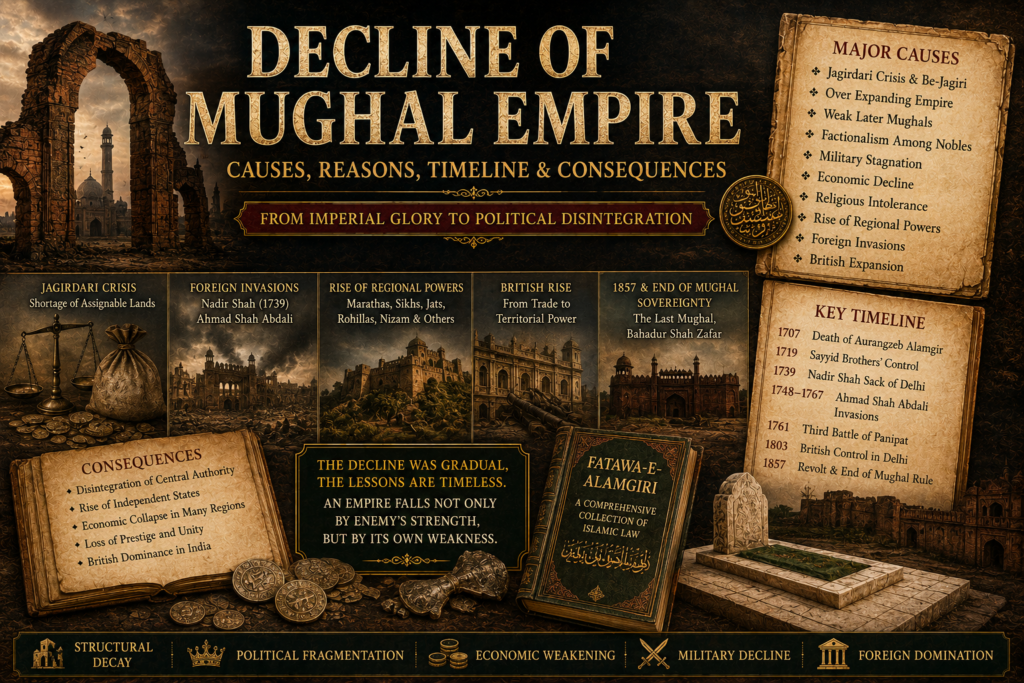
The decline of Mughal Empire was not caused by one ruler, one battle or one mistake. It was a gradual process. The Mansabdari and Jagirdari systems became overloaded, the army became outdated, the treasury weakened, nobles became factional, regional governors became independent, the Marathas expanded, Nadir Shah sacked Delhi in 1739, Ahmad Shah Abdali repeatedly invaded North India, and the British East India Company slowly converted trade into political power.
The Mughal story before decline had passed through several powerful phases. Zahir ud din Babar founded Mughal rule in 1526. Humayun lost and restored it. Akbar consolidated it through Rajput alliance, Mansabdari, revenue reform and Sulh-i-Kul. Jahangir preserved its cultural refinement. Shah Jahan gave it architectural splendour. Aurangzeb Alamgir expanded it to its widest extent, but the cost of that expansion was enormous.
To understand the decline of Mughal Empire, the earlier political background also matters. Bellum Report has already published connected guides on Muhammad Bin Qasim, the Ghaznavid Empire, Muhammad Ghori, the Slave Dynasty, the Khalji Dynasty, the Tughlaq Dynasty, the Sayyid Dynasty and the Lodhi Dynasty. These dynasties show how Delhi’s power rose, expanded, weakened and was replaced over time.
Recommended Book: If you want the full historical timeline from 711 to 2025 in one compact guide, buy The Indus Odyssey from Debal to Islamabad: The Ultimate Guide to Pakistan Affairs on Amazon Kindle.
Main Idea: The decline of Mughal Empire was caused by structural decay inside the empire and powerful pressures from outside. The Jagirdari crisis, military stagnation, factional nobility, weak later Mughals, regional states, Maratha pressure, Nadir Shah’s sack of Delhi, Abdali’s invasions and British expansion together transformed the Mughal emperor from a universal sovereign into a pensioner and finally ended the empire in 1857.
Show Table of Contents
- What Is Meant by Decline of Mughal Empire?
- Decline of Mughal Empire Timeline
- Breakdown of the Mansabdari System
- Jagirdari Crisis and Be-Jagiri
- Shrinking Khalisa and Fiscal Insolvency
- Ijarah System and Peasant Distress
- Military Stagnation and Technical Decline
- Intellectual Inertia and Printing Press Failure
- Factional Nobility and Moral Decay
- Weak Later Mughals
- Regional Fragmentation
- Nadir Shah and the Sack of Delhi
- Ahmad Shah Abdali and Afghan Invasions
- Maratha Rise and Mughal Weakness
- Treaty of Allahabad and British Rise
- Bahadur Shah Zafar and the End of Mughal Power
- Consequences of Decline of Mughal Empire
- Important Exam Points
- Recommended Book for Students
- FAQs
What Is Meant by Decline of Mughal Empire?
The decline of Mughal Empire means the gradual loss of Mughal political authority, military superiority, revenue control and imperial prestige from the late seventeenth century to the formal end of the empire in 1857. It was not a sudden collapse. It was a long process in which the emperor remained in name, but real power passed to nobles, regional rulers, Marathas, Afghans and eventually the British East India Company.
After Aurangzeb Alamgir died in 1707, the Mughal Empire still looked large on paper. But size alone does not make an empire strong. The empire had become financially exhausted, militarily overstretched and administratively rigid. The Deccan wars had drained resources, and the Jagirdari system had become unable to satisfy the nobility.
The later Mughal emperors lacked the authority of Akbar, Jahangir, Shah Jahan and Aurangzeb. They depended on powerful nobles, court factions and regional governors. The emperor’s name was still read in the Khutba and stamped on coins, but his actual control was shrinking.
By the time of Bahadur Shah Zafar, the Mughal emperor controlled little beyond the Red Fort. After the uprising of 1857, the British exiled him to Rangoon and formally ended Mughal rule.
Decline of Mughal Empire Timeline
| Year | Event | Importance |
|---|---|---|
| 1707 | Death of Aurangzeb Alamgir | Marked the end of the age of the Great Mughals and opened the succession crisis. |
| 1713–1719 | Farrukhsiyar and the Sayyid Brothers | Nobles became kingmakers and imperial dignity declined. |
| 1724 | Nizam-ul-Mulk left Delhi | Hyderabad became virtually independent, showing regional fragmentation. |
| 1737 | Baji Rao I raided near Delhi | Showed Mughal military weakness before Maratha mobility. |
| 1739 | Nadir Shah sacked Delhi | Destroyed Mughal prestige and drained imperial wealth. |
| 1748–1767 | Ahmad Shah Abdali’s invasions | Weakened Punjab and North India; Mughal authority became hollow. |
| 1761 | Third Battle of Panipat | Checked Maratha expansion but left North India politically fragmented. |
| 1764 | Battle of Buxar | Mughal emperor Shah Alam II was defeated by the British East India Company. |
| 1765 | Treaty of Allahabad | Shah Alam II granted Diwani rights of Bengal, Bihar and Orissa to the Company. |
| 1803 | British occupied Delhi | Mughal emperor came under British protection. |
| 1857–1858 | Uprising and exile of Bahadur Shah Zafar | Formal end of the Mughal Empire. |
Breakdown of the Mansabdari System
One of the major causes of decline of Mughal Empire was the breakdown of the Mansabdari system. Akbar had created this system to organize nobles by rank, salary and military responsibility. In the early Mughal period, it worked because the empire was expanding and enough revenue assignments were available.
By around 1700, the situation had changed. The number of Mansabdars increased greatly, but the amount of productive Jagir land did not increase at the same speed. This created competition among nobles and reduced the efficiency of the system.
Many Mansabdars were given ranks without enough revenue to support those ranks. As a result, they could not maintain the required cavalry and troops. The Mughal army became weaker in practice, even when official records looked impressive.
This was a structural problem. It showed that the empire’s administrative system had become too large, too expensive and too difficult to manage.
Jagirdari Crisis and Be-Jagiri
The Jagirdari crisis was perhaps the most important structural cause behind the decline of Mughal Empire. A Jagir was a revenue assignment given to a noble instead of a direct cash salary. In theory, the noble collected revenue and maintained troops for the emperor. In practice, the system began to fail.
By the late seventeenth and early eighteenth centuries, there were not enough good Jagirs for all nobles. This condition was called Be-Jagiri, meaning holding a Mansab without a proper revenue assignment.
Some Jagirs were also Zortalab, meaning difficult or rebellious lands. The cost of revenue collection in such areas could be higher than the revenue itself. Nobles posted there had little interest in protecting peasants or improving agriculture.
The result was corruption, peasant exploitation, military weakness and noble dissatisfaction. When the nobility lost confidence in the system, the central government lost its strongest administrative arm.
Shrinking Khalisa and Fiscal Insolvency
The Mughal state depended on revenue. The emperor needed money to maintain troops, forts, roads, court, workshops, artillery, nobles and administration. During the decline, the central treasury became weak.
In order to satisfy nobles, later emperors granted more and more Khalisa land as Jagirs. Khalisa was crown land whose revenue went directly to the imperial treasury. When Khalisa shrank, the emperor had less money under direct control.
This created a dangerous cycle. The emperor needed nobles, so he gave them land. But by giving them land, he weakened the treasury. With a weaker treasury, he became more dependent on nobles.
The decline of direct imperial revenue reduced the ability of the Mughal emperor to act independently. He became less a ruler and more a negotiator among powerful groups.
Ijarah System and Peasant Distress
The spread of the Ijarah system, or revenue farming, also contributed to the decline. Under this system, the right to collect revenue was auctioned to the highest bidder.
Ijaradars wanted quick profit. They often exploited peasants harshly because they had no long-term connection with the land. This led to rural distress and agrarian revolts.
The Jat, Satnami and Sikh uprisings were partly connected with agrarian discontent. When peasants, artisans and local communities felt oppressed, they became less willing to cooperate with the imperial state.
A strong empire needs a productive countryside. When revenue extraction becomes predatory, the state destroys the very base from which it collects wealth.
Military Stagnation and Technical Decline
Another major reason for the decline of Mughal Empire was military stagnation. The early Mughals had used artillery and cavalry effectively, but by the eighteenth century European warfare was changing rapidly.
The Mughal army remained heavily dependent on cavalry, war elephants and large camp-following armies. These forces looked impressive but moved slowly. European companies used disciplined infantry, flintlock muskets, mobile artillery and naval power.
The Mughals failed to build a strong blue-water navy. This was a serious weakness because European powers gained control over coastal trade and ports. The English East India Company understood the importance of sea power, while the Mughals continued to think mainly in land-based terms.
The empire also failed to modernize firearm technology quickly. While European armies improved muskets and artillery organization, the Mughal army became increasingly outdated.
Intellectual Inertia and Printing Press Failure
The decline of Mughal Empire was not only military and financial; it was also intellectual. The printing press reached India through Portuguese Jesuits in 1556, but the Mughal court did not adopt it as a major instrument of education, administration or knowledge.
The court preferred handwritten manuscripts and calligraphy. This preserved elite artistic culture but prevented mass circulation of books, technical knowledge and public debate.
Education also remained focused on traditional subjects such as theology, logic, Arabic grammar and classical texts. The Dars-i-Nizami curriculum was important in Islamic scholarship, but it did not create the same scientific and technical transformation that Europe was experiencing.
The Mughals also lacked accurate maritime knowledge and systematic cartography. European companies mapped coasts, trade routes and naval passages, while the Mughal state remained mostly land-oriented. This intellectual gap became politically costly.
Factional Nobility and Moral Decay
The nobility was once the sword of the empire, but during the decline it became a source of weakness. Nobles became divided into factions such as Turani, Irani, Hindustani and Deccani groups.
Instead of defending the empire collectively, nobles often struggled for appointments, revenue assignments and court influence. The Sayyid Brothers became kingmakers between 1713 and 1720, placing and removing emperors.
The Escheat system also weakened the aristocracy. Under this practice, the emperor could reclaim a noble’s wealth after death. Over time, nobles spent heavily on luxury instead of building durable institutions or loyal military bases.
Factionalism weakened the empire at crucial moments. During Nadir Shah’s invasion, jealousy between Mughal nobles such as Saadat Khan and Nizam-ul-Mulk contributed to poor coordination and disaster at Karnal.
Weak Later Mughals
The weakness of later Mughal emperors was another major cause. Bahadur Shah I tried to maintain unity but lacked the energy of earlier emperors. Jahandar Shah, Farrukhsiyar and others became dependent on powerful nobles.
Farrukhsiyar’s reign showed the humiliating decline of imperial authority. The Sayyid Brothers controlled politics and eventually had him deposed and killed. This shattered the sacred prestige of the Mughal throne.
Muhammad Shah Rangeela ruled from 1719 to 1748. His reign was culturally rich but politically weak. He loved music, painting and luxury, while the army and administration declined.
During Muhammad Shah’s reign, Nadir Shah invaded India and sacked Delhi. This was the clearest proof that the Mughal emperor could no longer defend his capital.
Regional Fragmentation
As the Mughal centre weakened, regional powers became stronger. Nizam-ul-Mulk established Hyderabad in 1724. Saadat Khan founded Awadh. Murshid Quli Khan made Bengal practically independent.
These rulers still used Mughal titles and formal loyalty, but they controlled their own revenue, armies and administration. Delhi became more symbolic than real.
Regional fragmentation was both a cause and consequence of decline. The centre weakened, so provinces became independent. Provinces became independent, so the centre weakened further.
This fragmentation created opportunities for the Marathas, Afghans and British. The British especially benefited because they could negotiate with divided regional states instead of facing a united empire.
Nadir Shah and the Sack of Delhi
Nadir Shah’s invasion in 1739 was one of the greatest shocks in Mughal history. The Persian ruler defeated the Mughals at the Battle of Karnal in only a few hours.
The Mughal army was large, but it was disorganized and badly led. Nadir Shah used mobile artillery, disciplined tactics and superior command. Mughal factionalism made the defeat even worse.
After victory, Nadir Shah entered Delhi. Following rumours that he had been killed, local unrest broke out. Nadir Shah ordered a massacre. Delhi suffered terrible slaughter, looting and humiliation.
Nadir Shah carried away enormous wealth, including the Peacock Throne and the Koh-i-Noor diamond. The invasion destroyed Mughal prestige. After 1739, the emperor could no longer claim to protect even his own capital.
Ahmad Shah Abdali and Afghan Invasions
After Nadir Shah, Ahmad Shah Abdali emerged as the founder of the Durrani Empire. Between 1748 and 1767, he launched repeated invasions into India.
Abdali’s invasions weakened Punjab, Delhi and North India. The Mughals were unable to resist effectively. The empire became dependent on regional alliances and temporary arrangements.
The Third Battle of Panipat in 1761 was fought between Ahmad Shah Abdali and the Marathas. Abdali defeated the Marathas, but he did not establish permanent control over India.
The result was a political vacuum. The Mughals were weak, the Marathas were checked, and the British East India Company eventually filled the gap.
Maratha Rise and Mughal Weakness
The rise of the Marathas was another major factor in the decline of Mughal Empire. Under Shivaji and later the Peshwas, the Marathas developed mobile warfare, hill forts, revenue claims and political ambition.
By the eighteenth century, Maratha influence reached the outskirts of Delhi. Baji Rao I’s raid near Delhi in 1737 shocked the Mughal court and showed that imperial defence had collapsed.
The Marathas extracted Chauth and Sardeshmukhi from Mughal territories. These taxes weakened the imperial revenue base and reduced Mughal control.
Although the Marathas lost badly at Panipat in 1761, they recovered later. Their rise showed that power in India had shifted away from Delhi toward regional military confederacies.
Treaty of Allahabad and British Rise
The Battle of Buxar in 1764 was a major turning point. Shah Alam II joined Mir Qasim of Bengal and Shuja-ud-Daulah of Awadh against the British East India Company, but they were defeated.
In 1765, the Treaty of Allahabad was signed. Shah Alam II granted the Diwani rights of Bengal, Bihar and Orissa to the British East India Company.
This transferred the right to collect revenue from some of India’s richest provinces to a trading company. The Mughal emperor became dependent on an annual pension.
The Treaty of Allahabad was one of the legal foundations of British political power in India. It showed that the Mughal emperor had lost real sovereignty.
Bahadur Shah Zafar and the End of Mughal Power
By the time of Bahadur Shah Zafar, the Mughal Empire had become a shadow. The emperor lived in the Red Fort, but the British controlled Delhi and real political power.
During the uprising of 1857, Indian sepoys declared Bahadur Shah Zafar as the symbolic emperor of Hindustan. He was old and powerless, but his name still carried emotional legitimacy.
After the British recaptured Delhi, Bahadur Shah Zafar was arrested, tried in the Red Fort and exiled to Rangoon. His sons were killed by William Hodson near Khooni Darwaza.
In 1858, the British formally ended the Mughal Empire. The long decline of Mughal Empire reached its final point.
Consequences of Decline of Mughal Empire
The consequences of the decline of Mughal Empire were enormous. First, political unity collapsed. India became divided among regional powers such as Hyderabad, Bengal, Awadh, Marathas, Sikhs, Rohillas and Mysore.
Second, foreign invasions became easier. Nadir Shah and Ahmad Shah Abdali were able to invade because the Mughal centre could not defend the frontier.
Third, the British East India Company gained power. It first entered as a trading company, then became a revenue collector, then a military power, and finally a colonial ruler.
Fourth, Delhi lost its role as the real political centre. It remained culturally important, but power moved to regional capitals and eventually to British-controlled institutions.
Finally, the fall of the Mughal Empire changed the history of South Asia forever. It opened the way for British rule, colonial exploitation, modern political movements and eventually the creation of India and Pakistan.
Important Exam Points
| Question | Answer |
|---|---|
| What was the main structural cause of the decline of Mughal Empire? | The Jagirdari crisis and breakdown of the Mansabdari system. |
| What was Be-Jagiri? | A condition where a Mansabdar held rank without an assigned revenue Jagir. |
| What was Zortalab? | Rebellious or difficult land where revenue collection was costly and unreliable. |
| Who theorized the Jagirdari crisis as a key cause? | Historian Satish Chandra. |
| When did Nizam-ul-Mulk establish Hyderabad? | 1724. |
| When did Nadir Shah sack Delhi? | 1739. |
| Which battle did Nadir Shah win against the Mughals? | Battle of Karnal. |
| What did Nadir Shah take from Delhi? | The Peacock Throne, Koh-i-Noor and massive wealth. |
| When was the Third Battle of Panipat fought? | 1761. |
| Who fought the Third Battle of Panipat? | Ahmad Shah Abdali and the Marathas. |
| When was the Battle of Buxar fought? | 1764. |
| What was the Treaty of Allahabad? | The 1765 treaty by which Shah Alam II granted Diwani rights of Bengal, Bihar and Orissa to the British East India Company. |
| When did the British occupy Delhi? | 1803. |
| Who was the last Mughal emperor? | Bahadur Shah Zafar. |
| When did the Mughal Empire formally end? | 1858, after the uprising of 1857. |
Recommended Book for Students
The decline of Mughal Empire becomes easier to understand when it is studied in a complete historical sequence. It was not only the fall of one dynasty. It was the transformation of South Asia from medieval empire to regional states, from regional states to company rule, and from company rule to British colonialism.
The Indus Odyssey from Debal to Islamabad: The Ultimate Guide to Pakistan Affairs explains the complete timeline from 711 to 2025. It connects Muhammad Bin Qasim, Ghaznavids, Muhammad Ghori, Delhi Sultanate, Mughals, decline of Mughal Empire, British rule, Pakistan Movement and modern Pakistan in one structured guide.
Buy the Kindle edition:
Buy The Indus Odyssey on Amazon India
Buy The Indus Odyssey on Amazon USA
Recommended for: CSS, PMS, PCS, PPSC, FPSC, UPSC background reading, university students, teachers, history learners and South Asian studies readers.
FAQs
What was the decline of Mughal Empire?
The decline of Mughal Empire was the gradual weakening of Mughal authority, revenue, military power and political control from the late seventeenth century to the formal end of the empire in 1858.
What were the main causes of decline of Mughal Empire?
The main causes of decline of Mughal Empire were the Jagirdari crisis, weak later Mughals, factional nobility, military stagnation, fiscal weakness, regional fragmentation, Maratha rise, foreign invasions and British expansion.
What were the reasons for decline of Mughal Empire in points?
The major reasons were Mansabdari breakdown, Be-Jagiri, shrinking Khalisa, Ijarah exploitation, outdated military, no strong navy, weak emperors, noble factionalism, Nadir Shah’s invasion, Abdali’s invasions, Maratha pressure and British rise.
What caused the decline of the Mughal Empire?
No single factor caused the decline. The Mughal Empire declined because internal structural weaknesses combined with external military, regional and colonial pressures.
What led to the decline of Mughal Empire in the 18th century?
In the eighteenth century, the empire suffered from weak rulers, regional independence, financial crisis, foreign invasions, Maratha expansion and the rise of the British East India Company.
What were the consequences of decline of Mughal Empire?
The consequences included regional fragmentation, loss of Delhi’s authority, rise of Marathas and Sikhs, Afghan invasions, British control of revenue, colonial rule and the formal end of Mughal sovereignty in 1858.
Who was the last Mughal emperor?
The last Mughal emperor was Bahadur Shah Zafar. He was exiled to Rangoon after the uprising of 1857.
Where can I buy The Indus Odyssey from Debal to Islamabad?
You can buy the Kindle edition on Amazon India and Amazon USA using these links: Amazon India and Amazon USA.
The Indus Odyssey from Debal to Islamabad
The Ultimate Guide to Pakistan Affairs (711-2025). A focused Kindle guide for CSS, PMS, PCS, PPSC and FPSC Pakistan Affairs preparation.