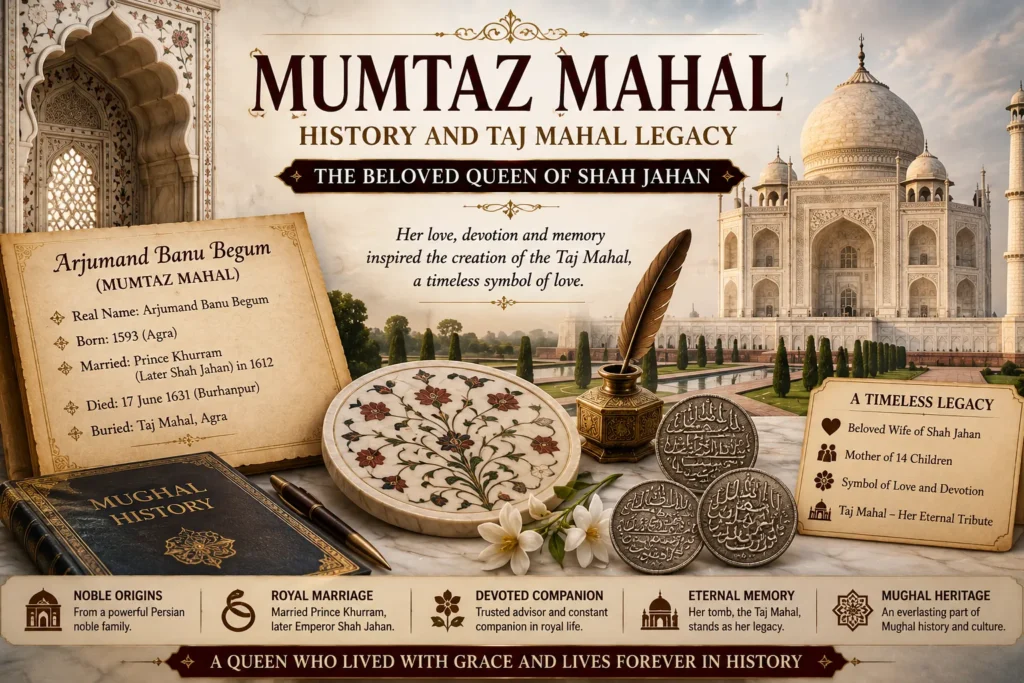
Mumtaz Mahal is one of the most remembered women of Mughal history because her life, death and legacy are permanently connected with the Taj Mahal. Her real name was Arjumand Banu Begum. She was the beloved wife of Emperor Shah Jahan, the mother of fourteen children, and the Mughal queen whose death inspired one of the most famous monuments in the world.
The story of Mumtaz Mahal is often presented as a romance, but it is also a serious chapter of imperial history. She belonged to a powerful noble family, lived at the center of the Mughal court, accompanied Shah Jahan during important phases of his life, and became the mother of princes and princesses who shaped the future of the empire. Her death in 1631 at Burhanpur during childbirth became the emotional foundation of the Taj Mahal.
Many readers search for Mumtaz Mahal real name, children, death cause, tomb and real photo. A historically correct answer must be clear: no authentic camera photograph of her exists because she died in the seventeenth century, long before photography became available in South Asia. Online images are later portraits, artistic illustrations, film recreations or modern digital images, not original photographs.
The life of Mumtaz Mahal belongs to the wider world of Mughal India. The empire was founded by Zahir ud din Babar, restored by Humayun, consolidated under Akbar, refined during Jahangir, and glorified architecturally under Shah Jahan. Her son Aurangzeb Alamgir later became one of the most powerful Mughal emperors. Popular Mughal memory also includes cultural stories such as Anarkali.
The deeper background of Mughal rule connects with earlier Muslim dynasties in the subcontinent, including Muhammad Bin Qasim, the Ghaznavid Empire, Muhammad Ghori, the Slave Dynasty, the Khalji Dynasty, the Tughlaq Dynasty, the Sayyid Dynasty and the Lodhi Dynasty. After the decline of Mughal Empire, the last symbolic Mughal phase ended under Bahadur Shah Zafar after the Revolt of 1857, its failure of revolt and the consequences of revolt.
Recommended Book: For a complete historical timeline from 711 to 2025, buy The Indus Odyssey from Debal to Islamabad: The Ultimate Guide to Pakistan Affairs on Amazon Kindle.
Main Idea: Mumtaz Mahal, originally Arjumand Banu Begum, was Shah Jahan’s beloved wife. She died in 1631 at Burhanpur during childbirth. Her remains were later moved to Agra, where the Taj Mahal became her final resting place and one of the greatest symbols of Mughal architecture.
Show Table of Contents
- Who Was Mumtaz Mahal?
- Mumtaz Mahal Real Name and Title
- Family Background
- Shah Jahan and Mumtaz Mahal
- First Husband Question
- Mumtaz Mahal Children
- Mumtaz Mahal Death at Burhanpur
- Cause of Death
- Burhanpur Connection
- Mumtaz Mahal Tomb in Agra
- Taj Mahal History
- Mumtaz Mahal Real Photo Facts
- 14 Powerful Facts
- Historical Importance
- Mughal Context
- Important Exam Points
- Official and Authentic Source Links
- Recommended Internal Reading
- FAQs About Mumtaz Mahal
Who Was Mumtaz Mahal?
Mumtaz Mahal was the chief and most beloved consort of Mughal emperor Shah Jahan. She was born in 1593 into an influential Persian-origin noble family and became one of the most famous women of the Mughal era. Her memory survives mainly because of the Taj Mahal, but her life also reflects royal family politics, imperial culture, motherhood and courtly prestige.
She was not a ruling queen in the same way as Nur Jahan, who exercised visible political authority during Jahangir’s reign. However, her place in Shah Jahan’s life was extraordinary. She remained close to him during his years as prince and emperor, accompanied him during important journeys, and became the mother of several children who later became central to the Mughal succession struggle.
The title by which she is remembered means “the chosen one of the palace” or “the exalted one of the palace.” This title reflected her high status in the imperial household. Her life should therefore be studied not only as romance but also as part of the Mughal court system.
Mumtaz Mahal Real Name and Title
The real name of Mumtaz Mahal was Arjumand Banu Begum. The popular title became famous because of her imperial rank and the monument built in her memory. This distinction is important for students because the original name and royal title are often confused.
In Mughal culture, formal titles were common. Prince Khurram became Shah Jahan after becoming emperor. Similarly, Arjumand Banu Begum became known through a title that reflected honour, rank and personal importance in the court. This is why most historical discussions remember her as Mumtaz Mahal, while serious study also mentions her birth name.
| Popular Title | Mumtaz Mahal |
| Real Name | Arjumand Banu Begum |
| Birth Year | 1593 |
| Death Year | 1631 |
| Husband | Shah Jahan |
| Father | Asaf Khan |
| Famous For | Inspiration for the Taj Mahal |
Family Background
Arjumand Banu Begum belonged to a high-ranking noble family. Her father, Asaf Khan, was an important figure in the Mughal court. Her aunt, Nur Jahan, was the influential wife of Emperor Jahangir and one of the strongest women in Mughal political history.
This background mattered because Mughal marriages were closely linked with court politics. Royal marriages strengthened alliances, increased family influence and connected powerful noble houses with the imperial dynasty. Her marriage to Prince Khurram strengthened the position of her family and linked her household to the future emperor.
Unlike Nur Jahan, she did not dominate imperial government. Yet she had emotional, domestic and symbolic influence. Her children later shaped the empire’s political future, especially during the war of succession after Shah Jahan’s illness. This is one reason Mumtaz Mahal remains important beyond the Taj Mahal story.
Shah Jahan and Mumtaz Mahal
Shah Jahan, originally Prince Khurram, married Arjumand Banu Begum in 1612. Their relationship became one of the most famous royal relationships in South Asian memory. She was not his only wife, as Mughal princes commonly had multiple marriages for dynastic and political reasons, but she became his favourite consort.
The story of Shah Jahan and Mumtaz Mahal is often presented as pure romance. A balanced historical view should include both emotion and empire. Shah Jahan’s grief after her death was real enough to inspire a great mausoleum, but the Taj Mahal was also an imperial project made possible by Mughal wealth, labour, artistic skill and political authority.
Thus, the relationship represents both personal love and royal power. The marble monument in Agra is a memorial to a wife, but it is also a statement of Shah Jahan’s imperial vision.
First Husband Question
Some readers search for the first husband of the Mughal queen. Reliable historical accounts do not show that she had a husband before Shah Jahan. She was betrothed to Prince Khurram and married him in 1612. Her known husband was Shah Jahan.
Direct Answer: There is no reliable historical record of Mumtaz Mahal having a husband before Shah Jahan. She is historically known as Shah Jahan’s beloved wife.
Mumtaz Mahal Children
Mumtaz Mahal gave birth to fourteen children. This is one of the most important facts about her life because several of those children became central figures in later Mughal politics. Not all survived into adulthood, which was common in the early modern period, but the surviving princes and princesses shaped the future of the empire.
Her famous sons included Dara Shikoh, Shah Shuja, Aurangzeb and Murad Bakhsh. Dara became known for his intellectual and spiritual interests. Aurangzeb later became emperor after defeating his brothers. Shah Shuja and Murad also took part in the succession struggle.
Her daughters included Jahanara Begum and Roshanara Begum, both of whom became influential in the imperial household. Jahanara especially held a respected position and remained closely associated with Shah Jahan.
| Question | Answer |
|---|---|
| How many children did she have? | Fourteen. |
| Who were her famous sons? | Dara Shikoh, Shah Shuja, Aurangzeb and Murad Bakhsh. |
| Who were her famous daughters? | Jahanara Begum and Roshanara Begum. |
| Which child was connected with her death? | Gauhara Begum, her fourteenth child. |
Mumtaz Mahal Death at Burhanpur
Mumtaz Mahal died on June 17, 1631, at Burhanpur. At that time Shah Jahan was involved in military affairs in the Deccan region, and she had accompanied him. Her death occurred during the birth of her fourteenth child.
This point is important because many people wrongly assume she died in Agra or inside the Taj Mahal. In reality, Agra became her final resting place later. Burhanpur was the place of death and temporary burial.
The death of Mumtaz Mahal deeply affected Shah Jahan. His personal grief later became connected with the construction of the Taj Mahal, turning a family tragedy into one of the most famous architectural memorials in world history.
Cause of Death
The cause of death was childbirth-related complications. Early modern childbirth was dangerous even for royal women. Medical care, surgery, infection control and emergency treatment were not developed according to modern standards.
This part of the story is often hidden behind the romance of the Taj Mahal. The monument is admired as a symbol of love, but it is also connected with maternal mortality and the risks women faced in the seventeenth century.
Important Clarification: Mumtaz Mahal did not die in Agra and did not die inside the Taj Mahal. She died at Burhanpur in 1631 during childbirth. Her remains were later transferred to Agra.
Burhanpur Connection
Burhanpur was an important Mughal center connected with Deccan campaigns. After the queen died there, her body was temporarily buried before being moved to Agra. This explains why her place of death and final tomb are different.
The Burhanpur connection is useful for students because it corrects a common misunderstanding. The Taj Mahal is in Agra, but the tragedy that led to its construction began in Burhanpur.
Mumtaz Mahal Tomb in Agra
The final tomb of Mumtaz Mahal is located inside the Taj Mahal complex in Agra. The monument was built as a mausoleum, and Shah Jahan was later buried beside her. The cenotaphs visible to visitors are symbolic markers, while the actual graves are placed in a lower chamber according to Mughal funerary tradition.
The tomb is the emotional and spiritual center of the complex. The white marble, calligraphy, garden layout, water channels and floral inlay work create an atmosphere of beauty, grief and royal memory.
Taj Mahal History
The Taj Mahal was built by Shah Jahan in memory of Mumtaz Mahal. Construction began after her death in 1631, and the main mausoleum was completed in the mid-seventeenth century. The wider complex took additional years to finish.
The building combines Persian, Timurid, Central Asian and Indian artistic traditions within the Mughal style. Its white marble, balanced design, charbagh garden, Quranic calligraphy and pietra dura decoration make it one of the most admired monuments in the world.
The Taj Mahal is often called a symbol of love, but it is also a symbol of imperial power. Such a structure required wealth, planning, artisans, materials and political authority. It is therefore both an emotional memorial and a grand statement of Mughal architecture.
Mumtaz Mahal Real Photo Facts
Many readers search for a real-life photo of Mumtaz Mahal. The historically accurate answer is that no real camera photograph exists. She lived from 1593 to 1631, long before photography became available in India.
Images found online are usually paintings, later portraits, film stills, AI-generated visuals or modern illustrations. These may be useful as artistic representations, but they should not be presented as authentic photographs.
SEO Answer: No original camera photo of Mumtaz Mahal exists. Any online image claiming to be a real photograph is not historically authentic because photography did not exist in her lifetime.
14 Powerful Facts
| 1. Real name | Arjumand Banu Begum. |
| 2. Famous title | Mumtaz Mahal. |
| 3. Birth year | 1593. |
| 4. Death date | June 17, 1631. |
| 5. Place of death | Burhanpur. |
| 6. Cause of death | Childbirth complications. |
| 7. Husband | Shah Jahan. |
| 8. Father | Asaf Khan. |
| 9. Famous aunt | Nur Jahan. |
| 10. Children | Fourteen. |
| 11. Famous sons | Dara Shikoh, Shah Shuja, Aurangzeb and Murad Bakhsh. |
| 12. Famous daughters | Jahanara Begum and Roshanara Begum. |
| 13. Final resting place | Taj Mahal, Agra. |
| 14. Photo fact | No authentic camera photograph exists. |
Historical Importance
The historical importance of Mumtaz Mahal lies in three areas: Mughal family history, imperial architecture and cultural memory. As a royal consort, she belonged to the highest circle of the Mughal court. As a mother, she gave birth to princes and princesses who shaped the empire after Shah Jahan. As a remembered figure, she became the emotional reason behind the Taj Mahal.
The monument made her memory global. Millions of visitors know her through the marble mausoleum in Agra. Yet a good historical understanding must go beyond romance. Her life also shows how royal women influenced dynastic continuity, courtly culture and imperial identity.
Mughal Context
Mumtaz Mahal lived during one of the strongest phases of Mughal rule. Shah Jahan’s reign is associated with artistic brilliance, imperial wealth and monumental architecture. The Taj Mahal, Red Fort of Delhi and Jama Masjid reflect the grandeur of this era.
The Mughal court was shaped by Persian language, Timurid heritage, Islamic kingship, Indian political realities and elite family networks. Royal women lived within the imperial household, but that household had political meaning. Marriage, motherhood, succession and patronage were all connected with power.
Her children later became part of one of the most dramatic succession struggles in Mughal history. Aurangzeb’s victory changed the political direction of the empire. Therefore, the queen’s legacy is connected not only with Shah Jahan’s grief but also with the future of Mughal rule.
Important Exam Points
| Main topic | Mumtaz Mahal |
| Real name | Arjumand Banu Begum |
| Born | 1593 |
| Died | June 17, 1631 |
| Death place | Burhanpur |
| Cause of death | Complications during childbirth |
| Husband | Shah Jahan |
| Father | Asaf Khan |
| Aunt | Nur Jahan |
| Children | Fourteen |
| Famous monument | Taj Mahal |
| Final tomb | Taj Mahal, Agra |
| Real photo | No authentic camera photograph exists |
Mumtaz Mahal Short Answer for Students
Mumtaz Mahal, whose real name was Arjumand Banu Begum, was the beloved wife of Shah Jahan. She belonged to an influential noble family, was the daughter of Asaf Khan and the niece of Nur Jahan. She had fourteen children and died in 1631 at Burhanpur during childbirth. Shah Jahan built the Taj Mahal in Agra as her mausoleum. No authentic photograph of her exists because she lived before the age of photography.
Possible Exam Questions
- Who was Mumtaz Mahal?
- What was her real name?
- How many children did she have?
- How did she die?
- Where did she die?
- Why was the Taj Mahal built?
- Is there any real-life photo of her?
- Discuss her importance in Mughal history.
- How is her life connected with the Mughal succession struggle?
Official and Authentic Source Links
The following official and authentic sources can be used for further verification and study:
Recommended Internal Reading on Bellum Report
To understand Mumtaz Mahal and the Mughal world in a wider historical context, readers should also study these Bellum Report posts:
- Zahir ud din Babar
- Humayun
- Akbar
- Jahangir
- Shah Jahan
- Anarkali
- Aurangzeb Alamgir
- Decline of Mughal Empire
- Bahadur Shah Zafar
- Revolt of 1857
- Failure of Revolt
- Consequences of Revolt
- Muhammad Bin Qasim
- Ghaznavid Empire
- Muhammad Ghori
- Slave Dynasty
- Khalji Dynasty
- Tughlaq Dynasty
- Sayyid Dynasty
- Lodhi Dynasty
Conclusion: Mumtaz Mahal as a Powerful Mughal Legacy Remembered Through the Taj Mahal
Mumtaz Mahal remains one of the most famous women in South Asian history because her memory is inseparable from the Taj Mahal. Her real name was Arjumand Banu Begum. She belonged to a powerful noble family, married Shah Jahan, became his most beloved consort and gave birth to fourteen children.
Her death at Burhanpur in 1631 during childbirth turned personal grief into architecture. Shah Jahan later built the Taj Mahal in Agra as her final tomb. The monument became a global symbol of love, loss, beauty and Mughal imperial art.
The story of Mumtaz Mahal should not be limited to romance alone. It also reflects royal motherhood, court culture, succession politics, the dangers of childbirth and the artistic brilliance of Shah Jahan’s reign. For students, the easiest way to remember her is through five points: real name Arjumand Banu Begum, wife of Shah Jahan, mother of fourteen children, death at Burhanpur, and inspiration for the Taj Mahal.
FAQs About Mumtaz Mahal
Who was Mumtaz Mahal?
Mumtaz Mahal was the beloved wife of Shah Jahan and the Mughal queen in whose memory the Taj Mahal was built.
What was the real name of Mumtaz Mahal?
The real name of Mumtaz Mahal was Arjumand Banu Begum.
Who was Mumtaz Mahal’s husband?
The husband of Mumtaz Mahal was Shah Jahan, the fifth Mughal emperor.
Who was Mumtaz Mahal’s first husband?
There is no reliable historical record of Mumtaz Mahal having any husband before Shah Jahan.
How many children did Mumtaz Mahal have?
Mumtaz Mahal had fourteen children, including Dara Shikoh, Aurangzeb, Jahanara Begum and Roshanara Begum.
How did Mumtaz Mahal die?
Mumtaz Mahal died in 1631 due to complications during childbirth.
Where did Mumtaz Mahal die?
Mumtaz Mahal died at Burhanpur, not Agra.
Where is Mumtaz Mahal buried?
Mumtaz Mahal is buried inside the Taj Mahal complex in Agra.
Is there any real photo of Mumtaz Mahal?
No authentic camera photograph of Mumtaz Mahal exists because she died long before photography. Online images are paintings, portraits, film stills or modern illustrations.
Why was the Taj Mahal built?
The Taj Mahal was built by Shah Jahan as a mausoleum for Mumtaz Mahal.
What is the Burhanpur connection?
Burhanpur was the place where Mumtaz Mahal died and was temporarily buried before her remains were transferred to Agra.
Where can I buy The Indus Odyssey from Debal to Islamabad?
You can buy the Kindle edition on Amazon India and Amazon USA using these links: Amazon India and Amazon USA.
The Indus Odyssey from Debal to Islamabad
The Ultimate Guide to Pakistan Affairs (711-2025). A focused Kindle guide for CSS, PMS, PCS, PPSC and FPSC Pakistan Affairs preparation.