American Revolutionary War · Evidence-led battle guide
Battle of Fort Lee
The Battle of Fort Lee on November 20, 1776 was principally an evacuation race. Four days after Fort Washington fell across the Hudson, Cornwallis crossed into New Jersey, landed north of Fort Lee and threatened to close on Nathanael Greene’s garrison. The Americans escaped before being trapped, but left guns, stores and equipment behind. The action opened the hard retreat across New Jersey that carried Washington’s army toward the Delaware and, one month later, the counterstroke at Trenton.
Quick answer
What happened at Battle of Fort Lee?
Cornwallis’s landing north of the fort threatened its landward escape route. Greene abandoned the position before the Crown force could seal the retreat, conceding the fort and much matériel but preserving most of the garrison.
Why it mattered
The loss ended the paired Fort Washington–Fort Lee scheme for contesting the lower Hudson and initiated the American withdrawal through New Jersey. The retreat preserved the army but deepened the logistical and morale crisis of late 1776.
Visual evidence + analytical reconstruction
See the Battlefield, Not Just the Summary
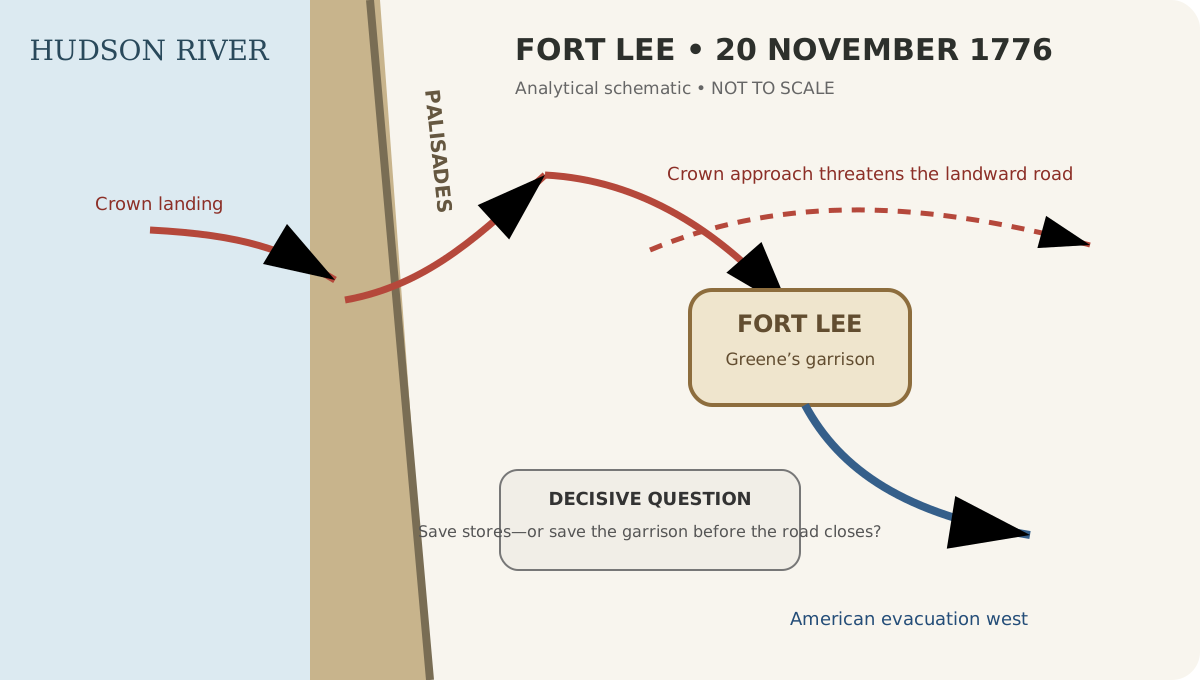
Fort Lee landing, Palisades ascent and evacuation schematic
Bellum schematic emphasizes why the landward road—not the fort wall—became decisive. Not to scale.
BellumReport Research Desk · Original 2026 analytical graphic · Bellum original graphic
Rights: Original explanatory graphic; not a surveyed map.

Landing of the British forces in the Jerseys
Contemporary 1776 watercolor used as visual evidence for the Hudson landing and Palisades setting.
Thomas Davies · 1776 · Wikimedia Commons / New York Public Library
Rights: Public domain historic work
Visual-method rule: Bellum analytical schematics are explanatory reconstructions, not surveyed maps. Historical images retain their own source and rights notes so illustration is never presented as direct eyewitness evidence.
Operational geography
Campaign Movement Map
A proportional campaign overview using each battle record’s modern reference coordinate. It explains operational movement; it is not a surveyed reconstruction of 1776 unit positions.
- Battle of Kip’s BayBritish victory
- Battle of Fort LeeBritish victory
- Battle of Mount HollyCrown tactical success; American strategic diversion
- Second Battle of TrentonAmerican defensive success
Campaign sequence
Where This Battle Fits in Its Campaign
Then & now
Battlefield Geography — Historical Ground in the Modern Landscape
Modern reference points are kept separate from claimed 1776 troop positions. A monument, park or surviving house can orient the visitor without proving that a specific unit stood on that exact modern spot.
Fort Lee Historic Park
1776 reference: Fort Lee defensive area above the Hudson
Modern reference: Fort Lee Historic Park, Fort Lee, NJ
Official modern visitor anchor for interpreting Fort Lee and the Palisades.
Location confidence: HighPalisades landing zone
1776 reference: Cornwallis landing below the Palisades north of the fort
Modern reference: Hudson shoreline north of Fort Lee
Approximate landscape anchor; historic landing descriptions do not justify a meter-level troop coordinate.
Location confidence: MediumSource-traceable command structure
Interactive Documented Order of Battle
This tree shows the documented core, not an invented complete roster. Search by formation, commander or battlefield role; expand a row to see source scope, strength basis and disposition. Omitted formations remain unresolved rather than silently classified as absent.
American
CommandFort Lee garrisonCommand: Nathanael GreeneHigh
Documented strength: 2,000 people (ABT forces-engaged estimate)
Battlefield role: Greene controlled the immediate evacuation decision.
American Battlefield Trust — Fort Lee · High confidence
CommandContinental Army strategic commandCommand: George WashingtonHigh
Battlefield role: Oversaw the wider retreat and response after the Hudson positions became untenable.
U.S. Army CMH — The New York Campaign, 1776 · High confidence
GarrisonFort Lee artillery and storesHigh
Battlefield role: Heavy matériel could not all be removed during the emergency abandonment.
American Battlefield Trust — Fort Lee · High confidence
ColumnRetreating Continental columnHigh
Battlefield role: Moved westward away from the Hudson as the New Jersey retreat began.
U.S. Army CMH — The New York Campaign, 1776 · High confidence
Crown
CommandFort Lee expeditionCommand: Charles CornwallisHigh
Documented strength: 4,000 people (ABT forces-engaged estimate)
Battlefield role: Commanded the Crown crossing and advance on Fort Lee.
American Battlefield Trust — Fort Lee · High confidence
FormationBritish and Hessian landing forceCommand: Charles CornwallisHigh
Battlefield role: Landed below the Palisades and climbed to threaten the American road network.
Wikimedia Commons — Landing of the British forces in the Jerseys, Thomas Davies · High confidence
Read behind the narrative
Primary Source Room
Primary evidence is powerful but not self-interpreting. Each item is paired with why it matters and what it cannot establish by itself.
The Landing of the British Forces in the Jerseys on 20 November 1776
Creator: Thomas Davies
Why it matters: A contemporary 1776 watercolor linked directly to Cornwallis’s landing below the Palisades, providing rare visual evidence for the operation’s maritime and terrain setting.
Read with caution: An artwork is selective and cannot establish exact numbers or every unit’s location; it should be compared with written campaign evidence.
Objectives Before the Battle
American objective
The immediate American objective became survival: evacuate men before the British approach cut the roads west and south, while saving as much artillery, ammunition, food and baggage as time permitted.
British / Crown objective
Howe and Cornwallis aimed to remove the remaining American strongpoint opposite Fort Washington, seize its stores, and keep pressure on a retreating army before it could establish a new defensive position.
Fort Lee Cannot Be Understood Without Fort Washington
Fort Lee and Fort Washington were conceived as paired Hudson defenses. Their value depended on a broader system: guns on opposite sides of the river, supporting positions and an army capable of preventing the enemy from simply operating around them. When Fort Washington surrendered on November 16, the strategic logic of holding Fort Lee changed immediately. A post designed to work with its partner now faced the enemy alone.
This relationship is why Bellum connects the two battles directly in the campaign graph. The question on November 20 was not whether Fort Lee’s earthworks were strong in isolation. It was whether the position still justified risking men and stores after the eastern fort had been lost and Crown troops could cross the Hudson north of the post. The answer arrived when Cornwallis’s column appeared on the New Jersey side.
Evidence basis: U.S. Army CMH — The New York Campaign, 1776
The Palisades Made the Landing Difficult—but Not Safe for the Fort
Cornwallis landed beneath the Palisades north of Fort Lee. The steep terrain imposed a real physical challenge on the Crown force, yet once troops climbed to the upper ground, the same geography worked against the Americans. The fort faced the Hudson; the existential threat came from an enemy now moving on the roads behind it.
Thomas Davies’s 1776 watercolor is useful here because it visualizes the landing at the base of the heights. Bellum pairs that contemporary image with a schematic that shows the operational direction after the ascent. The two visuals answer different questions. The historical artwork conveys terrain and maritime movement; the analytical graphic explains why gaining the heights endangered the landward escape route.
Evidence basis: Wikimedia Commons — Landing of the British forces in the Jerseys, Thomas Davies
Greene Had to Choose Between Property and the Garrison
An orderly evacuation of a fortified post requires time. Guns have to be limbered or disabled, ammunition packed, provisions loaded, baggage assigned to wagons and units given routes. Greene did not have that luxury once the Crown approach threatened the road out. Every additional hour spent saving stores increased the chance that the garrison itself would be caught.
The resulting abandonment looked wasteful because important matériel remained. That criticism is justified only if it also states the alternative. Fort Washington had demonstrated the cost of allowing a garrison to become isolated. At Fort Lee, Greene chose the mobile army over the fixed inventory. Bellum’s Decision Explorer treats this as a tradeoff rather than a morality tale: preserving troops and losing supplies was bad; preserving supplies too long and losing both might have been catastrophic.
Evidence basis: American Battlefield Trust — Fort Lee
Why Abandoned Stores Matter More Than the Casualty Total
Fort Lee produced relatively little direct fighting compared with Brooklyn or Fort Washington. If the page displayed only battlefield casualties, it would make the operation look trivial. The more important loss was logistical. Tents, artillery, ammunition, food and equipment left in and around the post were resources Washington’s retreating army badly needed as winter approached.
This is why Bellum separates human casualties from captured or abandoned matériel. A retreat can preserve combatants while still weaken an army’s ability to operate. The New Jersey campaign that followed was conducted by troops already under pressure from expiring enlistments, fatigue and supply problems. Fort Lee therefore belongs in the database not because it was a bloody stand, but because it converted a strategic withdrawal into a more severe logistical crisis.
Evidence basis: American Battlefield Trust — Fort Lee
Why Bellum Does Not Pretend the Crown Force Has One Exact Number
Modern accounts can describe Cornwallis’s force with different totals. American Battlefield Trust’s battle facts use roughly 4,000 for forces engaged, while narrative traditions sometimes refer to a larger landing or operational force. Those numbers are not automatically contradictory because authors may be counting different echelons or moments.
The database keeps the source, value and measurement basis together. A figure labeled “forces engaged” is not silently added to another labeled “landing force.” This rule matters beyond Fort Lee. Revolutionary War strength figures often move between paper returns, troops present, troops in a column and soldiers actually committed. Bellum’s evidence model is designed to show those categories rather than flattening them into a neat but historically misleading chart.
Evidence basis: American Battlefield Trust — Fort Lee
The Retreat Across New Jersey Starts Here
Once Fort Lee was abandoned, Washington’s army moved west and south through New Jersey under Crown pressure. This was not a planned march to a comfortable winter position. It was a retreat intended to keep the army beyond the reach of pursuing forces while protecting routes toward the Delaware. Each lost town and abandoned store affected morale and the impression that the Revolution might be collapsing.
The campaign graph therefore draws a long line from Fort Lee toward the December crisis rather than treating November 20 as an isolated endpoint. Trenton makes more sense when the reader can see what preceded it: successive withdrawals, shrinking operational space and the need for Washington to recover initiative. The contrast between Fort Lee and Trenton is one of the strongest before-and-after comparisons in the entire 1776 campaign.
Evidence basis: American Battlefield Trust — Fort Lee
Reading Fort Lee Historic Park Without Mistaking It for an Exact 1776 Overlay
Fort Lee Historic Park provides a modern interpretive anchor above the Hudson and includes Revolutionary War interpretation and a reconstructed encampment. It is valuable because the visitor can still understand the relationship between the heights, river and New York side. Yet a modern park boundary is not identical to every 1776 fortification, road or troop position.
Bellum’s Then & Now module therefore stores a feature type, source, confidence and uncertainty radius. The public map can say “official visitor anchor” without implying that a marker sits on the precise location of a regiment. This may seem overly careful, but geospatial overconfidence is common on history sites. A trustworthy battlefield explorer should show what is known, what is approximate and what has been transformed by two and a half centuries of development.
Evidence basis: Palisades Interstate Park Commission — Fort Lee Historic Park
Was Fort Lee a Defeat Even Though the Garrison Escaped?
Yes, but the answer requires levels. The Crown forces won the operation: they forced abandonment, took the position and acquired stores while the Americans retreated. At the same time, Greene avoided the kind of mass capture suffered at Fort Washington. The tactical result and the survival result point in different directions.
That is why Bellum does not use a single colored “win/loss” badge as the analysis. The page distinguishes possession of ground, human losses, matériel losses and campaign consequence. Fort Lee was a British victory that still preserved the core American requirement of keeping the army alive. That surviving army later crossed the Delaware and attacked Trenton, giving the evacuation an importance that cannot be seen from the fort alone.
Evidence basis: American Battlefield Trust — Fort Lee
Fort Lee Reveals the Difference Between Strategic Responsibility and Immediate Command
Washington carried responsibility for the larger Hudson and New Jersey situation, but Greene faced the immediate decision inside Fort Lee when the Crown advance became urgent. Separating those levels prevents the page from assigning every detail of the evacuation to one commander. Strategic policy determines whether a post remains occupied; battlefield command determines what can still be saved once an enemy column is already closing.
That distinction is especially important after Fort Washington. The American command had just experienced the consequences of retaining an exposed garrison too long. Fort Lee presented a related problem under a much shorter clock. Bellum links Washington and Greene to the same battle record but records different roles in the order of battle and Decision Explorer, allowing readers to see command as a hierarchy rather than a single famous name attached to every action.
Evidence basis: U.S. Army CMH — The New York Campaign, 1776
What Would “Holding Fort Lee” Actually Have Required?
A counterfactual defense of Fort Lee cannot begin with courage alone. To hold the post, the Americans would have needed secure landward communications, enough combat power to prevent Cornwallis from dominating the surrounding roads, time to remove or sustain stores, and a wider Hudson strategy that still justified the risk. After Fort Washington fell, several of those conditions had already deteriorated.
This is why the Bellum analysis does not ask merely whether Greene could have ordered the men to stay. It asks what operational system would have made staying useful. A fort whose enemy can approach from the rear may become a trap rather than a shield. The emergency abandonment was costly because it happened late, but the physical survival of the garrison shows why a mobile retreat could be strategically preferable to a dramatic last stand.
Evidence basis: American Battlefield Trust — Fort Lee
Forces & Casualties — Evidence, Not False Precision
The charts only compare figures that share a source and measurement definition. Other source-defined figures remain in the evidence table.
| Metric | Side | Value | Definition / basis | Source | Confidence |
|---|---|---|---|---|---|
| Casualties | American | 8 | estimated casualties | American Battlefield Trust — Fort Lee | Medium |
| Casualties | Crown | 0 | estimated casualties | American Battlefield Trust — Fort Lee | Medium |
| Strength | American | 2,000 | forces engaged / garrison context | American Battlefield Trust — Fort Lee | Medium |
| Strength | Crown | 4,000 | forces engaged | American Battlefield Trust — Fort Lee | Medium |
Battlefield Analysis
Terrain
The Palisades created a dramatic vertical obstacle between the Hudson landing place and the fort above. Once Crown troops gained the heights north of Fort Lee, the decisive geography shifted to the roads leading away from the post. The fort itself could not compensate for an enemy force operating on its landward side.
Intelligence
The fall of Fort Washington made Fort Lee’s isolation obvious, yet the timing and speed of Cornwallis’s movement still created tactical surprise. Once word arrived that Crown troops were advancing from the north, Greene had little time for a deliberate evacuation.
Turning point
The critical moment was not a breach of a wall. It was Greene’s recognition that remaining in the fort risked encirclement. The decision to leave converted a likely surrender into a costly but successful escape.
Logistics
Fort Lee is a logistics battle because the Americans saved the force but lost significant stores. Heavy guns, ammunition, tents, provisions and equipment could not all be removed during an emergency withdrawal. The cost of those abandoned supplies followed the army into the New Jersey retreat.
Weather
Accounts of the approach emphasize a wet November operation; conditions added friction to movement but did not alter the central fact that the garrison faced a converging threat from the north after the Hudson crossing.
Where Historical Sources Disagree
Modern summaries differ over whether to describe the Crown force as roughly 4,000 or 5,000. Those figures can reflect different definitions of the assault/landing column. Bellum stores each source-specific number with its measurement basis instead of averaging them.
Bellum does not average incompatible figures. Each number below retains its source, definition and confidence.
Battle Timeline & Tactical Phases
- 1
Early morning
Cornwallis crosses the Hudson
The Crown force landed north of Fort Lee, using the Hudson to place troops on the New Jersey side behind the strategic logic of the fort.
Location: Palisades north of Fort Lee
Evidence confidence: High - 2
Morning
Crown troops gain the heights
After landing below the Palisades, the column climbed toward the roads leading to the American position.
Location: Palisades / Fort Lee approaches
Evidence confidence: High - 3
Morning
Warning reaches Greene
News of the advance transformed the garrison’s problem from defense to evacuation; delay risked losing the road out.
Location: Fort Lee
Evidence confidence: High - 4
Late morning
Emergency abandonment
American troops left the fort quickly, saving men but abandoning stores that could not be moved in time.
Location: Fort Lee and westward roads
Evidence confidence: High - 5
After the evacuation
Retreat across New Jersey begins
The surviving army moved away from the Hudson under continuing Crown pressure, beginning the difficult retreat toward the Delaware.
Location: New Jersey interior
Evidence confidence: Medium
Bellum Decision Explorer
This section evaluates decisions using information and constraints available at the time, not simply whether the eventual outcome was good or bad.
Abandon Fort Lee before the escape road closes
Situation: Greene learned that Cornwallis had landed north of Fort Lee and was advancing from a direction that threatened the post’s landward communications.
What was known: The recent fall of Fort Washington demonstrated what could happen to an isolated Hudson position. The speed of the Crown approach left little time to move heavy matériel.
Alternatives: Remain and defend the fort; attempt a slower removal of stores; or order an immediate evacuation.
Constraints: Limited wagons, heavy guns, stores, poor time margin and the risk of losing the garrison if the roads were cut.
Decision: Greene ordered the troops out quickly, prioritizing the force over the property in the fort.
Outcome: Most of the garrison escaped, while the Crown forces took the position and captured valuable abandoned stores.
Hindsight guardrail: The loss of matériel was serious, but judging the decision requires comparing it with the plausible alternative of another mass surrender only four days after Fort Washington.
Claim-by-claim provenance
Source Agreement Matrix
This view separates broad source agreement from genuine disagreement. A conflict flag means the stored sources make materially different statements; it does not mean one source is automatically wrong.
1 independent source record in the ledger.
2 independent source records in the ledger.
1 independent source record in the ledger.
1 independent source record in the ledger.
1 independent source record in the ledger.
1 independent source record in the ledger.
Evidence Ledger & Source Trail
The evacuation began the American retreat across New Jersey that preceded Trenton and Princeton.
Fort Lee was abandoned on November 20, 1776 as Cornwallis approached after crossing the Hudson.
U.S. campaign chronology also places the Fort Lee abandonment immediately after Fort Washington in November 1776.
Nathanael Greene ordered the post abandoned when the Crown approach made continued defense untenable.
The hurried evacuation preserved most of the garrison but left important stores and equipment to the enemy.
Fort Lee Historic Park interprets the 1776 position above the Hudson and Palisades.
Palisades Interstate Park Commission — Fort Lee Historic Park
The Palisades Interstate Park Commission maintains Fort Lee Historic Park as an official interpretive site for the 1776 position.
Palisades Interstate Park Commission — Fort Lee Historic Park
Thomas Davies produced a 1776 watercolor depicting Cornwallis’s landing in New Jersey near Fort Lee.
Wikimedia Commons — Landing of the British forces in the Jerseys, Thomas Davies
Frequently Asked Questions
When was the Battle of Fort Lee?
Fort Lee was abandoned on November 20, 1776, four days after the fall of Fort Washington across the Hudson.
Source basis: American Battlefield Trust — Fort Lee
Who won at Fort Lee?
The Crown forces won the operation by forcing the Americans to abandon the post and leave valuable stores. The Americans nevertheless preserved most of the garrison by retreating before encirclement.
Source basis: American Battlefield Trust — Fort Lee
Why did Nathanael Greene abandon Fort Lee?
Cornwallis landed north of the fort and advanced from a direction that threatened the landward escape routes. Greene chose a rapid evacuation rather than risk another trapped garrison.
Source basis: American Battlefield Trust — Fort Lee
Were there heavy casualties at Fort Lee?
No major stand comparable to Fort Washington developed. American Battlefield Trust lists low direct casualties; the more consequential losses included stores and equipment abandoned during the emergency withdrawal.
Source basis: American Battlefield Trust — Fort Lee
What can visitors see at Fort Lee today?
Fort Lee Historic Park provides official interpretation above the Hudson and includes a reconstructed Revolutionary War encampment and visitor facilities. Bellum treats it as a modern interpretive anchor, not a precise boundary for every 1776 position.
Source basis: Palisades Interstate Park Commission — Fort Lee Historic Park
What happened after Fort Lee?
The Continental Army retreated across New Jersey toward the Delaware. That retreat created the strategic crisis from which Washington launched the Trenton counteroffensive in December.
Source basis: American Battlefield Trust — Fort Lee