American Revolutionary War · Evidence-led battle guide
Battle of White Plains
A British victory during Washington’s retreat north of New York City, with major source-definition differences in commonly repeated troop-strength figures.
Quick answer
What happened at Battle of White Plains?
British and Hessian forces forced the Americans from Chatterton Hill and compelled a further withdrawal.
Why it mattered
The defeat accelerated Washington’s loss of the New York position and preceded the disasters at Fort Washington and Fort Lee.
Visual evidence + analytical reconstruction
See the Battlefield, Not Just the Summary
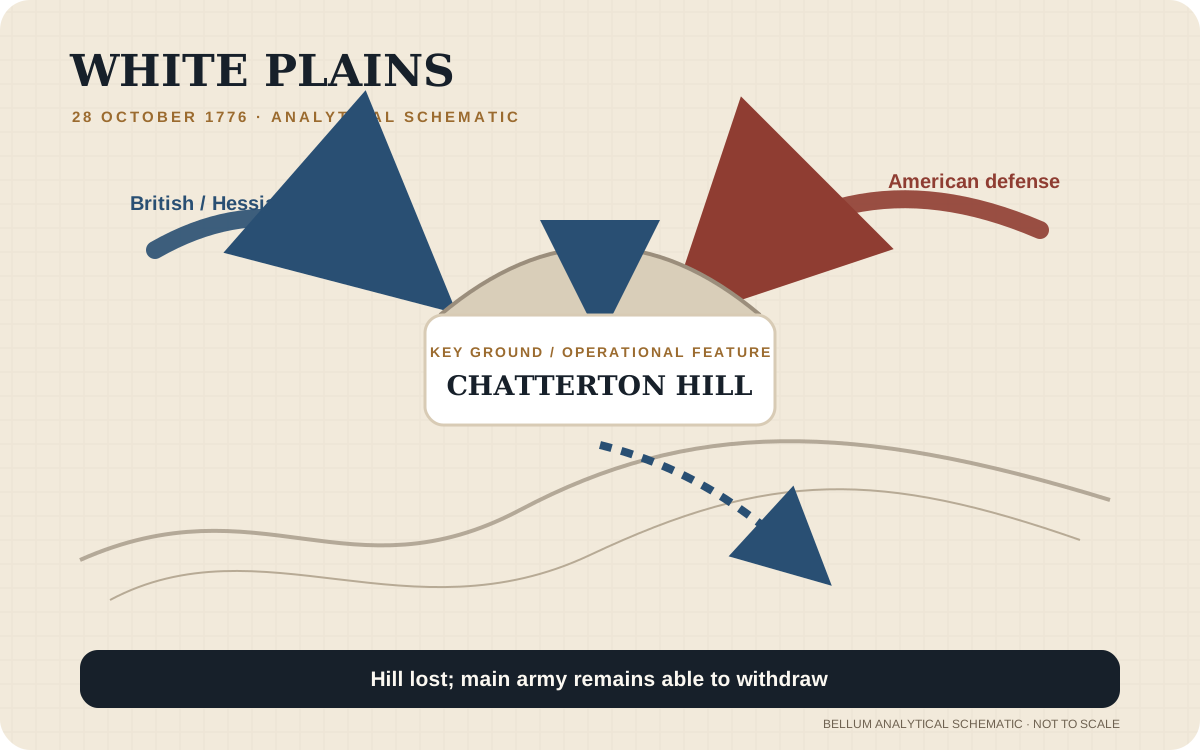
White Plains and Chatterton Hill schematic
Bellum schematic focuses on why Chatterton Hill became the tactical focal point and why the broader American army remained able to withdraw. Not to scale.
BellumReport Research Desk · Original 2026 analytical graphic · Bellum original graphic
Rights: Original explanatory graphic; not a surveyed map.

The engagement on the White Plains
Public-domain historical map showing the White Plains engagement and surrounding terrain.
D. Martin · 1792 · Wikimedia Commons / NYPL source
Rights: Public domain
Visual-method rule: Bellum analytical schematics are explanatory reconstructions, not surveyed maps. Historical images retain their own source and rights notes so illustration is never presented as direct eyewitness evidence.
Operational geography
Campaign Movement Map
A proportional campaign overview using each battle record’s modern reference coordinate. It explains operational movement; it is not a surveyed reconstruction of 1776 unit positions.
- Battle of Kip’s BayBritish victory
- Battle of Fort LeeBritish victory
- Battle of Mount HollyCrown tactical success; American strategic diversion
- Second Battle of TrentonAmerican defensive success
Campaign sequence
Where This Battle Fits in Its Campaign
Then & now
Battlefield Geography — Historical Ground in the Modern Landscape
Modern reference points are kept separate from claimed 1776 troop positions. A monument, park or surviving house can orient the visitor without proving that a specific unit stood on that exact modern spot.
Chatterton Hill
1776 reference: American defensive hill west of the Bronx River
Modern reference: Battle of White Plains Park / Chatterton Hill area, White Plains, NY
The hill is the key terrain feature in the battle narrative; modern development means historical and present-day boundaries require careful comparison.
Location confidence: MediumSource-traceable command structure
Interactive Documented Order of Battle
This tree shows the documented core, not an invented complete roster. Search by formation, commander or battlefield role; expand a row to see source scope, strength basis and disposition. Omitted formations remain unresolved rather than silently classified as absent.
American
BrigadeAlexander McDougall’s Chatterton Hill forceCommand: Alexander McDougallHigh
Battlefield role: Defended Chatterton Hill west of the Bronx River.
U.S. Army CMH — The New York Campaign, 1776 · High confidence
Crown
CommandHessian attack toward Chatterton HillCommand: Leopold Philip de HeisterHigh
Battlefield role: Directed German troops against the American position on Chatterton Hill.
U.S. Army CMH — The New York Campaign, 1776 · High confidence
BrigadeRall’s brigadeCommand: Johann RallHigh
Battlefield role: Attacked the southeastern portion of Chatterton Hill and helped turn the American line.
U.S. Army CMH — The New York Campaign, 1776 · High confidence
BrigadeDonop’s brigadeCommand: Carl von DonopHigh
Battlefield role: Pressed the Chatterton Hill defense in conjunction with other Crown formations.
U.S. Army CMH — The New York Campaign, 1776 · High confidence
BrigadeLeslie’s brigadeCommand: Alexander LeslieHigh
Battlefield role: British brigade involved in the pressure against Chatterton Hill.
U.S. Army CMH — The New York Campaign, 1776 · High confidence
Read behind the narrative
Primary Source Room
Primary evidence is powerful but not self-interpreting. Each item is paired with why it matters and what it cannot establish by itself.
General Orders, 30 October 1776
Creator: George Washington’s headquarters
Why it matters: These orders illuminate the operational environment immediately after the White Plains fighting: readiness, baggage, provisions and alarm procedures.
Read with caution: General orders describe headquarters requirements rather than giving a complete narrative of the battle itself.
Objectives Before the Battle
American objective
Washington sought to preserve the army while holding defensible ground north of New York and avoiding encirclement.
British / Crown objective
Howe sought to press the American withdrawal, seize tactically useful ground and create an opportunity for a more decisive defeat.
White Plains and Washington’s Withdrawal from New York
By late October 1776 the campaign had shifted away from lower Manhattan as Washington tried to keep the Continental Army from being trapped. White Plains became the next major test. The battle was fought on October 28 and ended in a British victory, but the engagement is especially useful for understanding the continuing American effort to trade ground for the survival of the main army.
The central strategic question was larger than Chatterton Hill. Howe needed to turn pressure into a result decisive enough to cripple Washington’s army; Washington needed to avoid that outcome while still contesting useful ground. White Plains ended with another American withdrawal, but the field army again escaped destruction and remained capable of continuing the campaign.
Evidence basis: NPS Cowpens — Revolutionary War Timeline
Why Chatterton Hill Became the Focal Point
The best-known fighting centered on Chatterton Hill, where American troops faced a powerful British and Hessian assault. NPS material on soldiers who served at White Plains describes American positions using stone walls and prepared defensive works, followed by cannon fire and a pincer attack that forced a retreat.
The hill mattered because it dominated part of the immediate battlefield and became the point at which the Crown attack achieved its clearest tactical success. Yet the action on Chatterton Hill should not automatically be treated as identical with every troop present around White Plains. This distinction helps explain why historical sources can produce very different strength estimates for what they call the “battle.”
Evidence basis: NPS Cowpens — Revolutionary War Timeline
Why White Plains Is a Source-Conflict Case Study
White Plains is a useful case study in source definition. One NPS timeline gives approximately 4,000 British and Hessian troops against 1,600 Americans in the action, while American Battlefield Trust lists approximately 7,500 Crown forces and 3,100 Americans as forces engaged. The totals are too different to be treated as if they describe the same measurement.
The discrepancy may reflect different geographic or chronological scopes, different definitions of “engaged,” or reliance on different historical estimates. A careful reader should therefore compare each number with its label and source rather than assume that the largest or most precise-looking figure is automatically the most accurate.
Evidence basis: NPS Cowpens — Revolutionary War Timeline
Casualties and the Limits of a Simple Victory Label
The NPS timeline notes that British casualties exceeded American casualties in its summary of the battle, even though the British and Hessians won the engagement. American Battlefield Trust provides a different, more detailed casualty breakdown. This is another reason outcome and cost must be presented separately.
A force can seize the objective and still suffer heavier losses in the process. Casualty summaries also change depending on whether killed, wounded, missing and captured are separated or combined. White Plains therefore demonstrates why a victory label cannot substitute for a full accounting of what each side paid to achieve or resist the result.
Evidence basis: American Battlefield Trust — White Plains
What the British Victory Accomplished—and What It Did Not
White Plains forced another American withdrawal and sustained British operational pressure. It also helped set the stage for the later assaults on Fort Washington and Fort Lee. Yet the main Continental Army again avoided decisive destruction.
That continuity is essential. Brooklyn, Harlem Heights, Pell’s Point and White Plains were not independent episodes; each altered the positions and options available in the next. By November, the campaign’s danger shifted toward the isolated Hudson forts. By December, after the retreat across New Jersey, Washington would seek to reverse the momentum with the offensive at Trenton.
Evidence basis: NPS — Timeline of the Revolution
Why White Plains Battle Statistics Disagree
Competing battle statistics should be read as evidence claims, not interchangeable facts. Each estimate needs a source, a definition and—where possible—an explanation of whether it refers to the whole army, a particular wing, or troops actually engaged. White Plains is especially vulnerable to confusion because a narrow account of Chatterton Hill can be compared accidentally with broader totals for the surrounding operations.
The most useful synthesis therefore preserves disagreement. Readers can see both estimates, understand what each source appears to measure and avoid false precision. Where the historical record does not support a single reconciled figure, the uncertainty itself is part of the result.
Evidence basis: American Battlefield Trust — White Plains
White Plains Was a Supply and Engineering Problem Before It Was a Battle
White Plains had importance before British and Hessian troops attacked Chatterton Hill. As Washington’s army withdrew north, military stores and provisions were moved into the area. NPS material on New York militia service describes local units guarding those supplies and helping prepare defensive works on the hills around the village under the supervision of engineer Rufus Putnam. The battlefield therefore grew around a logistical node as well as a defensible landscape.
That matters because an army cannot evaluate terrain in isolation from what it must protect. Strong ground in one direction may be less useful if stores, roads and retreat routes lie elsewhere. Washington needed positions that could delay Howe while preserving the army and the material required to keep it functioning. Chatterton Hill became famous because of the assault there, but the broader White Plains position connected earthworks, militia duties, roads and supply movement.
The campaign had already demonstrated the danger of static defense when an enemy possessed amphibious mobility and superior numbers. At White Plains the American command again had to balance holding useful ground against avoiding encirclement. The prepared works show that the army intended to resist; the later withdrawal shows that preservation of the force remained more important than treating every hill as ground that had to be held at any cost.
Evidence basis: NPS — New York Militia Soldier at White Plains
Militia on Chatterton Hill Faced Artillery Before the Assault
The Chatterton Hill action is sometimes reduced to a simple statement that British and Hessian troops took the hill. NPS evidence tied to militia soldier Frederick Stevenson gives a more textured picture. Graham’s militia helped prepare defensive positions on the hill, including use of stone walls, and then endured a heavy cannonade before the attacking troops moved against them. The assault combined superior firepower with pressure from more than one direction.
That sequence matters because it explains why a defensive wall is not the same as a fortress. Stone walls can provide cover from small-arms fire and help organize a line, but they do not remove the effects of artillery, flank pressure or numerical disadvantage. Once a pincer threatened the position, the defenders faced the danger that the hill would become an enclosure rather than a shield.
The militia role also complicates stereotypes about eighteenth-century American forces. These men were not simply an anonymous mass behind Continental regulars. Local militia guarded stores, built works and fought on a focal piece of terrain. Their experience shows how the campaign depended on different kinds of military service, each with distinct obligations and levels of training, operating together under rapidly changing conditions.
Evidence basis: NPS — New York Militia Soldier at White Plains
A Narrow Chatterton Hill Account and a Broad White Plains Account Are Not the Same Thing
White Plains demonstrates why historical statistics must be tied to the scope of the event being measured. One source can describe the troops directly involved in the Chatterton Hill action while another counts forces engaged across a wider portion of the operation. Both may use the label “Battle of White Plains,” yet the numbers can differ by thousands without one source necessarily making a simple arithmetic mistake.
The same problem affects casualties. A figure may count only killed and wounded in a particular action, include missing men, or summarize a broader period of fighting. Presenting a single number without the measurement basis creates false precision. For that reason the force and casualty visualizations on this page only place two values in the same chart when their source and definition are comparable. Other estimates remain visible in the evidence table instead of being averaged.
This method is especially important for a battle whose best-known tactical episode is only part of a larger maneuver. The goal is not to avoid giving readers numbers. It is to make each number answer a clear question: who was counted, in what part of the action, over what period, and according to which source.
Evidence basis: NPS Cowpens — Revolutionary War Timeline
Losing Chatterton Hill Did Not Destroy Washington’s Army
The British and Hessian success on Chatterton Hill gave Howe a tactical victory, but the larger American force remained capable of withdrawing. This distinction links White Plains directly to the pattern established at Brooklyn: the British could defeat portions of Washington’s army and seize important ground without necessarily trapping the main field force. The campaign therefore continued as a contest between British pressure and American preservation.
For Washington, the immediate value of a successful withdrawal was survival. For Howe, the limitation was that another victory had not produced the decisive destruction that might have ended organized resistance in the region. The operational consequences still favored the British. American positions around New York were shrinking, and the isolated Hudson forts would soon face direct attack. But the surviving main army remained available to retreat through New Jersey and, weeks later, counterattack at Trenton.
White Plains should therefore be placed between two kinds of outcomes. It was more than a skirmish because it accelerated the American loss of the New York position. It was less than the decisive annihilation the British command might have preferred. That tension explains both the seriousness of the defeat and the continued possibility of American recovery.
Evidence basis: NPS — Timeline of the Revolution
White Plains Shifted the Campaign from Manhattan to the Hudson Forts
White Plains sits at a transition point in the 1776 campaign. Before it, the central problem was the American retreat out of lower New York and away from British attempts to turn positions on Manhattan and in Westchester. After it, attention increasingly shifted toward the isolated forts along the Hudson—especially Fort Washington and Fort Lee. Reading White Plains in that sequence explains why its strategic effect was larger than the loss of Chatterton Hill alone.
Washington’s army survived, but the geographical space available for defending New York had narrowed again. The British could turn away from the Westchester pursuit and concentrate against fixed American positions that no longer fit comfortably inside a coherent field-army defense. Fort Washington would fall on November 16; Fort Lee would be abandoned days later. The retreat across New Jersey then followed.
This sequence is also why White Plains should link heavily to the pages before and after it. The battle inherits problems created at Brooklyn, Kip’s Bay and Pell’s Point, then passes a more dangerous operational situation to Fort Washington. The campaign graph is not decorative navigation: it is part of the historical explanation, showing how one incomplete British victory still changed the choices available in the next stage.
Evidence basis: NPS — Timeline of the Revolution
Forces & Casualties — Evidence, Not False Precision
The charts only compare figures that share a source and measurement definition. Other source-defined figures remain in the evidence table.
| Metric | Side | Value | Definition / basis | Source | Confidence |
|---|---|---|---|---|---|
| Casualties | American | 217 | 50 killed, 150 wounded, 17 missing/captured | American Battlefield Trust — White Plains | Medium |
| Casualties | British/Hessian | 233 | 47 killed, 182 wounded, 4 missing/captured | American Battlefield Trust — White Plains | Medium |
| Forces Engaged | American | 1,600 | NPS timeline action summary | NPS Cowpens — Revolutionary War Timeline | Medium |
| Forces Engaged | American | 3,100 | American Battlefield Trust forces engaged | American Battlefield Trust — White Plains | Medium |
| Forces Engaged | British/Hessian | 4,000 | NPS timeline action summary | NPS Cowpens — Revolutionary War Timeline | Medium |
| Forces Engaged | British/Hessian | 7,500 | American Battlefield Trust forces engaged | American Battlefield Trust — White Plains | Medium |
Battlefield Analysis
Terrain
Chatterton Hill, stone walls and prepared defensive positions shaped the focal fighting.
Intelligence
Both armies were maneuvering after the British flanking effort through Westchester; the exact scope of forces in the principal action differs by source.
Turning point
British and Hessian pressure on Chatterton Hill, including a pincer movement, forced the defenders to withdraw.
Where Historical Sources Disagree
Published force figures differ sharply by scope. NPS timeline material summarizes a 4,000 vs 1,600 action; American Battlefield Trust lists 7,500 British vs 3,100 American forces engaged. The two records should remain separate until their measurement scopes can be reconciled.
Bellum does not average incompatible figures. Each number below retains its source, definition and confidence.
Battle Timeline & Tactical Phases
- 1
Before October 28
American defensive position around White Plains
American forces occupied defensive ground around White Plains as the British and Hessian army approached through Westchester.
Location: White Plains defensive area
Evidence confidence: Medium - 2
October 28
Assault on Chatterton Hill
British and Hessian troops attacked the American position on Chatterton Hill after artillery pressure and maneuver against the defenses.
Location: Chatterton Hill
Evidence confidence: High - 3
Later October 28
American withdrawal from the hill
Under superior pressure and a pincer threat, the defenders gave up Chatterton Hill and the American army continued its withdrawal.
Location: Northward from White Plains
Evidence confidence: High
Bellum Decision Explorer
This section evaluates decisions using information and constraints available at the time, not simply whether the eventual outcome was good or bad.
Continue withdrawing rather than risk the main army after Chatterton Hill
Situation: The American position at White Plains had been pressured and Chatterton Hill was lost to British and Hessian attack.
What was known: The British retained numerical and operational pressure while Washington’s overriding strategic need was to avoid encirclement or destruction.
Alternatives: Counterattack aggressively; remain in the immediate position; withdraw to preserve the army.
Constraints: Unequal forces, uncertain scope of British maneuver, need to keep the Continental Army intact.
Decision: The American army continued its withdrawal rather than seeking a decisive general engagement.
Outcome: The British gained the battlefield and maintained pressure, but the main American army again escaped destruction.
Hindsight guardrail: Preserving the army does not change White Plains from a British victory; battle result and campaign survival are scored separately.
Claim-by-claim provenance
Source Agreement Matrix
This view separates broad source agreement from genuine disagreement. A conflict flag means the stored sources make materially different statements; it does not mean one source is automatically wrong.
1 independent source record in the ledger.
Evidence Ledger & Source Trail
White Plains was a British victory on October 28, 1776.
American Battlefield Trust — White Plains · Battle facts
Frequently Asked Questions
When was the Battle of White Plains?
It was fought on October 28, 1776.
Source basis: NPS Cowpens — Revolutionary War Timeline
Who won the Battle of White Plains?
British and Hessian forces won the engagement and forced the Americans from Chatterton Hill.
Source basis: American Battlefield Trust — White Plains
Why do troop estimates for White Plains differ?
Different sources appear to describe different scopes of the action. NPS summarizes about 4,000 Crown troops against 1,600 Americans, while American Battlefield Trust lists about 7,500 against 3,100. The estimates should not be merged without resolving what each source counts.
Source basis: NPS Cowpens — Revolutionary War Timeline
What was Chatterton Hill?
Chatterton Hill was the focal point of the best-known fighting, where American defenders faced British and Hessian attacks before withdrawing.
Source basis: American Battlefield Trust — White Plains
Did the British suffer more casualties at White Plains?
The NPS timeline summary states that British casualties exceeded American casualties in the action it describes. Other sources provide different component totals, so the categories and source definitions need to be compared before drawing a single total.
Source basis: NPS Cowpens — Revolutionary War Timeline
What happened after White Plains?
Washington continued withdrawing while British operations soon focused on Fort Washington and Fort Lee.
Source basis: NPS — Timeline of the Revolution