American Revolutionary War · Evidence-led battle guide
Battle of Princeton
The culminating victory of the Ten Crucial Days, fought on January 3, 1777.
Quick answer
What happened at Battle of Princeton?
Washington’s army defeated British troops near Princeton after maneuvering around Cornwallis at Trenton.
Why it mattered
Together with Trenton, Princeton revived support and recruitment and forced a British contraction in New Jersey.
Visual evidence + analytical reconstruction
See the Battlefield, Not Just the Summary
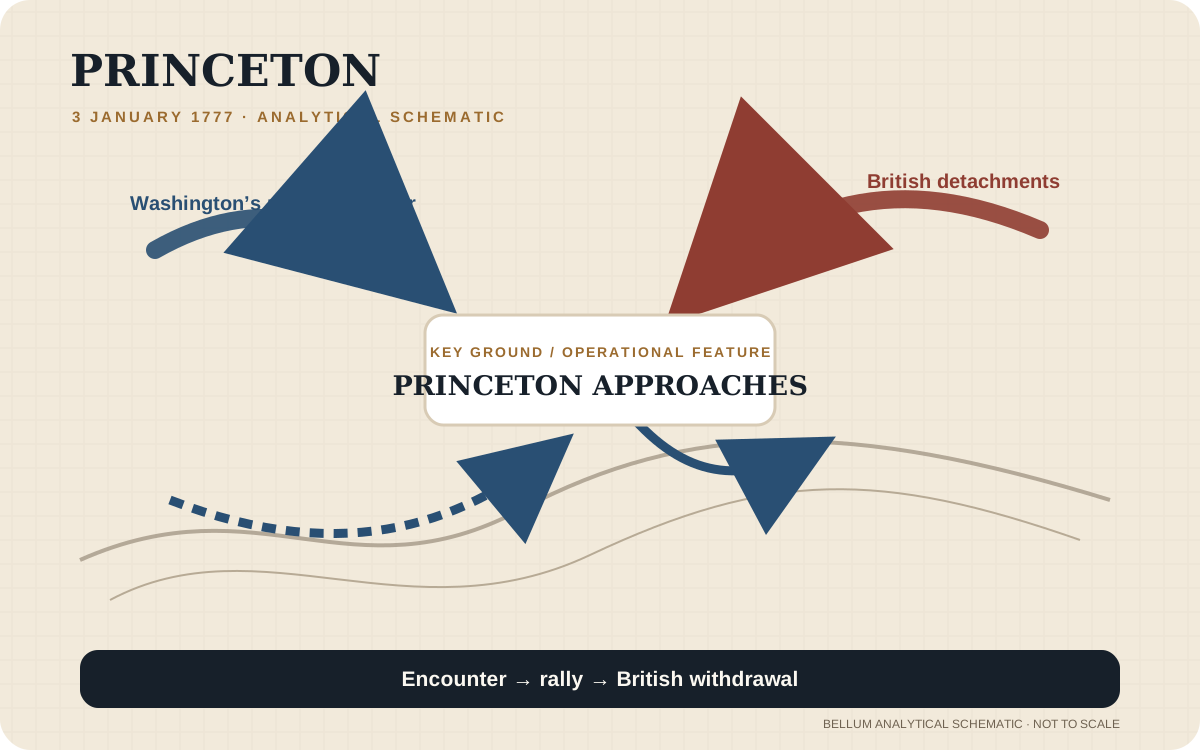
Princeton maneuver and rally schematic
Bellum schematic emphasizes operational movement around Cornwallis’s position followed by the encounter and rally at Princeton. Not to scale.
BellumReport Research Desk · Original 2026 analytical graphic · Bellum original graphic
Rights: Original explanatory graphic; not a surveyed map.

Washington at Princeton
Later public-domain lithograph used as historical illustration, not as literal evidence of troop placement.
Brückner / D. McLellan · 1853 · Wikimedia Commons / Library of Congress
Rights: Public domain
Visual-method rule: Bellum analytical schematics are explanatory reconstructions, not surveyed maps. Historical images retain their own source and rights notes so illustration is never presented as direct eyewitness evidence.
Operational geography
Campaign Movement Map
A proportional campaign overview using each battle record’s modern reference coordinate. It explains operational movement; it is not a surveyed reconstruction of 1776 unit positions.
- Battle of Kip’s BayBritish victory
- Battle of Fort LeeBritish victory
- Battle of Mount HollyCrown tactical success; American strategic diversion
- Second Battle of TrentonAmerican defensive success
Campaign sequence
Where This Battle Fits in Its Campaign
Then & now
Battlefield Geography — Historical Ground in the Modern Landscape
Modern reference points are kept separate from claimed 1776 troop positions. A monument, park or surviving house can orient the visitor without proving that a specific unit stood on that exact modern spot.
Princeton Battlefield State Park / Clarke House
1776 reference: core Princeton battlefield and Clarke farm
Modern reference: Princeton Battlefield State Park, 500 Mercer Rd, Princeton, NJ
NPS landmark documentation identifies the park as containing core battlefield ground and the Clarke House. Modern park boundaries do not encompass every movement of the battle.
Location confidence: HighSource-traceable command structure
Interactive Documented Order of Battle
This tree shows the documented core, not an invented complete roster. Search by formation, commander or battlefield role; expand a row to see source scope, strength basis and disposition. Omitted formations remain unresolved rather than silently classified as absent.
American
ArmyWashington’s Princeton maneuver forceCommand: George WashingtonHigh
Battlefield role: Army shifted around Cornwallis by night and advanced toward Princeton.
U.S. Army CMH — The New Jersey Campaign, 1776–1777 · High confidence
DivisionGreene’s advance divisionCommand: Nathanael GreeneHigh
Documented strength: 3,300 people (Army CMH approximate combined strength of Mercer, Cadwalader, Hitchcock and Mifflin brigades)
Battlefield role: Moved toward Princeton along the Post Road axis.
U.S. Army CMH — The New Jersey Campaign, 1776–1777 · High confidence
BrigadeMercer’s brigadeCommand: Hugh MercerHigh
Battlefield role: Advance element that encountered Mawhood’s British column.
U.S. Army CMH — The New Jersey Campaign, 1776–1777 · High confidence
BrigadeCadwalader’s brigadeCommand: John CadwaladerHigh
Battlefield role: Reinforced the hard-pressed American line after Mercer’s clash.
U.S. Army CMH — The New Jersey Campaign, 1776–1777 · High confidence
BrigadeDaniel Hitchcock’s brigadeCommand: Daniel HitchcockHigh
Battlefield role: Reinforced the battle around the Princeton fields.
U.S. Army CMH — The New Jersey Campaign, 1776–1777 · High confidence
BrigadeSt. Clair’s New England brigadeCommand: Arthur St. ClairHigh
Documented strength: 1,400 people (Army CMH approximate strength with Sullivan’s column)
Battlefield role: Advanced by the Saw Mill Road route.
U.S. Army CMH — The New Jersey Campaign, 1776–1777 · High confidence
Crown
CommandMawhood’s British detachmentCommand: Charles MawhoodHigh
Battlefield role: British troops moving from Princeton toward Cornwallis collided with Mercer’s advance.
U.S. Army CMH — The New Jersey Campaign, 1776–1777 · High confidence
Regiment17th Regiment of FootCommand: Charles MawhoodHigh
Battlefield role: Main British regiment in the field fighting against Mercer and Washington’s reinforcements.
U.S. Army CMH — The New Jersey Campaign, 1776–1777 · High confidence
Regiment55th Regiment of FootHigh
Battlefield role: Elements engaged around Princeton and Mercer Heights.
U.S. Army CMH — The New Jersey Campaign, 1776–1777 · High confidence
Cavalry16th Light DragoonsHigh
Battlefield role: Mounted detachment present in the battlefield area.
U.S. Army CMH — The New Jersey Campaign, 1776–1777 · High confidence
Regiment40th Regiment of FootHigh
Battlefield role: Elements remained in Princeton and were involved as the American attack reached the town.
U.S. Army CMH — The New Jersey Campaign, 1776–1777 · High confidence
Read behind the narrative
Primary Source Room
Primary evidence is powerful but not self-interpreting. Each item is paired with why it matters and what it cannot establish by itself.
Plan of the operations of General Washington against the King’s troops in New Jersey, 26 December 1776–3 January 1777
Why it matters: Places Princeton inside the same operational map as Trenton, making the campaign-level maneuver visible rather than treating the battle as an isolated event.
Read with caution: The map is strongest for operational relationships; detailed battlefield deployment requires additional tactical evidence.
Objectives Before the Battle
American objective
Washington sought to preserve the initiative gained at Trenton by maneuvering against a separate British force near Princeton.
British / Crown objective
British forces in the area needed to block the American advance and protect the New Jersey line while the main Crown army responded.
Princeton as the Culmination of the Ten Crucial Days
The Battle of Princeton was fought on January 3, 1777, at the end of the sequence commonly called the Ten Crucial Days. Washington’s army had already won at Trenton and maneuvered away from the main British force before striking near Princeton. NPS emphasizes that the victory helped rekindle support for independence, improve morale and encourage recruitment.
Princeton therefore makes most sense as the culmination of a rapid operational sequence. Washington moved from retreat across New Jersey to a surprise at Trenton, survived the British response, slipped away from the stronger force near Trenton and struck another target. The battlefield action was the final expression of that shift from defensive survival to temporary offensive initiative.
Evidence basis: NPS — Experiencing the Story of the Battle of Princeton
Why Maneuver Before the Battle Was as Important as the Fight
The Princeton operation followed Washington’s ability to disengage from the British position around Trenton and move toward Princeton. That maneuver changed the geometry of the campaign: instead of accepting battle where the British expected him, Washington created a new threat against a separate force.
The movement before the battle is therefore as important as the exchange of fire itself. By leaving campfires and slipping away during the night, the Americans sought to avoid Cornwallis’s main body and attack the British rear area around Princeton. The operation illustrates how maneuver can create a favorable local fight even when the enemy retains greater overall strength.
Evidence basis: U.S. Army CMH — Revolutionary War Campaigns
Washington’s Personal Role in Rallying the Troops
NPS highlights Washington leading the charge and rallying troops during the Battle of Princeton. The episode is important because command operated at the immediate battlefield level, not only through distant strategic planning.
When American troops came under pressure and formations wavered, Washington’s personal presence helped restore momentum at a critical point. That does not mean one dramatic moment explains the entire victory; the result also depended on prior maneuver, subordinate commanders and the ability of Continental units to re-form and continue the attack. The rally is best understood as one decisive leadership episode inside a larger tactical sequence.
Evidence basis: NPS — Experiencing the Story of the Battle of Princeton
Why Princeton Mattered Beyond the Battlefield
NPS links the victories of the Ten Crucial Days with renewed support for American independence, improved morale and increased recruitment in the following spring. Princeton therefore mattered as part of a sequence that altered perceptions of the Continental Army’s prospects after the disasters of 1776.
Those effects unfolded after the battle rather than during it. The immediate result was a local American victory and a British withdrawal from the area; the broader consequence was a change in confidence and operational posture across New Jersey. Separating those levels keeps the analysis from attributing every later political or military development to a few hours of combat.
Evidence basis: NPS — Experiencing the Story of the Battle of Princeton
Battlefield Preservation and Modern Interpretation
The Princeton battlefield remains an interpreted historic landscape. NPS has supported projects designed to present multiple perspectives and improve visitor understanding through modern interpretation, including digital tools. Preservation matters because the terrain gives physical context to a battle that otherwise risks becoming an abstract sequence of names and dates.
Modern interpretation also has limits. Roads have changed, structures have appeared or disappeared, and preserved parcels do not automatically mark every location involved in the 1777 action. Visitor-oriented mapping should therefore distinguish the protected battlefield landscape from reconstructed troop movements and from later monuments or commemorative features.
Evidence basis: NPS — Experiencing the Story of the Battle of Princeton
From Mercer’s Clash to Washington’s Rally
The best-known moment at Princeton—Washington riding forward to steady troops under pressure—only makes sense when placed after the opening collision. During the American march toward Princeton, Brigadier General Hugh Mercer’s detachment encountered British regulars under Lieutenant Colonel Charles Mawhood. The fight quickly became severe. Mercer was badly wounded, his men fell back, and the American advance risked losing momentum before Washington’s larger force could exploit the maneuver that had carried it around Cornwallis.
Washington arrived into that unstable situation rather than onto a battlefield already moving in his favor. His personal presence helped rally wavering troops and restore the attack. The British force then withdrew in different directions: some attempted to return toward Cornwallis, while other troops fell back toward Princeton. The battle consequently unfolded as connected actions rather than one neat line-versus-line engagement. Understanding that sequence clarifies why Mercer’s experience, Washington’s rally and the later fighting around Princeton belong in the same tactical story. It also prevents the dramatic image of the commander-in-chief at the front from obscuring the earlier combat that created the crisis he had to reverse.
Evidence basis: NPS — Experiencing the Story of the Battle of Princeton
The Princeton Victory Was Created During the Night Before the Battle
Princeton cannot be understood by beginning at the first musket shot on January 3. On the previous day Cornwallis had driven toward Washington’s position at Trenton. U.S. Army campaign history describes the Americans behind Assunpink Creek in a precarious position with the Delaware behind them. Rather than wait for a stronger British attack the next morning, Washington chose to move around Cornwallis during the night.
The maneuver required concealment and timing. Campfires were left burning while the army slipped away on a side road, turning a defensive crisis into an offensive movement toward Princeton. This changed the geometry of the campaign. Cornwallis expected Washington to remain in front of him; instead the Continental Army moved against British detachments and communications farther north.
This is why Princeton is a strong case for separating tactical and operational analysis. The battlefield victory mattered, but the opportunity for that victory was created before dawn by refusing the battle Cornwallis expected. Washington did not simply fight better at Princeton. He changed the location and terms of the next engagement. The night march is therefore the first phase of the Princeton story, not background that can be skipped.
Evidence basis: U.S. Army CMH — Revolutionary War Campaigns
Mawhood and Mercer Collided Before Washington Could Control the Fight
As the Americans approached Princeton, British troops under Lieutenant Colonel Charles Mawhood encountered a detachment led by Brigadier General Hugh Mercer. The contact disrupted any possibility of a perfectly choreographed American advance. Mercer’s men were hit hard, Mercer was badly wounded, and troops began to give ground. The battle had produced an immediate local crisis before Washington arrived at the decisive point.
That opening action shows why surprise at the operational level does not guarantee tactical ease. Washington had maneuvered around Cornwallis, but British units near Princeton were still capable of fighting aggressively when they met the American column. The Americans had to recover from the setback in real time. NPS interpretation emphasizes Washington’s personal rallying of troops, but that dramatic moment was necessary because Mercer’s initial fight had gone badly.
A useful tactical visualization should therefore show two transitions: first, the unexpected collision and American recoil; second, the arrival of reinforcements and restoration of the attack. Combining both phases prevents the battle from becoming a simple legend in which Washington rides onto a field already waiting to be won.
Evidence basis: NPS — Experiencing the Story of the Battle of Princeton
The Route to Morristown Converted Victory into a New Strategic Position
After the fighting Washington did not remain at Princeton indefinitely. Army campaign history describes the Continental force moving toward Morristown, where wooded hills offered protection while placing the Americans on the flank of British communications. The British consequently contracted their New Jersey positions toward New Brunswick and the east.
That movement gives Princeton significance beyond the prisoners and casualties of January 3. A tactical victory is strategically useful when it changes what the enemy must do afterward. Washington’s army had begun the Ten Crucial Days in a defensive crisis on the Pennsylvania side of the Delaware. It ended the sequence in a position from which it could threaten British movement and survive the winter with renewed confidence.
The contrast with November is sharp. After Fort Washington and Fort Lee, American movement had been forced by British pressure. After Princeton, movement toward Morristown followed an American-initiated sequence at Trenton, Assunpink Creek and Princeton. The Continental Army had not destroyed Howe’s forces or recovered New York, but it had recovered operational choice. That change is the strongest reason Princeton matters in the larger campaign.
Evidence basis: U.S. Army CMH — Revolutionary War Campaigns
Princeton’s Battlefield Story Includes Mercer, Nassau Hall and a Preserved Landscape
The memory of Princeton is spread across several physical and cultural landmarks rather than one monument. NPS interpretation centers the battlefield where Washington rallied troops and where Hugh Mercer was mortally wounded. The wider historical landscape also includes Nassau Hall in Princeton, associated with British troops and the final stages of the action, as well as roads and ground tied to the American approach and subsequent movement.
This dispersed geography is useful for interpretation because it resists reducing the battle to a single heroic image. Mercer’s fall represents the crisis of the opening fight; Washington’s rally represents command intervention; the movement toward Princeton shows how the action extended beyond one field; and the preserved battlefield allows visitors to study terrain that is still legible.
NPS has supported interpretation that deliberately includes multiple perspectives and modern digital tools. That approach fits the purpose of a battle database: connect tactical movement to people, places and evidence without pretending every remembered scene is equally well documented. Historical paintings can help readers visualize memory, but they are labeled as later artistic representations. The tactical schematic serves a different role by explaining movement and uncertainty rather than recreating a literal eyewitness view.
Evidence basis: NPS — Experiencing the Story of the Battle of Princeton
Nassau Hall Marks the Battle’s Extension into Princeton
The fighting did not end at the exact point where Washington rallied the American line. As British troops withdrew, part of the action extended toward Princeton itself. Nassau Hall—then the principal building of the College of New Jersey—became associated with British resistance and surrender during the closing stage. NPS and New Jersey historical interpretation preserve the building as part of the wider Revolutionary landscape.
Including Nassau Hall matters because it prevents the battlefield from being imagined as a single isolated meadow. Princeton was a movement battle tied to roads, detachments, the town and the larger route north. Troops defeated near the initial clash did not all disappear in the same direction; some moved toward Cornwallis, others toward Princeton, and American forces followed different parts of that retreat. The action therefore widened geographically as it progressed.
For modern interpretation, this creates an opportunity to connect preserved open battlefield with an eighteenth-century building that survived inside a later university landscape. The two places represent different phases of the same engagement. A visitor who sees only the field misses the closing movement toward town; a visitor who sees only Nassau Hall misses the tactical crisis and rally that made the later surrender possible.
Evidence basis: NPS — Experiencing the Story of the Battle of Princeton
Battlefield Analysis
Terrain
The battle unfolded across farmland and roads southwest of Princeton, with movement shaped by the approaches toward the town.
Intelligence
Washington’s maneuver around the main British force at Trenton created an operational surprise by shifting the threat toward Princeton.
Turning point
Washington’s personal rallying of American troops helped stabilize the fight and drive the engagement toward an American victory.
Battle Timeline & Tactical Phases
- 1
Night, January 2–3
American maneuver away from Trenton
Washington maneuvered away from the main British force near Trenton and moved toward Princeton.
Location: Trenton–Princeton corridor
Evidence confidence: Medium - 2
Morning, January 3
Battle develops southwest of Princeton
American and British forces engaged near Princeton as the Continental Army’s movement brought it into contact with British troops.
Location: Southwest of Princeton
Evidence confidence: Medium - 3
During the battle
Washington rallies the American line
Washington personally rallied troops as the engagement turned toward an American victory.
Location: Princeton battlefield
Evidence confidence: High
Bellum Decision Explorer
This section evaluates decisions using information and constraints available at the time, not simply whether the eventual outcome was good or bad.
Maneuver toward Princeton instead of accepting the expected fight near Trenton
Situation: After renewed fighting around Trenton, Washington faced the prospect of a stronger British force closing on his position.
What was known: The main British force was concentrated near Trenton while separate troops and communications remained vulnerable toward Princeton.
Alternatives: Remain and fight near Trenton; retreat back across the Delaware; maneuver around the British and strike toward Princeton.
Constraints: Exhausted troops, winter movement, need for secrecy and speed, risk of interception.
Decision: Washington maneuvered away from the expected battlefield and moved toward Princeton.
Outcome: The maneuver produced another American battlefield victory and extended the strategic effect of Trenton.
Hindsight guardrail: The decision is assessed as an operational maneuver that changed where the next battle occurred, not merely as a tactical choice inside Princeton.
Claim-by-claim provenance
Source Agreement Matrix
This view separates broad source agreement from genuine disagreement. A conflict flag means the stored sources make materially different statements; it does not mean one source is automatically wrong.
1 independent source record in the ledger.
1 independent source record in the ledger.
Evidence Ledger & Source Trail
The Battle of Princeton was fought January 3, 1777 and was an American victory during the Ten Crucial Days.
NPS — Experiencing the Story of the Battle of Princeton · Article introduction
Trenton and Princeton revived hopes that the war could be won and were followed by the winter encampment at Morristown.
NPS — Timeline of the Revolution · December 1776 to January 1777
Frequently Asked Questions
When was the Battle of Princeton?
The battle was fought on January 3, 1777.
Source basis: NPS — Experiencing the Story of the Battle of Princeton
Who won the Battle of Princeton?
Washington’s army defeated British troops near Princeton.
Source basis: NPS — Timeline of the Revolution
What were the Ten Crucial Days?
The term refers to the rapid sequence from the Delaware crossing and Trenton through the operations ending at Princeton between December 25, 1776 and January 3, 1777.
Source basis: NPS — Experiencing the Story of the Battle of Princeton
Why was Princeton important?
NPS emphasizes that the victory, together with Trenton, rekindled support for independence, improved morale and encouraged recruitment.
Source basis: NPS — Experiencing the Story of the Battle of Princeton
Did George Washington personally lead troops at Princeton?
NPS describes Washington leading the charge and rallying troops during the battle.
Source basis: NPS — Experiencing the Story of the Battle of Princeton
What happened to General Hugh Mercer at Princeton?
Mercer was badly wounded during the fighting after his troops encountered British forces near Princeton. His fall became one of the battle’s best-known episodes and was later depicted in John Trumbull’s painting of the engagement.
Source basis: NPS — Experiencing the Story of the Battle of Princeton