American Revolutionary War · Evidence-led battle guide
Battle of Fort Washington
The fall of Fort Washington was one of the most damaging American defeats of the 1776 New York campaign.
Quick answer
What happened at Battle of Fort Washington?
British and Hessian forces overwhelmed the fort’s outer defenses and compelled the garrison to surrender.
Why it mattered
The loss eliminated the principal remaining American strongpoint on Manhattan and resulted in thousands of prisoners, worsening the Continental Army’s crisis before the retreat across New Jersey.
Visual evidence + analytical reconstruction
See the Battlefield, Not Just the Summary
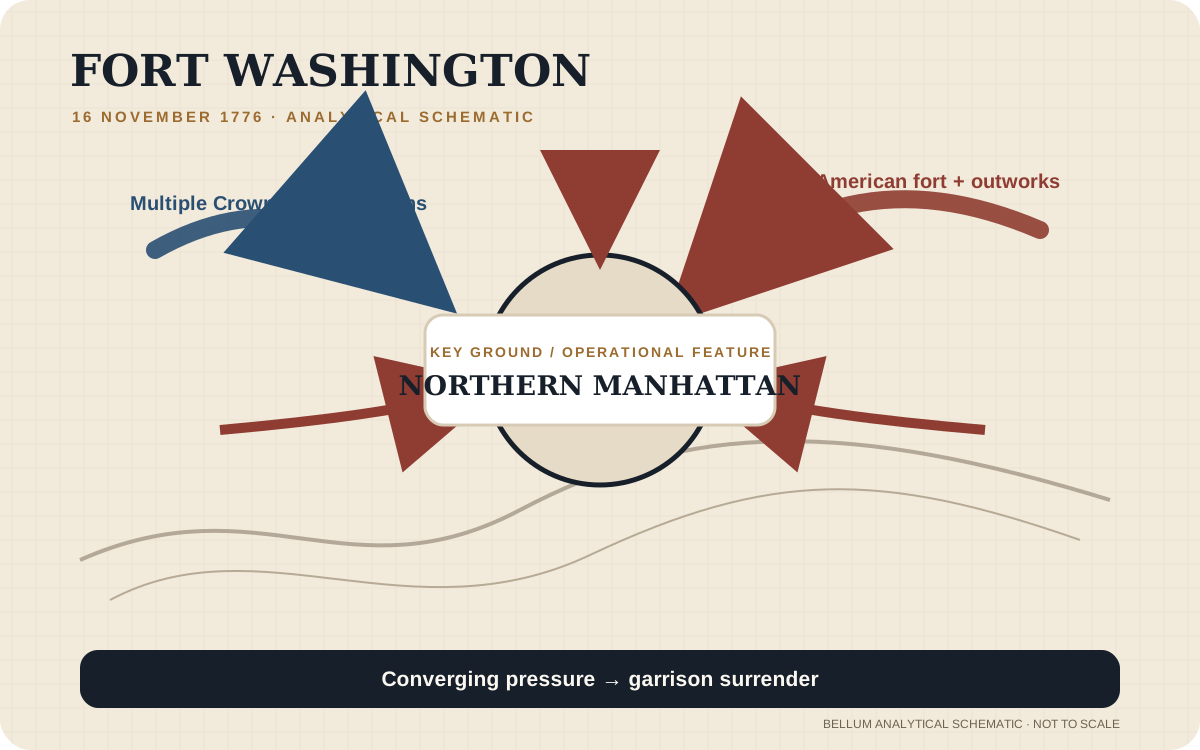
Fort Washington converging assault schematic
Bellum schematic visualizes the multi-directional pressure on the fort and outworks, ending with the garrison’s surrender. Not to scale.
BellumReport Research Desk · Original 2026 analytical graphic · Bellum original graphic
Rights: Original explanatory graphic; not a surveyed map.

View of the attack against Fort Washington
A contemporary British officer’s view showing the fort, redoubts, artillery fire, river and surrounding heights.
Thomas Davies · 1776 · Wikimedia Commons
Rights: Public domain / historic work
Visual-method rule: Bellum analytical schematics are explanatory reconstructions, not surveyed maps. Historical images retain their own source and rights notes so illustration is never presented as direct eyewitness evidence.
Operational geography
Campaign Movement Map
A proportional campaign overview using each battle record’s modern reference coordinate. It explains operational movement; it is not a surveyed reconstruction of 1776 unit positions.
- Battle of Kip’s BayBritish victory
- Battle of Fort LeeBritish victory
- Battle of Mount HollyCrown tactical success; American strategic diversion
- Second Battle of TrentonAmerican defensive success
Campaign sequence
Where This Battle Fits in Its Campaign
Then & now
Battlefield Geography — Historical Ground in the Modern Landscape
Modern reference points are kept separate from claimed 1776 troop positions. A monument, park or surviving house can orient the visitor without proving that a specific unit stood on that exact modern spot.
Fort Washington / Washington Heights
1776 reference: Fort Washington defensive complex
Modern reference: Bennett Park, Washington Heights, New York, NY
Modern reference to the fort area; the 1776 defensive system extended far beyond the surviving commemorative landscape.
Location confidence: MediumSource-traceable command structure
Interactive Documented Order of Battle
This tree shows the documented core, not an invented complete roster. Search by formation, commander or battlefield role; expand a row to see source scope, strength basis and disposition. Omitted formations remain unresolved rather than silently classified as absent.
American
CommandFort Washington garrisonCommand: Robert MagawHigh
Documented strength: 2,800 people (Army CMH approximately 2,800 in garrison before the assault)
Battlefield role: Overall defense of Fort Washington and its outworks.
U.S. Army CMH — The New York Campaign, 1776 · High confidence
RegimentMaryland and Virginia Rifle RegimentCommand: Moses RawlingsHigh
Battlefield role: Defended northern approaches with riflemen and three artillery pieces.
U.S. Army CMH — The New York Campaign, 1776 · High confidence
CommandSouthern Harlem Heights defenseCommand: Lambert CadwaladerHigh
Battlefield role: Held southern approaches and outworks.
U.S. Army CMH — The New York Campaign, 1776 · High confidence
Crown
ArmyCrown assault forceCommand: William HoweHigh
Documented strength: 13,000 people (Army CMH approximate massed assault force)
Battlefield role: Converging attack designed to collapse the isolated American garrison.
U.S. Army CMH — The New York Campaign, 1776 · High confidence
CommandKnyphausen’s northern attackCommand: Wilhelm von KnyphausenHigh
Battlefield role: Hessian attack from the north.
U.S. Army CMH — The New York Campaign, 1776 · High confidence
BrigadeRall-led Hessian elementsCommand: Johann RallHigh
Battlefield role: Participated in the northern attack through difficult ground.
U.S. Army CMH — The New York Campaign, 1776 · High confidence
BrigadeBritish Light Infantry BrigadeCommand: Edward MathewHigh
Battlefield role: Attacked from the east with Guards support.
U.S. Army CMH — The New York Campaign, 1776 · High confidence
BrigadeBrigade of GuardsHigh
Battlefield role: Part of the eastern assault.
U.S. Army CMH — The New York Campaign, 1776 · High confidence
Regiment42nd Regiment of FootCommand: Thomas StirlingHigh
Battlefield role: Crossed the Harlem River and struck American defenses from the east/southeast.
U.S. Army CMH — The New York Campaign, 1776 · High confidence
Read behind the narrative
Primary Source Room
Primary evidence is powerful but not self-interpreting. Each item is paired with why it matters and what it cannot establish by itself.
Manuscript map of British and American troop positions in the New York area
Creator: Unknown/period manuscript cartographer
Why it matters: Shows the larger defensive geography of northern Manhattan and adjacent areas in which Fort Washington operated.
Read with caution: Dating and exact troop-position precision must be assessed from the item record; it should not be treated as a survey-grade modern map.
Objectives Before the Battle
American objective
The American garrison sought to retain the fortified Manhattan position and contest British control along the Hudson.
British / Crown objective
Crown forces sought to eliminate the remaining fortified American position on Manhattan and capture its garrison.
Why Fort Washington Became a High-Risk Position
Fort Washington was one of the principal remaining American strongpoints on Manhattan after the campaign had shifted north. Holding it promised continued resistance along the Hudson corridor, but the position also exposed a substantial garrison to concentrated British and Hessian attack. On November 16, 1776, Crown forces overwhelmed the defenses and compelled the garrison to surrender.
The strategic danger came from the relationship between the fort and the wider campaign. A fortified position can be valuable while friendly forces can support it, reinforce it or use it as part of a larger defensive system. Once the surrounding situation deteriorates, the same fort can become a trap for the troops assigned to hold it.
Evidence basis: American Battlefield Trust — Fort Washington
The Multi-Directional Pressure on the Defenses
The Fort Washington battle was not a single frontal clash at one wall. Crown forces attacked the defensive system from multiple directions, compressing American positions toward the fort. The decisive result was the surrender of the garrison rather than an orderly withdrawal like those seen elsewhere in the campaign.
That difference changed the cost of defeat. Captured soldiers were removed from the Continental Army, weapons and stores were lost, and the Hudson position became untenable. A surrender therefore needs to be analyzed separately from ordinary battlefield casualties, because thousands of prisoners can matter strategically even when relatively few men are killed during the fighting itself.
Evidence basis: American Battlefield Trust — Fort Washington
Why the Force Comparison Matters
American Battlefield Trust lists roughly 3,000 American troops against about 8,000 British and Hessian forces engaged. Those figures help show the scale of pressure on the position, but they do not by themselves explain why the garrison remained exposed after the rest of Washington’s army had shifted away.
The deeper question is operational: what value did the fort still provide, what routes of withdrawal remained, and how quickly could Crown forces isolate the position? A complete analysis therefore has to pair the battle-day force comparison with the earlier decision to continue holding Fort Washington.
Evidence basis: American Battlefield Trust — Fort Washington
Why the Loss Was Worse Than Another Retreat
The fall of Fort Washington cost the Americans more than ground. A large garrison went into captivity, eliminating trained manpower at a moment when Washington’s army was already under severe pressure. That made the defeat qualitatively different from Brooklyn, where the main army escaped, or Pell’s Point, where a delaying force withdrew after completing its task.
The loss also reduced American control of the Hudson corridor around northern Manhattan and increased pressure on Fort Lee across the river. The campaign therefore moved quickly from a fortress defeat to a wider retreat, showing how the fate of one strongpoint could accelerate the collapse of an entire defensive position.
Evidence basis: American Battlefield Trust — Fort Washington
From Fort Washington to the Retreat Across New Jersey
Four days after Fort Washington, Fort Lee was abandoned as British pressure crossed the Hudson. The campaign then became a retreat across New Jersey. This sequence is essential for understanding why Trenton later had such an outsized effect on morale.
By late November and December, Washington’s army had moved from defending New York to trying to preserve itself while crossing New Jersey. Fort Washington sits at the hinge of that change: after its fall, there was no realistic return to the earlier Manhattan defensive system. The next phase of the war would be defined by retreat, enlistment problems and the search for an opportunity to strike back.
Evidence basis: NPS Cowpens — Revolutionary War Timeline
Command Responsibility: The Battle Before the Battle
Fort Washington was lost on November 16, but the decisive command problem developed before the assault began. A fortified position only remains useful while its garrison can be supported, supplied, reinforced or withdrawn. By mid-November the main Continental Army had shifted away from Manhattan, leaving Colonel Robert Magaw’s garrison increasingly exposed to a concentrated Crown attack. The issue was therefore not simply whether the fort could resist a frontal assault. It was whether retaining the post still justified the risk of losing the troops assigned to it.
That distinction matters when judging responsibility. Magaw commanded the garrison during the final battle, but the decision to keep thousands of men in the position belonged to the wider American command problem. Once Howe could attack the outer defenses from several directions, tactical courage could not repair the operational isolation of the post. The surrender was therefore the final stage of a chain of decisions: hold the Hudson position, retain the garrison after the wider withdrawal, accept the danger of encirclement, and then fight after the Crown forces had assembled overwhelming pressure. Fort Washington is best understood as a case where an operational decision created a battlefield problem that individual defenders could not solve by bravery alone.
Evidence basis: American Battlefield Trust — Fort Washington
Fort Washington Made Sense Only as Part of a Wider Hudson Defense
Fort Washington was not designed to exist as an isolated island of resistance. Its value came from a wider defensive concept along the Hudson, including the relationship with Fort Lee on the New Jersey side and the hope of contesting British use of the river. As the 1776 campaign moved north and the Continental field army shifted away from Manhattan, that system lost coherence. The fort remained strong ground, but the strategic environment around it had changed.
This is the central reason static fortifications can become deceptive. Walls, redoubts and high ground are visible measures of strength; support routes and operational freedom are less visible but equally important. A garrison can be well protected from one direction and still be in grave danger if the enemy can approach from several others while the field army cannot relieve it.
By mid-November Howe could concentrate a much larger Crown force against the position. The question was no longer whether Fort Washington had military value in theory. It was whether that value exceeded the risk of losing the garrison. The later surrender showed the cost of allowing a defensive asset to remain in place after its connection to the wider campaign had weakened.
Evidence basis: American Battlefield Trust — Fort Washington
The Assault Compressed the Defenders from Several Directions
The Crown attack worked by making the American outer defenses solve several problems at once. American Battlefield Trust describes Hugh Percy pressing from the south while Edward Mathew and Charles Cornwallis attacked from the eastern approaches; Hessian forces under Wilhelm von Knyphausen drove against the northern defenses. These movements did not need to arrive at precisely the same second to create the decisive effect. Their combined pressure reduced the garrison’s ability to shift reserves safely from one threatened sector to another.
Outer defensive lines are meant to keep an attacker away from the central fort and force him to pay for each approach. Once several of those lines begin to fail, however, retreating defenders can be compressed into a smaller area. Commanders lose space to maneuver, artillery positions become harder to sustain, and men from different sectors can arrive inside the fort faster than the command structure can reorganize them.
That is why the page’s schematic emphasizes converging arrows rather than one dramatic breach. Fort Washington fell because the defensive system was progressively reduced until Magaw no longer had a credible path to restore the perimeter or withdraw the garrison. The final surrender was the consequence of that compression.
Evidence basis: American Battlefield Trust — Fort Washington
The Prisoners Made Fort Washington a Strategic Manpower Disaster
The cost of Fort Washington cannot be understood by looking only at killed and wounded. The surrender placed thousands of American soldiers in British hands. In a war where the Continental Army struggled continuously with enlistments, trained manpower and unit continuity, the removal of an entire garrison had effects far beyond one day’s casualty list.
Prisoners are strategically different from wounded soldiers who may return to duty or troops who escape from a lost position. Captured men disappear from the field army immediately, often along with weapons, equipment and organizational experience. Their units may have to be rebuilt rather than merely replenished. The psychological effect can also exceed the numerical loss because surrender creates a visible symbol of vulnerability just as an enemy advance is continuing.
This is why Fort Washington belongs among the most damaging episodes of the New York campaign even though other battles involved larger armies. Brooklyn was a major defeat, but Washington extracted the main army. White Plains cost ground, but the force withdrew. At Fort Washington, the operational choice to hold the post ended with a mass surrender. The type of loss, not just the number of shots fired, made the battle strategically severe.
Evidence basis: American Battlefield Trust — Fort Washington
Fort Washington and Fort Lee Form One Chain of Consequences
The fall of Fort Washington was followed within days by the abandonment of Fort Lee across the Hudson. NPS timeline material places Fort Washington on November 16 and Fort Lee on November 20. Seen together, those events mark the collapse of the remaining American effort to hold the immediate New York–Hudson position and the beginning of the long retreat across New Jersey.
The sequence is important for understanding momentum. Armies do not experience battles as isolated encyclopedia entries. Loss of one position can expose another, force hurried movement, disrupt supply planning and alter what commanders believe the enemy will attempt next. After Fort Washington, the Americans could not treat Fort Lee as though nothing had changed. The British had demonstrated their ability to concentrate against fixed defenses and now held the initiative.
The retreat that followed drove Washington’s shrinking army toward the Delaware and created the crisis from which the Trenton operation emerged. Fort Washington therefore connects directly to the later American recovery. The December counterstroke makes more sense when readers first understand how much territory, matériel, manpower and confidence had been lost in November.
Evidence basis: NPS Cowpens — Revolutionary War Timeline
Why Magaw’s Final Surrender Was Different from an Earlier Withdrawal Decision
Once the outer defensive system had collapsed and Crown troops had compressed the garrison toward Fort Washington, Colonel Robert Magaw faced a battlefield decision very different from the earlier strategic question of whether the post should have been evacuated. By the final stage of the assault, the opportunity for an orderly withdrawal had largely disappeared. The fort was surrounded by superior forces, defensive space had contracted and thousands of men were concentrated inside a position that could not restore its broken perimeter.
Surrender in that situation ended immediate resistance but also created the battle’s defining American loss: mass capture. That outcome is why responsibility must be separated by decision stage. The choice to keep the garrison in the fort before November 16 determined the risk exposure. Magaw’s surrender after the lines collapsed determined how the final tactical crisis ended. Treating both as one decision obscures the difference between creating an operational trap and responding after the trap has closed.
The distinction also helps compare Fort Washington with Brooklyn. At Brooklyn Heights Washington still possessed boats, darkness and a viable route across the East River. At Fort Washington the garrison had no equivalent escape mechanism once the outer works were lost. The two defeats therefore produced radically different manpower consequences.
Evidence basis: American Battlefield Trust — Fort Washington
Forces & Casualties — Evidence, Not False Precision
The charts only compare figures that share a source and measurement definition. Other source-defined figures remain in the evidence table.
| Metric | Side | Value | Definition / basis | Source | Confidence |
|---|---|---|---|---|---|
| Forces Engaged | American | 3,000 | American Battlefield Trust battle facts | American Battlefield Trust — Fort Washington | Medium |
| Forces Engaged | British/Hessian | 8,000 | American Battlefield Trust battle facts | American Battlefield Trust — Fort Washington | Medium |
Battlefield Analysis
Terrain
The defensive system occupied high ground in northern Manhattan but depended on outer lines that could be attacked from multiple directions.
Intelligence
The key strategic issue was whether the isolated garrison could be supported or withdrawn before concentrated Crown forces closed on the position.
Turning point
Multi-directional attacks compressed the American defenses until the garrison could no longer maintain the outer positions and surrendered.
Battle Timeline & Tactical Phases
- 1
November 16
Crown forces close on the fortified position
British and Hessian forces advanced against the outer American defenses from multiple directions.
Location: Northern Manhattan defensive perimeter
Evidence confidence: Medium - 2
During the assault
Outer defenses collapse inward
American positions were compressed toward Fort Washington as Crown troops broke through the surrounding defensive lines.
Location: Approaches to Fort Washington
Evidence confidence: Medium - 3
Later November 16
Garrison surrender
With the defensive system overwhelmed, the American commander surrendered the fort and its garrison.
Location: Fort Washington
Evidence confidence: High
Bellum Decision Explorer
This section evaluates decisions using information and constraints available at the time, not simply whether the eventual outcome was good or bad.
The decision to continue holding Fort Washington
Situation: Fort Washington remained occupied after the campaign had shifted away from lower Manhattan and the main army’s position had become more precarious.
What was known: The fort still offered strategic value, but concentrated Crown forces could isolate and assault the position.
Alternatives: Evacuate the garrison earlier; reduce the position; continue holding the fort.
Constraints: Desire to contest the Hudson, confidence in defenses, uncertainty over British intentions and the cost of abandoning a fortified post.
Decision: The position continued to be held until Crown forces assaulted it on November 16.
Outcome: The fort fell and a large American garrison was captured, magnifying the strategic cost of the defeat.
Hindsight guardrail: A full judgment requires deeper primary-source research into who recommended holding or abandoning the post; this record therefore remains medium confidence.
Claim-by-claim provenance
Source Agreement Matrix
This view separates broad source agreement from genuine disagreement. A conflict flag means the stored sources make materially different statements; it does not mean one source is automatically wrong.
1 independent source record in the ledger.
Evidence Ledger & Source Trail
Fort Washington fell to British and Hessian forces on November 16, 1776.
American Battlefield Trust — Fort Washington · Battle facts
Frequently Asked Questions
When was the Battle of Fort Washington?
The fort fell on November 16, 1776.
Source basis: NPS Cowpens — Revolutionary War Timeline
Who won the Battle of Fort Washington?
British and Hessian forces won and the American garrison surrendered.
Source basis: American Battlefield Trust — Fort Washington
How many troops fought at Fort Washington?
American Battlefield Trust lists approximately 3,000 Americans and 8,000 British and Hessian troops engaged. Those figures describe that source’s estimate and should be compared with unit-level records before being treated as a final census.
Source basis: American Battlefield Trust — Fort Washington
Why was Fort Washington a serious American defeat?
The loss included the capture of a large garrison, so the strategic cost was greater than merely abandoning ground.
Source basis: American Battlefield Trust — Fort Washington
What happened after Fort Washington?
Fort Lee was abandoned days later and Washington’s army continued its retreat across New Jersey.
Source basis: NPS Cowpens — Revolutionary War Timeline
Why did the Americans lose so many prisoners at Fort Washington?
Because the garrison was compressed into the fort and ultimately surrendered rather than escaping in an orderly retreat. Captured soldiers therefore made up a major part of the American loss, which is why prisoner totals must be separated from killed and wounded.
Source basis: American Battlefield Trust — Fort Washington