American Revolutionary War · Evidence-led battle guide
Battle of Harlem Heights
A morale-important American battlefield success fought in upper Manhattan one day after the landing at Kip’s Bay.
Quick answer
What happened at Battle of Harlem Heights?
American forces checked and drove back British light troops in fighting in upper Manhattan.
Why it mattered
The limited victory improved morale immediately after the disasters on Long Island and at Kip’s Bay but did not reverse British control of lower Manhattan.
Visual evidence + analytical reconstruction
See the Battlefield, Not Just the Summary
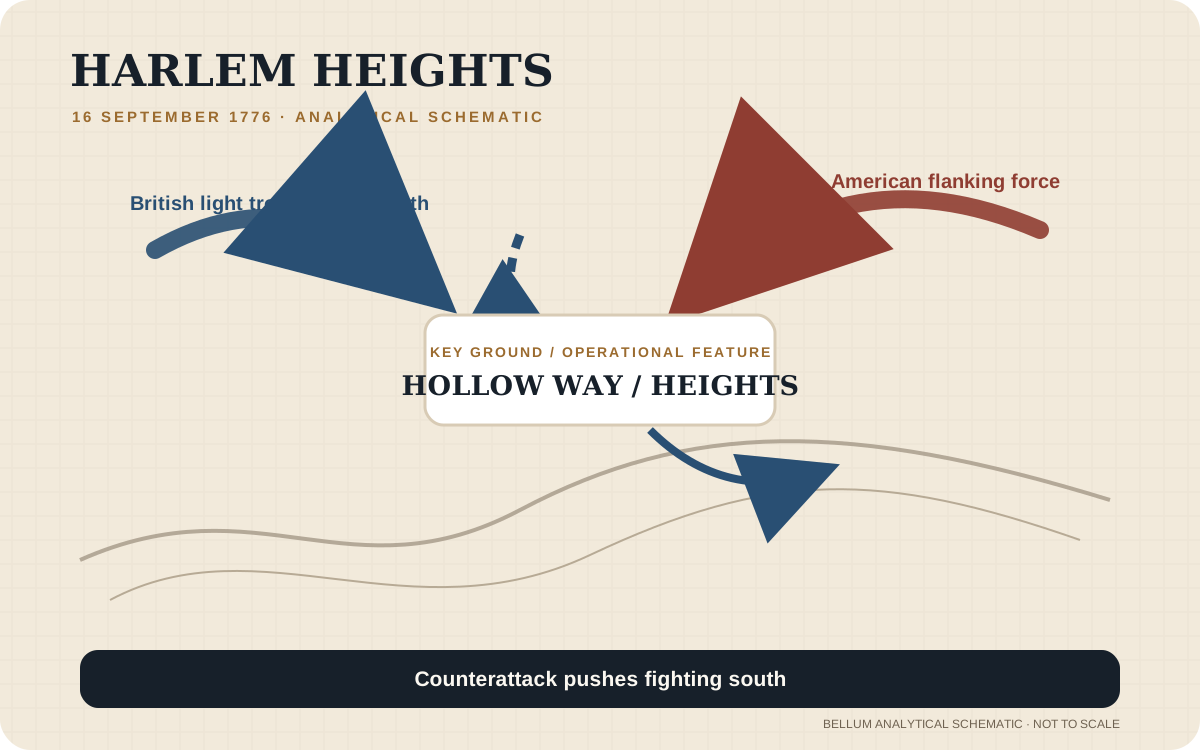
Harlem Heights counterattack schematic
Bellum schematic emphasizes the transition from reconnaissance and skirmishing to an American counterattack that pushed British light troops south. Not to scale.
BellumReport Research Desk · Original 2026 analytical graphic · Bellum original graphic
Rights: Original explanatory graphic; not a surveyed map.
.jpg)
The Battle of Harlem Heights
Rights-reviewed public-domain scan used as historical illustration with source attribution.
Historic print; scan by NYPL · historic print / public-domain scan · Wikimedia Commons / New York Public Library
Rights: Public domain
Visual-method rule: Bellum analytical schematics are explanatory reconstructions, not surveyed maps. Historical images retain their own source and rights notes so illustration is never presented as direct eyewitness evidence.
Operational geography
Campaign Movement Map
A proportional campaign overview using each battle record’s modern reference coordinate. It explains operational movement; it is not a surveyed reconstruction of 1776 unit positions.
- Battle of Kip’s BayBritish victory
- Battle of Fort LeeBritish victory
- Battle of Mount HollyCrown tactical success; American strategic diversion
- Second Battle of TrentonAmerican defensive success
Campaign sequence
Where This Battle Fits in Its Campaign
Then & now
Battlefield Geography — Historical Ground in the Modern Landscape
Modern reference points are kept separate from claimed 1776 troop positions. A monument, park or surviving house can orient the visitor without proving that a specific unit stood on that exact modern spot.
Harlem Heights battlefield landscape
1776 reference: upper Manhattan heights and Hollow Way area
Modern reference: West 120s–130s, Morningside Heights / Manhattanville, New York, NY
Modern neighborhood reference only; the battle unfolded across a broader changing landscape.
Location confidence: MediumSource-traceable command structure
Interactive Documented Order of Battle
This tree shows the documented core, not an invented complete roster. Search by formation, commander or battlefield role; expand a row to see source scope, strength basis and disposition. Omitted formations remain unresolved rather than silently classified as absent.
American
DetachmentKnowlton’s RangersCommand: Thomas KnowltonHigh
Documented strength: 150 people (Army CMH describes 150 picked soldiers)
Battlefield role: Reconnaissance force that made contact with the British and later participated in the flanking counterattack.
U.S. Army CMH — The New York Campaign, 1776 · High confidence
BrigadeNixon’s brigadeCommand: John NixonHigh
Battlefield role: Reinforced the American counterattack.
U.S. Army CMH — The New York Campaign, 1776 · High confidence
DetachmentThree companies, 3rd Virginia RegimentCommand: George WeedonHigh
Battlefield role: Joined Knowlton in the planned move against the British flank.
U.S. Army CMH — The New York Campaign, 1776 · High confidence
Crown
BrigadeLeslie’s pursuing forceCommand: Alexander LeslieHigh
Battlefield role: British light troops pursuing north from Manhattan positions.
U.S. Army CMH — The New York Campaign, 1776 · High confidence
Regiment42nd Regiment of FootHigh
Battlefield role: Part of Leslie’s force with light infantry battalions.
U.S. Army CMH — The New York Campaign, 1776 · High confidence
Read behind the narrative
Primary Source Room
Primary evidence is powerful but not self-interpreting. Each item is paired with why it matters and what it cannot establish by itself.
George Washington to John Hancock, 18 September 1776
Creator: George Washington
Why it matters: Washington’s near-contemporary account helps reconstruct the reconnaissance, counterattack and morale significance of Harlem Heights.
Read with caution: The report is written from headquarters and should be compared with British accounts and later unit-level evidence.
Objectives Before the Battle
American objective
Washington needed to hold the northern Manhattan position, rebuild confidence and prevent British probes from developing into another rout.
British / Crown objective
British light forces sought to press and test the American position after securing lower Manhattan.
Harlem Heights in the New York Campaign
The Battle of Harlem Heights was fought on September 16, 1776, after the American army had already suffered major reverses in the New York campaign. Washington’s troops occupied the northern heights of Manhattan while British forces controlled lower Manhattan. The engagement was limited compared with the scale of the broader campaign, but it mattered because it tested whether American troops could stand, maneuver and counterattack after repeated retreats.
The National Park Service describes roughly 2,000 Americans opposed by about 5,000 British troops in the action. Those figures describe the engagement, not every soldier available to either army in the New York theater. Keeping that scope clear prevents a relatively contained battle from being confused with the much larger forces operating around Manhattan.
Evidence basis: NPS — Harlem
How the Americans Reversed the Immediate Fight
NPS describes the British as being outflanked and forced south during the fighting. That tactical reversal is the core reason the engagement is remembered as an American battlefield success. The important point is not that the Americans suddenly regained strategic control of New York—they did not—but that troops who had been retreating were able to pressure British light forces and make them give ground.
The result therefore had two different scales. Tactically, the Americans won the immediate contest and ended the action with improved confidence. Strategically, the British still controlled lower Manhattan and retained the ability to shift the campaign elsewhere. Harlem Heights mattered precisely because a limited victory could improve morale without reversing the overall strategic situation.
Evidence basis: NPS — Harlem
Alexander Hamilton and the Battle Landscape
Alexander Hamilton was among the Continental troops involved at Harlem Heights. At this stage of the war he served as a young artillery captain, years before his later political career made his name far more familiar. His presence places the battle within the early military experience of several officers who would later become prominent in the Revolution and the new republic.
Hamilton’s role is most useful when kept in battlefield context. Artillery officers had to move guns, choose useful positions and support infantry in broken terrain while the engagement shifted across upper Manhattan. His participation also connects Harlem Heights to a broader service record that would include subsequent campaigning with Washington’s army.
Evidence basis: NPS — Harlem
Why a Small Battlefield Success Mattered to Morale
The value of Harlem Heights was psychological and organizational as well as tactical. The Continental Army had recently experienced defeat and withdrawal, so forcing British troops back showed that American units could still fight effectively under favorable circumstances. NPS characterizes the action as Washington’s first victory in the war.
That success should not be inflated into a strategic reversal. The British still occupied lower Manhattan, and Washington’s army remained exposed to another turning movement. Harlem Heights mattered because it interrupted a sequence of discouraging retreats and gave soldiers evidence that British troops could be checked and pushed back in a controlled engagement.
Evidence basis: NPS — Harlem
What Harlem Heights Did Not Change
Harlem Heights did not restore lower Manhattan to American control, destroy the British army, or end the threat to Washington’s position. The British remained capable of choosing new operational approaches, and the campaign soon shifted toward Westchester. The next major problem was not another direct push up Manhattan but Howe’s effort to maneuver around Washington’s position.
This limit is part of the battle’s significance. Tactical success gave the Continental Army confidence, but it did not solve the operational problem created by British naval mobility and control of New York. The sequence from Harlem Heights to Pell’s Point and White Plains shows how quickly the campaign moved from a morale-building fight to another struggle against possible encirclement.
Evidence basis: NPS — Timeline of the Revolution
Reading the Battle in Modern Manhattan
NPS places the fighting in western Harlem around the area of present-day West 125th Street and describes the British retreat south toward the area of present-day 106th Street. Those modern references help orient a visitor, but the eighteenth-century landscape contained different roads, fields, heights and property boundaries.
Modern street grids can therefore suggest where the action occurred without reproducing the battlefield precisely. A responsible reconstruction should distinguish a documented historic location from an approximate modern corridor. That is especially important in Manhattan, where later urban development has altered the visible terrain more dramatically than at many preserved rural battlefields.
Evidence basis: NPS — Harlem
Harlem Heights Began in the Shadow of Kip’s Bay
The timing of Harlem Heights is essential. The engagement came only one day after the British landing at Kip’s Bay forced another American retreat on Manhattan. Washington’s army had already absorbed the shock of Long Island, the evacuation of Brooklyn and the abandonment of lower New York. The troops gathering in the northern part of Manhattan were therefore not entering the fight from a position of confidence.
The British had also created a dangerous operational situation. Their landing on Manhattan threatened to cut American formations apart, and Washington did not have a precise picture of every British movement. NPS interpretation of the battlefield emphasizes this uncertainty: Knowlton’s reconnaissance was sent south because Washington needed to know where the British light troops actually were. That reconnaissance, not a prearranged set-piece attack, produced the first contact.
This context explains why the later counterattack carried more psychological weight than its territorial result alone would suggest. Harlem Heights did not recover New York City and did not end the British campaign. It did show troops who had been retreating that they could meet British light infantry, sustain a fight and force the immediate enemy back. The battle should therefore be read as a local tactical action embedded inside a much larger American retreat.
Evidence basis: NPS — Where the Battle of Harlem Heights Began
Knowlton’s Reconnaissance Turned Information Gathering into Combat
Lieutenant Colonel Thomas Knowlton’s Rangers were performing a reconnaissance mission when they encountered British light infantry. That detail matters because reconnaissance troops have a different purpose from a main battle line. Their job is to find the enemy, learn strength and direction, avoid being fixed unnecessarily and report information to the commander. At Harlem Heights, the scouting contact escalated when British troops pressed the withdrawing Rangers and the Americans chose to exploit the pursuit.
The engagement therefore illustrates the thin boundary between intelligence collection and combat. Knowlton’s men could not simply observe from a distance once discovered; they had to disengage under pressure. Washington, receiving information from the contact, recognized an opportunity to draw the pursuing British forward while another American force attempted to move against their flank. The plan transformed a reconnaissance clash into a larger counterstroke.
Knowlton was mortally wounded during the battle, making the success costly for the specialized unit he led. His role also connects Harlem Heights to a recurring problem in the New York campaign: Washington’s need for reliable battlefield intelligence. Poor knowledge of roads and enemy movement had contributed to the disaster on Long Island. At Harlem, reconnaissance produced information quickly enough for Washington to act on it.
Evidence basis: NPS — Where the Battle of Harlem Heights Began
Why Washington Stopped a Successful Pursuit
A victory narrative can make continued pursuit sound automatically desirable. At Harlem Heights Washington eventually faced the opposite problem: his troops were pushing the British back, but a longer advance risked carrying them toward stronger Crown forces. NPS battlefield interpretation notes that by about 3 p.m. Washington was concerned that the Americans might press too far and expose themselves to the main British body. He therefore called the troops back.
That decision is important because it separates tactical confidence from recklessness. The Americans had already achieved the battle’s most useful effects: they had resisted, counterattacked and compelled the immediate British force to give ground. Pursuing beyond the point where those gains could be secured would have risked turning a morale-building success into another damaging defeat.
The halt also reveals a change in Washington’s immediate command problem. Earlier in the battle he needed troops willing to advance after weeks of retreat. Later he needed the same troops to disengage before success created overconfidence. Good battlefield control requires both impulses. Harlem Heights was therefore not simply a story of Americans discovering aggression; it was a test of whether the army could attack and then stop on command while operating close to a larger enemy force.
Evidence basis: NPS — Harlem
Why the Modern Manhattan Landscape Can Hide the Battle
Harlem Heights is unusually difficult to imagine because the battlefield now lies inside a dense modern city. Streets, university buildings, parks, retaining walls and later construction have transformed the terrain that shaped the 1776 action. The absence of an open preserved field can make the engagement seem less geographically real than battles fought in rural landscapes.
The surviving interpretive points help restore that geography. NPS identifies locations along Riverside Drive and near Columbia University associated with the opening contact and the memory of Knowlton. Reading those points together allows a visitor to reconstruct movement north and south rather than treating a single plaque as the entire battlefield. The modern street grid should be used as a reference layer, not mistaken for the eighteenth-century landscape.
This is why the page’s visual reconstruction is deliberately schematic. Its purpose is to show the logic of reconnaissance, pursuit, attempted flanking movement, counterattack and controlled withdrawal. A precise modern map can be added only where historical positions can be supported confidently. Separating “known location,” “approximate battle zone” and “analytical movement” prevents the attractive graphic from claiming more geographical certainty than the evidence supports.
Evidence basis: NPS — Where the Battle of Harlem Heights Began
Knowlton’s Death Shows the Cost Hidden Inside the Victory
Harlem Heights produced the morale effect Washington badly needed, but the success was not cost-free. Lieutenant Colonel Thomas Knowlton was mortally wounded during the fighting, depriving the army of an officer closely associated with scouting and reconnaissance. His death matters because specialized leadership is not interchangeable with raw troop numbers. A small army struggling to understand British movements could ill afford to lose experienced officers who knew how to operate ahead of the main line.
The battle therefore contains two truths at once. American troops demonstrated that they could push British light forces back, yet one of the men most useful for gathering battlefield intelligence was lost in the process. The immediate psychological gain and the longer-term personnel cost should be shown together rather than allowing a simple “American victory” label to flatten the result.
That tension also helps explain why Washington’s decision to stop the pursuit mattered. Once the local objective had been achieved, continuing to press toward the larger British force could have converted a valuable limited success into greater officer and manpower losses. Harlem Heights was useful precisely because it remained limited: enough combat to restore confidence, not enough exposure to risk the army in another large defeat.
Evidence basis: NPS — Where the Battle of Harlem Heights Began
Forces & Casualties — Evidence, Not False Precision
The charts only compare figures that share a source and measurement definition. Other source-defined figures remain in the evidence table.
| Metric | Side | Value | Definition / basis | Source | Confidence |
|---|---|---|---|---|---|
| Forces Engaged | American | 2,000 | NPS Harlem summary | NPS — Harlem | Medium |
| Forces Engaged | British | 5,000 | NPS Harlem summary | NPS — Harlem | Medium |
Battlefield Analysis
Terrain
The fighting occurred across the heights of northern Manhattan, where broken ground and elevated positions shaped movement.
Intelligence
The engagement developed from probing and pursuit rather than a preplanned full-scale battle; both sides committed additional troops as the action grew.
Turning point
The American counter-movement threatened the British flank and helped force the British troops back toward their lines.
Battle Timeline & Tactical Phases
- 1
Morning, September 16
British probe and pursuit
British light troops pressed the American position in northern Manhattan and the engagement expanded as reinforcements entered the fight.
Location: Northern Manhattan / Harlem Heights
Evidence confidence: Medium - 2
Late morning
American flanking counter-movement
American forces attempted to pressure the British flank while other troops engaged from the front, changing the momentum of the action.
Location: Harlem Heights
Evidence confidence: Medium - 3
Afternoon
British withdrawal toward their lines
The British were driven back toward positions farther south; Washington then avoided turning the limited success into an uncontrolled general engagement.
Location: Toward present-day 106th Street area
Evidence confidence: Medium
Bellum Decision Explorer
This section evaluates decisions using information and constraints available at the time, not simply whether the eventual outcome was good or bad.
Turn a British probe into a controlled counterattack
Situation: American troops in northern Manhattan faced British light forces after a series of campaign reverses.
What was known: The British probe was limited enough to present an opportunity, but a larger British reserve remained available.
Alternatives: Remain entirely on the defensive; reinforce the skirmish; attempt a flanking counter-movement; break contact.
Constraints: Low morale after defeats, risk of escalation into a general battle, uncertain enemy strength beyond the immediate action.
Decision: American forces reinforced the fight and attempted to pressure the British flank while maintaining control of the larger position.
Outcome: The British were forced back and the Americans gained a limited battlefield victory without overturning the wider strategic situation.
Hindsight guardrail: The value of the decision is assessed as a limited counterstroke, not as an attempt to retake all of Manhattan.
Claim-by-claim provenance
Source Agreement Matrix
This view separates broad source agreement from genuine disagreement. A conflict flag means the stored sources make materially different statements; it does not mean one source is automatically wrong.
1 independent source record in the ledger.
Evidence Ledger & Source Trail
The Battle of Harlem Heights was fought September 16, 1776 and ended in an American battlefield success.
NPS — Harlem · Harlem history
Frequently Asked Questions
When was the Battle of Harlem Heights?
It was fought on September 16, 1776 in northern Manhattan.
Source basis: NPS — Harlem
Who won the Battle of Harlem Heights?
The engagement ended in an American battlefield victory, with British troops driven back toward their lines.
Source basis: NPS — Harlem
How many troops were engaged at Harlem Heights?
NPS summarizes approximately 2,000 Americans and 5,000 British troops in the engagement. These are treated as source-defined engagement figures.
Source basis: NPS — Harlem
Why was Harlem Heights important?
The victory restored confidence after earlier defeats and showed that American troops could force British regulars to give ground, although it did not reverse the strategic loss of lower Manhattan.
Source basis: NPS — Harlem
Was Alexander Hamilton at Harlem Heights?
NPS identifies Captain Alexander Hamilton among the Continental troops involved in the battle.
Source basis: NPS — Harlem
Where was the Battle of Harlem Heights fought?
NPS places the fighting in western Harlem near present-day West 125th Street, with British troops pushed south toward the area of present-day 106th Street.
Source basis: NPS — Harlem