American Revolutionary War · Evidence-led battle guide
Second Battle of Trenton
The Second Battle of Trenton on January 2, 1777, also known as the Battle of the Assunpink Creek, was the defensive hinge between the victories at Trenton and Princeton. Cornwallis advanced toward Trenton with a stronger Crown column while Edward Hand’s Americans delayed him along the road. Washington then formed south of Assunpink Creek, where repeated attacks against the bridge and crossings failed to break the line before darkness. The American success was incomplete until Washington solved the next problem: how to avoid being pinned and destroyed the following morning. His answer was the night march toward Princeton.
Quick answer
What happened at Second Battle of Trenton?
American delaying actions consumed daylight, and Washington’s main line south of Assunpink Creek repelled repeated Crown attempts to force the bridge and nearby crossings. The Continental army held its position through the evening.
Why it mattered
The defense prevented Cornwallis from crushing Washington at Trenton, but remaining in place invited a renewed attack. Washington used the night to disengage and march around the British position toward Princeton, turning a defensive survival into another offensive opportunity.
Visual evidence + analytical reconstruction
See the Battlefield, Not Just the Summary
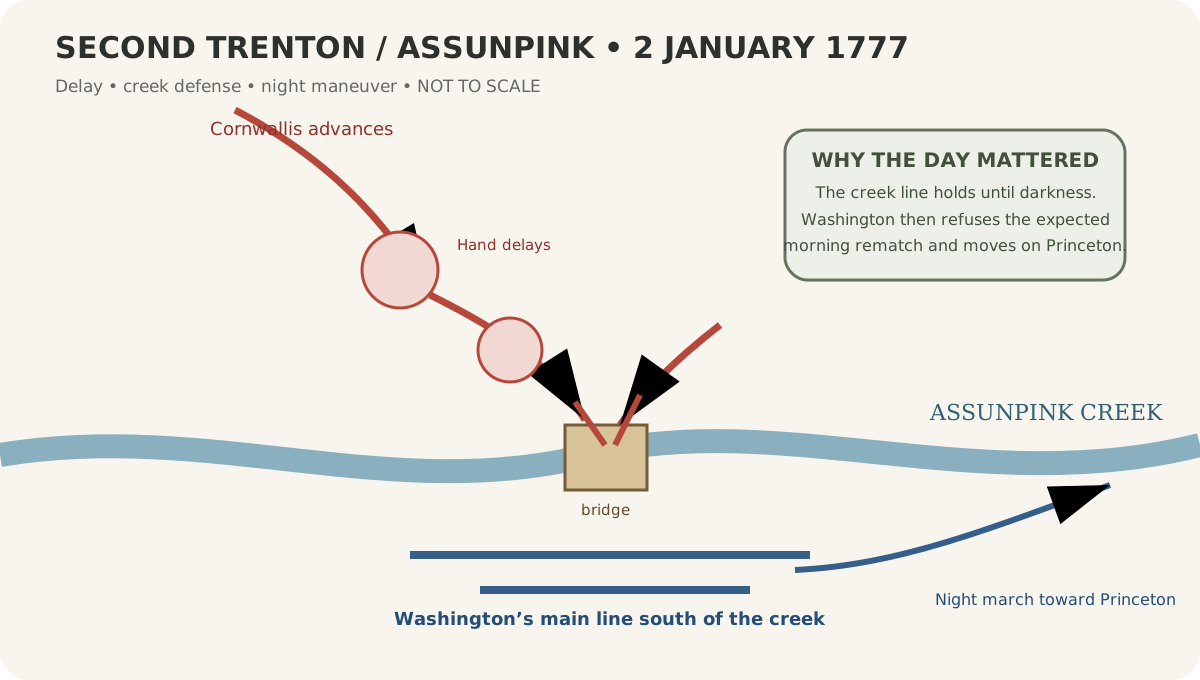
Assunpink Creek delaying action, bridge defense and night maneuver schematic
Bellum schematic connects the daytime defense to the operational escape toward Princeton. Not to scale.
BellumReport Research Desk · Original 2026 analytical graphic · Bellum original graphic
Rights: Original explanatory graphic; not a surveyed map.

General George Washington at Trenton
Trumbull’s 1792 commemorative portrait evokes the January 2 setting but was painted years later and is not eyewitness battlefield evidence.
John Trumbull · 1792 · Wikimedia Commons / Yale University Art Gallery
Rights: Public domain historic artwork
Visual-method rule: Bellum analytical schematics are explanatory reconstructions, not surveyed maps. Historical images retain their own source and rights notes so illustration is never presented as direct eyewitness evidence.
Operational geography
Campaign Movement Map
A proportional campaign overview using each battle record’s modern reference coordinate. It explains operational movement; it is not a surveyed reconstruction of 1776 unit positions.
- Battle of Kip’s BayBritish victory
- Battle of Fort LeeBritish victory
- Battle of Mount HollyCrown tactical success; American strategic diversion
- Second Battle of TrentonAmerican defensive success
Campaign sequence
Where This Battle Fits in Its Campaign
Then & now
Battlefield Geography — Historical Ground in the Modern Landscape
Modern reference points are kept separate from claimed 1776 troop positions. A monument, park or surviving house can orient the visitor without proving that a specific unit stood on that exact modern spot.
Assunpink Creek bridge zone
1776 reference: Bridge and creek crossing defended January 2
Modern reference: Assunpink Creek at South Broad Street, Trenton, NJ
Modern anchor for the key defended crossing; exact 1777 bridge geometry should be interpreted with historical maps.
Location confidence: HighNight route toward Princeton
1776 reference: Road network used in the disengagement
Modern reference: Northeast from Trenton toward Princeton
Broad directional anchor only; the route is represented as a campaign movement, not a precise GPS track.
Location confidence: LowSource-traceable command structure
Interactive Documented Order of Battle
This tree shows the documented core, not an invented complete roster. Search by formation, commander or battlefield role; expand a row to see source scope, strength basis and disposition. Omitted formations remain unresolved rather than silently classified as absent.
American
CommandContinental Army at TrentonCommand: George WashingtonHigh
Battlefield role: Overall American command.
U.S. Army CMH — The New Jersey Campaign, 1776–1777 · High confidence
DetachmentAdvance delaying forceCommand: Edward HandHigh
Battlefield role: Fought successive actions on the approach to Trenton to consume time.
American Battlefield Trust — Second Battle of Trenton / Assunpink Creek · High confidence
CommandAdvance assignment before Hand’s actionCommand: Matthias Alexis Roche de FermoyHigh
Battlefield role: Associated with the advance delaying mission before Hand took effective control.
U.S. Army CMH — The New Jersey Campaign, 1776–1777 · High confidence
ArtilleryContinental artillery at AssunpinkCommand: Henry KnoxHigh
Battlefield role: Supported the south-bank defense and later moved during the night disengagement.
U.S. Army CMH — The New Jersey Campaign, 1776–1777 · High confidence
RegimentMassachusetts Continentals including Little’s regimentCommand: Regimental officersHigh
Battlefield role: NPS source confirms men of the regiment fought on January 2 and again at Princeton.
National Park Service — Moses Sleeper and the Ten Crucial Days · High confidence
Crown
CommandCornwallis’s Trenton columnCommand: Charles CornwallisHigh
Battlefield role: Overall Crown command approaching Trenton.
American Battlefield Trust — Second Battle of Trenton / Assunpink Creek · High confidence
FormationBritish and Hessian assault elementsHigh
Battlefield role: Attempted to force the bridge and nearby approaches before darkness.
American Battlefield Trust — Second Battle of Trenton / Assunpink Creek · High confidence
Read behind the narrative
Primary Source Room
Primary evidence is powerful but not self-interpreting. Each item is paired with why it matters and what it cannot establish by itself.
Plan of the Operations of General Washington against the King’s Troops in New Jersey, 26 December 1776–3 January 1777
Creator: William Faden / period cartographic tradition
Why it matters: The period plan places Second Trenton inside the movement from the Delaware crossing through Trenton and Princeton, making the operational relationship between the battles visible.
Read with caution: Period cartography can simplify roads, timing and troop positions; it is not a modern georeferenced battlefield survey.
Objectives Before the Battle
American objective
Washington needed to preserve the army, hold the Assunpink line long enough to prevent immediate defeat, and then find a way to escape a stronger force without simply retreating back across the Delaware.
British / Crown objective
Cornwallis sought to bring Washington to decisive battle, drive through the Trenton position and reverse the psychological and operational effects of the December 26 American victory.
Assunpink Is the Missing Hinge Between Trenton and Princeton
Popular retellings often jump from Washington’s surprise victory at Trenton on December 26 directly to Princeton on January 3. That skips the moment when the recovery could have ended. Washington returned to New Jersey, while Cornwallis moved to bring the Americans to battle. On January 2 the Continental army faced a stronger Crown response and had to survive long enough to create another option.
Second Trenton is therefore the hinge of the Ten Crucial Days. The first Trenton restored initiative; Assunpink tested whether Washington could keep it; Princeton exploited the escape. Bellum’s campaign map makes this sequence visible with dates and movement rather than presenting three independent battle cards. Understanding the middle battle changes the story from two surprising victories into a continuous operational contest.
Evidence basis: U.S. Army CMH — The New Jersey Campaign, 1776–1777
Edward Hand Used Time as a Defensive Resource
The first American objective on January 2 was not to defeat Cornwallis north of Trenton. Edward Hand’s delaying force sought to slow the Crown advance. Every deployment, skirmish and withdrawal forced the column to spend winter daylight before it reached Washington’s main position behind Assunpink Creek.
This is a different tactical logic from a static defense. A delaying force succeeds by avoiding destruction while compelling the enemy to deploy, clear obstacles and re-form. Bellum’s phase timeline therefore measures the approach in stages rather than giving all attention to the bridge. Without the earlier delay, Cornwallis might have reached the creek with more daylight available for repeated assaults and reconnaissance of alternate crossings.
Evidence basis: American Battlefield Trust — Second Battle of Trenton / Assunpink Creek
Why Assunpink Creek Was More Valuable Than an Open Field
Washington’s main line used Assunpink Creek as a natural obstacle. The bridge and nearby crossings concentrated the attackers and reduced the advantage of superior numbers. Infantry and artillery south of the creek could fire into approaches that offered fewer easy routes than an open plain.
The defense was still vulnerable. A creek is not a fortress, and Crown troops could search for fords or renew the assault with more time. Its value on January 2 came from combining terrain with the hours already consumed by Hand’s delaying action. Bellum’s schematic shows these two layers together: the long approach from the north and the compressed final fight at the crossing. The battlefield was won with time as much as with ground.
Evidence basis: American Battlefield Trust — Second Battle of Trenton / Assunpink Creek
Cornwallis Had a Strong Position After Dark—But Not the Outcome He Wanted
By evening, Cornwallis had driven the American screen back to Trenton and stood close to Washington’s army. The Crown commander had not been routed. He retained a powerful force and could reasonably expect another chance in daylight. This is why describing January 2 merely as an American “victory” can be misleading if it implies Cornwallis was tactically helpless.
Washington’s achievement was survival under pressure. The bridge assaults failed to break the line before darkness, giving the Americans a pause. What happened in that pause determined the campaign. The British problem was not defeat at the creek alone; it was failure to keep Washington fixed there until the next morning. Bellum therefore separates the defensive result from the later operational escape.
Evidence basis: American Battlefield Trust — Second Battle of Trenton / Assunpink Creek
The Most Important Decision Happened After the Shooting Slowed
A conventional response to the evening situation was to remain behind Assunpink Creek and prepare for renewed battle. Another was to retreat back toward the Delaware. Washington instead chose a third option: disengage, move around Cornwallis and strike toward Princeton. That decision converted a defensive pause into an offensive maneuver.
The plan required deception and discipline. Campfires and activity near Trenton helped preserve the impression that the Americans were still in place, while troops and artillery moved onto back roads. The choice belongs in a battle page because it arose directly from the tactical outcome at the creek. A site that ends the story when firing stops misses the command decision that gave January 2 its larger significance.
Evidence basis: U.S. Army CMH — The New Jersey Campaign, 1776–1777
Frozen Ground Became Part of the Operational Opportunity
Winter conditions had caused hardship throughout the Ten Crucial Days, but on the night after Assunpink they also influenced movement. Hardened roads could carry men, horses and artillery more effectively than soft mud. The same cold that exhausted soldiers helped make a rapid night march practicable.
Environmental details should not become deterministic folklore. Frozen roads did not choose Princeton for Washington or guarantee secrecy. They were one condition inside a plan that also depended on route selection, noise control, rear-guard deception and the British expectation of another morning fight. Bellum keeps weather and logistics in separate fields so the page can explain how environment enabled action without pretending it caused the outcome by itself.
Evidence basis: U.S. Army CMH — The New Jersey Campaign, 1776–1777
Why Strength Figures for Second Trenton Are Easy to Misuse
Authors may count Cornwallis’s whole marching column, only troops reaching the creek, Washington’s entire army around Trenton or the specific formations defending the bridge. Those populations are not interchangeable. If a chart puts two impressive totals side by side without defining them, it can create an illusion of precision while comparing unlike things.
For that reason, Bellum does not force a force-strength bar chart onto this page unless the database contains measurements with compatible scopes. The Evidence Ledger can still display a source’s number with its basis. Refusing a misleading visualization is itself a feature: historical data quality should determine whether a graph appears, not a design requirement that every page contain the same chart.
Evidence basis: American Battlefield Trust — Second Battle of Trenton / Assunpink Creek
The Night March Makes Princeton Part of the Assunpink Story
The January 3 battle at Princeton began with a decision made after the January 2 defense. Washington’s army left Cornwallis behind, moved northeast and struck a separate Crown force near Princeton. The two battles are therefore operationally inseparable even though they have different tactical maps and participants.
Bellum’s internal links reflect causation rather than generic “related posts.” The Assunpink page links forward to Princeton because the night maneuver created the next battle; Princeton links back because its opening situation cannot be understood without the escape from Trenton. This relationship graph is one of the database’s intended advantages over article collections where chronology is left to a sidebar or tag archive.
Evidence basis: U.S. Army CMH — The New Jersey Campaign, 1776–1777
Artillery at Assunpink Had Two Jobs: Hold the Crossing and Leave Quietly
Continental artillery strengthened Washington’s position behind Assunpink Creek because the bridge and approaches forced attackers into predictable lanes. Guns could support infantry defending a constrained crossing more effectively than they could cover every possible approach on open terrain. Yet the same artillery became a logistical liability once Washington decided to leave during the night.
The army then had to move guns, teams and ammunition without revealing that the camp was emptying. This double role—combat power by day, movement problem by night—shows why Bellum links tactical and logistical analysis on the same page. Artillery is not merely a number in an order of battle. Its usefulness changes with terrain, road condition, noise, horses, ammunition and the commander’s next intended movement.
Evidence basis: U.S. Army CMH — The New Jersey Campaign, 1776–1777
The Campfire Deception Worked Because It Reinforced British Expectations
Deception is strongest when it tells an opponent something he is already prepared to believe. After the January 2 fighting, Cornwallis had reason to expect Washington to remain near Trenton and face another attack in the morning. Maintaining fires and signs of activity around the American position supported that expectation while the main body moved away.
The tactic did not make the army invisible. Its purpose was to delay recognition long enough for the march toward Princeton to gain distance. Bellum therefore treats the deception as a time-buying mechanism, much like Hand’s delaying action earlier in the day. In both cases the Americans were not trying to destroy Cornwallis’s main force; they were manipulating when and where that force could effectively engage them.
Evidence basis: U.S. Army CMH — The New Jersey Campaign, 1776–1777
Forces & Casualties — Evidence, Not False Precision
The charts only compare figures that share a source and measurement definition. Other source-defined figures remain in the evidence table.
No two directly comparable source-defined figures are available yet, so Bellum intentionally does not draw a misleading strength chart.
| Metric | Side | Value | Definition / basis | Source | Confidence |
|---|---|---|---|---|---|
| Sequence-day | American | 2 | Second Trenton within Ten Crucial Days | National Park Service — Moses Sleeper and the Ten Crucial Days | High |
Battlefield Analysis
Terrain
Assunpink Creek formed a natural barrier south of Trenton. The bridge concentrated movement into a narrow crossing while the creek and nearby fords complicated a frontal assault. Roads north of town also gave Hand’s delaying force successive places to contest the British advance.
Intelligence
Both commanders knew the other army was close, but the crucial information problem came after dark. Cornwallis expected to renew the battle in the morning. Washington’s council instead considered escape and maneuver, using campfires and a concealed march to prevent the British from recognizing the movement in time.
Turning point
The battlefield turning point was the failure of Crown assaults to force the Assunpink line before darkness. The operational turning point came afterward, when Washington rejected a static overnight defense and chose the road to Princeton.
Logistics
The American army had already crossed the Delaware, fought at Trenton and returned to New Jersey. On January 2 it had to sustain a defensive line, manage ammunition and artillery, and then move much of the army at night without alerting the enemy. Silence, road condition and rear-guard deception became logistical weapons.
Weather
Cold winter conditions and hardening ground became operationally important after the fighting. The frozen roads helped Washington’s army move artillery and men during the night march toward Princeton while the British expected another battle near Trenton.
Where Historical Sources Disagree
Strength and casualty figures for January 2 vary because authors count different groups: Cornwallis’s marching column, troops actually engaged at the creek, Washington’s total army in the Trenton area, or only the units in the bridge defense. Bellum therefore labels scope for every number and avoids a single unsupported “battle strength” total.
Bellum does not average incompatible figures. Each number below retains its source, definition and confidence.
Battle Timeline & Tactical Phases
- 1
Morning–afternoon
Cornwallis advances toward Trenton
The Crown column moved south toward Washington while American detachments contested its progress.
Location: Roads north of Trenton
Evidence confidence: High - 2
Afternoon
Hand conducts a delaying action
Edward Hand’s force used successive positions to slow the British approach and consume winter daylight.
Location: Approaches to Trenton
Evidence confidence: High - 3
Late afternoon
Washington forms behind Assunpink Creek
The Continental main body occupied the south side of the creek with artillery and infantry covering the bridge and crossings.
Location: Assunpink Creek
Evidence confidence: High - 4
Dusk
Assaults fail at the crossings
Crown troops attempted to force the bridge and nearby approaches but did not break Washington’s line before darkness.
Location: Assunpink bridge and creek line
Evidence confidence: High - 5
Night
Night disengagement toward Princeton
Rather than await a renewed attack, Washington moved the army around Cornwallis toward Princeton while maintaining the appearance of a camp near Trenton.
Location: Back roads from Trenton toward Princeton
Evidence confidence: Medium
Bellum Decision Explorer
This section evaluates decisions using information and constraints available at the time, not simply whether the eventual outcome was good or bad.
Leave Assunpink Creek and strike toward Princeton
Situation: Washington had held the creek line on January 2, but Cornwallis still had a powerful force close at hand and could renew the attack in daylight.
What was known: The Americans knew they had survived the day but could not assume the same crossings would remain secure under a deliberate morning assault.
Alternatives: Remain behind the creek; retreat back across the Delaware; or disengage around the Crown position and attack Princeton.
Constraints: Enemy proximity, exhausted troops, artillery movement, secrecy, winter roads and the need to avoid exposing the army during disengagement.
Decision: Washington chose a concealed night march toward Princeton while leaving signs of an occupied camp near Trenton.
Outcome: The army escaped the expected morning battle and fought a separate British force at Princeton on January 3.
Hindsight guardrail: The maneuver worked, but its success should not erase the risk. A discovered night withdrawal could have exposed columns on the road; the decision was a calculated operational gamble, not an inevitable masterstroke.
Claim-by-claim provenance
Source Agreement Matrix
This view separates broad source agreement from genuine disagreement. A conflict flag means the stored sources make materially different statements; it does not mean one source is automatically wrong.
1 independent source record in the ledger.
1 independent source record in the ledger.
2 independent source records in the ledger.
1 independent source record in the ledger.
1 independent source record in the ledger.
2 independent source records in the ledger.
Evidence Ledger & Source Trail
John Trumbull’s 1792 portrait depicts Washington at Trenton on the night after the Assunpink fighting and before Princeton; it is later commemorative art rather than an eyewitness battlefield image.
Wikimedia Commons — General George Washington at Trenton by John Trumbull
NPS records Continental soldiers fighting at Second Trenton on January 2 and Princeton on January 3.
National Park Service — Moses Sleeper and the Ten Crucial Days
Second Trenton was fought on January 2, 1777 along the Assunpink Creek at Trenton.
American Battlefield Trust — Second Battle of Trenton / Assunpink Creek
Army campaign history places the January 2 Assunpink defense between the first Trenton action and Princeton.
Washington’s army held the line south of Assunpink Creek through repeated attempts to force the crossings.
American Battlefield Trust — Second Battle of Trenton / Assunpink Creek
American troops delayed the Crown advance before the main fight at the creek.
American Battlefield Trust — Second Battle of Trenton / Assunpink Creek
The American army disengaged after dark and moved toward Princeton rather than await a renewed frontal battle.
The sequence is corroborated by soldier-level NPS interpretation that follows Continental troops from January 2 at Trenton to January 3 at Princeton.
National Park Service — Moses Sleeper and the Ten Crucial Days
Frequently Asked Questions
When was the Second Battle of Trenton?
The Second Battle of Trenton, or Battle of Assunpink Creek, was fought on January 2, 1777, between the December 26 victory at Trenton and the January 3 Battle of Princeton.
Source basis: American Battlefield Trust — Second Battle of Trenton / Assunpink Creek
Why is Second Trenton called the Battle of Assunpink Creek?
Washington’s main defensive position formed south of Assunpink Creek at Trenton, where the bridge and crossings became the focal points of Crown attacks late on January 2.
Source basis: American Battlefield Trust — Second Battle of Trenton / Assunpink Creek
Who won the Second Battle of Trenton?
The Americans achieved a defensive success by holding the creek line through the evening. The campaign result depended on what followed: Washington disengaged at night and marched toward Princeton.
Source basis: U.S. Army CMH — The New Jersey Campaign, 1776–1777
What did Edward Hand do at Second Trenton?
Hand led a delaying force on the Crown approach to Trenton. Its purpose was to consume time and reduce the daylight available to Cornwallis before he reached Washington’s main line.
Source basis: American Battlefield Trust — Second Battle of Trenton / Assunpink Creek
Why did Washington leave Trenton after holding the creek?
Remaining behind Assunpink invited another, potentially stronger attack in daylight. Washington instead chose a concealed night march around Cornwallis toward Princeton.
Source basis: U.S. Army CMH — The New Jersey Campaign, 1776–1777
Did the same American soldiers fight at Second Trenton and Princeton?
Yes. National Park Service research on Moses Sleeper notes Continental soldiers who fought at Second Trenton on January 2 and then at Princeton on January 3, illustrating the continuity of the campaign.
Source basis: National Park Service — Moses Sleeper and the Ten Crucial Days