American Revolutionary War · Evidence-led battle guide
Battle of Brooklyn
The first major battle after the Declaration of Independence was a major British tactical victory. The subsequent East River evacuation preserved Washington’s main army, while competing force and casualty estimates require careful separation by source and measurement scope.
Quick answer
What happened at Battle of Brooklyn?
British and Hessian forces outflanked and defeated the American forward positions on Long Island, forcing the survivors into the Brooklyn Heights defenses.
Why it mattered
The British secured Long Island and later New York City, but Washington preserved the Continental Army by evacuating across the East River, keeping the rebellion’s principal field army intact.
Visual evidence + analytical reconstruction
See the Battlefield, Not Just the Summary
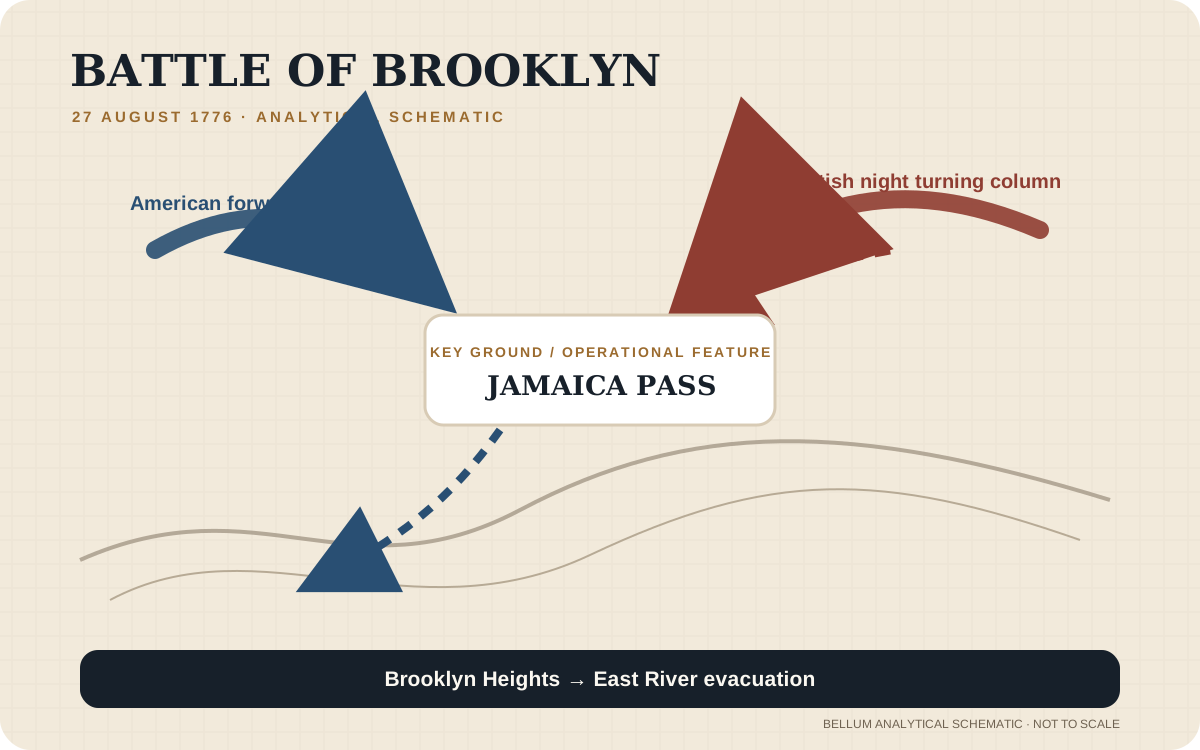
Battle of Brooklyn tactical schematic
Bellum schematic: Jamaica Pass flanking movement, collapse of the forward defense, concentration at Brooklyn Heights, and subsequent evacuation. Not to scale.
BellumReport Research Desk · Original 2026 analytical graphic · Bellum original graphic
Rights: Original explanatory graphic; underlying historical claims require cited evidence.

The Delaware Regiment at the Battle of Long Island
A later U.S. National Guard heritage painting used as historical illustration, not as primary-source evidence.
Domenick D'Andrea · c. 2004 · Wikimedia Commons / U.S. National Guard
Rights: Public domain in the United States
Visual-method rule: Bellum analytical schematics are explanatory reconstructions, not surveyed maps. Historical images retain their own source and rights notes so illustration is never presented as direct eyewitness evidence.
Operational geography
Campaign Movement Map
A proportional campaign overview using each battle record’s modern reference coordinate. It explains operational movement; it is not a surveyed reconstruction of 1776 unit positions.
- Battle of Kip’s BayBritish victory
- Battle of Fort LeeBritish victory
- Battle of Mount HollyCrown tactical success; American strategic diversion
- Second Battle of TrentonAmerican defensive success
Campaign sequence
Where This Battle Fits in Its Campaign
Then & now
Battlefield Geography — Historical Ground in the Modern Landscape
Modern reference points are kept separate from claimed 1776 troop positions. A monument, park or surviving house can orient the visitor without proving that a specific unit stood on that exact modern spot.
Battle Pass
1776 reference: pass through the Heights of Guan
Modern reference: Battle Pass, East Drive, Prospect Park, Brooklyn, NY
NYC Parks identifies Battle Pass on the east side of Prospect Park. This is a modern reference anchor, not a claim that every 1776 position survives unchanged.
Location confidence: HighOld Stone House / Gowanus fighting area
1776 reference: Vechte-Cortelyou House area
Modern reference: Old Stone House, J.J. Byrne Park, Brooklyn, NY
Useful modern orientation for the fierce rear-guard fighting associated with Stirling’s withdrawal. Modern streets and park boundaries differ from the 1776 landscape.
Location confidence: HighSource-traceable command structure
Interactive Documented Order of Battle
This tree shows the documented core, not an invented complete roster. Search by formation, commander or battlefield role; expand a row to see source scope, strength basis and disposition. Omitted formations remain unresolved rather than silently classified as absent.
American
CommandLong Island defenseCommand: Israel PutnamHigh
Battlefield role: Overall Continental command on Long Island after the British landing; defense divided across the Heights of Guan and Brooklyn lines.
U.S. Army CMH — The New York Campaign, 1776 · High confidence
BrigadeStirling’s right-wing commandCommand: William Alexander, Lord StirlingHigh
Documented strength: ≥ 1,500 people (Army CMH describes Stirling’s command as more than 1,500 men)
Battlefield role: Held the American right facing the British demonstration and later fought a delaying action.
U.S. Army CMH — The New York Campaign, 1776 · High confidence
Regiment1st Maryland RegimentCommand: William SmallwoodHigh
Battlefield role: Part of Stirling’s command; elements participated in the rear-guard fighting near the Gowanus route.
U.S. Army CMH — The New York Campaign, 1776 · High confidence
RegimentDelaware RegimentCommand: John HasletHigh
Battlefield role: Part of Stirling’s command on the American right.
U.S. Army CMH — The New York Campaign, 1776 · High confidence
BattalionPennsylvania State Battalion of MusketryHigh
Battlefield role: Reinforced Stirling’s right-wing force.
U.S. Army CMH — The New York Campaign, 1776 · High confidence
RegimentPennsylvania State RegimentHigh
Battlefield role: Samuel Miles’s regiment operated forward of the main line around the Bedford and Jamaica approaches.
U.S. Army CMH — The New York Campaign, 1776 · High confidence
Regiment14th Continental RegimentCommand: John GloverHigh
Battlefield role: Maritime-experienced regiment ordered to help crew evacuation boats after the battlefield defeat.
U.S. Army CMH — The New York Campaign, 1776 · High confidence
Regiment27th Continental RegimentHigh
Battlefield role: Used with Glover’s regiment in the Brooklyn Heights evacuation boat operation.
U.S. Army CMH — The New York Campaign, 1776 · High confidence
Crown
CommandHowe’s main turning columnCommand: William HoweHigh
Documented strength: 10,000 people (Army CMH approximate strength for main Jamaica Pass turning column)
Battlefield role: Primary operational blow through Jamaica Pass against the American left/rear.
U.S. Army CMH — The New York Campaign, 1776 · High confidence
VanguardLight infantry and dragoons vanguardCommand: Henry ClintonHigh
Battlefield role: Led the night approach and seizure of Jamaica Pass.
U.S. Army CMH — The New York Campaign, 1776 · High confidence
BrigadeBritish Light Infantry BrigadeHigh
Battlefield role: Fast-moving infantry in the Jamaica Pass vanguard.
U.S. Army CMH — The New York Campaign, 1776 · High confidence
Regiment16th Light DragoonsHigh
Battlefield role: Mounted element in the advance toward Jamaica Pass.
U.S. Army CMH — The New York Campaign, 1776 · High confidence
BrigadeBrigade of GuardsHigh
Battlefield role: Part of Howe’s flanking column.
U.S. Army CMH — The New York Campaign, 1776 · High confidence
Regiment33rd Regiment of FootHigh
Battlefield role: Part of Howe’s flanking column.
U.S. Army CMH — The New York Campaign, 1776 · High confidence
CommandGrant’s demonstration against the American rightCommand: James GrantHigh
Documented strength: 7,000 people (Army CMH approximate strength)
Battlefield role: Fixed Stirling’s command while the main British column turned the American flank.
U.S. Army CMH — The New York Campaign, 1776 · High confidence
Regiment42nd Regiment of FootHigh
Battlefield role: Included in Grant’s force against the American right.
U.S. Army CMH — The New York Campaign, 1776 · High confidence
Read behind the narrative
Primary Source Room
Primary evidence is powerful but not self-interpreting. Each item is paired with why it matters and what it cannot establish by itself.
George Washington to John Hancock, 31 August 1776
Creator: George Washington
Why it matters: Washington reports the defeat and withdrawal from Long Island close to the event, making it essential for understanding what headquarters believed had happened.
Read with caution: A commander’s report has informational limits: estimates were provisional, visibility was incomplete, and it reflects the American command perspective.
A plan of New York Island… showing the engagement on Long Island
Creator: William Faden
Why it matters: Provides period cartographic framing for the Long Island battlefield and routes, useful when compared with modern geography.
Read with caution: Like all period maps, it reflects the cartographer’s information, scale choices and intended audience; troop placement should be read critically.
Objectives Before the Battle
American objective
Washington sought to defend New York while preserving the Continental Army and denying easy British control of the harbor approaches.
British / Crown objective
Howe sought to destroy or decisively defeat Washington’s army and secure New York as a strategic base.
Why New York Became the Central Strategic Problem in 1776
The Battle of Brooklyn cannot be understood as an isolated fight on Long Island. New York offered a deep harbor, access to the Hudson corridor, and a base from which British land and naval forces could operate together. Washington therefore faced two problems at once: he had to contest a strategically important city, but he also had to avoid losing the Continental Army in a position where British naval mobility could help trap it.
That tension encouraged a broad American deployment across Manhattan and Long Island. The arrangement covered several possible British approaches, but it also dispersed troops and complicated reinforcement. Howe, by contrast, could exploit sea control to choose a landing area and concentrate against part of Washington’s defensive system. The battle grew from this mismatch between the ground Washington felt compelled to defend and the mobility available to the British expeditionary force.
Evidence basis: U.S. Army CMH — Revolutionary War Campaigns
Jamaica Pass and the Operational Turning Movement
The most consequential movement of the battle developed around Jamaica Pass. American forward positions guarded several approaches across the wooded heights, but the eastern route was not covered strongly enough to prevent a large British turning column from moving through during the night. Once that column reached the American rear, troops holding the forward line faced pressure from more than one direction.
Jamaica Pass mattered because it converted terrain and information into surprise. The British did not merely push harder against the strongest American position; they used an inadequately protected route to appear where the defense was least prepared to meet them. The resulting threat to the American rear explains why the pass belongs at the center of any tactical reconstruction of the battle.
Evidence basis: NPS — The Maryland 400
The Retreat, the Maryland Troops and the Fight for Escape
As the American forward defense collapsed, the immediate problem changed from holding ground to getting surviving units back toward the fortified Brooklyn Heights position. Fighting around the Gowanus area and the Old Stone House became associated with costly rear-guard actions by Maryland and Delaware troops. Their role is important because the battle was no longer being fought for a conventional victory; parts of the American force were buying time and space for others to escape.
The tactical problem changed sharply during this phase. Units that had begun the day defending passes and roads now had to disengage while British and Hessian forces pressed from several directions. Men trying to reach Brooklyn Heights encountered marshy ground, waterways and crowded retreat routes. The rear-guard fighting is therefore best understood as part of the effort to prevent a battlefield defeat from becoming the destruction of entire formations.
Evidence basis: NPS — The Maryland 400
From Battlefield Defeat to the Brooklyn Heights Crisis
The British tactical victory did not automatically end with the destruction of Washington’s army. Survivors withdrew into the Brooklyn Heights defenses, creating a new operational situation. The Continental Army had the East River behind it, British forces in front, and the possibility that naval action or a tighter investment could make withdrawal impossible.
The August 27 battlefield result and the crisis that followed need to be separated. Britain had won the battle and forced the Americans back, but Washington still possessed a field army concentrated inside the works. The next question was no longer who controlled the battlefield; it was whether that army could be trapped before it escaped. This distinction explains why the British victory was severe without becoming the decisive annihilation that might have transformed the war.
Evidence basis: NPS — The Role of Governors Island in the American Revolution
Why the East River Evacuation Changed the Strategic Meaning of the Defeat
Washington ultimately ordered a nighttime evacuation from Brooklyn Heights to Manhattan. That choice preserved the principal Continental field army after a severe tactical reverse. Boats carried men, equipment and artillery across the East River while the remaining troops concealed the movement from the British front.
The withdrawal changed the strategic meaning of the defeat because it saved the institution the British most needed to destroy: Washington’s main army. Britain gained Long Island and retained the initiative around New York, but the rebellion still possessed an organized force capable of retreating, regrouping and fighting again. The escape did not erase the defeat; it limited what the British victory could accomplish.
Evidence basis: NPS — The Role of Governors Island in the American Revolution
Why Battle of Brooklyn Troop Numbers Differ by Source
Published strength figures for Brooklyn often appear contradictory because the sources are not always counting the same thing. One figure may describe troops available around New York, another troops landed on Long Island, another troops assigned to the Long Island defenses, and another only those directly engaged in a particular part of the battle. Casualty summaries can likewise separate or combine killed, wounded, missing and captured men.
For that reason, a single number without a measurement label can be less accurate than a range of apparently conflicting figures. The useful comparison is not “which source has the right total?” but “what population is each source counting?” The evidence table therefore keeps whole-army strength, landing strength, engaged strength and casualty categories separate whenever the underlying source permits that distinction.
Evidence basis: U.S. Army CMH — Revolutionary War Campaigns
The Long Island Passes Were the Real Defensive Geometry
The American forward line on Long Island was not a continuous wall. Roads crossed the wooded ridge through a series of passes, and any one of those routes could become the doorway into the rear of the defenders. That made the problem fundamentally different from simply placing more men on a front line. A pass that was weakly watched could negate strength elsewhere by allowing an enemy column to bypass the positions built to stop a direct advance.
Howe’s army exploited that geometry. While fighting and demonstrations held American attention on other approaches, the major turning column moved toward Jamaica Pass and emerged behind portions of the American defense. Once that happened, units that had been oriented toward an enemy in front faced pressure from another direction. Retreat routes became more dangerous, communication became harder, and local resistance could no longer restore the original defensive scheme.
This is why a useful map of Brooklyn must emphasize roads, ridge lines and passes rather than simply drawing two colored blocks for the armies. The battle was decided as much by access through the terrain as by the volume of musket fire. Jamaica Pass mattered because control of a route changed the relationship among all the other American positions.
Evidence basis: U.S. Army CMH — Revolutionary War Campaigns
The Maryland Rear Guard Was an Escape Problem, Not a Stand-Alone Charge
The famous Maryland action near the Old Stone House is often remembered as an isolated heroic charge. In operational terms it belonged to a larger problem: men on the American right needed time and space to escape a battlefield that was closing around them. Lord Stirling directed most of his troops toward the Gowanus route while a smaller body of Maryland soldiers fought against far stronger Crown forces near the stone house. NPS material describes Marylanders and Delawareans surrounded by British infantry and Hessians, with fire coming from the vicinity of the building before the Maryland troops counterattacked.
The value of the action therefore cannot be measured only by whether the Marylanders held the ground. They did not. The more useful question is what their resistance allowed other Americans to do while the British were occupied. Rear-guard combat often asks a unit to trade local survival or freedom of movement for time gained by a larger force. That is one reason the episode became so prominent in the memory of the battle.
The terrain made the escape even more difficult. Gowanus Creek and its marshy approaches were not a clean open corridor. Men trying to withdraw had to negotiate water, mud, enemy fire and confusion. A tactical diagram that shows only the charge misses the central relationship: rear-guard pressure, constrained crossing terrain and the movement of survivors toward Brooklyn Heights.
Evidence basis: NPS — The Maryland 400
Washington’s Problem After the Forward Line Collapsed
Once the forward American positions had been broken, Washington faced a different battle from the one planned before August 27. The immediate task was no longer to defeat the British on Long Island. It was to prevent a tactical defeat from becoming the destruction or capture of a large part of the Continental Army. The surviving troops concentrated behind the Brooklyn Heights works while the British controlled the initiative outside them.
A commander in that position has to judge several risks at once. Remaining could invite a siege, renewed assault or naval action that cut the East River connection. Withdrawing required boats, disciplined movement, darkness and enough concealment to prevent the British from attacking troops while they were most vulnerable. The decision also carried political weight because abandoning Long Island conceded ground close to New York after the newly declared United States had tried to defend the city.
Washington chose preservation of the field army over continued possession of the position. That choice did not erase the defeat, but it changed what the British victory could accomplish. Howe gained Long Island and later New York City; he did not capture the principal American army at Brooklyn Heights. The distinction between losing a battlefield and losing an army is central to understanding why the campaign continued.
Evidence basis: NPS — The Role of Governors Island in the American Revolution
How Glover’s Mariners Turned a Retreat into an Operation
The East River withdrawal succeeded because evacuation was treated as an organized military operation rather than a spontaneous flight. John Glover’s Marblehead men brought skills developed in a maritime community: handling boats, judging water and moving men and matériel under difficult conditions. NPS describes the regiment helping move thousands of soldiers as well as artillery, ammunition, horses, cattle and provisions during the night withdrawal from Brooklyn.
The physical problem was formidable. An army that had just been defeated had to leave defensive works, move to embarkation points, load boats without creating panic, cross a tidal river and unload on Manhattan while maintaining enough order to prevent the rear from collapsing. Wind and tide initially complicated the movement. Later conditions improved, and fog helped conceal the evacuation from British observation.
The result demonstrates why logistics belongs inside a battle page rather than in a separate footnote. The fighting on August 27 created the crisis, but seamanship, transport capacity, discipline and concealment determined whether that crisis ended with escape or mass capture. The evacuation also gives Brooklyn an unusual tactical shape: the battle’s decisive American success occurred after the battlefield defeat, in the management of withdrawal rather than in combat.
Evidence basis: NPS — John Glover: Sailor, Soldier, Patriot
Forces & Casualties — Evidence, Not False Precision
The charts only compare figures that share a source and measurement definition. Other source-defined figures remain in the evidence table.
No two directly comparable source-defined figures are available yet, so Bellum intentionally does not draw a misleading strength chart.
| Metric | Side | Value | Definition / basis | Source | Confidence |
|---|---|---|---|---|---|
| Army Strength | American | 19,000 | Continental troops stretched from northern Manhattan to Brooklyn | NPS — The Role of Governors Island in the American Revolution | Medium |
| Army Strength | American | 20,000 | Army assembled around New York; Army CMH says over 20,000 | U.S. Army CMH — Revolutionary War Campaigns | Medium |
| Army Strength | British/Hessian | 32,000 | British force available around New York/Staten Island | NPS — The Role of Governors Island in the American Revolution | Medium |
| Captured | American | 700–1,200 | Army CMH estimate | U.S. Army CMH — Revolutionary War Campaigns | Medium |
| Casualties | British/Hessian | 367 | Howe-listed losses as summarized by Army CMH | U.S. Army CMH — Revolutionary War Campaigns | Medium |
| Killed Wounded | American | 300–400 | Army CMH estimate | U.S. Army CMH — Revolutionary War Campaigns | Medium |
| Troops Landed | British/Hessian | 20,000 | Landed on Long Island Aug 22–25 | U.S. Army CMH — Revolutionary War Campaigns | High |
Battlefield Analysis
Terrain
A chain of wooded heights and passes divided the landing areas from the American Brooklyn positions; Jamaica Pass became decisive in the British turning movement.
Intelligence
The American defense had insufficient coverage of Jamaica Pass, enabling the British night flanking column to reach the rear of American positions.
Turning point
The British flanking movement through Jamaica Pass placed major American formations in a converging attack from front and rear.
Where Historical Sources Disagree
Force totals vary because sources count different scopes: whole armies around New York, troops landed on Long Island, troops assigned to Brooklyn, and men actually engaged. Each source-specific number should therefore remain tied to its own measurement basis rather than being collapsed into a false-precision total.
Bellum does not average incompatible figures. Each number below retains its source, definition and confidence.
Battle Timeline & Tactical Phases
- 1
Night, August 26–27
British night flanking movement
A large British column moved around the American left through Jamaica Pass, exploiting weak coverage and setting up a rear attack.
Location: Jamaica Pass / eastern approach
Evidence confidence: High - 2
Morning, August 27
Converging attacks on the American forward line
British forces struck from the rear while Hessian and other forces pressed American positions from the front, breaking the forward defense.
Location: Western Long Island/Brooklyn approaches
Evidence confidence: High - 3
Late morning
Rear-guard fighting and retreat toward Brooklyn Heights
American formations attempted to escape toward the Brooklyn Heights defenses; the Maryland and Delaware troops fought a costly rear-guard action near the Old Stone House and Gowanus area.
Location: Gowanus / Old Stone House area
Evidence confidence: Medium - 4
August 27–29
Brooklyn Heights containment
The surviving American force occupied the fortified Brooklyn Heights position while Washington assessed the danger of encirclement and loss of the army.
Location: Brooklyn Heights
Evidence confidence: Medium - 5
Night, August 29–30
Night evacuation across the East River
Washington ordered a concealed withdrawal by boat to Manhattan; the evacuation preserved the Continental Army after the tactical defeat.
Location: Brooklyn Heights to Manhattan
Evidence confidence: High
Bellum Decision Explorer
This section evaluates decisions using information and constraints available at the time, not simply whether the eventual outcome was good or bad.
Defend both Manhattan and Long Island
Situation: Washington had to defend a strategically important port without certainty about the main British landing and attack axis.
What was known: British naval mobility created uncertainty over where the main blow would fall, and Washington lacked enough trained troops to secure every approach strongly.
Alternatives: Concentrate more heavily on Manhattan; abandon Long Island; hold a thinner forward screen; reinforce the Long Island passes more aggressively.
Constraints: Large geographic frontage, limited training, British naval superiority, uncertain intelligence.
Decision: Washington divided forces between Manhattan and Long Island and maintained forward positions protecting the Brooklyn approaches.
Outcome: The divided defense left exploitable weaknesses, including inadequate coverage of Jamaica Pass, and major forward elements were outflanked.
Hindsight guardrail: The existence of a better alternative is not assumed merely because the historical outcome was unfavorable; each alternative must be tested against information and constraints available before the battle.
Evacuate Brooklyn Heights instead of holding or surrendering
Situation: After the defeat of the forward positions, the Continental force faced the East River at its back and the risk of siege or destruction.
What was known: British forces had tactical superiority around the position, while the river crossing remained possible but vulnerable to discovery and naval interference.
Alternatives: Attempt to hold the fortified position; seek battle again; negotiate surrender; withdraw across the East River.
Constraints: Night movement, boat availability, secrecy, weather, current/tide, British fleet risk, exhausted troops.
Decision: Washington ordered a concealed nighttime boat evacuation to Manhattan.
Outcome: The withdrawal succeeded and preserved the Continental Army, converting a potentially catastrophic defeat into a survivable strategic setback.
Hindsight guardrail: The successful evacuation does not erase the prior battlefield defeat; the two outcomes should be assessed separately.
Claim-by-claim provenance
Source Agreement Matrix
This view separates broad source agreement from genuine disagreement. A conflict flag means the stored sources make materially different statements; it does not mean one source is automatically wrong.
1 independent source record in the ledger.
1 independent source record in the ledger.
1 independent source record in the ledger.
1 independent source record in the ledger.
Evidence Ledger & Source Trail
U.S. Army campaign designation for Long Island spans August 26–29, 1776.
U.S. Army CMH — Revolutionary War Campaigns · Long Island campaign summary
The principal Battle of Brooklyn/Long Island was fought on August 27, 1776.
NPS — The Role of Governors Island in the American Revolution · Battle narrative
Washington evacuated the army from Brooklyn Heights across the East River, preserving the Continental field army after defeat.
NPS — The Role of Governors Island in the American Revolution · Evacuation narrative
British forces used the weakly defended Jamaica Pass to turn the American position and attack from the rear.
NPS — The Maryland 400 · Battle narrative
Frequently Asked Questions
When was the Battle of Brooklyn fought?
The principal battle was fought on August 27, 1776. U.S. Army campaign designations may use a broader August 26–29 range because they include the surrounding operations and the later evacuation.
Source basis: NPS — The Role of Governors Island in the American Revolution
Is the Battle of Brooklyn the same as the Battle of Long Island?
Yes. Battle of Brooklyn and Battle of Long Island are common names for the same major engagement fought on August 27, 1776; modern sources use both names.
Source basis: NPS — The Role of Governors Island in the American Revolution
Who won the Battle of Brooklyn?
British and Hessian forces won the tactical battle, defeating the American forward positions and securing Long Island. Washington later evacuated the Continental Army, preventing the defeat from becoming the destruction of the main army.
Source basis: NPS — The Role of Governors Island in the American Revolution
Why was Jamaica Pass important?
The pass provided a route around the American left. A British turning column used the weakly covered approach to reach the American rear, helping create a converging attack.
Source basis: NPS — The Maryland 400
How many troops fought at the Battle of Brooklyn?
There is no single universally comparable figure because sources count different scopes—whole armies around New York, troops landed on Long Island, troops assigned to the defenses and troops directly engaged. Any strength estimate should therefore be read together with its measurement definition.
Source basis: U.S. Army CMH — Revolutionary War Campaigns
Why did Washington evacuate Brooklyn?
After the battlefield defeat, the army at Brooklyn Heights risked being trapped against the East River. Washington chose a nighttime withdrawal to Manhattan, preserving the Continental field army.
Source basis: NPS — The Role of Governors Island in the American Revolution