American Revolutionary War · Evidence-led battle guide
Battle of Trenton
Washington’s surprise attack at Trenton transformed the immediate strategic mood of the war and opened the Ten Crucial Days.
Quick answer
What happened at Battle of Trenton?
Washington’s force surprised and defeated the Hessian garrison at Trenton after crossing the Delaware.
Why it mattered
The victory revived American morale and helped restore operational initiative after the collapse of the New York campaign.
Visual evidence + analytical reconstruction
See the Battlefield, Not Just the Summary
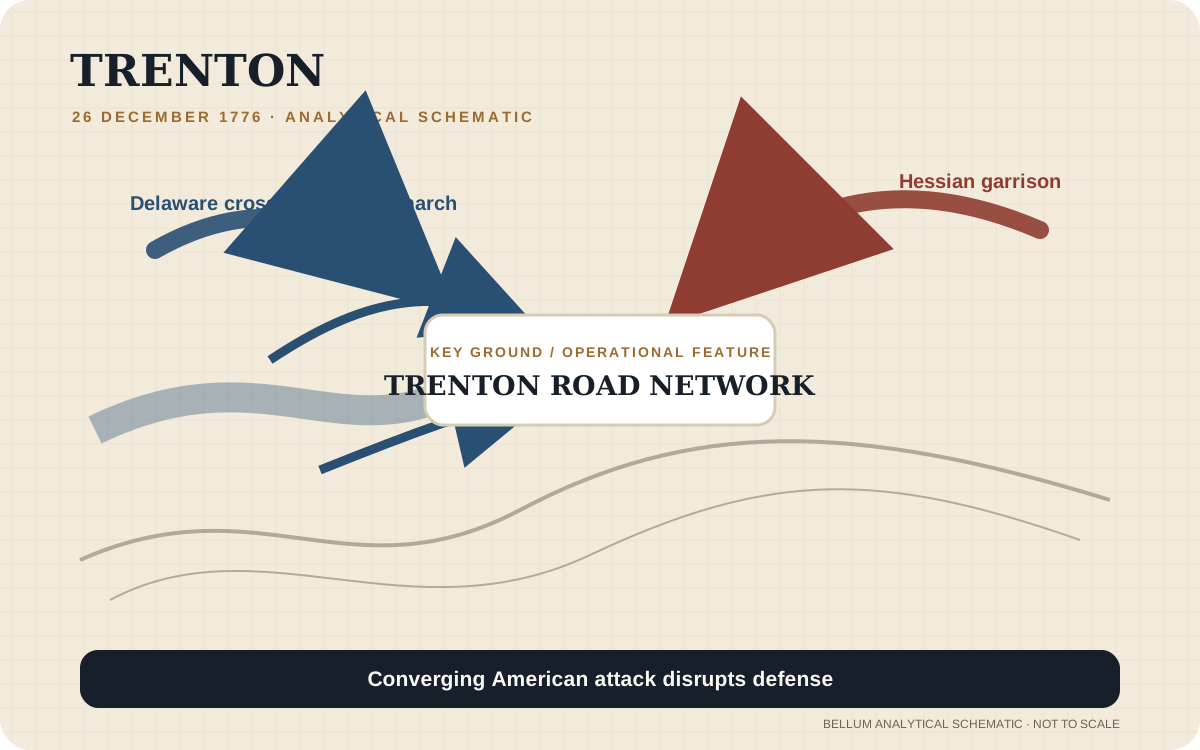
Trenton crossing and converging attack schematic
Bellum schematic connects the river crossing and march to the tactical convergence in Trenton. Not to scale.
BellumReport Research Desk · Original 2026 analytical graphic · Bellum original graphic
Rights: Original explanatory graphic; not a surveyed map.

Washington crossing the Delaware
This 1842 print is a later artistic depiction, included as illustration and clearly separated from direct battle evidence.
Joseph Napoleon Gimbrede after Thomas Sully · 1842 · Library of Congress
Rights: No known restrictions on publication
Visual-method rule: Bellum analytical schematics are explanatory reconstructions, not surveyed maps. Historical images retain their own source and rights notes so illustration is never presented as direct eyewitness evidence.
Operational geography
Campaign Movement Map
A proportional campaign overview using each battle record’s modern reference coordinate. It explains operational movement; it is not a surveyed reconstruction of 1776 unit positions.
- Battle of Kip’s BayBritish victory
- Battle of Fort LeeBritish victory
- Battle of Mount HollyCrown tactical success; American strategic diversion
- Second Battle of TrentonAmerican defensive success
Campaign sequence
Where This Battle Fits in Its Campaign
Then & now
Battlefield Geography — Historical Ground in the Modern Landscape
Modern reference points are kept separate from claimed 1776 troop positions. A monument, park or surviving house can orient the visitor without proving that a specific unit stood on that exact modern spot.
Trenton Battle Monument
1776 reference: upper-town artillery / approach area
Modern reference: Trenton Battle Monument, N Warren St & N Broad St, Trenton, NJ
City of Trenton identifies the monument as commemorating the First Battle of Trenton. It is a visitor orientation point, not a substitute for reconstructing all 1776 positions.
Location confidence: HighOld Barracks
1776 reference: British/Hessian military infrastructure in Trenton
Modern reference: Old Barracks Museum, 101 Barrack St, Trenton, NJ
A surviving Revolutionary-era site useful for modern orientation to Trenton’s military landscape.
Location confidence: HighSource-traceable command structure
Interactive Documented Order of Battle
This tree shows the documented core, not an invented complete roster. Search by formation, commander or battlefield role; expand a row to see source scope, strength basis and disposition. Omitted formations remain unresolved rather than silently classified as absent.
American
ArmyWashington’s Delaware striking forceCommand: George WashingtonHigh
Documented strength: 2,400 people (Approximate force that completed the Delaware crossing and marched on Trenton)
Battlefield role: Main attacking force divided into Greene’s and Sullivan’s columns.
U.S. Army CMH — The New Jersey Campaign, 1776–1777 · High confidence
BrigadeLord Stirling’s brigadeCommand: William Alexander, Lord StirlingHigh
Documented strength: 673 people (Campaign return cited by Army CMH)
Battlefield role: Part of Greene’s division in the Trenton attack.
Scope note: This figure is an organizational/campaign return associated with the formation, not a claim that every listed soldier crossed the Delaware or fought in Trenton. Do not sum it with the 2,400-man striking-force estimate.
U.S. Army CMH — The New Jersey Campaign, 1776–1777 · High confidence
BrigadeAdam Stephen’s brigadeCommand: Adam StephenHigh
Documented strength: 549 people (Campaign return cited by Army CMH)
Battlefield role: Part of Greene’s division.
Scope note: This figure is an organizational/campaign return associated with the formation, not a claim that every listed soldier crossed the Delaware or fought in Trenton. Do not sum it with the 2,400-man striking-force estimate.
U.S. Army CMH — The New Jersey Campaign, 1776–1777 · High confidence
BrigadeHugh Mercer’s brigadeCommand: Hugh MercerHigh
Documented strength: 838 people (Campaign return cited by Army CMH)
Battlefield role: Part of Greene’s division.
Scope note: This figure is an organizational/campaign return associated with the formation, not a claim that every listed soldier crossed the Delaware or fought in Trenton. Do not sum it with the 2,400-man striking-force estimate.
U.S. Army CMH — The New Jersey Campaign, 1776–1777 · High confidence
BrigadeMatthias Fermoy’s brigadeCommand: Matthias FermoyHigh
Documented strength: 638 people (Campaign return cited by Army CMH)
Battlefield role: Part of Greene’s division.
Scope note: This figure is an organizational/campaign return associated with the formation, not a claim that every listed soldier crossed the Delaware or fought in Trenton. Do not sum it with the 2,400-man striking-force estimate.
U.S. Army CMH — The New Jersey Campaign, 1776–1777 · High confidence
Regiment1st Continental RegimentHigh
Battlefield role: Infantry formation in Fermoy’s brigade.
U.S. Army CMH — The New Jersey Campaign, 1776–1777 · High confidence
BattalionGerman BattalionHigh
Battlefield role: Continental German Battalion in Fermoy’s brigade.
U.S. Army CMH — The New Jersey Campaign, 1776–1777 · High confidence
BrigadeArthur St. Clair’s brigadeCommand: Arthur St. ClairHigh
Documented strength: 500 people (Campaign return cited by Army CMH)
Battlefield role: New England brigade in Sullivan’s division.
Scope note: This figure is an organizational/campaign return associated with the formation, not a claim that every listed soldier crossed the Delaware or fought in Trenton. Do not sum it with the 2,400-man striking-force estimate.
U.S. Army CMH — The New Jersey Campaign, 1776–1777 · High confidence
BrigadeJohn Glover’s brigadeCommand: John GloverHigh
Documented strength: 977 people (Campaign return cited by Army CMH)
Battlefield role: Massachusetts and Connecticut Continentals in Sullivan’s division.
Scope note: This figure is an organizational/campaign return associated with the formation, not a claim that every listed soldier crossed the Delaware or fought in Trenton. Do not sum it with the 2,400-man striking-force estimate.
U.S. Army CMH — The New Jersey Campaign, 1776–1777 · High confidence
BrigadePaul Dudley Sargent’s brigadeCommand: Paul Dudley SargentHigh
Documented strength: 827 people (Campaign return cited by Army CMH)
Battlefield role: New England and New York Continentals in Washington’s force.
Scope note: This figure is an organizational/campaign return associated with the formation, not a claim that every listed soldier crossed the Delaware or fought in Trenton. Do not sum it with the 2,400-man striking-force estimate.
U.S. Army CMH — The New Jersey Campaign, 1776–1777 · High confidence
ArtilleryContinental artilleryCommand: Henry KnoxHigh
Documented strength: 418 people (Artillery personnel in campaign return; Army CMH notes crews for at least thirty guns in the wider force)
Battlefield role: Placed guns to dominate the principal streets and support infantry attacks.
Scope note: This figure is an organizational/campaign return associated with the formation, not a claim that every listed soldier crossed the Delaware or fought in Trenton. Do not sum it with the 2,400-man striking-force estimate.
U.S. Army CMH — The New Jersey Campaign, 1776–1777 · High confidence
CavalryPhiladelphia Light HorseHigh
Battlefield role: Mounted reconnaissance and headquarters support during the operation.
U.S. Army CMH — The New Jersey Campaign, 1776–1777 · High confidence
Crown
Detachment16th Light Dragoons detachmentHigh
Documented strength: 20 people (Army CMH garrison detail)
Battlefield role: Small British mounted detachment attached to the garrison.
U.S. Army CMH — The New Jersey Campaign, 1776–1777 · High confidence
Hessian
GarrisonRall’s Trenton garrisonCommand: Johann RallHigh
Documented strength: 1,382 people (Army CMH effective strength on 26 December)
Battlefield role: Three Hessian regiments with jaegers, dragoons and six light field pieces.
U.S. Army CMH — The New Jersey Campaign, 1776–1777 · High confidence
RegimentGrenadier Regiment von RallCommand: Balthasar BrethauerHigh
Documented strength: 512 people (Army CMH effective strength)
U.S. Army CMH — The New Jersey Campaign, 1776–1777 · High confidence
RegimentFusilier Regiment von KnyphausenCommand: Friedrich Ludwig von DechowHigh
Documented strength: 429 people (Army CMH effective strength)
U.S. Army CMH — The New Jersey Campaign, 1776–1777 · High confidence
RegimentFusilier Regiment von LossbergCommand: Franz SchefferHigh
Documented strength: 345 people (Army CMH effective strength)
U.S. Army CMH — The New Jersey Campaign, 1776–1777 · High confidence
Read behind the narrative
Primary Source Room
Primary evidence is powerful but not self-interpreting. Each item is paired with why it matters and what it cannot establish by itself.
Plan of the operations of General Washington against the King’s troops in New Jersey, 26 December 1776–3 January 1777
Why it matters: Connects Trenton to the larger operational sequence culminating at Princeton and helps visualize roads, rivers and maneuver relationships.
Read with caution: The map compresses multiple days of operations and is not a minute-by-minute tactical diagram.
Objectives Before the Battle
American objective
Washington sought a sudden offensive success that could disrupt enemy dispositions, capture a vulnerable garrison and restore American morale.
British / Crown objective
The Hessian garrison’s immediate objective was to hold Trenton and maintain Crown control of the New Jersey outpost network.
Why Washington Needed More Than a Defensive Retreat
By December 1776 the Continental Army had retreated across New Jersey after losing the New York positions. The strategic problem was no longer simply survival; Washington needed an action that could disrupt enemy confidence and restore American morale. Trenton provided that opportunity because a Hessian garrison held the town while Washington’s army stood across the Delaware.
The attack belongs at the beginning of the Ten Crucial Days rather than as an isolated Christmas episode. Its importance came from the way Washington used a sudden success to reopen the campaign. Trenton changed the immediate balance of confidence, but the more important test was whether the Americans could exploit the victory before the British recovered.
Evidence basis: U.S. Army CMH — Revolutionary War Campaigns
The Delaware Crossing as an Operational Problem
The attack depended on moving approximately 2,400 troops across the Delaware in severe winter conditions, together with artillery, horses and other equipment. NPS material on John Glover emphasizes the role of the Marblehead mariners in transporting the force. The crossing was therefore not a decorative prelude to the battle—it was the enabling operation that made the surprise possible.
The logistical risk extended beyond putting infantry into boats. Artillery had to reach the New Jersey side, columns had to form in darkness and bad weather, and the army still faced a march before reaching Trenton. Every delay reduced the time available for surprise. The battle plan therefore began at the river, not at the first street in town.
Evidence basis: U.S. Army CMH — Revolutionary War Campaigns
Surprise, Tempo and the Hessian Garrison
Washington attacked on December 26 and defeated the Hessian garrison. U.S. Army historical material lists roughly 1,400 Hessian troops in the garrison and approximately 2,400 Americans in the attacking force. The surprise and speed of the operation prevented the defenders from turning their position into a prolonged contest.
The page therefore treats force numbers, surprise and operational timing as separate explanatory factors. A larger attacking force does not make the victory automatic; it still had to cross the river, march to the objective and coordinate the attack under difficult conditions.
Evidence basis: U.S. Army CMH — Revolutionary War Campaigns
Why the Prisoner Count Was Strategically Important
Army historical material records hundreds of Hessian troops captured after the action. Capturing a large part of the garrison gave the American victory a visible and measurable result beyond possession of Trenton. It also created a logistical task because prisoners had to be moved away from the battlefield and back across the river.
Prisoners should not be hidden inside a single casualty total. Killed, wounded and captured soldiers represent different battlefield and strategic effects. At Trenton the captured garrison mattered especially because it removed a formed enemy force while providing evidence that Washington’s battered army could still conduct a successful offensive operation.
Evidence basis: U.S. Army CMH — Revolutionary War Campaigns
Trenton Was the Beginning, Not the End
The strategic value of Trenton becomes clearer when it is connected to the subsequent operations at Second Trenton and Princeton. The American army did not simply win and return permanently to safety. Washington used the momentum to continue maneuvering against British forces in New Jersey.
That sequence turned one surprise attack into a short campaign. British commanders had to respond to an enemy they had expected to be retreating or dissolving, while Washington had to keep moving before superior Crown forces could pin him down. Princeton on January 3 closed the ten-day sequence and confirmed that Trenton had been the beginning of an operational counterstroke.
Evidence basis: NPS — Timeline of the Revolution
Why Trenton Changed the Mood of the War
Trenton did not destroy the British army or decide independence in one morning. Its importance came from timing. After months of defeats and retreat, a successful offensive action demonstrated that Washington’s army remained capable of planning and executing a difficult operation. Princeton soon reinforced that effect.
The change was therefore psychological and operational rather than final. American soldiers and supporters had a concrete victory after a season of setbacks, while British commanders had to account for renewed Continental activity in New Jersey. The battle mattered because it altered expectations at a moment when expectations themselves affected enlistment, morale and political confidence.
Evidence basis: U.S. Army CMH — Revolutionary War Campaigns
Trenton Was Planned Against an Army Crisis, Not Merely a Hessian Outpost
By late December 1776 Washington’s problem was larger than the garrison at Trenton. The Continental Army had been driven out of New York, lost Fort Washington and Fort Lee, retreated across New Jersey and crossed into Pennsylvania. U.S. Army campaign history describes Washington reaching the Delaware with only about 3,000 men before reinforcements increased his available force. Enlistments were approaching expiration and the political value of another retreat was rapidly diminishing.
That context explains the willingness to accept the extraordinary risks of a winter river crossing. A small tactical victory had potential effects that ordinary positional defense could not provide: prisoners, captured weapons, disruption of the Crown outpost system and proof that the army could still take the initiative. Washington was therefore not attacking Trenton because it was the most important city on the map. He was attacking because a vulnerable garrison offered a realistic target whose defeat could change the condition of his own army.
The operation is best understood as a calculated attempt to convert tactical surprise into strategic recovery. The objective was not simply to occupy streets in Trenton. It was to interrupt a sequence of defeat before the army’s cohesion and the rebellion’s confidence deteriorated further.
Evidence basis: U.S. Army CMH — Revolutionary War Campaigns
Ice, Boats, Artillery and Distance Were Part of the Battle Plan
The Delaware crossing is often treated as a dramatic preface to the battle, but it was an essential phase of the operation itself. Men, artillery, horses, ammunition and command elements had to reach the New Jersey side in usable order before the march on Trenton could begin. Severe winter conditions slowed the schedule and increased the chance that surprise would be lost before the columns reached the town.
John Glover’s Marblehead soldiers brought maritime experience that had already mattered during the Brooklyn evacuation. NPS describes Glover’s men ferrying Washington’s force across the Delaware under extreme weather conditions. The continuity is striking: the same kind of practical boat-handling skill that helped preserve the army after a defeat in August now enabled an offensive operation in December.
Other planned crossings did not succeed on schedule, which meant Washington’s main force had to attack without every supporting column originally intended. That fact makes the eventual convergence on Trenton more significant. The plan survived friction because the force that did cross continued to march and attack. Logistics did not guarantee victory, but failure in logistics would have prevented the battle from happening at all.
Evidence basis: NPS — John Glover: Sailor, Soldier, Patriot
Knox’s Artillery and the Street Geometry Helped Break the Hessian Defense
Once the American columns reached Trenton, the battle became a short, violent contest for control of the town’s approaches and streets. U.S. Army historical interpretation describes Colonel Johann Rall attempting to form a defense around King and Queen Streets with Hessian regiments and artillery, while American troops supported by Henry Knox’s guns pressed the attack. The loss of artillery support and Rall’s mortal wounding contributed to the collapse of organized resistance.
Urban street geometry matters here. A garrison surprised before it has fully concentrated must form under pressure, move through constrained routes and establish firing lines while the attacker is already entering the town. Artillery positioned to dominate streets can magnify that pressure by making it harder for defenders to reorganize in open intersections or move guns into effective positions.
The battle was brief compared with major day-long engagements, but brevity should not be confused with simplicity. Its outcome depended on the crossing, the march, surprise, converging columns, artillery placement and the garrison’s inability to recover from the initial disruption. Each phase amplified the next until surrender became more likely than a prolonged defense.
Evidence basis: U.S. Army CMH — Soldiers of the American Revolution: Trenton
Washington Did Not Try to Hold Trenton Permanently on December 26
After the Hessian surrender Washington faced another operational decision: what to do with exhausted troops, captured prisoners and seized matériel while British forces remained in New Jersey. The immediate value of the victory could have been lost if the army stayed in an exposed position and was counterattacked before it recovered. Washington therefore returned across the Delaware with the prisoners rather than treating Trenton as a permanent conquest.
That withdrawal is sometimes overshadowed by the famous attack, but it shows the same preservation instinct seen after Brooklyn. The objective had been to strike, capture and disrupt—not to become fixed in a town merely because it had just been won. Days later Washington would return to New Jersey, leading into the Second Battle of Trenton and then Princeton.
The sequence explains why Trenton should be placed inside the Ten Crucial Days rather than interpreted as an isolated Christmas miracle. Its real strategic power came from what followed: the army remained intact, confidence rose, initiative shifted, and Washington was able to create another operational problem for the British. The victory opened possibilities; it did not finish the campaign.
Evidence basis: U.S. Army CMH — Revolutionary War Campaigns
Trenton Was More Than the “Drunken Hessians” Story
Popular retellings sometimes reduce Trenton to a simple story in which unsuspecting Hessians were incapacitated by Christmas celebration and Washington won because the defenders were not ready to fight. That explanation is too small for the operation. U.S. Army historical accounts do note the effect of surprise and the condition of the garrison, but the American victory still required an ice-choked river crossing, a difficult winter march, coordinated columns, artillery support and rapid pressure once the fighting entered town.
Even a surprised garrison can recover if the attacker arrives piecemeal or loses momentum. Rall attempted to organize a defense, and Hessian troops fought before the position collapsed. The important analytical question is therefore not whether every defender was fully alert at the first shot; it is why the Americans prevented the garrison from converting initial confusion into an organized sustained defense.
The answer lies in cumulative pressure. Surprise shortened Hessian reaction time. Converging American movement complicated concentration. Knox’s artillery increased pressure on key streets and guns. Rall’s mortal wounding damaged command during the crisis. Each factor reinforced the others. Trenton becomes more impressive, not less, when it is explained as an integrated operation rather than as a victory over a caricatured enemy. That interpretation also gives the Hessian defenders proper historical agency: they attempted to form, maneuver and resist under rapidly worsening circumstances rather than functioning as passive figures in an American legend.
Evidence basis: U.S. Army CMH — Soldiers of the American Revolution: Trenton
Forces & Casualties — Evidence, Not False Precision
The charts only compare figures that share a source and measurement definition. Other source-defined figures remain in the evidence table.
No two directly comparable source-defined figures are available yet, so Bellum intentionally does not draw a misleading strength chart.
| Metric | Side | Value | Definition / basis | Source | Confidence |
|---|---|---|---|---|---|
| Attack Force | American | 2,400 | Washington force ferried across Delaware | U.S. Army CMH — Revolutionary War Campaigns | High |
| Captured | Hessian | 918 | Captured after surrender | U.S. Army CMH — Revolutionary War Campaigns | High |
| Dead | American | 4 | Army CMH summary | U.S. Army CMH — Revolutionary War Campaigns | Medium |
| Garrison Strength | Hessian | 1,400 | Trenton garrison | U.S. Army CMH — Revolutionary War Campaigns | High |
| Killed | Hessian | 30 | Army CMH estimate | U.S. Army CMH — Revolutionary War Campaigns | High |
| Wounded | American | 4 | Army CMH summary | U.S. Army CMH — Revolutionary War Campaigns | Medium |
Battlefield Analysis
Terrain
The operation depended first on the Delaware River crossing and then on converging approaches into Trenton.
Intelligence
The attack relied on achieving surprise against the Hessian garrison before it could organize an effective defense.
Turning point
The converging American attack disrupted the garrison early and prevented a coherent prolonged defense.
Logistics
Moving troops, artillery, horses and equipment across the Delaware was an essential enabling operation for the attack.
Weather
Severe winter weather complicated the river crossing and march, increasing the operational risk before combat.
Battle Timeline & Tactical Phases
- 1
Night, December 25–26
Delaware crossing
Washington’s force crossed the Delaware with troops, artillery, horses and equipment in severe winter conditions.
Location: Delaware River above Trenton
Evidence confidence: High - 2
Early December 26
March toward Trenton
After the crossing, the American columns moved toward Trenton before the Hessian garrison could prepare for a coordinated attack.
Location: Approaches to Trenton
Evidence confidence: Medium - 3
Morning, December 26
Converging American attack
American forces struck the garrison from converging directions, disrupting organized Hessian resistance.
Location: Trenton
Evidence confidence: High - 4
After the battle
Hessian surrender and withdrawal across the river
A large part of the Hessian garrison was captured and the American force later moved back across the Delaware with prisoners.
Location: Trenton to Delaware crossings
Evidence confidence: High
Bellum Decision Explorer
This section evaluates decisions using information and constraints available at the time, not simply whether the eventual outcome was good or bad.
Cross the Delaware and attack Trenton
Situation: The Continental Army had retreated across New Jersey and needed an opportunity to regain initiative before the strategic situation deteriorated further.
What was known: A Hessian garrison held Trenton, while a difficult river crossing and winter weather made the operation risky but could also help conceal the attack.
Alternatives: Remain on the defensive in Pennsylvania; conduct smaller raids; attack another outpost; cross and strike Trenton.
Constraints: Weather, river conditions, expiring enlistments, artillery and transport requirements, need for surprise.
Decision: Washington committed to the nighttime crossing and a coordinated morning attack on Trenton.
Outcome: The Hessian garrison was defeated and a large number of prisoners captured, restoring American morale and initiative.
Hindsight guardrail: Success depended on logistics and surprise; the favorable outcome should not obscure the substantial pre-battle risk.
Claim-by-claim provenance
Source Agreement Matrix
This view separates broad source agreement from genuine disagreement. A conflict flag means the stored sources make materially different statements; it does not mean one source is automatically wrong.
1 independent source record in the ledger.
Evidence Ledger & Source Trail
Washington attacked Trenton on December 26, 1776 and defeated the Hessian garrison.
U.S. Army CMH — Revolutionary War Campaigns · Trenton campaign summary
Frequently Asked Questions
When was the Battle of Trenton?
Washington attacked Trenton on December 26, 1776.
Source basis: U.S. Army CMH — Revolutionary War Campaigns
Who won the Battle of Trenton?
The Continental Army defeated the Hessian garrison at Trenton.
Source basis: U.S. Army CMH — Revolutionary War Campaigns
How many Americans crossed the Delaware for Trenton?
U.S. Army historical material gives approximately 2,400 troops in Washington’s attacking force.
Source basis: U.S. Army CMH — Revolutionary War Campaigns
How large was the Hessian garrison?
The U.S. Army campaign summary gives approximately 1,400 Hessians in the Trenton garrison.
Source basis: U.S. Army CMH — Revolutionary War Campaigns
Why was the Battle of Trenton important?
The victory restored morale and operational initiative after the disastrous New York campaign and opened the sequence that culminated at Princeton.
Source basis: U.S. Army CMH — Revolutionary War Campaigns
Was Trenton the end of the Ten Crucial Days?
No. Trenton was followed by further operations, including the Second Battle of Trenton and the Battle of Princeton on January 3, 1777.
Source basis: NPS — Timeline of the Revolution